Introduction
Modern digital systems are no longer just collections of code; they are living, breathing infrastructures that require a unique blend of engineering and operations. Achieving high availability while maintaining a rapid pace of innovation is a challenge faced by every global organization today. This is where Site Reliability Engineering (SRE) steps in. It bridges the gap between development and operations by applying software engineering mindsets to system administration tasks.
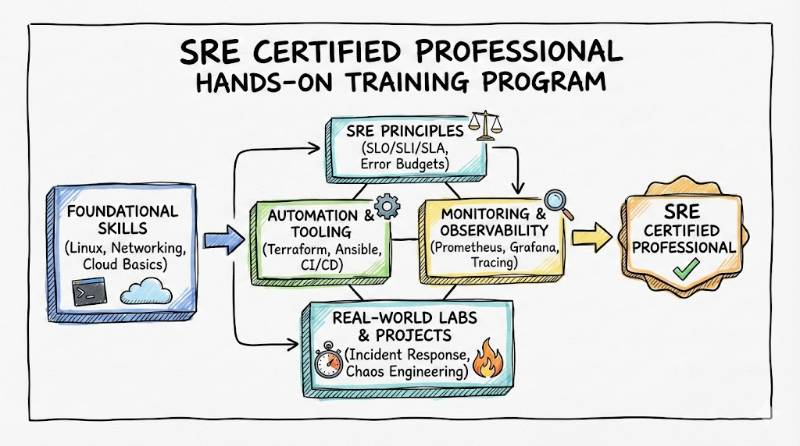
The SRE Certified Professional (Training & Certification) program is designed to equip professionals with the methodologies needed to manage large-scale, complex systems. In an era where even a few minutes of downtime can result in millions of dollars in lost revenue, the role of an SRE has become indispensable. This certification provides a structured approach to learning how to build scalable and highly reliable software systems.
For engineers and managers alike, certifications serve as a benchmark of quality. They validate that an individual has moved beyond theoretical knowledge and possesses the practical skills required to handle real-world production incidents. Whether you are based in India or working in a global market, staying updated with these standards is essential for long-term career growth in the cloud ecosystem.
SRE Certified Professional (Training & Certification) Overview
| Track | Level | Who it’s for | Prerequisites | Skills Covered | Recommended Order |
| Site Reliability Engineering | Professional | Software Engineers, DevOps, Managers | Basic Linux & Cloud Knowledge | Error Budgets, SLIs/SLOs, Automation, Incident Management | After DevOps Foundation |
Why Choose DevOpsSchool?
When embarking on a journey toward professional certification, the choice of a training partner is critical. DevOpsSchool is widely recognized for its commitment to practical, hands-on learning. The programs are crafted by industry veterans who understand the nuances of production environments.
A significant advantage of choosing this institution is the focus on real-world scenarios rather than just theoretical concepts. Participants are guided through lab exercises that mimic actual industry challenges. This ensures that the knowledge gained is immediately applicable in a professional setting. Furthermore, the support system provided helps learners navigate complex technical topics with ease, making the transition into a specialized role much smoother.
Certification Deep-Dive: SRE Certified Professional (Training & Certification)
What is this certification?
This certification is a comprehensive professional program that focuses on the principles and practices of Site Reliability Engineering. It is designed to teach how to balance the need for new features with the requirement for system stability through automation and data-driven decision-making.
Who should take this certification?
- Experienced Software Engineers looking to move into operations.
- DevOps Engineers aiming to specialize in high-availability systems.
- System Administrators transitioning to a cloud-native environment.
- Engineering Managers who need to oversee reliability teams.
Skills you will gain
- Defining and measuring Service Level Indicators (SLIs) and Service Level Objectives (SLOs).
- Managing Error Budgets to balance risk and innovation.
- Implementing automation to reduce “toil” in operational tasks.
- Conducting effective post-mortems and incident response.
- Monitoring and alerting strategies for distributed systems.
Real-world projects you should be able to do after this certification
- Building an automated incident response pipeline for a microservices architecture.
- Designing a dashboard that tracks reliability metrics in real-time across multiple regions.
- Creating a “toil” reduction roadmap for an existing legacy application.
Preparation plan
- 7–14 days plan: Focus on the core definitions of SRE. Read the official syllabus and understand the difference between DevOps and SRE. Familiarize yourself with basic monitoring tools.
- 30 days plan: Dive deep into SLIs, SLOs, and Error Budgets. Start practicing with automation scripts and containerization. Review case studies of major system outages and how they were handled.
- 60 days plan: Engage in intensive lab work. Build a small-scale reliable system on a cloud platform. Take practice exams and refine your understanding of incident management protocols.
Common mistakes to avoid
- Ignoring the cultural aspect of SRE and focusing only on tools.
- Setting unrealistic SLOs that are impossible for the development team to meet.
- Failing to document post-mortems properly, leading to repeated mistakes.
Best next certification after this
- Same track: Advanced SRE Architecture.
- Cross-track: DevSecOps Professional to integrate security into the reliability flow.
- Leadership / management: Engineering Leadership for Reliability Teams.
Choose Your Learning Path
Finding the right path is essential for career longevity. Here are six structured routes based on your current interests:
- DevOps Path: Focuses on the integration of development and operations through CI/CD and automation. Best for those who enjoy streamlining the software delivery lifecycle.
- DevSecOps Path: Prioritizes the “security as code” philosophy. This is ideal for professionals who want to ensure that reliability and security are built into the system from day one.
- Site Reliability Engineering (SRE) Path: The ultimate path for those interested in the stability, scalability, and performance of production environments.
- AIOps / MLOps Path: Tailored for engineers working with machine learning models and data-driven automation. It is best for those looking to apply AI to operational challenges.
- DataOps Path: Focuses on the reliability and flow of data across an organization. It is designed for those who want to treat data pipelines with the same rigor as software code.
- FinOps Path: A specialized track for managing cloud costs and financial accountability. Ideal for professionals who want to bridge the gap between engineering and finance.
Role → Recommended Certifications Mapping
To help you decide which step to take next, here is a mapping based on common industry roles:
- DevOps Engineer: DevOps Professional & SRE Certified Professional.
- Site Reliability Engineer (SRE): SRE Certified Professional & Chaos Engineering Practitioner.
- Platform Engineer: Kubernetes Certified Administrator & SRE Certified Professional.
- Cloud Engineer: Multi-Cloud Architect & SRE Certified Professional.
- Security Engineer: DevSecOps Certified Professional.
- Data Engineer: DataOps Professional & Big Data Architect.
- FinOps Practitioner: Certified FinOps Associate.
- Engineering Manager: SRE for Managers & Strategic IT Leadership.
Next Certifications to Take
Based on global industry trends for software engineers, the following recommendations are provided for those who have completed the SRE Certified Professional program:
- Same-track: Performance Engineering Professional (to deepen system tuning skills).
- Cross-track: DevSecOps Expert (to ensure secure reliability).
- Leadership-focused: Digital Transformation Officer (for those moving into executive roles).
Training & Certification Support Institutions
Several institutions provide the necessary support and training for these certifications. Here is a brief overview:
- DevOpsSchool: A premier training provider known for its extensive course catalog and highly experienced instructors. The focus is consistently on practical, job-oriented skills.
- Cotocus: This organization specializes in high-end technical consulting and training. It is an excellent choice for teams looking for customized corporate training solutions.
- ScmGalaxy: A community-driven platform that offers a wealth of resources for software configuration management and DevOps professionals. It is a great place for continuous learning.
- BestDevOps: Known for providing focused and concise training modules that help professionals quickly upskill in specific DevOps and SRE tools.
- devsecopsschool.com: A dedicated space for learning how to integrate security into the DevOps pipeline, offering specialized tracks for security professionals.
- sreschool.com: A platform entirely focused on the SRE discipline, providing deep dives into reliability engineering and system architecture.
- aiopsschool.com: This institution focuses on the intersection of Artificial Intelligence and Operations, teaching how to use ML to solve IT problems.
- dataopsschool.com: A specialized training provider for data management and pipeline reliability, perfect for data engineers and architects.
- finopsschool.com: The go-to source for learning cloud financial management and cost optimization strategies.
FAQs Section
General FAQs
- What is the difficulty level of the SRE certification?
The exam is considered intermediate to advanced, requiring a solid grasp of both coding and system operations. - How much time is required to prepare?
Most professionals find that 4 to 8 weeks of consistent study is sufficient. - Are there any prerequisites?
While not mandatory, a basic understanding of Linux, networking, and at least one cloud platform is highly recommended. - In what sequence should I take these certifications?
It is usually best to start with a DevOps foundation before moving into the SRE Certified Professional track. - What is the career value of this certification?
It significantly increases your marketability for high-paying roles in top-tier tech companies. - Does this certification help with job growth?
Yes, it often leads to senior engineering roles or specialized reliability positions. - Is the exam online or offline?
The exam is typically conducted online through a proctored environment. - How long is the certification valid?
Most professional certifications in this field are valid for two to three years. - Are lab exercises included in the training?
Yes, reputable training providers like DevOpsSchool include extensive hands-on labs. - What kind of questions are asked in the exam?
The exam usually consists of scenario-based multiple-choice questions. - Can a manager take this course?
Absolutely. It helps managers understand the technical constraints and goals of their reliability teams. - Is this certification recognized globally?
Yes, the standards taught are based on industry-wide practices used by global tech giants.
SRE Certified Professional Specific FAQs
- What is the core focus of the SRECP?
The focus is on applying engineering principles to operational problems to ensure system reliability. - Does it cover specific tools like Prometheus or Grafana?
Yes, the training involves learning the tools used for monitoring, alerting, and visualization. - Is coding required for SRECP?
A basic ability to read and write scripts (like Python or Bash) is very helpful for the automation components. - What is the pass mark for the exam?
Usually, a score of 70% or higher is required to pass. - How does this differ from a standard DevOps course?
While DevOps is a philosophy, SRE is a specific implementation of that philosophy with defined roles and metrics. - Are post-mortems covered in detail?
Yes, learning how to conduct blameless post-mortems is a key part of the curriculum. - Will this certification help me in a Cloud Architect role?
Yes, understanding reliability is a core pillar of cloud architecture. - Does the certification cover containerization?
Yes, managing reliability in Kubernetes and Docker environments is a major topic.
Testimonials
“The SRECP program gave me a completely new perspective on how to handle production outages. The focus on blameless culture and automation has drastically improved our team’s response time.” — Arjun, DevOps Engineer
“Transitioning from a traditional sysadmin role was tough until I took this certification. The practical labs helped me understand how to measure reliability using SLIs and SLOs effectively.” — Sarah, SRE
“As a manager, this course helped me speak the same language as my engineers. We now have a clear Error Budget that has improved our release velocity without sacrificing stability.” — Rajesh, Engineering Manager
“Understanding the ‘toil’ concept was a game-changer. I was able to automate away 30% of my daily manual tasks within a month of completing the training.” — Priya, Cloud Engineer
“Security and reliability go hand in hand. This certification provided the missing pieces for our DevSecOps strategy, ensuring our systems stay up and secure.” — Vikram, Security Engineer
Conclusion
The journey to becoming an SRE Certified Professional is one of the most rewarding paths an engineer can take in today’s market. By focusing on the SRE Certified Professional (Training & Certification), professionals are not just learning a set of tools, but a mindset that prioritizes long-term system health and scalability.
As the cloud ecosystem continues to evolve, the demand for experts who can bridge the gap between “building” and “running” will only grow. Planning your learning path strategically—starting with core reliability principles and expanding into specialized tracks—will ensure a resilient and high-growth career.