Introduction
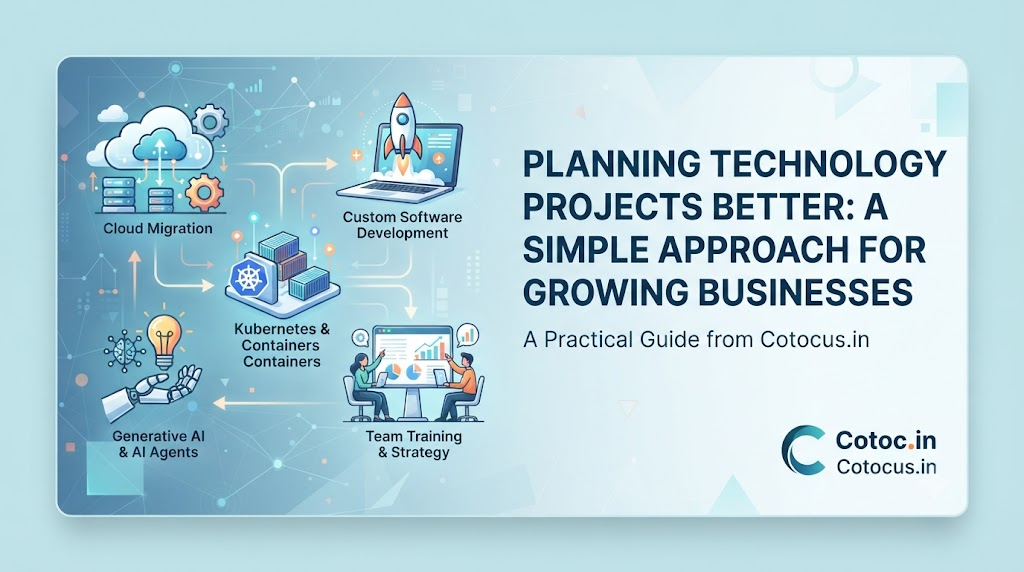
Building reliable software requires balancing multiple fast-moving technological requirements. Companies need applications that load quickly, protect user data, process complex business logic, and adapt as user expectations evolve. In recent years, artificial intelligence has added a new layer of capability to this landscape. Organizations are no longer looking simply for web pages or standalone databases; they want systems that automate workflows, predict outcomes, and integrate easily across different platforms.
Achieving these goals requires a cohesive approach to engineering. Software applications must run on flexible cloud infrastructure, release updates through reliable automation pipelines, and scale seamlessly using container orchestration systems. At the same time, teams must build mobile interfaces that connect directly to these backend architectures while continually upgrading their internal technical skills.
Cotocus works across these connected domains, offering services spanning artificial intelligence, custom application development, cloud migration, container management, mobile engineering, and corporate technical training. By examining how these foundational areas work together, businesses can better understand how to plan, build, and maintain digital products that remain resilient as technology advances.
The Interconnected Role of Modern Software and AI Services
Digital product development is rarely a single, isolated task. When an organization decides to launch a web application or automate an internal process, several technology layers must align.
To see how these layers function in practice, consider a company launching a digital healthcare support tool:
- The Interface: A mobile application gives patients quick access to appointment details and advice.
- The Application Layer: Custom software processes user requests, verifies credentials, and securely manages health records.
- The Intelligence Layer: Artificial intelligence assists by summarizing clinical documents or answering common user questions through automated assistants.
- The Delivery Pipeline: DevOps practices ensure that developers can deploy fixes and feature updates continuously without taking the service offline.
- The Infrastructure: Cloud infrastructure and container orchestration host the entire application, dynamically scaling up server capacity when traffic surges.
- The Human Element: Continuous engineering training keeps internal development teams updated on security, code quality, and cloud operations.
If any of these pieces is neglected, the entire product suffers. A brilliant machine learning algorithm cannot help users if the mobile app constantly crashes, and a well-designed web dashboard will stall if the underlying cloud setup cannot handle peak demand. Modern software engineering focuses on building all of these layers as a unified ecosystem.
Cotocus and Its Core Technology Focus
Cotocus operates as an engineering and digital product partner, supporting organizations through full-cycle software development, platform engineering, and technical enablement. Rather than treating artificial intelligence or cloud hosting as separate add-ons, the company focuses on designing applications with these capabilities built directly into their architecture.
The technical capabilities supported across the platform include:
- AI Software Engineering: Integrating machine learning models, predictive analytics, and natural language processing into everyday software platforms.
- Generative AI & Autonomous Agents: Building language-driven workflows, smart documentation tools, and goal-directed automated assistants.
- Custom Software & SaaS Development: Designing custom backends, multi-tenant web platforms, and API systems built to scale.
- DevOps Engineering: Streamlining deployment pipelines, automating infrastructure management, and maintaining system stability through proactive monitoring.
- Cloud & Container Orchestration: Assisting with cloud transitions and running application workloads on container systems like Kubernetes.
- Mobile Experience Design: Developing cross-platform mobile apps that connect with cloud backends.
- Corporate Technical Education: Delivering hands-on technical training to help enterprise teams adopt modern engineering tools and workflows.
Understanding these individual capability areas helps demonstrate how companies apply them when building or updating digital software platforms.
3. Key Technology Capabilities for Business Applications
Generative AI for Business Applications
Generative AI enables software to interpret, summarize, and generate human-like content across vast sets of information. At an enterprise level, this technology goes far beyond simple text completion.
Large language models (LLMs) process natural language inputs, allowing systems to digest complex text datasets—such as technical manuals, legal agreements, or financial reports—and turn them into actionable insights. Through Retrieval-Augmented Generation (RAG), applications link language models directly to an organization’s internal databases. This ensures that generated responses draw from accurate, real-time proprietary data rather than general web knowledge.
Common business applications for generative AI include:
- Automated Document Parsing: Extracting structured key data points from unstructured PDF forms, invoices, and contracts.
- Context-Aware Knowledge Bases: Enabling internal support staff to search company repositories using conversational queries.
- Intelligent Content Drafting: Creating personalized communication templates, summaries, and code snippets within regulated environments.
When evaluating Generative AI Development Services, organizations typically begin by identifying routine information workflows where automated language processing can save time or improve response accuracy.
AI Agents and Business Automation
While standard chatbots rely on basic rules or simple text prompts to generate static replies, autonomous AI agents can execute multi-step tasks independently to achieve a specific goal.
An AI agent combines reasoning capabilities with external tool access. It evaluates an incoming request, breaks it down into sequential actions, queries connected systems, and completes tasks without requiring constant human guidance.
Key operational capabilities of AI agents include:
- Goal-Driven Task Planning: Splitting complex requests into smaller sub-tasks and executing them sequentially.
- System & API Integration: Reading data from or writing updates to external systems, such as CRMs, ticketing tools, or inventory databases.
- Adaptive Decision Support: Adjusting actions dynamically based on intermediate tool outputs or unexpected system responses.
For example, an internal IT support agent might receive a request to grant new employee access permissions. Rather than just offering a link to an instruction page, the agent checks the employee’s role, verifies manager approval, issues the access request through the system API, and notifies the team once access is confirmed. Organizations exploring AI Agent Development Services focus on these structured, goal-oriented operational workflows.
Custom Software and SaaS Product Development
Off-the-shelf software platforms do not always match unique operational needs or specialized data privacy standards. Custom software engineering allows businesses to build tailored web platforms, internal tools, and software-as-a-service (SaaS) products from the ground up.
Building modern custom software involves several core components:
- Microservices Architecture: Splitting large applications into smaller, independent modules that operate, update, and scale separately.
- API Development: Designing clear protocols that enable desktop platforms, mobile applications, and third-party systems to share information securely.
- Multi-Tenant System Design: Building SaaS platforms where thousands of individual organizations share underlying compute infrastructure safely while keeping their data completely isolated.
- Minimum Viable Product (MVP) Delivery: Building and launching core application features quickly so early users can test real-world functionality before full scale production.
Choosing a specialized Custom Software Development Company India enables businesses to access skilled engineering teams who can take custom platforms from initial conceptual wireframes to high-performance, production-ready software. Furthermore, companies turning internal applications into commercial platforms rely on structured SaaS Product Development Services to design subscriptions, manage user accounts, and maintain high software uptime across distributed regions.
DevOps and Reliable Software Delivery
DevOps bridges the traditional gap between software developers and IT infrastructure operations teams. Its main goal is to shorten development cycles while maintaining system stability, security, and performance.
Core DevOps practices include:
- Continuous Integration and Delivery (CI/CD): Automatically building, testing, and verifying code changes whenever developers upload updates, preventing bugs from reaching live users.
- Infrastructure as Code (IaC): Writing configuration code (using tools like Terraform or Ansible) to provision server environments automatically, eliminating manual setup errors.
- DevSecOps Integration: Embedding security checks directly into automated development pipelines to catch code vulnerabilities early.
- System Observability & SRE: Monitoring application logs, system metrics, and operational health in real time using dashboards like Prometheus and Grafana.
Working with an established DevOps Consulting Services India partner helps organizations automate manual release steps, reduce software deployment failures, and maintain reliable software delivery practices as development teams expand.
Cloud Migration and Kubernetes
Moving applications from on-premises data centers to public cloud platforms—such as Amazon Web Services (AWS), Microsoft Azure, or Google Cloud Platform (GCP)—enables businesses to adjust server resources based on demand rather than purchasing physical hardware in advance.
However, moving to the cloud effectively requires more than simply copying files to a remote server. Successful migration strategies involve:
- Application Re-architecting: Redesigning legacy programs into cloud-native microservices that scale easily.
- Cost Management Optimization: Monitoring active cloud infrastructure to prevent paying for unused compute capacity.
- Data Security & Governance: Setting up strong identity controls, encryption, and access policies for stored information.
Once software is containerized using tools like Docker, managing hundreds of running application containers across multiple servers becomes a complex operational challenge.
This is where Kubernetes comes in. As an open-source orchestration platform, Kubernetes automatically schedules, balances, and repairs application containers across cluster environments. Businesses utilizing Cloud Migration Services India often combine cloud transitions with Kubernetes Consulting Services to ensure their microservices applications run smoothly and recover automatically from system errors.
Mobile Applications and Corporate Technology Training
Mobile apps serve as the primary digital interface for millions of end users daily. Whether building native applications for iOS and Android or utilizing multi-platform frameworks like Flutter and React Native, mobile development relies heavily on strong backend connectivity. Mobile systems must sync offline data quickly, support biometrics, and make secure API calls to cloud services without draining device batteries. Partnering with an experienced Mobile App Development Company India helps teams design responsive user experiences that stay tightly integrated with core backend systems.
At the same time, software frameworks, cloud tooling, and artificial intelligence models evolve constantly. Technology investments stall when internal teams lack the expertise required to manage new tools efficiently.
Structured Corporate AI and DevOps Training programs bridge this knowledge gap. By upskilling internal engineers in container management, pipeline automation, security practices, and machine learning operations (MLOps), organizations build resilient internal teams capable of supporting modern software over the long term.
How Businesses Can Decide Which Technology They Need
Not every organization needs every modern engineering tool immediately. The right technological choice always depends on specific business challenges, legacy infrastructure, internal team bandwidth, and growth targets.
Here is how different operational priorities map to engineering solutions:
- Building a New Market Product: Early-stage startups typically need fast iteration. Building an MVP using custom software frameworks and launching it on manageable cloud platforms allows the team to validate features quickly before expanding infrastructure.
- Improving Operational Productivity: Companies dealing with repetitive back-office work, document review, or routine support tickets often benefit most from targeted generative AI integrations or goal-directed AI agents.
- Commercializing Internal Software: Organizations that have built a useful internal tool and want to offer it to external customers need SaaS product engineering to add multi-tenancy, billing gateways, and user access management.
- Scaling Up Deployment Frequency: Companies experiencing broken software releases, long manual QA steps, or server downtime during updates should prioritize DevOps pipelines and CI/CD automation.
- Modernizing Legacy Servers: Businesses managing aging physical servers that struggle during peak traffic should evaluate cloud migration combined with container orchestration tools like Kubernetes.
- Expanding User Accessibility: Companies looking to engage customers on mobile devices need mobile application engineering that connects seamlessly to existing web services and APIs.
Step-by-Step Guide to Planning an AI or Software Project
A structured planning process helps software projects run smoothly, controlling costs and preventing mid-development delays.
Step 1: Define the Core Problem
Clearly articulate what operational challenge or user need the project addresses before writing any code. Avoid choosing software tools simply because they are popular.
Step 2: Understand User Requirements
Identify who will interact with the application daily. Outline core user journeys, data input steps, accessibility requirements, and performance expectations.
Step 3: Decide Whether AI Is Actually Necessary
Determine if the project truly requires artificial intelligence, or if straightforward relational databases and custom business logic can solve the problem more reliably and affordably.
Step 4: Select the Application Architecture
Choose an architecture that matches system requirements—such as clean REST/GraphQL APIs, microservices, or a modular backend structure—to handle future updates without breaking core features.
Step 5: Plan Cloud, Security, and Infrastructure
Select cloud environments early, define data encryption standards, establish user access roles, and ensure compliance with relevant industry data regulations.
Step 6: Build Development and Deployment Pipelines
Set up automated testing pipelines and Continuous Integration steps from day one so code changes are checked automatically before deployment.
Step 7: Test, Monitor, and Improve System Health
Deploy application performance monitoring and logging tools to track response times, identify database bottlenecks, and maintain software reliability in live environments.
Step 8: Plan for Future Scaling and Team Capability
Establish documentation and provide technical training to ensure internal engineering teams can maintain, extend, and secure the application as user numbers grow.
Practical Scenario: Building a Scalable Smart Logistics Platform
To see how these individual technical components fit together in a real-world workflow, consider a fictional logistics business called FreightFlow Logistics.
FreightFlow manages hundreds of delivery vehicles and handles thousands of shipping requests daily. The team relies on legacy spreadsheets and manual emails, causing delayed dispatch updates, high operational overhead, and missed delivery tracking notifications.
Here is how FreightFlow could approach modernizing its operations:
- Custom SaaS Core: The engineering team builds a custom microservices backend paired with a web dashboard, replacing manual spreadsheets with real-time central data storage.
- AI Dispatch Agent Integration: The company integrates an autonomous AI agent connected to real-time traffic and weather APIs. The agent analyzes delivery routes, assigns dispatches automatically, and adjusts driver schedules when unexpected delays occur.
- Mobile Driver Interface: A lightweight cross-platform mobile application gives delivery drivers instant route updates, turn-by-turn navigation, and digital proof-of-delivery tools.
- Cloud Migration and Kubernetes Setup: FreightFlow runs its platform on public cloud infrastructure, placing application microservices inside Docker containers managed by Kubernetes. During seasonal delivery peaks, the platform automatically provisions additional server capacity to preserve performance.
- DevOps Automation: Automated CI/CD pipelines run code tests and deploy performance fixes smoothly, eliminating system downtime during peak business hours.
- Internal Engineering Enablement: The company upskills its internal IT staff in cloud management and container monitoring, ensuring they can operate and maintain the platform securely.
By addressing each layer of its technology stack step-by-step, FreightFlow turns an inefficient manual setup into a scalable, automated digital platform.
Operational Benefits of an Integrated Engineering Strategy
Taking a cohesive, structured approach to software engineering delivers measurable long-term advantages:
- System Scalability: Modular application designs and container orchestrators allow platforms to handle sudden spikes in traffic without crashing or slowing down.
- Higher Software Reliability: Automated testing, dev pipelines, and real-time observability tools catch system errors before end users encounter them.
- Faster Release Cycles: Standardized CI/CD processes enable engineering teams to release new features, security patches, and system improvements quickly.
- Reduced Operational Overhead: Replacing manual routines with goal-driven AI agents and automated workflows frees up internal teams to focus on strategic initiatives.
- Stronger Data Security: Embedding security checks directly into development pipelines helps safeguard sensitive enterprise data against emerging risks.
- Sustainable Internal Expertise: Ongoing technical training builds long-term organizational knowledge, reducing reliance on external maintenance over time.
Common Technical Pitfalls to Avoid
Avoiding common development mistakes saves organizations significant time, budget, and operational frustration.
| Common Engineering Mistake | Operational Impact | Recommended Practical Solution |
| Adding AI Without a Clear Purpose | High computational costs with minimal real-world user benefit. | Define the core operational problem first; apply machine learning models only where standard logic falls short. |
| Treating Cloud Migration as a Direct Copy | Unoptimized infrastructure running on high monthly cloud bills. | Re-architect legacy systems into efficient microservices before moving workloads to cloud environments. |
| Adopting Kubernetes Without Operational Capability | Increased system complexity and unexpected cluster management outages. | Train internal engineering teams thoroughly on container management and observability before managing production clusters. |
| Neglecting Application Security Early On | Higher risk of security breaches and costly late-stage code rewrites. | Embed automated security vulnerability scans directly into early CI/CD integration pipelines. |
| Ignoring Ongoing Application Monitoring | Slow application response times that go unnoticed until users report failures. | Deploy centralized logging, metrics dashboards, and proactive alerting tools across all application environments. |
| Overlooking Team Skill Upgrades | External delivery teams build software that internal staff cannot maintain or scale. | Invest in corporate technology training alongside software delivery to ensure smooth operational handoffs. |
Overview of Core Technology Areas
The following matrix provides a summary of major software engineering areas, their core technical capabilities, and typical business use cases:
| Technology Capability Area | Core Features & Concepts | Primary Business Use Cases |
| Generative AI | LLMs, RAG architecture, Natural Language Processing, data extraction. | Context-aware search engines, automated text parsing, internal knowledge bases. |
| AI Agents | Multi-step task planning, API tool usage, autonomous workflow execution. | Operational automation, intelligent ticket processing, decision support systems. |
| Custom Software Development | Microservices, custom REST/GraphQL APIs, enterprise application platforms. | Custom business applications, specialized enterprise platforms, backend system integrations. |
| SaaS Engineering | Multi-tenant databases, user account subscription tools, scalable web frontends. | Commercial software products, cloud-hosted business tools, subscription platforms. |
| DevOps Practices | Automated CI/CD pipelines, Infrastructure as Code, continuous observability. | Streamlining software releases, reducing release bugs, automating server setups. |
| Cloud & Kubernetes Orchestration | AWS/Azure/GCP hosting, container management, self-healing clusters. | High-traffic applications, legacy modernization, resilient cloud architectures. |
| Mobile Engineering | Cross-platform development (Flutter, React Native), secure API communication. | User-facing mobile apps, field service management, multi-device experiences. |
| Corporate Technical Training | Structured hands-on workshops, cloud labs, security best practices. | Upskilling internal software teams, adopting new platforms, maintaining systems internally. |
Frequently Asked Questions
FAQ 1: How does an AI agent differ from a standard company chatbot?
A standard chatbot provides pre-written responses or basic text answers using pre-set rules. An AI agent breaks complex goals into smaller sub-tasks, interacts with connected software tools via APIs, and executes multi-step workflows independently.
FAQ 2: What is Retrieval-Augmented Generation (RAG) and why is it useful?
Retrieval-Augmented Generation connects a language model directly to an organization’s internal databases. This allows the model to produce accurate responses based on real-time proprietary data while reducing incorrect or invented outputs.
FAQ 3: What are the main benefits of building custom software over buying off-the-shelf platforms?
Custom software is engineered specifically around an organization’s unique operational workflows, security specifications, and integration requirements, eliminating unnecessary licensing fees and rigid functional constraints.
FAQ 4: Why is multi-tenancy crucial for SaaS applications?
Multi-tenant architecture allows thousands of customer accounts to share the same underlying server infrastructure safely. This keeps system operating costs manageable while ensuring each customer’s data remains completely private.
FAQ 5: How does DevOps improve software delivery speed?
DevOps automates code testing, integration, and release steps using CI/CD pipelines. This allows teams to ship updates, bug fixes, and new features frequently without interrupting live services.
FAQ 6: When should a business consider moving its applications to the cloud?
Organizations should evaluate cloud migration when their physical server hardware approaches end-of-life, when operational traffic fluctuates significantly, or when they need to scale applications globally across multiple regions.
FAQ 7: What primary challenge does Kubernetes solve for containerized applications?
Kubernetes automates the deployment, scaling, network load balancing, and self-healing of application containers across server clusters, eliminating the need to monitor and restart individual containers manually.
FAQ 8: Should a business choose native or cross-platform mobile development?
Cross-platform frameworks like Flutter and React Native allow developers to build iOS and Android apps using a single code base, reducing initial development time. Native development remains ideal for specialized apps that require deep hardware access.
FAQ 9: Why is technical training important when adopting new software technologies?
Without structured training, internal engineering teams often struggle to operate, update, and secure modern cloud or AI platforms effectively, leading to operational bottlenecks and long-term external dependency.
FAQ 10: How do software platforms handle unexpected traffic spikes without crashing?
Scalable software platforms utilize microservices, container orchestrators like Kubernetes, auto-scaling cloud groups, and database caching tools to automatically add compute resources during peak demand.
Decision Guide for Business Needs
Use this reference guide to match operational goals with recommended technology approaches:
| Business Goal or Challenge | Primary Technology Area | Core Objective |
| Adding intelligent text parsing or context search to software | Generative AI & RAG | Enable applications to interpret and query complex text data automatically. |
| Automating multi-step internal workflows and tasks | AI Agents | Execute operational actions independently using goal-driven systems. |
| Building a proprietary application tailored to internal operations | Custom Software Engineering | Develop secure backends, APIs, and interfaces designed for custom needs. |
| Launching a scalable cloud-based software product for customers | SaaS Product Engineering | Create multi-tenant web applications with flexible subscription features. |
| Accelerating deployment schedules while reducing bugs | DevOps & DevSecOps | Automate software testing, builds, and releases with CI/CD pipelines. |
| Updating legacy physical servers to flexible infrastructure | Cloud Migration Services | Move workload environments to scalable platforms like AWS, Azure, or GCP. |
| Managing microservices across containerized environments | Kubernetes Consulting | Automate container scheduling, load balancing, and operational self-healing. |
| Engaging end users across diverse mobile devices | Mobile App Development | Build cross-platform mobile applications linked to cloud backends. |
| Building strong internal capabilities for modern engineering | Corporate Technical Training | Upskill internal teams in cloud platforms, container management, and security. |
Conclusion
Modernizing digital operations is an ongoing journey rather than a one-time project. Success requires connecting user-facing mobile and web applications to robust microservice backends, hosted on auto-scaling cloud environments, and updated through automated DevOps pipelines. Integrating artificial intelligence—whether through context-aware generative AI search or goal-directed autonomous agents—allows businesses to add valuable capabilities to these platforms.
Cotocus supports organizations across this full engineering lifecycle. By pairing end-to-end software development with corporate technical training, companies can deploy modern digital products while ensuring their internal teams retain the knowledge required to operate, secure, and scale those systems over time. Taking a structured, problem-first approach ensures that technology investments deliver lasting operational value.