Introduction
Crypto looks exciting, but beginners can make risky decisions without understanding why prices rise, fall, and remain inactive for long periods. A sudden rally may create fear of missing out, while a sharp decline may lead to panic selling. Both reactions can damage a carefully planned financial strategy. Crypto Market Cycles Explained gives readers a practical way to understand accumulation, growth, excitement, distribution, decline, and recovery without pretending that prices can be predicted perfectly. This guide is useful for new investors, traders, salaried people, and crypto learners who want to separate market behaviour from online hype. Practical cycle awareness encourages research, emotional control, security, and long-term discipline instead of rushed decisions.
What is Crypto Market Cycles ?
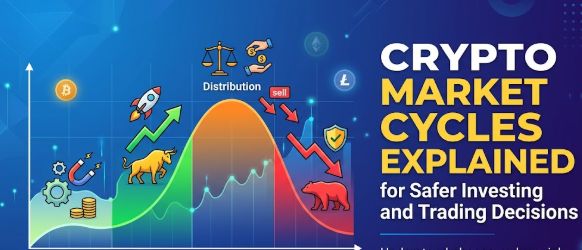
A crypto market cycle is a broad pattern showing how cryptocurrency prices and investor attitudes change over time. A cycle may begin when prices are low and public interest is limited. It can then move through recovery, stronger growth, widespread excitement, profit-taking, decline, and eventual stabilisation.
The stages do not follow an exact timetable. One cycle may develop slowly, while another may move rapidly because of economic conditions, regulations, technological developments, institutional participation, security incidents, or changes in market liquidity.
People search for Crypto Market Cycles Explained because price movements can otherwise appear random. A beginner may see a major cryptocurrency rising and assume that the rise will continue indefinitely. Another person may see a decline and conclude that the entire market has permanently failed. Cycle awareness provides context for these reactions.
In real life, cycle understanding can influence:
- When an investor begins researching an asset
- How much money a trader is willing to risk
- Whether someone buys gradually or all at once
- When an investor reviews profits and losses
- How a person reacts to online excitement
- Whether emergency savings remain protected
- How financial records are maintained for tax reporting
Consider a beginner who first notices cryptocurrency after prices have already risen sharply. Social media posts may show impressive gains, encouraging the person to invest a large amount immediately. If the market enters a correction, the person may suffer a major loss and panic. A cycle-aware investor would recognise that extreme public excitement may indicate higher risk and would investigate valuation, liquidity, security, and personal financial capacity before acting.
A common misunderstanding is that market cycles operate like a fixed calendar. They do not. Historical patterns can offer context, but they cannot guarantee when a phase will start, how long it will last, or how far prices will move.
The practical takeaway is simple: use cycles as a risk-awareness framework, not as a prediction machine.
Why Crypto Market Cycles Are Important
Understanding market cycles matters because crypto decisions do not exist separately from a person’s wider financial life. A poorly planned investment can affect savings, debt repayment, household expenses, taxes, and long-term goals.
Savings and Emergency Funds
Crypto assets can experience sharp price movements. Money needed for rent, food, education, healthcare, loan payments, or emergencies should not depend on the short-term value of a volatile asset.
The common mistake is investing money simply because the market appears to be rising. The better approach is to maintain an emergency reserve and invest only an amount that can remain exposed to risk without harming essential obligations.
Borrowing and Debt
Using borrowed money to purchase cryptocurrency adds repayment pressure to market risk. Even when an asset declines, the loan, interest, and repayment schedule remain.
Understanding cycles may help a borrower recognise that an exciting market phase is not a reliable reason to take on debt. The better approach is to assess existing obligations and avoid financing speculative activity with credit cards, personal loans, or money borrowed from friends.
Investing and Trading
Investors and traders operate differently. An investor may hold assets for a longer period based on research and risk tolerance. A trader may make shorter-term decisions using price action, volume, and predefined entry and exit rules.
Cycle awareness helps both groups understand the broader environment. However, it does not replace research, portfolio planning, or risk management.
Tax Planning
Buying, selling, exchanging, transferring, or earning crypto may create record-keeping and tax responsibilities depending on the applicable jurisdiction. Investors who trade frequently during active market phases may create many transactions that become difficult to document later.
A better approach is to maintain records from the beginning and consult a qualified tax professional when necessary.
Emotional Decision-Making
Market cycles often magnify fear and greed. During rapid growth, people may believe they are missing a rare opportunity. During a decline, they may believe prices can never recover.
Recognising these emotional patterns can create a pause between feeling and action. That pause is often more valuable than any price prediction.
Practical Scenario
Suppose a salaried employee sees a crypto asset rising quickly and plans to invest the money reserved for an upcoming insurance payment. Cycle awareness would not reveal the next price, but it would highlight the possibility that the market is already in an overheated phase. Protecting the insurance payment and investing only a small, affordable amount would be the more disciplined choice.
The Real Problem Readers Face With Crypto Market Cycles
The main challenge is not simply that crypto prices move. The deeper problem is that people often receive information without context.
A beginner may encounter confident predictions, edited profit screenshots, influencer promotions, anonymous trading groups, and dramatic headlines. One source may claim that a rally has only started, while another predicts an immediate collapse. Without a framework, the reader may act based on whichever message creates the strongest emotion.
Several problems commonly appear.
Lack of Awareness
Many people enter the market without understanding wallets, exchanges, private keys, transaction fees, volatility, or liquidity. They focus on potential returns before learning how ownership and risk work.
Confusing Online Advice
Different commentators use different indicators, timeframes, and assumptions. Their personal incentives may also be unclear. Some may already own the asset they promote, receive referral income, or benefit from increased attention.
Unrealistic Expectations
A past price increase can make future growth look inevitable. Beginners may expect every low-priced token to become valuable or believe that an earlier market pattern must repeat exactly.
Weak Planning
Some participants enter without deciding how much they can lose, how long they intend to hold, when they will review the decision, or what conditions would make them exit.
Poor Comparison
People may compare assets only by price. They may ignore token supply, security, utility, liquidity, governance, developer activity, and platform reliability.
Ignoring Risk
During optimistic phases, risk warnings can seem unnecessary. Yet platform failures, scams, technical problems, market manipulation, and sudden regulatory changes can occur in any cycle.
Dependence on Social Media
Social media can help people discover ideas, but popularity is not proof of quality. Repetition can create false confidence, especially when similar claims are copied across many accounts.
No Clear Next Step
Beginners are often told to “buy the dip,” “hold forever,” or “take profits,” but these statements lack personal context. The right action depends on financial capacity, research, time horizon, tax position, security arrangements, and risk tolerance.
The better approach is to slow the process down. Learn the asset, identify the likely market environment, assess personal finances, verify the platform, write a risk plan, and act only when the decision remains reasonable without excitement or pressure.
How Crypto Market Cycles Work Step by Step
Step 1: Market Decline Slows
This stage begins when a previous decline starts losing strength. Prices may still be unstable, and negative sentiment can remain widespread. It matters because experienced participants may begin evaluating whether selling pressure is weakening. A beginner can apply this knowledge by observing price stability, trading volume, project activity, and broader market conditions rather than immediately assuming that the bottom has arrived. For example, a major asset may stop creating new lows for several weeks but still remain risky. The common mistake is investing a large amount after the first small rebound. A better approach is gradual research, cautious position sizing, and acceptance that another decline may still occur.
Step 2: Accumulation Develops
Accumulation describes a period when some participants begin building positions while general public interest remains limited. Prices may move within a broad range rather than rising strongly. This phase matters because risk and opportunity can coexist: valuations may be lower, but confidence is also uncertain. Beginners can use a watchlist, study project fundamentals, and invest gradually only when appropriate. A practical example is purchasing small amounts at planned intervals instead of attempting to identify one perfect entry point. The common mistake is assuming every low-priced asset is undervalued. The better approach is to distinguish price from quality and examine security, adoption, liquidity, token supply, and long-term relevance.
Step 3: Recovery Gains Attention
During recovery, prices begin establishing a stronger upward structure, and market confidence slowly improves. News coverage may become less negative, trading activity may increase, and previously inactive participants may return. This stage matters because early optimism can develop into a broader trend, but false recoveries remain possible. A beginner can apply the concept by reviewing whether growth is supported by stronger volume, improving market conditions, or genuine project progress. The common mistake is treating every price increase as proof of a new bull market. A better approach is to wait for multiple forms of evidence and maintain a predefined risk limit.
Step 4: Expansion or Bull Market Strengthens
An expansion phase is characterised by wider participation, rising prices, stronger optimism, and greater attention from media and online communities. More assets may begin increasing, although their quality can vary greatly. This stage matters because gains can encourage excessive confidence. A practical example is an investor whose portfolio rises quickly and who responds by doubling the original risk without new research. The common mistake is assuming that skill alone caused every gain. The better approach is to review position sizes, rebalance when necessary, protect essential funds, and avoid increasing exposure only because recent results were positive.
Step 5: Euphoria and Speculation Increase
Euphoria occurs when expectations become extremely optimistic. New participants may enter rapidly, risky tokens may attract attention, and warnings may be dismissed as negativity. It matters because prices can continue rising while the quality of decision-making declines. Beginners can apply this knowledge by watching for behaviour such as guaranteed-return language, aggressive borrowing, extreme price targets, and pressure to act immediately. The common mistake is purchasing solely because everyone appears to be earning money. The better approach is to revisit the original plan, examine downside risk, consider partial profit-taking where suitable, and reject decisions driven by fear of missing out.
Step 6: Distribution and Profit-Taking Appear
Distribution is a period when some earlier participants reduce their holdings while new buyers continue entering. Prices may remain high, move sideways, or become more volatile. This stage matters because market strength can hide a change in ownership and sentiment. A practical example is an asset repeatedly reaching a similar high but failing to maintain further progress. The common mistake is assuming that every temporary decline will be followed by an immediate new high. The better approach is to monitor risk, avoid chasing breakouts without confirmation, and decide in advance how profits or losses will be managed.
Step 7: Decline or Bear Market Begins
A bear market involves sustained weakness, falling confidence, reduced liquidity, and significant price declines across many assets. Negative news receives greater attention, and projects with weak foundations may struggle. This stage matters because emotional pressure can lead to panic selling or reckless attempts to recover losses. A beginner can apply cycle knowledge by reviewing whether the investment thesis has changed, separating strong assets from weak speculation, and protecting remaining capital. The common mistake is repeatedly buying every small decline without a limit. The better approach is to use planned allocation rules and preserve cash for essential needs.
Step 8: Capitulation and Stabilisation
Capitulation occurs when fear becomes intense and many participants sell after large losses. Market activity may later settle into a quieter stabilisation period. This stage matters because it can mark the transition toward a new accumulation phase, but the timing remains uncertain. A practical example is widespread public rejection of the entire market after a long decline. The common mistake is believing that extreme fear automatically proves the exact bottom. The better approach is patient evaluation, gradual action, secure custody, and continued attention to project and platform risks.
Key Factors That Influence Crypto Market Cycles
Market Liquidity
Liquidity refers to how easily assets can be bought or sold without causing major price changes. When more capital enters crypto markets, prices may rise more easily. When liquidity becomes limited, declines can accelerate.
Beginners should inspect trading volume and the depth of the market. A token may show a high quoted value but still be difficult to sell at that price.
Broader Economic Conditions
Interest rates, inflation expectations, employment conditions, access to credit, and investor appetite for risk can influence crypto demand. When people become cautious, speculative assets may experience greater selling pressure.
The mistake is analysing cryptocurrency as though it operates independently from the wider financial system. The better approach is to consider both crypto-specific developments and general economic conditions.
Bitcoin Market Behaviour
Bitcoin often has a major influence on broader crypto sentiment. When Bitcoin moves strongly, other assets may follow, although the timing and scale can differ.
This relationship is not guaranteed. Some smaller assets may decline even while Bitcoin remains stable. Investors should analyse each asset individually rather than assuming that all cryptocurrencies will respond equally.
Adoption and Real-World Use
Growing use by individuals, businesses, institutions, or developers may support long-term interest in a network. However, partnership announcements and adoption claims should be verified carefully.
The common mistake is treating every announcement as proof of sustainable demand. A better approach is examining whether people are actively using the technology and whether that activity creates meaningful value.
Regulation and Legal Developments
Government rules, court decisions, taxation policies, exchange requirements, and restrictions can influence access and confidence. These matters vary by jurisdiction and can change.
Readers should rely on official information and qualified professionals rather than social media interpretations.
Technology and Network Security
Upgrades, congestion, outages, vulnerabilities, and successful attacks can affect market confidence. A technically strong project can still face operational risks.
Before investing, beginners should understand how the network works, who controls key decisions, and whether previous security problems were addressed transparently.
Exchange Reliability
An investor may correctly analyse an asset but still lose access because of an unreliable platform. Exchange security, custody practices, withdrawal policies, legal status, and operational history are therefore important.
Keeping all assets on one exchange creates concentration risk. Depending on the person’s knowledge and circumstances, secure self-custody may reduce some risks while creating responsibility for private-key protection.
Investor Psychology
Fear, greed, regret, overconfidence, and herd behaviour can strengthen cycle movements. Rising prices attract attention, while falling prices often reduce interest even when the underlying technology has not changed.
Written rules can reduce emotional decision-making. For example, investors can define a maximum allocation, review schedule, and conditions for reducing exposure before market pressure appears.
Network Fees and Transaction Costs
During high activity, network fees may increase. Trading fees, withdrawal charges, spreads, and tax costs can also reduce returns.
The mistake is measuring performance only through the difference between buying and selling prices. The better approach is recording the complete cost of every decision.
Scams and Market Manipulation
Fraud often increases when public excitement is high. Fake giveaways, impersonation, phishing, pump-and-dump groups, and fraudulent investment platforms exploit urgency and greed.
Never share a seed phrase or private key. Verify website addresses, platform identity, and transaction details independently.
Detailed Breakdown of Crypto Market Cycles
Cryptocurrency and Blockchain Basics
Cryptocurrency is a digital asset that may operate through a blockchain or another distributed network. A blockchain records transactions in a way that participants can verify according to the network’s rules.
Not every cryptocurrency has the same design or purpose. Some support payments, smart contracts, decentralised applications, governance, digital ownership, or network services. Others may have limited practical use.
A market cycle affects the prices of these assets, but price movement does not always reflect technological quality. Weak projects can rise during speculative periods, while useful projects can decline during broad market stress.
Wallets and Exchanges
An exchange is a platform that enables buying, selling, or converting crypto assets. A wallet manages the credentials needed to access and transfer assets.
Custodial platforms generally control the private keys on behalf of users. Non-custodial wallets place that responsibility on the user. Neither structure removes all risk.
During active cycles, beginners may choose platforms quickly because they want immediate market access. This creates an opportunity for fake websites and unreliable services. Platform verification should happen before money is deposited.
Transactions and Confirmations
Crypto transfers are usually irreversible. Sending funds to the wrong address or using an incompatible network may result in permanent loss.
A safer habit is to verify the address, asset, network, fee, and destination before approving the transaction. For a large transfer, a small test transaction may reduce operational risk.
Volatility Across Cycle Stages
Volatility can appear in every phase, but it often increases around major turning points. During expansion, sharp declines may occur even within an upward trend. During a bear market, strong temporary rallies may occur without ending the broader decline.
The common mistake is interpreting one day of price movement as a complete change in the cycle. The better approach is to examine longer timeframes and multiple indicators.
Market Sentiment
Sentiment reflects how participants generally feel about the market. Optimism can support buying, while fear can accelerate selling.
Sentiment can be observed through news tone, online discussion, search interest, trading volume, funding conditions, and investor positioning. However, sentiment is not a reliable standalone signal.
Extreme optimism may last longer than expected, and extreme fear does not guarantee an immediate recovery.
Fundamental Analysis
Fundamental analysis examines the underlying quality and potential value of an asset. It may include:
- Network use
- Developer activity
- Token supply and distribution
- Security history
- Governance
- Competitive position
- Revenue or fee generation
- Community quality
- Regulatory exposure
- Long-term utility
During a bull market, investors may ignore fundamentals because many prices are rising. During a bear market, they may ignore improvements because sentiment is negative. A disciplined process considers fundamentals in both environments.
Technical Analysis
Technical analysis studies price, volume, trends, momentum, and market structure. It can help traders define possible entry, exit, and risk levels.
Technical analysis does not guarantee outcomes. Indicators may conflict, and patterns can fail. It should be used with position sizing and stop-loss planning rather than as a promise of certainty.
Token Supply and Valuation
A token’s unit price alone says little about its valuation. Total supply, circulating supply, future issuance, locked tokens, and demand all matter.
A token priced at $0.10 is not automatically cheaper than one priced at $1,000. The number of available units and the value of the entire network must be considered.
Market Capitalisation
Market capitalisation is commonly calculated by multiplying the current price by the circulating supply. It provides a general comparison of network size but does not show how much money could actually be withdrawn at the quoted value.
Liquidity, ownership concentration, and trading depth must also be considered.
Bull Markets
A crypto bull market is a sustained period of generally rising prices and confidence. New users enter, trading activity grows, and projects may raise capital more easily.
The major risk is overconfidence. Investors may increase position sizes, abandon diversification, or purchase unfamiliar assets simply because prices are rising.
A better approach is to strengthen risk controls as excitement increases.
Bear Markets
A bear market is a sustained period of falling prices, lower confidence, and reduced activity. Weak projects may fail, and investors may face large unrealised losses.
Bear markets can provide time for learning and evaluating quality, but they are not automatically safe buying opportunities. Assets can continue declining or disappear completely.
Accumulation Phase
The accumulation phase often follows a major decline. Prices may remain within a range while patient participants begin building positions.
This phase can feel uninteresting because media attention is low. The risk is assuming that the market cannot decline further. Gradual allocation and continued research are usually more responsible than concentrated buying.
Distribution Phase
The distribution phase often develops after a strong rise. Earlier investors may begin selling while new participants remain optimistic.
Price action may become unstable, and repeated attempts to move higher may fail. The risk is buying aggressively because past growth looks impressive.
Altcoin Cycles
Alternative cryptocurrencies may move differently from Bitcoin. Some may rise later in a broad market expansion, while others may never recover from previous declines.
Beginners should avoid assuming that every altcoin will follow the same cycle. Lower liquidity, concentrated ownership, and limited utility can create additional risk.
Stablecoins
Stablecoins are designed to maintain a value linked to another asset, often a traditional currency. They can support trading and transfers, but they are not risk-free.
Risks can include reserve quality, issuer reliability, regulatory action, smart-contract problems, loss of the intended value link, and platform failure.
Decentralised Finance
Decentralised finance applications offer services such as exchanging, lending, borrowing, and earning rewards through blockchain-based systems.
During growth phases, attractive yields may draw users who do not understand smart-contract, liquidity, liquidation, or token risks. High returns usually reflect additional risk rather than free income.
Why Random Tips Are Risky
A trading tip rarely includes the sender’s purchase price, position size, time horizon, financial capacity, or exit plan. The person sharing it may benefit when others buy.
Research should be independent. A useful test is to explain in writing why the asset is being considered, what could make the idea fail, and how much loss is acceptable.
Common Mistakes Beginners Make With Crypto Market Cycles
Buying Only Because Prices Are Rising
This happens because rising prices create urgency and social proof. The buyer may enter near a period of extreme optimism without evaluating downside risk.
The better approach is to ask whether the decision would still make sense if the asset declined significantly after purchase.
Selling Only Because Prices Are Falling
Falling prices can create fear, especially when the investor has no written plan. Panic selling may convert a temporary decline into a permanent loss.
The better action depends on whether the original investment thesis remains valid, whether the position is affordable, and whether risk limits have been breached.
Trying to Identify the Exact Bottom
Calling the precise bottom is extremely difficult. Investors who wait for perfect certainty may miss opportunities, while those who act too early may face further declines.
Gradual allocation can reduce dependence on one timing decision, although it cannot prevent losses.
Trusting Guaranteed-Profit Claims
No legitimate market participant can guarantee returns from a volatile cryptocurrency. Such claims may be misleading or fraudulent.
Verify identities, licences where applicable, platform ownership, withdrawal rules, and risk disclosures.
Investing Emergency Money
Emergency funds exist for unexpected essential expenses. Crypto volatility can make that money unavailable when needed.
Keep essential savings separate from speculative investments.
Borrowing to Invest
Debt creates a fixed obligation while crypto produces an uncertain outcome. A price decline can leave the investor with both losses and repayments.
Avoid using loans, credit cards, or borrowed household money to chase market gains.
Ignoring Fees
Trading fees, spreads, network fees, withdrawal charges, and taxes can significantly affect results, especially for frequent traders.
Record the complete cost of each transaction.
Sharing Sensitive Information
Seed phrases, private keys, passwords, and authentication codes should never be shared. Legitimate support teams do not need a seed phrase to assist a user.
Use unique passwords and strong authentication methods.
Ignoring Tax and Legal Duties
Frequent transactions may create complex reporting requirements. Ignoring them can cause stress, penalties, or inaccurate filings.
Maintain transaction records and consult an appropriate professional.
Depending Only on Social Media
Popular content may be entertaining but incomplete. Algorithms often promote dramatic opinions rather than balanced analysis.
Use primary project information, technical documentation, platform terms, and independent research.
Acting Under Pressure
Scammers and aggressive promoters often create artificial urgency. Statements such as “last chance” or “buy before everyone else” are designed to reduce careful thinking.
Pause, verify, and reject any decision that cannot survive a reasonable review period.
“Don’t Do This” Checklist
- Do not invest money needed for essential expenses.
- Do not borrow to purchase volatile crypto assets.
- Do not share a private key or seed phrase.
- Do not trust guaranteed-return promises.
- Do not send funds before verifying the wallet address and network.
- Do not select an exchange only because of an attractive promotion.
- Do not assume a previous cycle will repeat exactly.
- Do not follow anonymous tips without independent research.
- Do not ignore transaction records and tax obligations.
- Do not increase position size after emotional losses.
- Do not treat every low-priced token as undervalued.
- Do not make major decisions during panic or euphoria.
Practical Real-Life Examples of Crypto Market Cycles
Example 1: A Salaried Employee During a Bull Market
A salaried employee sees colleagues discussing rapid crypto gains and considers using money reserved for monthly expenses. The challenge is fear of missing out. A better action is to protect essential funds, create a small risk budget, and research before buying. The learning is that market excitement should never overrule household responsibilities.
Example 2: A Beginner Following an Online Tip
A beginner purchases an unknown token after seeing repeated social media posts. The token has weak liquidity and falls when early holders sell. A better action would have been checking supply distribution, trading volume, project utility, and promoter incentives. Popularity is not the same as reliability.
Example 3: An Investor During a Market Decline
An investor sees a major asset decline and sells everything in panic despite having originally planned to hold for several years. A better action is to review the original thesis, financial capacity, and risk limit before selling. Cycle awareness cannot guarantee recovery, but it can prevent decisions based only on one emotional day.
Example 4: A Small Business Owner Managing Records
A business owner makes many crypto transactions during a highly active market but keeps no organised records. Tax preparation later becomes difficult. A better action is to record dates, values, fees, platforms, wallets, and transaction purposes from the beginning. Good documentation reduces financial and compliance confusion.
Example 5: A Crypto Learner Avoiding a Fake Platform
A learner encounters a website promising fixed daily returns during a period of widespread market optimism. Instead of depositing money, the learner checks company information, withdrawal reports, legal status, and security warnings. The platform cannot be verified, so the learner avoids it. The lesson is that excitement often creates ideal conditions for fraud.
Two Useful Tables for Better Understanding
Table 1: Major Crypto Market Cycle Phases
| Cycle Phase | Common Market Behaviour | Typical Investor Emotion | Main Risk | Better Approach |
|---|---|---|---|---|
| Stabilisation | Decline slows but uncertainty remains | Fear and doubt | Assuming the bottom is confirmed | Research patiently and act gradually |
| Accumulation | Prices move within a broad range | Disinterest | Buying weak assets only because they are cheap | Focus on quality, liquidity, and security |
| Recovery | Prices and activity begin improving | Cautious optimism | Treating a temporary rally as certainty | Look for multiple supporting signals |
| Expansion | Wider participation and stronger price growth | Confidence | Increasing exposure too quickly | Review allocation and protect essential funds |
| Euphoria | Extreme optimism and speculative activity | Greed and urgency | Chasing inflated prices or scams | Reduce emotional decisions and reassess risk |
| Distribution | Profit-taking increases near elevated prices | Denial or overconfidence | Assuming every decline will reverse immediately | Use predefined profit and loss rules |
| Decline | Sustained weakness and falling confidence | Fear and regret | Panic selling or uncontrolled averaging down | Reassess the thesis and preserve capital |
| Capitulation | Heavy selling and widespread pessimism | Despair | Believing extreme fear guarantees a bottom | Remain patient and avoid exact predictions |
Table 2: Beginner Mistakes and Safer Responses
| Beginner Mistake | Why It Is Risky | Safer Response |
|---|---|---|
| Buying after a sudden rally | Entry may occur during extreme speculation | Wait, research, and use a planned allocation |
| Using borrowed money | Repayment continues even if prices fall | Use only affordable risk capital |
| Keeping all assets on one platform | A single failure can affect the entire holding | Review custody and concentration risk |
| Sharing a seed phrase | Anyone with it may control the wallet | Store it privately and offline where appropriate |
| Ignoring liquidity | Selling may be difficult during stress | Check volume, spreads, and market depth |
| Trading without records | Fees, taxes, and results become unclear | Maintain a complete transaction journal |
| Following anonymous influencers | Incentives and holdings may be undisclosed | Verify claims through independent sources |
| Assuming cycles are fixed | Timing and price ranges vary | Use cycles for context, not certainty |
| Investing emergency funds | Money may be unavailable when needed | Separate essential savings from speculation |
| Chasing losses | Position size and emotional risk increase | Stop, review, and return to predefined limits |
Tools, Methods, and Frameworks Readers Can Use
Market Cycle Journal
A market cycle journal records observations about price trends, sentiment, volume, news, and personal emotions. It helps beginners distinguish facts from feelings.
Write why a trade or investment is being considered, what phase the market may be in, what evidence supports that view, and what would prove the view wrong. This reduces impulsive decisions.
Crypto Investment Plan
An investment plan defines the maximum allocation, time horizon, acceptable loss, review frequency, and exit conditions.
It prevents a common mistake: changing the entire strategy every time prices move.
Risk Budget
A risk budget is the amount of money a person can expose to uncertain outcomes without affecting essential goals. It should remain separate from rent, food, healthcare, education, taxes, debt payments, and emergency savings.
The purpose is not to make crypto safe. It is to limit the damage if the investment performs badly.
Position-Sizing Method
Position sizing determines how much money is placed into one asset or trade. A small position limits the impact of a wrong decision.
Beginners can define a maximum percentage for any single asset and avoid increasing it simply because the asset is popular.
Gradual Buying Method
Gradual buying divides an intended investment into smaller purchases over time. This reduces dependence on one entry price.
It does not guarantee profit and can still create losses if the asset continues declining. Its value is mainly behavioural and risk-related.
Exchange Comparison Checklist
Before selecting an exchange, compare:
- Security measures
- Withdrawal procedures
- Fee structure
- Supported networks
- Customer support
- Legal availability
- Identity verification requirements
- Operational history
- Custody arrangements
- Account-protection features
This prevents choosing a platform based only on advertising or a temporary bonus.
Wallet Safety Checklist
A wallet safety checklist includes device security, seed-phrase storage, software authenticity, transaction verification, and recovery planning.
It helps users avoid phishing, malware, accidental transfers, and loss of access.
Transaction Verification Habit
Before approving a transfer, verify the asset, destination address, network, amount, and fee. Check the first and last characters of the address and avoid relying only on copied clipboard data.
For larger amounts, consider a small test transfer when practical.
Scam Warning Checklist
Warning signs include guaranteed returns, pressure to act immediately, requests for private keys, fake celebrity endorsements, unclear ownership, restricted withdrawals, and rewards that depend heavily on recruiting others.
A checklist creates a consistent response instead of relying on instinct.
Portfolio Review Method
A portfolio review examines allocation, performance, risk concentration, security, fees, and whether the original reasons for ownership still apply.
Reviews should be scheduled rather than triggered by every market headline.
Expert Tips to Make Better Decisions
1. Understand the Asset Before the Price
Price tells you what the market currently offers, not what the asset does. Learn the project’s purpose, security model, token supply, governance, and competition before considering a purchase.
2. Define Risk Before Expected Return
Beginners often focus on how much they could gain. Start by asking how much could be lost, how quickly access may be needed, and whether that loss would affect essential responsibilities.
3. Keep Emergency Money Separate
Emergency savings should remain accessible and stable. Separating them from crypto prevents a market decline from becoming a household financial emergency.
4. Avoid Large First Positions
A small initial position allows time to learn about market behaviour, exchange operations, wallet security, and personal emotional reactions without excessive exposure.
5. Use Written Entry and Exit Rules
Write the reason for entering, the conditions for reviewing the position, and the maximum acceptable risk. Written rules reduce the influence of panic and greed.
6. Compare Several Platforms
Fees, security, withdrawal policies, and support quality vary. Selecting the first platform encountered can create unnecessary operational and custody risk.
7. Protect Private Information
Use strong unique passwords, secure authentication, and verified applications. Never disclose seed phrases, private keys, or authentication codes.
8. Verify Before Every Transaction
Crypto transfers may not be reversible. A careful review of the address, network, and amount can prevent a permanent mistake.
9. Treat High Yields as High Risk
Unusually high rewards often involve smart-contract risk, token inflation, liquidity risk, leverage, or unsustainable incentives. Understand where the return comes from.
10. Do Not Copy Influencer Portfolios
Another person may have a different entry price, income, risk tolerance, or commercial interest. Build a plan around personal circumstances instead.
11. Review Total Costs
Include platform fees, spreads, network charges, withdrawal fees, and tax consequences. A profitable-looking trade may be less attractive after all costs are included.
12. Reduce Activity During Emotional Stress
Financial decisions made under anger, fear, regret, or excitement are often poorly controlled. Step away from the market until the decision can be reviewed calmly.
13. Maintain Accurate Records
Record purchases, sales, transfers, fees, wallet addresses, and transaction identifiers. Good records support performance analysis, security reviews, and tax preparation.
14. Diversify Carefully
Diversification does not mean buying many similar speculative tokens. Consider how assets are related and whether they depend on the same platform, market narrative, or risk factor.
15. Accept Uncertainty
No indicator, analyst, or market-cycle model can remove uncertainty. A mature strategy is designed to remain manageable when forecasts are wrong.
Case Studies: How Better Understanding Changes Decisions
Case Study 1: The First-Time Investor Entering During Euphoria
Profile: Rohan is a salaried employee who has never invested in cryptocurrency.
Situation: He begins noticing crypto after several assets rise sharply and conversations about rapid profits become common among friends.
Problem: Rohan believes that waiting will cause him to miss the opportunity permanently.
Wrong approach: He plans to invest most of his short-term savings in several tokens recommended by an online group. He has not researched the projects or checked whether he can afford a major decline.
Better approach: Rohan learns about the euphoria stage, creates an emergency reserve, limits his crypto exposure, and begins with a small amount. He studies wallet safety, token supply, and liquidity before selecting any asset.
Result or learning: Some assets later decline, but the limited allocation prevents serious financial harm. Rohan gains practical experience without disrupting his monthly obligations.
Key takeaway: Market excitement should lead to stronger risk controls, not larger unplanned exposure.
Case Study 2: The Trader Chasing Losses in a Bear Market
Profile: Meera is an active trader with several months of experience.
Situation: After performing well during a rising market, she continues using the same strategy when prices begin declining.
Problem: Repeated losses create frustration, and Meera increases position sizes to recover money quickly.
Wrong approach: She trades more frequently, removes stop-loss limits, and follows aggressive predictions from social media accounts.
Better approach: Meera reviews the broader cycle, reduces position sizes, pauses low-quality trades, and records every decision in a journal. She identifies that her previous strategy depended heavily on upward momentum.
Result or learning: She does not immediately recover the losses, but she stops the uncontrolled decline in her account and develops a strategy suited to changing conditions.
Key takeaway: Protecting capital and correcting behaviour are more important than quickly recovering a loss.
Case Study 3: The Long-Term Holder Ignoring Platform Risk
Profile: Arjun is a small business owner who holds cryptocurrency as a long-term speculative investment.
Situation: He buys quality assets during a quiet accumulation period and leaves all holdings on one exchange.
Problem: Arjun focuses on market direction but does not review custody, withdrawal, or platform concentration risks.
Wrong approach: He assumes that a well-known exchange removes the need for personal security planning.
Better approach: Arjun studies custodial and non-custodial options, enables strong account protection, tests withdrawals, documents recovery procedures, and spreads operational risk appropriately.
Result or learning: His market view remains uncertain, but his access and security planning improve substantially.
Key takeaway: Understanding a market cycle is not enough. Platform, custody, and cybersecurity risks must also be managed.
Risk Awareness: What Readers Must Check First
Market Risk
Market risk is the possibility that crypto prices will decline because of changing demand, economic conditions, regulation, security events, or sentiment.
Reduce exposure by limiting position sizes, diversifying carefully, and avoiding essential-money investments.
Volatility Risk
Volatility means prices can change rapidly. A position may gain or lose significant value within a short period.
Use an allocation that remains manageable during large movements and avoid leverage unless its risks are fully understood.
Liquidity Risk
Liquidity risk arises when an asset cannot be sold easily near the expected price. This is common in small or thinly traded tokens.
Check trading volume, spreads, exchange listings, and ownership concentration.
Platform Risk
An exchange or service may face hacking, insolvency, operational failure, withdrawal restrictions, or legal problems.
Evaluate platform reliability, test withdrawals, strengthen account security, and avoid unnecessary concentration.
Custody Risk
Custody risk concerns control over the keys required to access assets. Third-party custody creates dependency, while self-custody creates personal responsibility.
Choose an approach that matches your knowledge and use secure recovery procedures.
Cybersecurity Risk
Phishing websites, malicious applications, compromised devices, fake support representatives, and clipboard malware can lead to asset theft.
Verify software sources, secure devices, use strong authentication, and never share recovery credentials.
Fraud Risk
Fraud includes fake exchanges, Ponzi-style schemes, impersonation, pump-and-dump groups, and false investment services.
Reject guaranteed returns and verify ownership, legal status, withdrawal processes, and independent user reports.
Smart-Contract Risk
A smart contract may contain coding errors, design weaknesses, or malicious functions. Even audited systems can experience failures.
Avoid investing solely because a platform displays high returns. Understand the contract’s function and the limits of any security review.
Stablecoin Risk
A stablecoin may lose its intended value because of reserve problems, market panic, issuer failure, or technical issues.
Do not assume that the word “stable” means the asset has no risk.
Leverage and Liquidation Risk
Leverage allows a trader to control a larger position with less capital. It also magnifies losses and may cause forced liquidation.
Beginners should avoid leverage until they fully understand collateral, funding costs, and liquidation mechanics.
Emotional Risk
Fear, greed, regret, and overconfidence can cause people to abandon their plans.
Use written rules, smaller positions, and scheduled reviews to reduce emotional reactions.
Misinformation Risk
False claims can spread quickly through videos, messaging groups, and social media.
Verify information through official documentation and multiple independent sources.
Legal and Compliance Risk
Crypto rules vary by location and may affect trading, ownership, reporting, promotion, and taxation.
Check current official requirements and consult qualified legal or tax professionals when necessary.
Data Privacy Risk
Unnecessary disclosure of identity documents, wallet balances, or account information can increase fraud and security exposure.
Use trusted services and share only the information required for legitimate purposes.
Checklist Before Taking Action
- I understand what the asset or platform is designed to do.
- I have reviewed the likely market-cycle environment without treating it as certain.
- I can afford to lose the amount being considered.
- My emergency fund and essential expenses are protected.
- I am not using borrowed money.
- I have checked token supply, liquidity, utility, and major risks.
- I have compared more than one exchange or service.
- I understand trading, withdrawal, and network fees.
- I have verified the wallet address and blockchain network.
- I know who controls the private keys.
- My passwords and authentication methods are secure.
- My seed phrase is stored privately and safely.
- I have checked for guaranteed-return claims or urgency tactics.
- I have reviewed legal and tax responsibilities.
- I have prepared an entry, review, and exit plan.
- I have defined the maximum position size.
- I am not acting from panic, greed, or social pressure.
- I have documented the reason for the decision.
- I have considered professional advice where appropriate.
- I understand that the market may behave differently from past cycles.
Use this checklist before depositing funds, purchasing an asset, entering a trade, transferring crypto, joining a yield programme, or changing custody arrangements. A single unchecked risk may justify delaying the decision until more information is available.
Strategic Insights for Better Decision-Making
Market Structure Matters More Than Labels
People often debate whether the market is officially bullish or bearish. A more useful approach is examining price structure, volume, liquidity, participation, and risk conditions.
Cycle labels should summarise evidence rather than replace it.
Position Sizing Protects Decision Quality
A position that is too large can make rational analysis difficult. Even a small price movement may create stress and lead to impulsive action.
Smaller positions allow investors to review information more objectively.
Diversification Requires Independent Risks
Holding ten tokens built on the same network or driven by the same market narrative may provide less diversification than expected.
Review whether holdings depend on the same technology, exchange, investor group, or economic condition.
Cash Is Also a Position
Investors sometimes believe that all available capital must remain invested. Holding cash can preserve flexibility and reduce pressure to sell other assets during an emergency.
Cash also provides an alternative when market conditions are unclear.
Cycle Transitions Are Usually Unclear
A transition may only become obvious after it has already developed. Attempting to react to every possible change can create excessive trading and fees.
Use confirmation, position limits, and longer review periods.
Portfolio Review Should Be Scheduled
Constantly checking prices can increase emotional pressure. A planned weekly, monthly, or quarterly review may be more appropriate depending on the strategy.
The review should examine allocation, security, fees, thesis changes, and personal financial needs.
Profit-Taking Needs a Plan
Some investors watch gains disappear because they have no method for reducing exposure. Others sell too early because they fear any decline.
A predefined plan may include partial sales, rebalancing, or holding based on long-term objectives. The choice should reflect personal circumstances rather than online slogans.
Losses Need Limits
Holding indefinitely is not always disciplined. If the project suffers a security failure, loses its utility, faces severe liquidity problems, or no longer meets the original thesis, reassessment is necessary.
Define conditions that would make the investment unacceptable before purchasing.
Custody Should Match Knowledge
Self-custody can reduce dependence on an exchange but creates responsibility for key management. Exchange custody may be convenient but creates counterparty risk.
Beginners should understand both models before choosing.
Network Fees Affect Timing
During periods of heavy activity, transaction fees may rise. Investors making small transfers may find that costs represent a significant portion of the amount.
Check fee conditions before moving funds.
Tax Planning Should Begin Early
Waiting until filing time can make transaction reconstruction difficult. Maintain records throughout every phase of the market cycle.
Professional advice may be especially important for frequent trading, business use, mining, staking, or cross-border activity.
Avoiding Herd Mentality
A large crowd can still be wrong. Widespread agreement often appears strongest near emotional extremes.
Ask what evidence supports the decision and what information could disprove it.
Long-Term Thinking Requires Active Risk Management
Long-term investing does not mean ignoring security, project changes, or personal circumstances. A long holding period still requires periodic review.
Patience and neglect are not the same.
Key Terms Explained for Beginners
- Crypto Market Cycle: A broad pattern describing how cryptocurrency prices, participation, and sentiment move through periods such as accumulation, expansion, distribution, and decline.
- Accumulation: A quieter phase in which some investors gradually purchase assets while public interest remains limited.
- Bull Market: A sustained period of generally rising prices and increasing confidence. It can create opportunities but also excessive optimism.
- Bear Market: A sustained period of falling prices and weaker sentiment. It may expose weak projects and poor risk planning.
- Distribution: A phase in which some earlier holders reduce their positions while new participants continue buying.
- Capitulation: A period of intense selling caused by fear, exhaustion, or forced exits after a major decline.
- Volatility: The speed and size of price movements. Higher volatility increases both possible gains and possible losses.
- Liquidity: The ability to buy or sell an asset without causing a major price change.
- Market Capitalisation: The asset’s current price multiplied by its circulating supply. It is a general comparison tool, not a measure of available cash.
- Private Key: A secret credential that controls access to crypto assets. Anyone who obtains it may be able to transfer the funds.
- Seed Phrase: A sequence of words used to recover a wallet. It must remain private and securely stored.
- Exchange: A platform where users can buy, sell, or convert digital assets. Exchanges carry custody, operational, and security risks.
- Stablecoin: A crypto asset designed to track the value of another asset. It may reduce price volatility but still carries issuer, reserve, technical, and regulatory risks.
- Dollar-Cost Averaging: A method of investing fixed amounts at planned intervals. It reduces dependence on one entry point but does not guarantee profit.
- Fear of Missing Out: Emotional pressure to act because others appear to be earning money. It commonly increases during strong market rallies.
Who Should Read This Blog
Beginners
Beginners can use this guide to understand why crypto markets rise and fall and why no market phase offers certainty.
Students
Students learning about finance, blockchain, or economics can understand the relationship between technology, liquidity, market sentiment, and investor behaviour.
Salaried Employees
Salaried employees can learn why essential expenses, emergency savings, insurance payments, and debt obligations should remain separate from speculative investments.
Small Business Owners
Business owners can use the guide to improve transaction records, platform reviews, cash-flow planning, and tax awareness.
New Investors
New investors can learn how to research assets, define risk limits, and avoid entering only because prices are rising.
Traders
Traders can use cycle awareness to adapt position sizing, strategies, and expectations to changing market conditions.
Loan Seekers
Loan seekers can understand why borrowed money and volatile investments create a dangerous combination of fixed repayment and uncertain value.
Crypto Learners
Crypto learners can build knowledge about wallets, exchanges, custody, network fees, security, and fraud prevention.
Casino Content Creators
Casino content creators who also discuss cryptocurrency can use this guide to avoid misleading financial claims and explain crypto payment risks responsibly.
Finance Bloggers
Finance bloggers can improve educational content by separating historical patterns from guaranteed predictions and presenting balanced risk information.
People Improving Money Awareness
Anyone building stronger financial habits can learn how emotional decisions, poor records, and weak planning affect investment outcomes.
People Trying to Avoid Financial Mistakes
Readers concerned about scams, panic selling, over-investing, or misinformation can use the practical frameworks and checklists before acting.
Frequently Asked Questions
1. What does Crypto Market Cycles Explained mean?
Crypto Market Cycles Explained refers to understanding the recurring stages of market behaviour, including accumulation, recovery, expansion, euphoria, distribution, decline, and stabilisation. These stages provide context but cannot predict exact prices or dates.
2. Why are crypto market cycles important for beginners?
Cycles help beginners recognise how investor emotions and market conditions change. This awareness may reduce panic buying, fear-based selling, and unrealistic expectations, although it cannot remove investment risk.
3. What are the main stages of a crypto market cycle?
The main stages are usually described as accumulation, recovery, expansion, euphoria, distribution, decline, capitulation, and stabilisation. Real markets may move between these stages irregularly or experience temporary reversals.
4. Can market cycles predict the best time to buy crypto?
No. Market cycles can support analysis, but they cannot identify a guaranteed entry point. Beginners should combine cycle awareness with research, position sizing, financial planning, and acceptance of uncertainty.
5. How long does a cryptocurrency market cycle last?
There is no fixed duration. A cycle may be influenced by liquidity, economic conditions, regulation, adoption, technology, security incidents, and investor sentiment. Past timing should not be treated as a future schedule.
6. What is the biggest beginner mistake during a bull market?
The biggest mistake is often increasing exposure because recent gains create overconfidence. Beginners may use emergency funds, borrow money, or purchase weak assets without research. A written risk limit offers better protection.
7. Is a bear market always a good buying opportunity?
No. Some strong assets may eventually recover, but weak assets can continue falling or disappear. Research, liquidity, security, utility, and affordable position sizing remain necessary during a bear market.
8. How can salaried people invest in crypto more carefully?
They should first protect monthly expenses, emergency savings, insurance, and debt repayments. Any crypto allocation should be limited to money that can remain exposed to major loss without harming essential responsibilities.
9. Does Crypto Market Cycles Explained help traders?
Yes. Cycle awareness can help traders understand broader conditions and adjust strategies, position sizes, and expectations. However, traders still need risk controls, tested methods, and predefined loss limits.
10. What security checks should beginners complete?
Beginners should verify the exchange, use strong authentication, protect seed phrases, download genuine wallet software, check addresses and networks, and test withdrawals. Security should be reviewed before significant funds are deposited.
11. Should investors follow crypto influencers?
Influencers may offer useful ideas, but their incentives, holdings, and risk tolerance may differ. Treat their content as a starting point for research rather than personalised financial advice or proof of future performance.
12. What is the best next step after learning about crypto cycles?
Create a written plan covering financial capacity, asset research, allocation, custody, transaction security, fees, taxes, review timing, and exit conditions. Begin only when the decision remains reasonable without social pressure or excitement.
Conclusion
Crypto Market Cycles Explained provides a practical framework for understanding why digital-asset markets pass through periods of low interest, accumulation, recovery, expansion, speculation, distribution, decline, and stabilisation. These stages can help beginners interpret changing market behaviour, but they should never be treated as a fixed timetable or guaranteed price-prediction system. The most important lesson is that market awareness must be combined with personal financial discipline. Before purchasing or trading cryptocurrency, protect essential expenses, maintain emergency savings, avoid borrowed money, define an affordable risk budget, compare platforms, understand custody, review fees, maintain records, and verify tax or legal responsibilities. Investors should also recognise that emotional pressure changes throughout a cycle. Fear of missing out is strongest when prices are rising rapidly, while panic and regret become stronger during declines. Neither emotion should control a financial decision. A written plan, gradual position sizing, scheduled portfolio reviews, independent research, and clear security procedures can create a more stable process. Readers should examine the asset’s utility, liquidity, token supply, network security, governance, adoption, and competitive position rather than focusing only on its unit price. They should also verify every transaction, protect private keys and seed phrases, and reject any service promising fixed or guaranteed returns.