Introduction
Imagine a digital notebook shared by thousands of people around the world. Every time someone sends money, a new page of transactions is added to the notebook.
If anyone can write on the page, chaos will follow. People could spend money they do not have or rewrite history. To prevent this, blockchains need a digital bouncer. They need a system to make sure every new page is honest and correct before it gets locked into the chain forever.
This is where consensus mechanisms come in. They are the rules that allow strangers to trust each other over the internet without a middleman like a bank.
For years, one system dominated the crypto world. Today, a newer system powers many of the fastest-growing networks. Understanding the difference between these two systems helps you see how digital money survives, consumes energy, and evolves.
What Is Proof of Work?
Proof of Work is the original security system designed for cryptocurrencies. It was introduced by Bitcoin’s creator, Satoshi Nakamoto, in 2008.
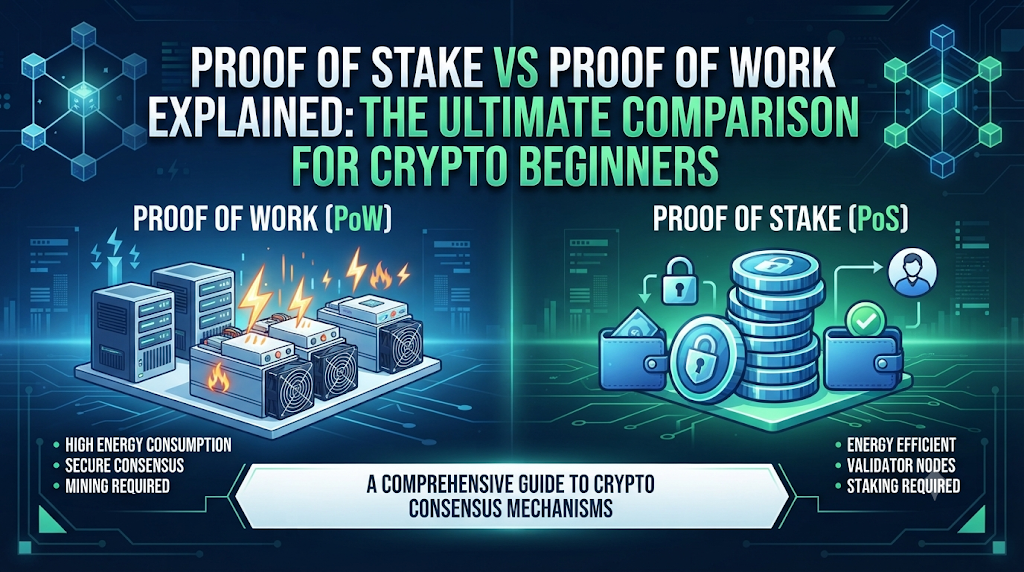
In simple terms, Proof of Work means proving you did hard, expensive work to protect the network.
Why Does It Matter?
Without a central bank to approve transactions, a blockchain needs a fair way to choose who gets to write the next block of data. Proof of Work uses computer competition to solve this problem. It ties network security to the real physical world through electricity and hardware costs.
How Does It Work?
- Transaction Pooling: When you send cryptocurrency, your transaction waits in a queue with thousands of others.
- The Race: Specialized computers, called miners, bundle these transactions into a block and race to solve a cryptographic puzzle. This puzzle is essentially a guessing game that requires massive trial-and-error computations.
- Finding the Answer: The first miner to guess the correct solution broadcasts it to the network.
- Verification: Other computers quickly check the answer. Because checking is easy while guessing is hard, validation takes just seconds.
- The Reward: The winning miner gets newly created cryptocurrency and transaction fees as a reward for their effort.
What Is Proof of Stake?
Proof of Stake is a newer system designed to solve the high energy consumption and speed limits of Proof of Work.
In simple terms, Proof of Stake means proving you have a financial stake in the network’s health. Instead of using raw computer power, participants lock up their own coins as a security deposit.
Why Does It Matter?
Proof of Stake removes the need for expensive mining hardware and massive electricity usage. It allows everyday people to help secure the network and earn rewards directly from their digital wallets.
How Does It Work?
- Staking Coins: Participants, called validators, lock up a specific amount of cryptocurrency in a smart contract.
- Random Selection: The network’s software randomly chooses a validator to create the next block of transactions.
- The Stake Weight: Your chance of being chosen depends on how many coins you have staked. If you stake more coins, you get chosen more often.
- Validation and Rewards: The chosen validator checks the transactions, builds the block, and adds it to the chain. If they do a good job, they earn newly minted coins. If they try to cheat, the network burns a portion of their staked coins as a penalty.
Key Differences Between PoW and PoS
| Feature | Proof of Work (PoW) | Proof of Stake (PoS) |
| Primary Resource | Computer hardware and electricity | Financial capital (crypto tokens) |
| Participants | Miners | Validators |
| Energy Consumption | Very high | Very low |
| Hardware Requirements | Expensive, specialized equipment (ASICs) | Standard computer or staking pool |
| Entry Barrier | High cost of hardware and power | Minimum token requirement or staking pool |
| Famous Examples | Bitcoin, Litecoin | Ethereum, Cardano, Solana |
Practical Examples to Understand the Difference
The Security Guard Analogy
Think of securing a high-security building.
- Proof of Work is like hiring elite security guards who run marathons. To prove they are dedicated, they must sweat, spend energy, and burn calories. If a guard tries to let a thief inside, they waste all their hard work and lose the money they spent on running shoes and training.
- Proof of Stake is like requiring security guards to leave a massive cash deposit at the front desk. To get the job, you must lock up $100,000 in the safe. If you do your job well, you earn interest on your deposit. If you let a thief in, the manager takes your cash deposit away permanently.
Real-World Considerations and Trade-Offs
No consensus mechanism is perfect. Both systems trade off different qualities to achieve security.
Environmental Impact
Proof of Work requires vast amounts of electricity. Miners run high-powered machines 24/7 to solve puzzles. Critics point out that this carbon footprint can harm the environment, though proponents argue that it encourages the use of renewable energy. Proof of Stake uses a tiny fraction of that energy—often compared to the power consumption of a few household refrigerators.
Centralization Risks
- In PoW: Hardware gets expensive. Over time, mining moves to massive warehouses run by professional companies with cheap electricity. This can concentrate power among a few large mining pools.
- In PoS: Wealth can concentrate power. People who hold a large amount of coins can stake more, win more rewards, and accumulate even more influence over time. This is known as the “rich get richer” problem.
Security and Attack Costs
- PoW Attack: To cheat a PoW network like Bitcoin, an attacker must buy and run more than 50% of the world’s mining power. This costs billions of dollars in physical hardware and electricity, making it nearly impossible.
- PoS Attack: To cheat a PoS network, an attacker must buy more than 50% of all staked tokens in existence. While extremely expensive, the attack relies purely on market acquisition rather than physical supply chains.
Common Mistakes Beginners Make
- Mistake: Assuming Proof of Stake is completely risk-free.
- Why people make it: Staking sounds like a traditional bank savings account with steady interest.
- Why it causes problems: Staked assets can face “slashing” penalties if the validator goes offline or misbehaves. You also face market volatility while your funds are locked.
- What you should do instead: Research staking providers carefully and understand lock-up periods before committing your funds.
- Mistake: Believing Proof of Work will disappear overnight.
- Why people make it: PoS networks are newer and more energy-efficient.
- Why it causes problems: Bitcoin relies entirely on PoW for its unmatched security and decentralization, which many investors value more than transaction speed.
- What you should do instead: Recognize that different networks serve different purposes and use the consensus model that fits their goals.
Decision-Making Framework: Which Network Style Fits Your Goals?
When evaluating a cryptocurrency project, use this simple framework to assess its consensus model:
- Check the Energy Model: Is the network sustainable and compliant with modern environmental standards?
- Review Decentralization: How many independent miners or validators secure the network?
- Analyze Security History: Has the network suffered successful 51% attacks or major downtime?
- Understand Staking Options: If it is PoS, can you stake easily through decentralized pools, or do you need specialized technical setups?
- Evaluate Use Case: Does the network prioritize maximum security and censorship resistance (like Bitcoin), or high speed and low fees (like Ethereum or Solana)?
Key Terms
- Consensus Mechanism: A fault-tolerant system used by blockchains to agree on a single source of data.
- Block: A collection of digital transactions bundled together and added to the blockchain.
- Mining: The process of using computer hardware to solve complex math problems in PoW networks.
- Validator: A participant in a PoS network responsible for verifying transactions and creating new blocks.
- Staking: Locking up cryptocurrency tokens in a wallet or smart contract to support network operations.
- 51% Attack: A scenario where a single entity controls the majority of a network’s mining power or stake, allowing them to reverse transactions.
- ASIC: Application-Specific Integrated Circuit—specialized computer chips built exclusively for mining PoW cryptocurrencies.
- Smart Contract: Self-executing code stored on a blockchain that automatically runs when conditions are met.
FAQs
Can a Proof of Work network switch to Proof of Stake?
Yes. Ethereum famously completed this transition in September 2022, an event known as “The Merge.” It successfully switched from energy-intensive mining to validator staking without stopping the network.
Which system is more secure?
Both systems offer high security, but in different ways. Proof of Work relies on physical energy and hardware limits, making it battle-tested over many years. Proof of Stake relies on economic penalties, making attacks financially ruinous for the attacker.
Do I need expensive equipment to earn crypto rewards?
With Proof of Work, yes—you need specialized mining rigs. With Proof of Stake, no—you can often delegate your coins to a staking pool using a standard smartphone or laptop wallet.
Does Proof of Stake make transactions faster?
Generally, yes. Because PoS does not require computers to burn energy on trial-and-error puzzles, blocks can be proposed and finalized much faster than in traditional PoW systems.
Conclusion
Both Proof of Work and Proof of Stake solve the same fundamental problem: how to maintain trust in a digital world without a central authority. Proof of Work trades energy efficiency for battle-tested, uncompromised security. Proof of Stake trades physical hardware for economic efficiency and higher transaction speeds.
Understanding these differences helps you look past market hype and evaluate how a blockchain truly operates under the hood.