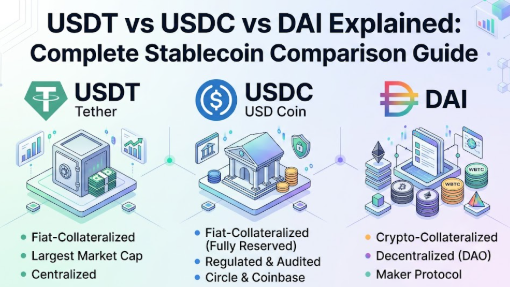
Introduction
Crypto looks exciting, but beginners can make risky decisions without understanding the basics, and stablecoins are one area where the word “stable” can create a false sense of certainty. Someone entering cryptocurrency for the first time may see USDT, USDC, and DAI trading around one US dollar and assume they are essentially identical. In reality, they differ in how they are issued, what supports their value, who controls important parts of the system, how redemption works, how widely they are accepted, and what kinds of risks users face. USDT is a fiat-linked stablecoin issued by Tether, which states that its tokens are backed by its reserves. USDC is issued by Circle and is backed by highly liquid cash and cash-equivalent reserve assets, with Circle describing USDC as redeemable one-for-one for US dollars subject to applicable conditions. DAI follows a different history and structure because it developed as a collateral-backed stablecoin within the Maker protocol rather than as a conventional company-issued digital dollar. The Maker ecosystem has since evolved into Sky, which now describes USDS as the upgraded version of DAI. Understanding these distinctions is important for investors, traders, DeFi users, crypto learners, business owners, and anyone considering holding digital dollars temporarily. A stablecoin can reduce exposure to the price volatility associated with assets such as Bitcoin, but it introduces different risks involving issuers, reserves, smart contracts, exchanges, blockchains, liquidity, regulation, wallets, and depegging. This USDT vs USDC vs DAI Explained guide therefore focuses on practical understanding rather than simply ranking three tokens. Readers will learn how each model works, what advantages and trade-offs each approach creates, what mistakes beginners commonly make, and how to evaluate a stablecoin according to a specific purpose rather than following popularity, social-media claims, or assumptions about safety.
Understanding USDT vs USDC vs DAI in Simple Words
A stablecoin is a crypto token designed to maintain a relatively stable value compared with another asset. USDT, USDC, and DAI are generally designed around the value of the US dollar.
The key word is designed. A stablecoin is not the same thing as physical US dollars sitting in your pocket, nor does the name guarantee that its market price can never move away from one dollar.
What Is USDT?
USDT, commonly called Tether, is issued by Tether. The company describes USDT as pegged one-to-one to the US dollar and backed by Tether’s reserves. Those reserves can include cash equivalents and other reserve assets rather than meaning that every token is necessarily represented by a physical dollar bill in a bank vault.
USDT is commonly used for:
- Moving money between crypto exchanges
- Trading cryptocurrency pairs
- Holding crypto value temporarily
- Transferring dollar-linked value over blockchains
- Accessing certain DeFi platforms
- Receiving or sending crypto-related payments
What Is USDC?
USDC is a dollar-linked stablecoin issued by Circle through its applicable regulated affiliates.
Circle states that USDC is backed by highly liquid cash and cash-equivalent assets and is redeemable one-to-one for US dollars under its applicable redemption framework. Circle also publishes information about its reserve structure and third-party assurance processes.
USDC is commonly used for payments, exchange trading, treasury operations, blockchain applications and DeFi.
What Is DAI?
DAI developed through Maker as a crypto-native, collateral-backed stablecoin. Instead of following exactly the same issuer-reserve model as USDT or USDC, the Maker system historically used smart contracts, collateralized positions, liquidation mechanisms, governance and other stability tools to support DAI.
Maker’s technical documentation describes DAI as collateral-backed and explains the use of overcollateralization within the system.
The ecosystem has subsequently been rebranded as Sky. Sky now describes USDS as the upgraded version of DAI and provides a mechanism through which DAI can be upgraded to USDS.
Beginner Example
Suppose Rahul owns cryptocurrency worth $2,000 but does not want to remain exposed to short-term market volatility.
He could sell his volatile crypto for a stablecoin instead of immediately withdrawing money through a banking system.
But choosing USDT, USDC, or DAI requires another decision.
He should ask:
- Which blockchain am I using?
- Is the token native or bridged?
- What are the transaction fees?
- Where will I store it?
- Who or what supports its value?
- How easily can I convert it back?
- Am I comfortable with issuer or smart-contract risk?
The common misunderstanding is believing that all stablecoins are simply interchangeable digital dollars.
The better takeaway is that similar prices do not mean identical structures or risks.
Why Comparing USDT, USDC, and DAI Is Important
A USDT vs USDC vs DAI comparison matters because people use stablecoins for very different purposes.
A trader may value liquidity and exchange availability. A DeFi participant may care more about smart-contract compatibility. A business transferring digital value may care about settlement, compliance and redemption. A long-term crypto holder may focus on custody and issuer risk.
Savings and Cash Management
Some crypto users temporarily hold stablecoins instead of volatile assets. However, stablecoins should not automatically be treated like insured bank deposits.
Their risks are different.
Investing
Stablecoins can serve as a temporary settlement asset while investors decide where to allocate capital. Holding a stablecoin, however, does not remove all financial risk.
Trading
Stablecoin pairs are widely used to enter and exit crypto positions without converting to traditional currency after every trade.
Liquidity, exchange support and network compatibility therefore become important.
DeFi
Stablecoins can be supplied to lending protocols, liquidity pools or other decentralized applications.
This adds additional smart-contract, protocol, liquidation and counterparty risks beyond the stablecoin itself.
Risk Awareness
Consider two users holding the same dollar value.
One holds USDC directly in a self-custody wallet.
Another deposits USDC into an unfamiliar DeFi protocol offering unusually high returns.
Their stablecoin exposure may initially look similar, but their overall risk is very different.
The second user has added protocol and smart-contract risk.
The practical lesson is simple: evaluate both the stablecoin and what you intend to do with it.
The Real Problem Readers Face With Stablecoin Comparisons
The hardest part of comparing stablecoins is not finding information. It is separating useful information from noise.
Beginners encounter thousands of posts claiming that one stablecoin is the “safest,” another is “fully decentralized,” or a particular token can generate effortless passive income.
These statements frequently remove important context.
Lack of Awareness
Many users do not know the difference between an issuer-backed token and a collateral-backed protocol asset.
Too Much Conflicting Advice
One community may prefer USDT because of liquidity while another prefers USDC because of reserve transparency.
A DeFi-focused community may prioritize DAI or its successor ecosystem.
The recommendations often reflect the community’s priorities rather than the reader’s needs.
Emotional Decision-Making
People sometimes switch stablecoins immediately because of a rumor or social-media post without checking primary information.
Weak Comparison
Looking only at price ignores:
- Backing
- Redemption
- Governance
- Liquidity
- Network
- Smart-contract risk
- Counterparty risk
- Regulatory exposure
Unrealistic Expectations
Stablecoins are not designed to become $2 or $10 in the way speculative crypto assets might.
Their purpose is generally to remain near their reference value.
Ignoring Platform Risk
Even a functioning stablecoin can be lost when held on a hacked, insolvent or fraudulent platform.
Depending Only on Social Media
A viral post should never replace independent verification.
The better approach is to start with the structure of the asset, understand the risks and then evaluate whether those characteristics suit your intended use.
How USDT, USDC, and DAI Work Step by Step
Step 1: Understand the One-Dollar Target
USDT, USDC, and DAI are designed to maintain a value around one US dollar. This matters because their usefulness depends heavily on market confidence that the peg can be maintained. Beginners should understand that a target is not an absolute guarantee. A common mistake is seeing a $1 target and treating the token as risk-free cash. A better approach is to investigate how the stablecoin attempts to maintain that target.
Step 2: Identify the Backing Model
USDT and USDC use issuer-managed reserve structures, while DAI developed through a collateralized protocol model. Tether states that USDT is backed by its reserves, while Circle states that USDC is backed by highly liquid cash and cash-equivalent assets. DAI’s original architecture relies on collateral and protocol mechanisms. The mistake is assuming every stablecoin is backed in exactly the same way. The better approach is understanding what assets and mechanisms ultimately support the token.
Step 3: Understand Issuance and Redemption
Centralized stablecoins are generally created and redeemed through their issuing organizations and approved counterparties. Circle, for example, explains that qualified customers can mint and redeem USDC through its infrastructure, while many ordinary users obtain or sell USDC through exchanges and other market participants. DAI works differently because protocol mechanisms historically created DAI through collateralized positions and related facilities. Beginners should not assume that buying a token on an exchange gives them exactly the same redemption relationship as an institutional issuer customer.
Step 4: Check the Blockchain Network
Stablecoins can operate on multiple networks. The same ticker can therefore exist on Ethereum, Tron, Solana and other blockchains depending on the token. Sending a stablecoin through an incompatible network can result in serious problems or lost funds. Tether specifically warns users to verify the correct transport protocol when sending tokens. The better approach is checking the blockchain, token contract and receiving platform before every transfer.
Step 5: Understand Market Liquidity
Liquidity describes how easily an asset can be bought or sold without significant price disruption. A heavily traded stablecoin may be more convenient for active traders, but high liquidity alone does not answer questions about reserves, governance or platform risk. Compare liquidity according to the exchange and blockchain you actually plan to use.
Step 6: Decide Where the Stablecoin Will Be Stored
Users may keep stablecoins on exchanges, custodial platforms, hardware wallets, software wallets or DeFi protocols. Each creates a different risk profile. Leaving funds on an exchange creates exchange-counterparty risk. Self-custody reduces reliance on an exchange but places responsibility for private-key protection on the user. There is no risk-free storage method.
Step 7: Evaluate the Intended Use
Someone trading several times daily may prioritize exchange liquidity. Someone using decentralized applications may prioritize DeFi integration. Someone accepting blockchain payments may prioritize network fees and settlement reliability. Choosing based only on a friend’s recommendation is a mistake. Match the stablecoin to the specific job.
Step 8: Monitor Risk After Choosing
Risk assessment should continue after the initial purchase. Reserve disclosures, protocol governance, exchange conditions, network support and regulation can change. The mistake is researching once and assuming the situation will never evolve. The better approach is periodically reviewing material changes affecting the asset or platform.
Key Factors That Influence Stablecoin Decisions
Peg Stability
The main purpose of a dollar-linked stablecoin is maintaining a price close to the dollar.
Temporary market deviations can still occur, particularly during periods of stress.
Reserve or Collateral Quality
Users should understand what supports the stablecoin.
For issuer-backed stablecoins, examine reserve disclosures and redemption structures.
For decentralized systems, examine collateral quality, collateralization, governance and liquidation mechanisms.
Wallet Safety
A perfectly functioning stablecoin does not protect a user who exposes a seed phrase.
Wallet security remains essential.
Exchange Reliability
Holding stablecoins on a centralized exchange means relying on that exchange to safeguard assets and process withdrawals.
Stablecoin risk and exchange risk are separate.
Transaction Fees
The cost of moving a stablecoin depends heavily on the blockchain and current network conditions.
A token suitable for a large transfer may be inefficient for many tiny payments on a high-fee network.
Smart-Contract Risk
Tokens and DeFi applications rely on software.
Bugs, exploits and integration problems can create losses.
Scam Awareness
Fake tokens may use the same name or ticker as legitimate assets.
Never identify a token solely by its ticker.
Regulatory and Legal Risk
Rules applying to stablecoins, exchanges, taxation and crypto services differ by country and can change.
Users should evaluate obligations relevant to their jurisdiction.
Detailed Breakdown of USDT vs USDC vs DAI
USDT: The Exchange-Liquidity-Focused Stablecoin
USDT is one of the most deeply integrated stablecoins throughout cryptocurrency markets.
It is frequently used as a quote currency on exchanges, allowing traders to move between crypto assets and dollar-linked value.
Tether says each issued USDT is backed by its reserves and publishes information concerning those reserves and tokens in circulation.
Why Users Choose USDT
Common reasons include:
- Broad exchange availability
- Large trading markets
- Multi-chain availability
- Familiarity among traders
- Cross-platform transfers
Main Trade-Off
USDT relies on an identifiable issuer and issuer-managed reserve system.
Users therefore need to evaluate not only blockchain technology but also the issuer’s reserve management, redemption framework and legal structure.
Practical Approach
USDT may be useful where liquidity and platform compatibility are particularly important, but popularity should not be confused with the absence of risk.
USDC: Reserve Transparency and Financial Infrastructure
USDC also targets one US dollar but places significant emphasis on reserve transparency and regulated issuance.
Circle says USDC reserves consist of highly liquid cash and cash-equivalent assets and that the majority of reserves are held through the Circle Reserve Fund, alongside other cash holdings.
USDC is designed for uses including:
- Payments
- Trading
- Blockchain applications
- Institutional settlement
- DeFi
- Cross-border digital value transfer
Important Distinction
Circle’s direct minting and redemption arrangements have eligibility requirements. Everyday users commonly purchase or sell USDC through exchanges or other market participants rather than interacting directly with the issuer.
Common Mistake
Some beginners interpret reserve transparency as meaning USDC is completely risk-free.
It is not.
Users still face issuer, banking, platform, blockchain, custody and regulatory risks.
DAI: The Collateral-Backed Crypto-Native Approach
DAI became important because it demonstrated a different approach to creating dollar-linked blockchain value.
Instead of relying exclusively on a company holding corresponding fiat-style reserves, the Maker system used collateralized smart contracts, governance and liquidation mechanisms.
Maker’s technical documentation describes DAI as collateral-backed and explains how overcollateralization supports debt positions in the system.
Why This Matters
DAI has historically appealed to users interested in:
- DeFi
- On-chain collateral
- Smart-contract-based financial infrastructure
- Reduced dependence on a single conventional issuer
However, describing DAI simply as “fully decentralized” can oversimplify its actual risk structure because protocol governance and collateral composition create dependencies of their own.
DAI and the Sky Transition
An important modern distinction is that Maker became Sky, and Sky describes USDS as the upgraded version of DAI. Users can access an upgrade path between DAI and USDS through the Sky ecosystem.
This means a current stablecoin comparison should recognize DAI’s historical significance while also understanding the ongoing evolution of its ecosystem.
Stablecoins and Blockchain Transactions
Stablecoins are blockchain tokens.
A normal transaction requires:
- A sender wallet
- A receiver address
- A supported blockchain
- Sufficient network-fee currency
- Correct token selection
- Blockchain confirmation
The stablecoin may be worth approximately one dollar while the cost of moving it changes according to the blockchain.
Native Versus Bridged Stablecoins
This distinction is important.
A native stablecoin is issued directly on a supported blockchain according to the issuer’s official infrastructure.
A bridged token may represent an asset locked elsewhere and transferred through bridge infrastructure.
Circle explicitly distinguishes native USDC from bridged versions and warns that bridged USDC may not have the same issuer support or redemption path as native USDC.
Beginners should therefore verify exactly which token they are buying.
Stablecoins Are Not Guaranteed Income Products
Owning USDT, USDC or DAI does not automatically generate a return.
Returns advertised by exchanges or DeFi platforms generally come from a separate lending, staking, liquidity or incentive arrangement.
That arrangement adds another layer of risk.
A high advertised yield should therefore trigger more investigation, not less.
Common Mistakes Beginners Make With Stablecoins
1. Assuming Stable Means Risk-Free
Stable refers primarily to the intended price relationship.
It does not eliminate issuer, platform, liquidity, smart-contract or cybersecurity risk.
2. Following Random Social-Media Advice
A popular creator may have incentives or incomplete information.
Use primary disclosures and independent research.
3. Choosing Only by Popularity
A large user base can improve liquidity but does not automatically make a token appropriate for every purpose.
4. Using the Wrong Network
Sending USDT on one network to a destination expecting another can cause serious problems.
Always verify both sides.
5. Keeping Everything on One Exchange
This concentrates counterparty risk.
Think carefully about custody.
6. Buying Fake Stablecoins
Scammers can create tokens with familiar names.
Verify contract information through trusted sources and platforms.
7. Chasing Excessive Yield
An unusually high return may involve lending, leverage, liquidity or protocol risk.
The stablecoin itself does not make the strategy safe.
8. Sharing Seed Phrases
No legitimate support representative needs your seed phrase.
Anyone obtaining it may control the wallet.
9. Ignoring Tax Responsibilities
Buying, selling, transferring, earning or disposing of crypto can have tax consequences depending on jurisdiction.
Maintain records.
10. Using Emergency Money
Funds needed for rent, medical costs, food or essential expenses should generally not be exposed to unnecessary crypto risk.
Don’t Do This Checklist
- Don’t assume a stablecoin can never depeg.
- Don’t send funds before confirming the blockchain.
- Don’t share seed phrases or private keys.
- Don’t trust guaranteed-return claims.
- Don’t buy a token solely because of its ticker.
- Don’t ignore withdrawal restrictions.
- Don’t place emergency money into speculative DeFi strategies.
- Don’t assume an exchange balance equals self-custody.
- Don’t follow anonymous advice without verification.
- Don’t ignore local tax and regulatory requirements.
Practical Real-Life Examples of USDT vs USDC vs DAI
Example 1: Active Crypto Trader
A trader frequently moves between Bitcoin and dollar-linked assets. The challenge is finding sufficient liquidity on the exchange being used. Instead of choosing a stablecoin from online rankings, the trader checks available trading pairs, withdrawal networks and custody risk. The learning is that liquidity requirements can make the appropriate choice platform-specific.
Example 2: Beginner Using USDC
A beginner purchases USDC because they value its reserve disclosures. They initially assume that this makes the investment risk-free. After learning about exchange and wallet risks, they separate stablecoin risk from custody risk. The lesson is that strong reserve characteristics do not protect against every failure scenario.
Example 3: DeFi Learner Exploring DAI
A DeFi learner wants DAI because of its crypto-native history but understands little about collateral or smart contracts. Instead of immediately depositing funds into several protocols, the learner first studies DAI, the Maker-to-Sky transition and the protocol being considered. The learning is that decentralized infrastructure requires additional technical understanding.
Example 4: Small Business Receiving Crypto
A small business receives stablecoin payments from overseas customers. Initially, the owner focuses only on receiving one dollar of digital value for every dollar invoiced. A better process includes checking network costs, exchange availability, accounting records, tax treatment and conversion options. Operational simplicity matters as much as the stablecoin name.
Example 5: User Attracted by High Yield
A user sees a platform advertising unusually attractive returns for depositing a stablecoin. Rather than assuming the stablecoin itself guarantees the return, the user investigates the platform, smart contracts, withdrawal terms and source of yield. The learning is that yield risk and stablecoin risk must be evaluated separately.
Table 1: USDT vs USDC vs DAI Comparison
| Factor | USDT | USDC | DAI |
|---|---|---|---|
| Basic model | Issuer-backed stablecoin | Issuer-backed stablecoin | Historically collateral-backed protocol stablecoin |
| Main organization/system | Tether | Circle | Maker, now evolved into Sky |
| Dollar target | Approximately $1 | Approximately $1 | Approximately $1 |
| Backing approach | Tether-managed reserves | Highly liquid cash and cash-equivalent reserves | Protocol collateral and stability mechanisms |
| Common strength | Trading liquidity and broad integration | Transparency, payments and regulated financial infrastructure | Crypto-native and DeFi-oriented architecture |
| Main dependency | Issuer and reserves | Issuer, reserves and financial infrastructure | Smart contracts, collateral and governance |
| DeFi use | Common | Common | Historically central to DeFi |
| Beginner complexity | Moderate | Moderate | Higher |
| Important consideration | Network and issuer risk | Native token, issuer and platform risk | Protocol structure and Sky transition |
Table 2: Stablecoin Risk and Better Approach
| Situation | Common Mistake | Better Approach |
|---|---|---|
| Choosing a stablecoin | Picking the most popular name | Compare purpose, backing, liquidity and risks |
| Sending funds | Ignoring blockchain network | Verify network and address before sending |
| Storage | Keeping everything on one platform | Evaluate custody and counterparty exposure |
| DeFi | Assuming stablecoin means safe yield | Research the protocol separately |
| High returns | Trusting guaranteed profit claims | Identify where the return comes from |
| Wallet use | Saving seed phrase online | Use secure offline backup practices |
| Token selection | Relying only on ticker | Verify the genuine token and contract |
| Long-term holding | Never reviewing developments | Monitor important issuer or protocol changes |
Tools, Methods, and Frameworks Readers Can Use
Stablecoin Comparison Checklist
Create a simple written checklist covering backing, issuer, liquidity, blockchain, redemption and custody.
It prevents decisions based purely on brand recognition.
Wallet Safety Checklist
Before transferring meaningful amounts, verify:
- Wallet address
- Blockchain
- Token contract
- Seed phrase security
- Device security
This reduces basic operational mistakes.
Test Transaction Method
For an unfamiliar wallet or network, consider sending a small test amount before a much larger transaction when fees make that practical.
This helps identify address and network mistakes.
Exchange Comparison Checklist
Check:
- Deposit network
- Withdrawal network
- Withdrawal fees
- Liquidity
- Account security
- Withdrawal restrictions
Do not assume every exchange supports every version of a stablecoin.
Transaction Journal
Maintain records of:
- Purchases
- Sales
- Transfers
- Fees
- Wallet addresses
- Exchange transactions
This can improve portfolio management and tax recordkeeping.
Risk-Layer Method
Evaluate risk in separate layers:
Layer 1: Stablecoin
Layer 2: Blockchain
Layer 3: Wallet
Layer 4: Exchange
Layer 5: DeFi protocol
A strong asset at Layer 1 cannot eliminate failures at Layers 2–5.
Expert Tips to Make Better Stablecoin Decisions
1. Decide Your Purpose First
A trader, payment user and DeFi participant have different requirements. Identify why you need the stablecoin before comparing tokens.
2. Understand the Backing
Do not stop at “backed by dollars.” Investigate the structure behind that statement and how redemption works.
3. Never Treat the Peg as Guaranteed
Stablecoins target a stable value, but market stress can produce temporary deviations. Plan accordingly.
4. Compare Networks Before Fees
Sometimes the blockchain matters more to your transaction cost than the stablecoin itself. Verify compatible networks before transferring.
5. Separate Asset Risk From Platform Risk
USDT stored on Exchange A does not have precisely the same overall risk as USDT held in self-custody.
Always identify where the asset is held.
6. Verify Native and Bridged Tokens
A bridged version can introduce bridge-related risks and may not have the same issuer relationship as native issuance.
Check before buying or transferring.
7. Avoid Concentrating Unnecessary Risk
Users with significant crypto exposure should think carefully before concentrating everything in one exchange, protocol or technical setup.
Diversification can reduce some risks, although it cannot eliminate them.
8. Protect Your Seed Phrase
Store recovery information securely and never provide it to support agents, websites or strangers.
Your seed phrase can represent control over your assets.
9. Investigate Yield Separately
A platform offering yield on USDC does not make that return a characteristic of USDC itself.
Study the lending or DeFi arrangement generating the yield.
10. Watch for Fake Tokens
Check token authenticity rather than trusting a logo or ticker.
Fake USDT, USDC and DAI-style tokens can be created by scammers.
11. Keep Emergency Funds Separate
Crypto infrastructure can experience delays, freezes, network congestion or platform failures.
Money needed immediately for essential expenses should not depend on complex crypto access.
12. Keep Written Records
Documentation supports tax reporting, security investigation and better financial review.
13. Research Before Large Transfers
The cost of a few extra minutes of verification is small compared with sending significant funds through the wrong network.
14. Monitor Important Changes
Stablecoin structures and ecosystems evolve. DAI’s transition within the Sky ecosystem demonstrates why old explanations can become incomplete.
15. Do Not Search for a Universal Winner
The better question is not “Which stablecoin is best?”
Ask, “Which risk profile and infrastructure best fit what I am trying to do?”
Case Studies: How Better Understanding Changes Decisions
Case Study 1: The Frequent Trader
Profile: Arjun is a salaried professional who trades cryptocurrency occasionally after work.
Situation: His exchange offers several USDT trading pairs with strong liquidity.
Problem: He assumes the highest-volume stablecoin must automatically be the safest place for all his crypto savings.
Wrong approach: Arjun treats liquidity and overall safety as the same concept.
Better approach: He separates trading convenience from long-term custody. He investigates Tether’s reserve model, exchange risk, withdrawal networks and wallet options before deciding how much exposure is appropriate.
Result or learning: He understands that USDT’s trading usefulness does not answer every custody or risk question.
Key takeaway: Evaluate a stablecoin according to the specific financial function it performs.
Case Study 2: The USDC User
Profile: Meera operates a small online business and receives some blockchain-based payments.
Situation: She prefers USDC because she values transparent reserve information and its payment infrastructure.
Problem: She holds all received USDC indefinitely on one exchange.
Wrong approach: She assumes choosing a stablecoin with clear reserve disclosures removes the need to assess exchange counterparty risk.
Better approach: Meera reviews custody, withdrawal access, transaction records, local tax obligations and operational needs separately.
Result or learning: Her financial process becomes more disciplined without assuming that any single stablecoin removes every risk.
Key takeaway: Asset selection is only one component of crypto risk management.
Case Study 3: The DeFi Learner
Profile: Kabir is learning decentralized finance.
Situation: He becomes interested in DAI because of its history in collateralized DeFi.
Problem: He finds older articles that discuss Maker and DAI without explaining the transition toward Sky and USDS.
Wrong approach: He assumes every historical explanation describes the current ecosystem perfectly.
Better approach: Kabir studies current Sky information, understands that USDS is positioned as DAI’s upgraded version and examines the exact protocol and token he intends to use.
Result or learning: He makes decisions based on current infrastructure rather than outdated terminology.
Key takeaway: Crypto research should account for protocol evolution.
Risk Awareness: What Readers Must Check First
Depegging Risk
A stablecoin may temporarily trade below or above its intended value.
Reduce exposure by understanding the peg mechanism, liquidity and redemption structure.
Issuer Risk
USDT and USDC depend significantly on centralized organizations and their financial, legal and operational infrastructure.
Review official disclosures rather than relying on assumptions.
Collateral Risk
Collateral-backed systems depend on the quality, liquidity and management of collateral.
Extreme market conditions can test those mechanisms.
Smart-Contract Risk
DAI and DeFi integrations depend heavily on software.
Audits and long operating histories can help inform risk assessment but cannot prove that software is incapable of failure.
Platform Risk
An exchange can experience insolvency, hacking, withdrawal restrictions or operational disruption regardless of the stablecoin being held.
Liquidity Risk
A token may be widely liquid globally but less liquid on a particular exchange, blockchain or trading pair.
Check the market you will actually use.
Bridge Risk
Cross-chain bridges introduce additional technical assumptions.
Use native stablecoins where appropriate and understand the risks when bridges are necessary.
Fraud Risk
Fake websites, tokens, wallet applications and support representatives remain a major threat.
Verify everything independently.
Cybersecurity Risk
Weak passwords, malware, phishing and exposed seed phrases can lead to loss.
Use strong security practices.
Regulatory Risk
Stablecoin and cryptocurrency rules continue to evolve across jurisdictions.
Compliance requirements can affect exchanges, issuers and users.
Tax Risk
Crypto transactions may create reporting or tax consequences.
Maintain accurate records and obtain professional tax advice where needed.
Misinformation Risk
Old articles and viral posts can become outdated quickly.
Prioritize current primary documentation for important decisions.
Readers should verify relevant details independently and consult qualified financial, tax, legal or investment professionals whenever their situation requires professional advice.
Checklist Before Taking Action
Before buying, transferring or using USDT, USDC, DAI or another stablecoin, confirm:
- I understand what the stablecoin is designed to do.
- I understand who or what supports its value.
- I have reviewed major issuer or protocol risks.
- I have compared relevant alternatives.
- I know which blockchain I am using.
- The receiving platform supports that network.
- I have verified the authentic token.
- I understand transaction and withdrawal fees.
- I have considered exchange or custody risk.
- My wallet and seed phrase are protected.
- I am not relying on guaranteed-return claims.
- I understand any DeFi platform before depositing funds.
- Emergency money is kept separate.
- I maintain transaction records.
- I have considered tax and regulatory implications.
- I am making the decision based on research rather than panic or greed.
- I have considered professional advice where necessary.
Use this checklist before significant transactions, not after something goes wrong. Stablecoin risk management is primarily about preventing avoidable mistakes and understanding the remaining risks that cannot be completely eliminated.
Strategic Insights for Better Stablecoin Decision-Making
Wallet Custody
Ask who actually controls the private keys.
When assets remain on an exchange, the platform generally controls the underlying wallet infrastructure.
Self-custody provides greater direct control but creates greater personal security responsibility.
Exchange Risk
Choose stablecoins and exchanges separately.
A trusted stablecoin does not automatically make an unreliable exchange trustworthy.
Stablecoin Diversification
Some sophisticated users avoid concentrating all digital-dollar exposure in one stablecoin.
However, diversification adds management complexity and should be based on understood risks rather than arbitrary splitting.
Transaction Confirmation
Blockchain transfers are often difficult or impossible to reverse.
Verify:
- Recipient
- Network
- Token
- Amount
before final approval.
Network Fee Awareness
A $100 stablecoin balance may still require a separate blockchain’s native asset to pay transaction fees.
For example, moving a token on an Ethereum-compatible network may require its relevant gas token.
Smart-Contract Exposure
Simply holding a token can have one risk profile.
Depositing it in a lending market adds another.
Providing liquidity can add additional risks.
Borrowing against it adds leverage and potentially liquidation risk.
Always map the complete transaction chain.
Stablecoin Governance
Different models make decisions differently.
Issuer-backed stablecoins rely heavily on corporate policies and legal infrastructure.
Protocol-backed stablecoins rely more on smart contracts and governance systems.
Neither structure eliminates governance risk; they distribute it differently.
DeFi Evolution
DAI demonstrates why crypto terminology should be reviewed continuously.
Maker evolved into Sky, and the ecosystem now positions USDS as DAI’s upgraded stablecoin.
A beginner researching DAI should therefore understand both its historical Maker architecture and its current relationship with Sky.
Key Terms Explained for Beginners
- Stablecoin: A crypto token designed to maintain a relatively stable value against another asset, commonly the US dollar.
- Peg: The target relationship between a stablecoin and its reference asset. A dollar stablecoin generally targets approximately $1.
- Depeg: A situation where the market value moves materially away from its target price.
- Reserve: Assets maintained to support an issuer-backed stablecoin’s circulating tokens.
- Collateral: Assets pledged or held within a financial structure to support debt or token issuance.
- Overcollateralization: Providing collateral worth more than the amount borrowed or issued to create an additional risk buffer.
- Liquidity: How easily an asset can be bought, sold or converted without causing major price movement.
- Redemption: Converting a stablecoin back into its underlying or referenced fiat value through an eligible issuer or market mechanism.
- Blockchain: A distributed digital ledger that records cryptocurrency transactions.
- Wallet: Software or hardware used to interact with blockchain assets and manage cryptographic keys.
- Private Key: Secret cryptographic information that provides control over blockchain assets. It should never be shared.
- Seed Phrase: A recovery phrase capable of restoring access to a crypto wallet. Anyone obtaining it may potentially control the wallet.
- Smart Contract: Blockchain-based code that executes predefined functions automatically.
- DeFi: Decentralized finance, referring to blockchain applications that provide functions such as lending, borrowing, exchanging and liquidity provision.
- Bridge: Infrastructure used to move or represent assets across different blockchains. Bridges can create additional technical risk.
Who Should Read This Blog
Beginners
It explains stablecoins without requiring advanced blockchain knowledge.
Students
Students researching crypto and blockchain can understand how different stablecoin models work.
Salaried Employees
People gradually exploring cryptocurrency can learn why stablecoins should not automatically be treated like bank savings.
Small Business Owners
Businesses considering stablecoin payments can understand network, conversion, custody and recordkeeping considerations.
New Investors
Investors can understand how stablecoins differ from volatile assets and why stablecoin risk still exists.
Traders
Traders can evaluate liquidity, trading pairs, networks and exchange support.
Loan Seekers
Anyone considering crypto-backed borrowing should understand that using stablecoins as collateral or borrowed assets can create repayment and liquidation risks.
Crypto Learners
The USDT vs USDC vs DAI Explained comparison provides a foundation for understanding stablecoin architecture.
Casino Content Creators
Writers covering crypto casinos can better distinguish payment-token characteristics without making misleading claims about stability or safety.
Finance Bloggers
Content creators can explain stablecoins more accurately and responsibly.
People Improving Financial Awareness
The guide demonstrates a broader principle: understand the structure and risk of a financial product before using it.
Frequently Asked Questions
1. What does USDT vs USDC vs DAI Explained mean?
USDT vs USDC vs DAI Explained refers to comparing three dollar-linked stablecoins according to their backing, issuance structure, liquidity, governance, blockchain use and risks. Although all target a similar value, they do not use identical mechanisms.
2. What is the biggest difference between USDT, USDC and DAI?
USDT and USDC are issued through centralized organizations with reserve-backed models. DAI historically developed as a collateral-backed protocol stablecoin through Maker, which has since evolved into Sky with USDS positioned as DAI’s upgraded version.
3. Is USDT always worth exactly one dollar?
USDT is designed to track the US dollar, but market prices can move slightly above or below the target. No stablecoin price should be assumed to be mathematically guaranteed at every moment.
4. Is USDC backed by US dollars?
Circle says USDC is fully backed by highly liquid cash and cash-equivalent assets and is redeemable one-to-one for US dollars under applicable conditions. Reserve structures should still be reviewed rather than simplified to “cash in a vault.”
5. Is DAI decentralized?
DAI developed through a decentralized protocol and collateralized smart-contract system, but describing it simply as completely decentralized can hide dependencies involving governance, collateral, stablecoins and real-world financial infrastructure. Its ecosystem has also evolved significantly through Sky.
6. Which is best for beginners: USDT, USDC or DAI?
There is no universally best stablecoin for every beginner. USDT may offer strong trading availability, USDC emphasizes reserve transparency and financial infrastructure, while DAI has historically provided a more crypto-native model. The appropriate choice depends on purpose and risk tolerance.
7. Is USDT safer than USDC?
Safety cannot be reduced to a single ranking. Compare reserve structures, issuer exposure, liquidity, custody, blockchain, regulatory conditions and the platform where the stablecoin will be stored.
8. Can USDT, USDC or DAI lose their peg?
Yes. Stablecoins are designed to maintain their targets, but temporary depegging can occur under unusual market, liquidity or operational stress. Users should not treat the peg as an unconditional guarantee.
9. Can I earn money by holding stablecoins?
The token itself does not necessarily generate a return. Exchanges or DeFi applications may offer lending or other yield opportunities, but those products add separate counterparty, smart-contract, liquidity and potentially regulatory risks.
10. What is the most important lesson from USDT vs USDC vs DAI Explained?
The most important lesson is that similar prices do not mean identical assets. Compare the mechanism supporting each stablecoin, its liquidity, governance, network, custody arrangement and your intended use.
11. Is DAI being replaced by USDS?
The Maker ecosystem became Sky, and Sky currently describes USDS as the upgraded version of DAI while providing a DAI-to-USDS upgrade mechanism. Users researching DAI should therefore understand the current Sky ecosystem as well.
12. What should I check before buying a stablecoin?
Check the authentic token, blockchain network, backing or collateral model, liquidity, issuer or governance structure, exchange reliability, wallet security, transaction fees, redemption options and relevant tax or legal requirements.
Conclusion
USDT vs USDC vs DAI Explained is ultimately more than a comparison of three tokens trading near one dollar. It is an introduction to the different ways blockchain systems attempt to create stable digital value. USDT uses an issuer-managed reserve structure and has extensive integration throughout cryptocurrency trading markets. Tether states that issued tokens are backed by its reserves. USDC follows another centralized issuer model, with Circle emphasizing highly liquid reserve assets, redemption infrastructure, transparency and regulatory compliance. DAI represents a different chapter in stablecoin development because it originated as a collateral-backed protocol asset through Maker. Its ecosystem has since developed into Sky, where USDS is positioned as the upgraded version of DAI. None of these characteristics automatically produces a universally correct choice. A trader may prioritize liquidity and exchange pairs, a payment user may prioritize predictable conversion and network availability, while a DeFi participant may place more importance on smart-contract compatibility and protocol design. Beginners should therefore avoid deciding from popularity, fear, promises of yield or social-media opinions. Start by defining why you need a stablecoin. Then understand its backing, issuer or governance model, available blockchains, liquidity, storage method, redemption possibilities and major risks. Verify the exact network before every transfer, protect private keys and seed phrases, investigate platforms separately from the stablecoin, and never assume that a dollar peg makes an asset equivalent to insured cash. If the stablecoin will be used for lending, borrowing or earning yield, analyze that additional financial product independently because its risks can be substantially greater than simply holding the token. Maintain accurate records, consider tax and regulatory obligations and periodically review important developments because crypto infrastructure continues to evolve. The goal should not be to find a supposedly perfect stablecoin but to make informed decisions with a clear understanding of what can go right, what can go wrong and how much risk you are prepared to accept. That approach is more useful than chasing rankings because responsible crypto participation depends on knowledge, verification, security and disciplined financial decision-making.