Introduction
Imagine walking into a local store where the shopkeeper has no cash in the register to give you change. You want to buy an item, but the trade cannot happen because there is no medium to facilitate the exchange.
For a long time, digital currency trading faced a similar problem. Traditional finance relies on order books. Buyers and sellers place bids and asks, and a central matching engine pairs them up. If no one wants to buy your specific asset at your exact price, your trade sits unfinished.
Decentralized finance (DeFi) needed a different solution because it operates without central authorities or traditional market makers. The answer came in the form of liquidity pools. They changed how crypto assets move across blockchains, making instant trades possible 24 hours a day without requiring a traditional counterparty.
What Is a Liquidity Pool?
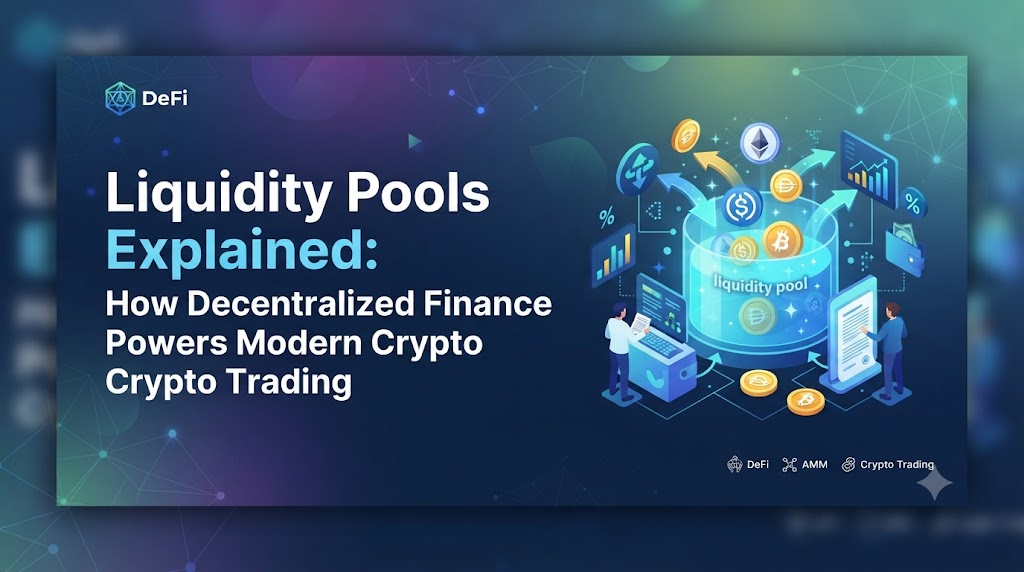
A liquidity pool is a collection of funds locked inside a smart contract—a piece of self-executing code on a blockchain.
In simple words, it is like a community-owned piggy bank for digital tokens. Two different tokens are usually deposited into the pool in equal value. For example, a pool might hold Ethereum and a stablecoin like USDC.
Why Does It Matter?
Without liquidity pools, decentralized exchanges (DEXs) would struggle to function. Traditional order books require constant, active buyers and sellers for every token pair. Liquidity pools remove that requirement. Anyone can trade instantly against the pool, regardless of whether a matching seller is online at that exact second.
How Liquidity Pools Work
To understand how these pools function behind the scenes, you need to look at two core concepts: Automated Market Makers (AMMs) and the Constant Product Formula.
The Role of the Automated Market Maker (AMM)
An Automated Market Maker is the software protocol that manages the liquidity pool. Instead of negotiating a price with another person, you trade directly against the smart contract. The price of the asset is determined automatically by a mathematical formula based on the ratio of the tokens inside the pool.
The Constant Product Formula
Most popular liquidity pools use a simple algebraic formula:
$x \times y = k$
- $x$ represents the quantity of the first token in the pool.
- $y$ represents the quantity of the second token in the pool.
- $k$ is a fixed constant that must remain unchanged during trades (ignoring fees for a moment).
When someone buys token $x$ from the pool, they add token $y$ to it. This changes the ratio. Because $k$ must stay the same, token $x$ becomes scarcer in the pool, causing its price to rise automatically. This mathematical rule ensures that trades always adjust prices based on supply and demand.
The Two Main Participants: Traders and Liquidity Providers
A functioning liquidity ecosystem relies on two distinct groups of people playing different roles.
1. Traders
Traders use the liquidity pools to swap one cryptocurrency for another. They pay a small trading fee (often around 0.3%) for the convenience of instant execution. This fee goes directly to support the pool.
2. Liquidity Providers (LPs)
Liquidity providers are everyday users who deposit their idle crypto assets into the pool. In return for taking on financial risk, LPs earn a proportional share of the trading fees generated by the pool.
Practical Example: How a Swap Happens
Let us look at a simple hypothetical example to see the mechanics in action.
- Setting Up the Pool: A liquidity pool is created with 10 Ethereum (ETH) and 20,000 USD Coin (USDC). The starting price of 1 ETH is set at 2,000 USDC.
- The Trade: A trader wants to buy 1 ETH. They send 2,000 USDC into the pool.
- The Adjustment: The pool now holds 11 ETH and 22,000 USDC. To keep the ratio balanced, the AMM recalculates the price.
- The Result: The trader receives their ETH instantly, and the pool grows larger, distributing a tiny fraction of the collected fee to all liquidity providers.
Why Do People Become Liquidity Providers?
Providing liquidity has become a popular way to generate passive income in crypto markets. The main benefits include:
- Fee Generation: Every time a trade happens, LPs earn a slice of the transaction fees proportional to their share of the pool.
- Yield Farming Incentives: Many DeFi protocols offer extra token rewards to LPs to encourage deeper market depth.
- Capital Efficiency: Instead of letting assets sit idle in a private wallet, LPs put their holdings to work.
Major Risks and Limitations
While liquidity pools offer attractive rewards, they come with distinct financial and technical risks that every participant should evaluate carefully.
Impermanent Loss
Impermanent loss happens when the price ratio of the deposited tokens changes significantly compared to when you first added them to the pool.
If you deposited two volatile assets, and one skyrockets in value while the other drops, withdrawing your funds might leave you with less total value than if you had simply held the tokens in your personal wallet. It is called “impermanent” because the loss can shrink or disappear if token prices return to their original ratio, but it becomes permanent the moment you withdraw.
Smart Contract Vulnerabilities
Liquidity pools live entirely inside code. If a hacker finds a bug or a logic flaw in the smart contract, they can drain the entire pool, leading to a total loss of funds.
Rug Pulls
On permissionless blockchains, anyone can create a new token and a new liquidity pool. Dishonest project creators sometimes withdraw all their paired assets (like ETH or stablecoins) from the pool, leaving investors holding worthless tokens that cannot be sold.
Common Mistakes Beginners Make
Entering the world of DeFi liquidity provision without proper preparation often leads to costly errors.
- Chasing Unrealistically High Yields: High percentage yields usually mean extreme token volatility or high risk. Beginners often ignore the underlying asset risk and focus solely on the reward rate.
- Ignoring Gas Fees: On networks like Ethereum, depositing, compounding, and withdrawing funds requires paying transaction fees. High gas fees can easily wipe out small liquidity provider earnings.
- Supplying Volatile Pairs Without Research: Pairing two brand-new, highly volatile altcoins increases the severity of impermanent loss compared to pairing a stablecoin with a major asset.
Decision-Making Framework for Liquidity Providers
Before locking your crypto into a pool, use a structured approach to evaluate the decision:
- Assess the Asset Pair: Are you comfortable holding both tokens long-term if their prices diverge?
- Check Protocol Security: Has the smart contract undergone professional security audits?
- Calculate Costs vs. Returns: Will the trading fees and rewards outweigh potential gas costs and impermanent loss?
- Start Small: Test the process with a small amount of capital to understand how claiming rewards and withdrawing funds works.
Key Terms
- Automated Market Maker (AMM): A protocol that uses math formulas to price assets and enable automated trades without an order book.
- Constant Product Formula: The mathematical rule ($x \times y = k$) that keeps liquidity pools balanced during token swaps.
- Impermanent Loss: A temporary reduction in dollar value experienced by liquidity providers due to price shifts between deposited assets.
- Liquidity Provider (LP): A user who deposits crypto into a smart contract pool to help facilitate decentralized trades.
- Smart Contract: Self-executing digital code stored on a blockchain that automatically carries out transactions when conditions are met.
- Slippage: The difference between the expected price of a trade and the price at which the trade actually executes.
FAQs
What is the difference between an order book and a liquidity pool?
An order book matches individual buyers and sellers directly at agreed-upon prices. A liquidity pool uses pooled funds and mathematical formulas to let users trade instantly against a smart contract without needing a direct buyer or seller.
Do I need technical knowledge to become a liquidity provider?
No advanced coding skills are required, but you do need to understand how to use a Web3 crypto wallet, connect to decentralized exchanges, and manage blockchain transaction fees safely.
Is providing liquidity risk-free?
No. Liquidity providers face risks including impermanent loss, smart contract exploits, and severe drops in the market value of the deposited tokens.
Can I lose my original deposit in a liquidity pool?
Yes. If the smart contract is hacked, or if the tokens in the pool suffer a severe drop in market value (or crash to zero), you can lose some or all of your deposited capital.
How are liquidity pool fees paid?
Fees are paid by traders executing swaps on the platform. These fees are automatically added back into the pool, increasing the value of the liquidity providers’ shares.
Conclusion
Liquidity pools serve as the foundational engine of decentralized finance. By replacing traditional order books with automated smart contracts, they allow digital assets to move freely and instantly across global markets.
While providing liquidity offers a way to earn passive income, success requires careful risk management, an understanding of impermanent loss, and respect for smart contract security. Approaching DeFi with caution and clear knowledge helps protect your capital while participating in the future of digital asset exchange.