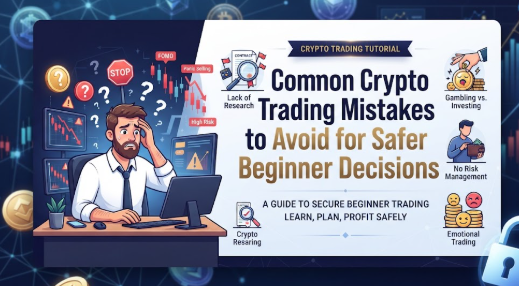
Introduction
Crypto trading can look simple when a chart is rising, a social media post shows a large profit, or a friend recommends a fast-moving coin. The difficulty appears when prices reverse, fees increase, emotions take control, or a platform becomes unreliable. Beginners often lose money not because they lack intelligence, but because they act without a clear plan, risk limits, security habits, or realistic expectations. Understanding common crypto trading mistakes to avoid can help new traders protect capital, recognize scams, manage volatility, and make calmer decisions. This guide explains practical trading habits, risk checks, wallet safety, exchange selection, position sizing, and review methods for beginners, salaried people, investors, and crypto learners.
What is Common Crypto Trading Mistakes ?
Crypto trading means buying and selling digital assets with the expectation that their market prices will change. A trader may purchase an asset at one price and try to sell it later at a higher price. Some traders also use more complex methods, including short selling, derivatives, margin, and leverage.
The process may appear straightforward, but it involves uncertainty. Crypto prices can move quickly, market liquidity can change, transaction costs can increase, and unexpected events can affect a particular asset or platform.
A crypto trading mistake is any decision, habit, or action that exposes a person to unnecessary risk. It may involve buying without research, risking too much capital, using an unreliable platform, following social media hype, or failing to secure an account.
People search for common crypto trading mistakes to avoid because many beginners enter the market without fully understanding its risks. They may know how to place an order but not how to manage that order after the price changes.
How Crypto Trading Works
A person creates an account on a crypto exchange, completes the required verification process, deposits funds, chooses a trading pair, and places an order. Depending on the platform, the person may use a market order, limit order, or stop order.
After the purchase, the trader must decide:
- How long to hold the asset
- How much loss is acceptable
- When to take profit
- Where to store the asset
- How to record the transaction
- How to manage tax and compliance responsibilities
Placing an order is only one part of trading. Risk management, security, record-keeping, emotional control, and exit planning are equally important.
Beginner-Friendly Example
Suppose a beginner has $1,000 available for investment and sees a cryptocurrency rising rapidly. Instead of risking the entire $1,000, the person may allocate only a small portion based on a written risk limit.
Before entering, the trader decides the maximum acceptable loss and identifies a possible exit point. This does not remove market risk, but it prevents one trade from controlling the person’s entire financial position.
Common Misunderstanding
A common misunderstanding is that a strong project will always produce a profitable trade. A project may have useful technology and still experience major price declines. A trader can also lose money by entering at an unsuitable price, using excessive leverage, or selling in panic.
Practical Takeaway
Crypto trading should be treated as a structured financial activity rather than a shortcut to fast income. Every trade needs a reason, risk limit, security check, and exit plan.
Why Avoiding Crypto Trading Mistakes Is Important
Avoiding preventable mistakes is important because crypto trading can affect more than a trading account. Poor decisions may damage savings, increase debt pressure, create tax complications, expose personal data, and disturb emotional well-being.
Protecting Savings
Beginners sometimes invest money reserved for rent, household expenses, education, medical needs, or emergencies. A sudden market decline can then create immediate financial pressure.
Crypto capital should generally come from money that is not needed for essential short-term responsibilities. Keeping emergency savings separate helps prevent forced selling during an unfavorable market condition.
Controlling Borrowing Risk
Using a personal loan, credit card, or borrowed funds for speculative trading increases pressure. The trader must repay the debt even when the market position loses value.
Borrowing costs can continue while the asset price falls. This combination can turn a trading loss into a longer-term debt problem.
Improving Investment Decisions
Understanding trading mistakes encourages people to evaluate assets more carefully. Instead of buying because of hype, they begin reviewing purpose, liquidity, supply structure, security concerns, project communication, and market behavior.
Research does not guarantee success, but it helps remove some avoidable uncertainty.
Managing Trading Emotions
Fear and greed can cause traders to abandon their plans. Greed may lead to oversized positions, while fear may cause panic selling after a temporary decline.
A written trading process creates a decision framework before emotions become intense.
Supporting Tax Awareness
Crypto transactions may create reporting or tax responsibilities depending on the person’s location and circumstances. Poor records can make it difficult to calculate purchase prices, proceeds, gains, losses, and fees.
Maintaining accurate transaction records can support better reporting and professional review.
Developing Long-Term Financial Discipline
The habits used in responsible crypto trading also support broader financial discipline. These habits include planning, record-keeping, risk limits, regular reviews, and separating essential money from speculative capital.
Practical Scenario
A salaried employee receives a monthly income and keeps six months of essential expenses in a separate emergency fund. The person allocates a small, predefined amount to crypto and does not use credit to increase the position. When the market becomes volatile, household finances remain protected because the trading allocation was separated from essential savings.
The Real Problem Crypto Traders Face
The biggest problem is not always a lack of information. Crypto traders often face too much information from exchanges, influencers, private groups, online communities, advertisements, videos, and anonymous accounts.
This creates several difficulties.
Lack of Basic Awareness
A person may understand that cryptocurrency can be bought and sold but may not understand wallets, custody, network fees, liquidity, private keys, token supply, or platform risk.
Without these basics, the trader may make decisions based only on price movement.
Confusing Online Advice
One source may recommend holding for years, while another suggests frequent short-term trades. Some creators promote a token without clearly explaining their relationship with the project.
Beginners may struggle to separate education, opinion, promotion, and speculation.
Emotional Decision-Making
Fast-moving prices create urgency. A trader may believe that waiting for research will cause an opportunity to disappear. This fear of missing out can encourage rushed purchases.
The same person may later sell in panic when prices decline.
Poor Planning
Many traders decide when to buy but not when to sell. They do not define the maximum acceptable loss, profit-taking method, holding period, or conditions that would invalidate the trade.
Without an exit plan, every price movement becomes an emotional decision.
Weak Comparison
A token may look attractive when viewed alone. However, the trader may not compare it with similar projects, alternative investments, cash needs, or the option of making no trade.
Sometimes the safest decision is to wait.
Unrealistic Expectations
People may expect every trade to generate a large profit. This can encourage frequent trading, leverage, concentration, and refusal to accept manageable losses.
Responsible trading recognizes that losses are possible even when research and planning are completed.
Ignoring Risk
Some beginners focus only on possible profit. They may not consider platform failure, wallet theft, phishing, liquidity problems, technical errors, or legal and tax responsibilities.
Depending on Social Media
Social media can be useful for discovering topics, but it should not be the only research source. Trending posts can be incomplete, biased, outdated, or promotional.
Not Knowing the Next Step
A trader may recognize that a trade is risky but still lack a practical decision process. A simple checklist can help the person pause, compare options, set limits, and document the decision.
How to Avoid Crypto Trading Mistakes Step by Step
Step 1: Define Your Financial Purpose
Before trading, decide why you are participating. You may want to learn about digital assets, build limited market experience, diversify a broader portfolio, or test a trading strategy. The purpose matters because it determines the appropriate time horizon and risk level. For example, a person exploring crypto should not automatically use the same position size as an experienced trader. A common mistake is entering because other people appear to be making money. A better approach is to write a clear purpose and decide how crypto fits within your broader financial plan.
Step 2: Separate Trading Money From Essential Money
Create a clear boundary between crypto capital and funds needed for rent, food, debt payments, education, medical needs, business operations, and emergencies. This matters because crypto prices can decline quickly and may not recover when you need the money. For example, a trader using next month’s rent may be forced to sell during a market decline. The common mistake is calling essential savings “temporary trading capital.” The better approach is to trade only with an amount that does not threaten necessary financial responsibilities.
Step 3: Research the Asset and Its Market
Review what the asset is designed to do, how it is used, how tokens enter circulation, where it is traded, and what major risks exist. Look beyond promotional statements and price charts. For example, a token may have a popular community but limited liquidity or unclear utility. A common mistake is assuming popularity automatically means long-term value. A better approach is to compare the project’s purpose, transparency, trading activity, security history, and risk factors before making a decision.
Step 4: Choose a Position Size
Decide how much capital you are prepared to allocate before placing the order. Position size should reflect your total trading capital, acceptable loss, market volatility, and confidence in the setup. For example, allocating a small percentage of trading capital limits the damage if the position fails. A common mistake is increasing the position because the trader feels strongly about the asset. A better approach is to use a predefined risk rule that applies even when excitement is high.
Step 5: Plan the Entry and Exit
Write down the reason for entering, preferred entry range, maximum acceptable loss, profit-taking approach, and conditions that would invalidate the trade. This matters because an unplanned trade can turn into an indefinite holding position after the price falls. For example, a short-term trader may continue holding simply to avoid accepting a loss. The common mistake is deciding the exit only after emotions appear. The better approach is to plan multiple outcomes before entering.
Step 6: Verify the Transaction Carefully
Check the asset name, network, wallet address, order type, quantity, and fees before confirming. Crypto transactions may be difficult or impossible to reverse. For example, sending an asset through an unsupported network can result in delayed or lost access to funds. A common mistake is rushing because the market is moving. A better approach is to use a verification routine and send a small test transaction when appropriate.
Step 7: Secure the Account and Wallet
Use a unique password, multi-factor authentication, verified applications, secure devices, and protected recovery information. Never share a seed phrase, private key, authentication code, or remote access to a device. A common mistake is assuming exchange security alone is sufficient. A better approach is to understand which protections are controlled by the platform and which are your personal responsibility.
Step 8: Review and Record the Trade
After closing or adjusting a position, record the reason, result, fees, emotional state, and lessons. Review whether you followed the original plan rather than judging only the profit or loss. A profitable trade can still involve poor discipline, while a controlled loss can reflect a well-managed process. The common mistake is remembering only successful trades. A better approach is to maintain a trading journal and improve one repeated weakness at a time.
Key Factors That Influence Crypto Trading Decisions
Market Volatility
Volatility refers to the speed and size of price movements. Crypto assets can experience significant changes over short periods, which can create both opportunity and risk.
Beginners should reduce position sizes when volatility is difficult to manage. A common mistake is using the same position size in calm and highly volatile markets.
Wallet Safety
Wallet safety involves protecting private keys, seed phrases, devices, passwords, and transaction details. A wallet provides access to crypto assets, but that access can be compromised through phishing, malware, false applications, or careless storage.
Recovery information should be stored privately and securely. It should never be entered into an unknown website or shared with a support representative.
Exchange Reliability
An exchange is a platform where users may buy, sell, and sometimes store digital assets. Traders should examine security practices, account protections, withdrawal processes, fee transparency, supported regions, and customer support.
Using multiple platforms without understanding their risks can make account management more difficult.
Transaction Fees
Trading costs may include exchange fees, spreads, withdrawal charges, funding costs, and network fees. Small costs can become meaningful when a person trades frequently.
A trader should calculate the approximate total cost before entering and exiting a position.
Scam Awareness
Crypto scams may appear as fake giveaways, impersonation accounts, investment schemes, false support messages, phishing websites, manipulated tokens, or promises of fixed returns.
Pressure, secrecy, urgency, and guaranteed profit language are major warning signs.
Private Key and Seed Phrase Safety
A private key or seed phrase can provide control over funds. Anyone who obtains it may be able to move the assets.
Legitimate support teams should not require your seed phrase. Sharing it can result in permanent loss of control.
Platform Risk
A platform may experience technical problems, withdrawal restrictions, cybersecurity incidents, operational failure, or legal limitations. Keeping all assets on one platform increases concentration risk.
Traders should consider what would happen if access became temporarily or permanently unavailable.
Long-Term Risk Understanding
Holding an asset for a long time does not automatically make it safe. Technology, competition, project activity, regulations, market demand, and security conditions can change.
Long-term positions still require periodic review.
Detailed Breakdown of Common Crypto Trading Mistakes
Treating Crypto as Guaranteed Income
Crypto is often presented through stories of rapid gains, but price appreciation is not guaranteed. A trader may experience losses, long periods of poor performance, or complete failure of an individual asset.
Treating crypto as a salary replacement can create pressure to trade even when no suitable opportunity exists. The better approach is to consider trading income uncertain and protect regular financial responsibilities separately.
Buying Only Because the Price Is Rising
A rising price can attract attention, but it does not explain whether the asset is suitable or reasonably valued. Buying after a rapid increase may expose the trader to a sharp reversal.
Momentum can be part of a strategy, but it needs risk controls. Entering only because of excitement is not a complete strategy.
Using Excessive Leverage
Leverage allows a trader to control a larger position with a smaller amount of capital. It can increase gains, but it also increases losses and liquidation risk.
Beginners may underestimate how small price movements can affect a leveraged position. A safer approach is to avoid leverage until its mechanics, costs, and risks are fully understood.
Trading Without a Stop or Invalidation Point
A stop or invalidation point identifies when the original trade idea is no longer acceptable. Without one, a manageable loss can grow while the trader waits for a recovery.
A stop does not guarantee execution at an exact price, especially during fast markets. However, planning a loss limit is still better than having no limit.
Averaging Down Without a Plan
Averaging down means purchasing more after the price declines. It reduces the average entry price but also increases the amount exposed to the same asset.
This may be reasonable only when it is part of a predefined strategy and the original reasons remain valid. Repeatedly buying to avoid admitting a mistake can create dangerous concentration.
Ignoring Liquidity
Liquidity describes how easily an asset can be bought or sold without causing a large price change. Low-liquidity assets may show attractive prices but become difficult to exit.
A trader should review trading activity, spreads, market depth, and available trading pairs.
Confusing Investing With Trading
Investing usually involves a longer time horizon and a thesis about long-term value. Trading focuses more on price movement, timing, and defined risk.
Problems arise when a failed trade is renamed a long-term investment simply because the trader does not want to sell.
Holding Too Many Unrelated Tokens
Owning many tokens does not automatically provide meaningful diversification. Several crypto assets may react similarly during broad market declines.
Diversification should consider different risk drivers, not just the number of holdings.
Failing to Take Partial Profits
Some traders refuse to sell because they expect the price to continue rising. The position may later return to the entry price or become a loss.
A structured profit-taking method can reduce emotional pressure without requiring the trader to sell the entire position at once.
Leaving Assets Unprotected
Keeping funds on an exchange may be convenient, but it creates platform exposure. Moving assets to a personal wallet introduces different responsibilities, including private-key protection.
The best custody choice depends on experience, access needs, amount, and ability to secure recovery information. No storage method is completely risk-free.
Ignoring Tax and Record-Keeping
Frequent trades, transfers, rewards, fees, and conversions can create complicated records. Waiting until a filing deadline may make accurate reporting difficult.
A trader should maintain transaction histories and consult a qualified tax professional when needed.
Copying Another Trader’s Strategy
A strategy may depend on a person’s capital, experience, time availability, risk tolerance, tools, and emotional discipline. Copying the visible trade without understanding these factors can produce different results.
Learn the logic behind a method before applying it.
Common Mistakes Beginners Make in Crypto Trading
1. Following Random Advice
This happens because online recommendations are easy to access and may sound confident. The risk is that the person giving the advice may have different goals, may already own the asset, or may be promoting it.
Instead, use online posts as starting points for independent research rather than final instructions.
2. Ignoring Risk Before Expected Profit
Beginners often calculate how much they could earn but not how much they could lose. This creates oversized positions and weak exit planning.
Start every decision with downside questions: What could go wrong? How much could be lost? Can the position be exited?
3. Failing to Compare Platforms
A platform may have a simple interface but unsuitable fees, limited withdrawals, weak account protection, or poor support.
Compare security controls, cost structure, withdrawal rules, supported networks, and availability before depositing funds.
4. Trusting Guaranteed-Profit Claims
No legitimate trading opportunity can remove market uncertainty. Guaranteed returns, fixed daily profits, and pressure to recruit other users are serious warning signs.
Do not send funds merely because a person displays screenshots or testimonials.
5. Making Emotional Decisions
Fear, greed, frustration, and excitement can change a trading plan. A trader may chase a rising market, sell after a sudden decline, or increase risk after a loss.
Use written rules and take a pause when emotions become intense.
6. Using Emergency Money
Emergency funds exist for unexpected essential expenses. Crypto prices may decline when the money is needed.
Keep speculative capital separate from household and emergency funds.
7. Ignoring Fees and Spreads
A trader may make several small profitable trades but still have a poor net result after fees and spreads.
Calculate the full cost of entry, exit, funding, withdrawal, and network use.
8. Not Reading Terms and Conditions
Platforms may have withdrawal limits, regional restrictions, identity requirements, asset-specific rules, or account review processes.
Understand the relevant terms before depositing a large amount.
9. Sharing Sensitive Information
Scammers may pretend to be exchange employees, wallet support teams, project administrators, or recovery specialists.
Never share private keys, seed phrases, passwords, authentication codes, or remote device access.
10. Ignoring Legal and Tax Responsibilities
A person may assume crypto activity is outside normal reporting requirements. However, responsibilities can vary by jurisdiction and transaction type.
Keep records and obtain professional advice based on your circumstances.
11. Depending Only on Social Media
Social media algorithms often prioritize engaging content rather than balanced risk analysis. Viral popularity is not evidence of safety or long-term value.
Review multiple independent sources and project-level information.
12. Revenge Trading
Revenge trading happens when a person immediately takes another position to recover a loss. The next trade is often larger, faster, and less researched.
Accept the loss, stop trading temporarily, and review the original decision before taking another position.
Don’t Do This Checklist
- Do not invest essential household money.
- Do not borrow money to chase a market trend.
- Do not buy only because a token is trending.
- Do not share your seed phrase or private key.
- Do not trust guaranteed-return claims.
- Do not increase risk to recover a previous loss.
- Do not use leverage without understanding liquidation.
- Do not send large transfers without verification.
- Do not ignore fees, spreads, or withdrawal costs.
- Do not keep trading when fear or anger controls decisions.
- Do not confuse a failed trade with a planned investment.
- Do not ignore transaction records and tax responsibilities.
Practical Real-Life Examples of Crypto Trading Mistakes
Example 1: A Salaried Employee Uses Essential Savings
Situation: A salaried employee uses money reserved for household bills to purchase a fast-rising cryptocurrency.
Mistake or challenge: The price declines before the next salary date, forcing the employee to sell at a loss.
Better action: Keep household money separate and use only a limited speculative allocation.
Learning: Trading should not threaten essential monthly responsibilities.
Example 2: A Beginner Follows an Influencer’s Tip
Situation: A beginner buys a token after seeing repeated social media posts predicting a major price increase.
Mistake or challenge: The trader does not research liquidity, token supply, or the promoter’s possible interest.
Better action: Treat the post as an idea for research and independently evaluate the asset.
Learning: Confidence and popularity do not replace evidence.
Example 3: A Trader Uses Excessive Leverage
Situation: A new trader uses a leveraged position because the expected profit appears much larger.
Mistake or challenge: A relatively small adverse price movement causes a major loss.
Better action: Avoid leverage until the mechanics, funding costs, and liquidation risks are fully understood.
Learning: Larger exposure increases both opportunity and danger.
Example 4: A Small Business Owner Mixes Business Funds With Crypto
Situation: A business owner temporarily uses money reserved for supplier payments to trade crypto.
Mistake or challenge: The position loses value when the supplier payment becomes due.
Better action: Separate business operating funds from speculative investments.
Learning: Cash-flow responsibilities should take priority over uncertain market opportunities.
Example 5: A Crypto Learner Responds to Fake Support
Situation: A user receives a private message from someone claiming to provide wallet support.
Mistake or challenge: The person is asked to enter a seed phrase on a recovery website.
Better action: Stop communication, use verified support channels, and never disclose recovery information.
Learning: Legitimate support should not require control of a user’s wallet.
Table 1: Crypto Trading Mistake Versus Better Approach
| Common mistake | Why it is risky | Better approach |
|---|---|---|
| Buying because a token is trending | The price may already reflect excessive excitement | Research the asset and define an entry limit |
| Risking most available capital | One loss can damage the entire account | Use controlled position sizing |
| Trading with emergency funds | Money may be needed during a market decline | Separate essential and speculative funds |
| Using high leverage | Small movements can create large losses | Avoid leverage or use only after proper education |
| Following anonymous tips | Motives and evidence may be unclear | Verify information independently |
| Trading without an exit plan | Losses may grow because decisions are delayed | Set invalidation and profit-taking rules |
| Ignoring account security | Funds and personal data may be exposed | Use strong authentication and secure devices |
| Forgetting fees | Frequent costs can reduce the final result | Calculate total trading and transfer costs |
| Sharing recovery information | Another person may gain wallet control | Keep private keys and seed phrases private |
| Revenge trading | Emotional pressure weakens judgment | Pause, review, and return with a plan |
Table 2: Pre-Trade Crypto Risk Review
| Check | Questions to ask | Safer action |
|---|---|---|
| Financial readiness | Is this money needed for essential expenses? | Do not trade with essential money |
| Asset understanding | Do I understand the asset’s purpose and risks? | Research before placing an order |
| Position size | How much can I afford to lose? | Use a predefined allocation |
| Entry reason | Why am I entering at this price? | Write a clear trading thesis |
| Exit plan | When will I reduce or close the position? | Set rules before entering |
| Liquidity | Can the asset be sold without major difficulty? | Review market activity and spreads |
| Platform safety | Is the exchange suitable and secure? | Compare security, fees, and withdrawals |
| Transaction details | Are the network and address correct? | Verify carefully and consider a test transfer |
| Emotional condition | Am I acting from fear, greed, or pressure? | Pause until the decision is calm |
| Records | Can I document the transaction accurately? | Save order, fee, and transfer details |
Tools, Methods, and Frameworks Readers Can Use
Trading Journal
A trading journal records the reason for each trade, position size, entry, exit, fees, result, emotions, and lessons. It helps traders identify repeated habits that are difficult to notice from memory.
Beginners can use a notebook or spreadsheet. The purpose is not to create a complicated reporting system but to make decisions visible and reviewable.
A journal helps avoid repeated emotional trades and selective memory.
Position-Sizing Method
Position sizing determines how much capital is allocated to a trade. A simple method starts with the maximum amount the trader is prepared to lose and works backward from the planned exit point.
This prevents confidence or excitement from deciding the size of the trade.
Wallet Safety Checklist
A wallet safety checklist includes verifying applications, protecting recovery information, using secure devices, checking addresses, and avoiding unknown links.
Reviewing the checklist before transfers can reduce rushed security errors.
Exchange Comparison Checklist
This method compares platforms according to account security, fee transparency, withdrawal rules, supported assets, liquidity, customer support, and regional availability.
It helps beginners avoid choosing an exchange based only on advertisements or interface design.
Transaction Verification Habit
Before confirming a transfer, review the asset, network, destination address, quantity, and fees. For an unfamiliar destination, a small test transaction may help confirm compatibility.
This habit reduces errors caused by copying the wrong address or selecting an unsupported network.
Scam Warning Checklist
A scam checklist looks for guaranteed returns, urgent payment requests, impersonation, secrecy, unrealistic rewards, seed-phrase requests, and unknown websites.
The checklist creates a pause before money or information is shared.
Pre-Trade Decision Framework
Use the following sequence:
- Understand the asset.
- Identify the reason for entering.
- Estimate potential downside.
- Select the position size.
- Plan the exit.
- Verify platform and transaction security.
- Record the decision.
- Review the result later.
This framework helps turn trading from an impulsive activity into a controlled process.
Monthly Crypto Review
A monthly review examines open positions, concentration, platform exposure, wallet security, fees, records, and progress toward financial goals.
It also helps traders decide whether crypto exposure has grown beyond the original limit.
Expert Tips to Make Better Crypto Decisions
1. Learn the Process Before Risking Capital
Understanding orders, wallets, networks, fees, and security matters more than finding a popular token. Beginners can start by observing markets and testing processes with very small amounts.
This reduces the chance of losing money through operational errors.
2. Start With a Small Allocation
A small allocation provides practical experience without making every price movement financially stressful. It also gives the trader time to understand personal emotional reactions.
Increase exposure only after demonstrating consistent discipline.
3. Check Risk Before Expected Return
Before estimating possible profit, identify the maximum loss, platform risk, liquidity concerns, and conditions that could invalidate the trade.
This changes the decision from “How much can I make?” to “Is this risk acceptable?”
4. Keep Emergency Funds Separate
Emergency savings should remain available for essential needs. A trading position may decline or become difficult to exit at the wrong time.
Use a separate account or written allocation to create a clear boundary.
5. Avoid Trading Under Pressure
Do not trade because friends, online groups, or countdown messages suggest immediate action. Genuine financial decisions should allow time for verification.
Urgency is especially dangerous when money must be transferred to an unfamiliar platform or wallet.
6. Compare More Than One Exchange
Different exchanges may have different fees, spreads, security protections, withdrawal processes, and asset availability.
Comparing multiple options can reveal limitations that are not visible from promotional material.
7. Use Written Entry and Exit Rules
A written plan reduces the temptation to change decisions after prices move. Record the entry reason, acceptable loss, profit-taking method, and review date.
The plan should be created before the trade, not after a loss develops.
8. Reduce Trading Frequency
More trades create more opportunities for fees, emotional decisions, and execution mistakes. Frequent activity is not automatically productive activity.
Trade only when the setup meets your predefined conditions.
9. Protect Personal Information
Use unique passwords, multi-factor authentication, verified devices, and private recovery storage. Be suspicious of support messages sent through private social media accounts.
Security should be treated as part of trading performance.
10. Verify Every Transfer
Crypto transfers can be difficult to reverse. Check the network, address, asset, amount, and fees before confirming.
A few extra seconds of verification can prevent a serious operational mistake.
11. Do Not Blindly Copy Other Traders
Another trader may have more capital, a different risk limit, faster information, hedging positions, or a completely different exit strategy.
Study the reasoning behind a trade rather than copying the visible entry.
12. Review Mistakes Without Hiding Them
A losing trade should be reviewed honestly. Identify whether the loss came from normal market uncertainty or a failure to follow the process.
The purpose is improvement, not self-punishment.
13. Consider Tax and Compliance Early
Do not wait until a filing deadline to organize records. Save transaction histories, fees, transfers, and conversion details as you trade.
Consult a qualified professional when rules or calculations are unclear.
14. Avoid Increasing Risk After a Loss
A loss can create an urge to recover money immediately. This often produces larger positions and weaker analysis.
Take a planned break and return only when emotional pressure has reduced.
15. Accept That No Trade Is Mandatory
Missing a price movement is not the same as losing money. There will always be uncertainty and additional market opportunities.
Waiting is a valid decision when the risk cannot be understood or controlled.
Case Studies: How Better Understanding Changes Decisions
Case Study 1: The Salaried Beginner Chasing a Trending Token
Profile: Rahul is a salaried employee who recently started learning about cryptocurrency.
Situation: He notices a token rising rapidly and sees several social media accounts predicting further gains.
Problem: Rahul feels that delaying the purchase will cause him to miss an important opportunity.
Wrong approach: He considers using most of the money saved for monthly household expenses.
Better approach: Rahul pauses and reviews his finances. He keeps essential money separate, researches the token, checks liquidity, and limits the position to a small educational allocation.
Result or learning: The token later becomes highly volatile, but Rahul’s household finances remain unaffected. He learns that protecting financial stability is more important than chasing a single opportunity.
Key takeaway: A small, planned position can provide experience without putting essential responsibilities at risk.
Case Study 2: The Trader Using Leverage After a Loss
Profile: Meera has several months of spot-trading experience and begins experimenting with leveraged products.
Situation: After one losing trade, she wants to recover the amount quickly.
Problem: Frustration causes her to increase leverage and enter without completing her normal research.
Wrong approach: She focuses on the potential profit while ignoring liquidation risk and emotional pressure.
Better approach: Meera closes the trading application, records the original mistake, and pauses for two days. She later creates a rule that prohibits increasing position size after a loss.
Result or learning: The pause prevents an emotional trade. She realizes that controlling behavior is more important than recovering one loss immediately.
Key takeaway: Revenge trading can transform a manageable loss into a serious financial problem.
Case Study 3: The Crypto User Contacted by Fake Support
Profile: Daniel is transferring cryptocurrency from an exchange to a personal wallet for the first time.
Situation: After asking a question in an online group, he receives a private message from an account claiming to be official support.
Problem: The account directs him to a website that asks for his seed phrase.
Wrong approach: Daniel initially believes the request may be necessary to connect or verify the wallet.
Better approach: He stops, checks the official support information, and confirms that recovery phrases should never be shared. He blocks the account and changes passwords associated with the exposed email.
Result or learning: No funds are lost, and Daniel creates a wallet security checklist for future transactions.
Key takeaway: Anyone requesting a seed phrase should be treated as a serious security threat.
Risk Awareness: What Readers Must Check First
Market Risk
Market risk is the possibility that an asset’s price will decline because of changing demand, broad market conditions, project developments, or investor behavior.
Reduce this risk through limited position sizes, diversification, planned exits, and realistic expectations. It cannot be eliminated completely.
Volatility Risk
Volatility risk comes from fast and significant price movements. A position that appears manageable can change quickly.
Use smaller allocations, avoid excessive leverage, and do not rely on exact exit prices during rapidly moving conditions.
Liquidity Risk
Liquidity risk is the possibility that an asset cannot be sold easily at the expected price. This is especially relevant for smaller or lightly traded tokens.
Review trading activity, spreads, order-book depth, and available markets before entering.
Platform Risk
Platform risk includes technical failures, account restrictions, cybersecurity incidents, operational problems, and withdrawal limitations.
Compare platforms carefully and avoid unnecessary concentration on one service.
Fraud Risk
Fraud may involve fake projects, impersonation, phishing, false investment managers, manipulated tokens, or guaranteed-profit schemes.
Verify identities and websites, avoid rushed transfers, and never disclose private recovery information.
Cybersecurity Risk
Cybersecurity risk includes malware, password theft, SIM-related attacks, compromised devices, fake applications, and account takeover.
Use strong passwords, multi-factor authentication, updated devices, and trusted applications.
Custody Risk
Custody risk concerns how and where assets are stored. Exchange custody creates platform dependency, while personal custody creates responsibility for private keys and recovery information.
Choose a method that matches your knowledge and ability to secure access.
Emotional Risk
Emotional risk appears when fear, greed, frustration, confidence, or social pressure controls decisions.
Written trading rules, smaller positions, breaks, and journals can help reduce emotional behavior.
Misinformation Risk
Crypto information can spread rapidly without verification. Predictions may be presented as facts, and sponsored content may not always be obvious.
Use several sources and separate evidence from opinion.
Legal and Compliance Risk
Crypto-related rules, restrictions, reporting duties, and platform availability may differ by location and may change.
Verify applicable requirements and seek qualified legal or tax advice where necessary.
Tax-Related Risk
Poor records can make it difficult to calculate gains, losses, fees, transfers, and taxable events.
Maintain complete records throughout the year rather than reconstructing them later.
Concentration Risk
Concentration risk occurs when too much capital is placed in one asset, one category, one wallet, or one platform.
Set exposure limits and review them regularly.
Checklist Before Taking Crypto Trading Action
- I understand what the asset is and why it exists.
- I have reviewed the major risks and possible downside.
- I am not using emergency or household money.
- I am not borrowing money for this trade.
- I have compared relevant platforms and costs.
- I understand the trading pair and order type.
- I have checked liquidity and spread conditions.
- I have selected an appropriate position size.
- I have written my reason for entering.
- I have defined an invalidation or loss limit.
- I have considered how and when to take profit.
- I understand the platform’s withdrawal process.
- I have verified the asset, network, and wallet address.
- I am using a secure password and multi-factor authentication.
- I have not shared my seed phrase or private key.
- I have checked for scam warning signs.
- I am not acting from fear, greed, anger, or pressure.
- I have considered fees and network costs.
- I can maintain accurate transaction records.
- I have considered tax, legal, and compliance responsibilities.
- I understand that profit is not guaranteed.
- I am prepared to accept the planned loss.
- I have considered making no trade.
- I will review the decision afterward.
Use this checklist immediately before placing an order or transferring funds. A checklist is most useful when it can stop an unsuitable decision, not when it is completed after the trade. Any answer that feels uncertain should be investigated before proceeding.
Strategic Insights for Better Crypto Decision-Making
Position Sizing
Position sizing is one of the most important forms of crypto risk management. It determines how much damage one unsuccessful trade can cause.
Beginners often choose size based on confidence. A more disciplined approach is to choose size according to predefined risk limits and market volatility.
Portfolio Allocation
Crypto should be considered within the context of the person’s complete financial position. A trader may own several crypto assets but still have excessive overall exposure to one high-risk market category.
Review crypto alongside cash needs, emergency savings, debt, and other investments.
Wallet Custody
Custody is a strategic decision rather than a purely technical one. Exchange storage may support convenient trading, while personal wallets may provide greater control but require careful security.
The correct choice depends on access needs, experience, amount, and security discipline.
Exchange Concentration
Using only one exchange can simplify trading, but it also creates dependence on one platform. Using too many platforms can create record-keeping and security problems.
Choose a manageable number of platforms and understand why each one is being used.
Transaction Confirmation
Crypto transactions involve technical details that may differ by asset and network. Confirmations, tags, memo fields, supported networks, and fees can affect successful transfers.
Read the receiving platform’s instructions before sending funds.
Scam Pattern Recognition
Many scams use similar patterns:
- Guaranteed or fixed returns
- Urgent payment requests
- Impersonation of support staff
- Requests for seed phrases
- Unknown wallet-verification websites
- Pressure to recruit others
- Claims that withdrawals require additional deposits
- Promises to recover previously lost crypto
Recognizing the pattern can be more useful than memorizing individual scam names.
Network Fee Awareness
Network fees can change with demand and may make small transfers uneconomical. A trader should consider whether the transfer is necessary and whether the selected network is supported at both ends.
Never choose a network only because it appears cheaper without checking compatibility.
Avoiding Herd Mentality
Herd mentality occurs when people follow a crowd because collective behavior appears safer or more informed. In reality, a large group can still act emotionally.
Independent research and predefined entry conditions can reduce this influence.
Trading Discipline
Discipline means following the process even when emotions encourage a different action. It includes respecting position limits, accepting losses, avoiding revenge trades, and waiting when no suitable opportunity exists.
Consistency is more valuable than occasional excitement.
Review and Adaptation
A trading strategy should be reviewed based on recorded decisions. The goal is not to change the strategy after every loss, but to identify patterns over several trades.
Change one variable at a time so that improvements can be evaluated clearly.
Key Terms Explained for Beginners
- Cryptocurrency: A digital asset that uses cryptographic and distributed-ledger technologies. Different cryptocurrencies may have different purposes, risks, and structures.
- Blockchain: A shared record system in which transactions or data are organized into connected blocks. Not every blockchain works in the same way.
- Crypto Exchange: A platform that allows users to buy, sell, or trade cryptocurrencies. Exchanges can differ in fees, security, liquidity, and regional availability.
- Wallet: A tool used to manage the keys that provide access to crypto assets. Wallets may be software-based, hardware-based, custodial, or non-custodial.
- Private Key: Secret information that can authorize transactions. Anyone with access to a private key may be able to control the associated funds.
- Seed Phrase: A set of recovery words used to restore access to certain wallets. It must be kept private and secure.
- Volatility: The speed and size of price changes. High volatility can create both trading opportunities and significant losses.
- Liquidity: The ease with which an asset can be bought or sold without causing a large price change.
- Market Order: An instruction to buy or sell immediately at the best available market price. The final execution price may differ during fast markets.
- Limit Order: An instruction to buy or sell only at a specified price or better. Execution is not guaranteed.
- Spread: The difference between the available buying and selling prices. A wider spread can increase the effective cost of a trade.
- Leverage: The use of borrowed exposure to control a larger position. It can increase gains, losses, and liquidation risk.
- Liquidation: The forced closing of a leveraged position when the account can no longer support the required margin.
- Position Size: The amount of capital allocated to a particular trade. Position size should be connected to risk tolerance and loss limits.
- Stop-Loss: An order or planned exit intended to limit a loss. Execution at an exact price may not be guaranteed during extreme volatility.
Who Should Read This Blog
Beginners
Beginners can use this guide to understand the difference between placing a trade and managing a complete trading decision.
Students
Students interested in blockchain and digital assets can learn practical risk, security, and financial-discipline principles before committing money.
Salaried Employees
Salaried people can understand why essential monthly income and emergency savings should remain separate from speculative capital.
Small Business Owners
Business owners can learn why operating cash, supplier payments, payroll money, and tax reserves should not be exposed to crypto volatility.
New Investors
New investors can understand asset research, diversification, custody, and long-term risk.
Active Traders
Traders can use the checklists, position-sizing principles, emotional controls, and review methods to improve discipline.
Loan Seekers
Loan seekers can understand why borrowed money should not be used casually for speculative crypto activity.
Crypto Learners
Crypto learners can build knowledge about exchanges, wallets, private keys, networks, scams, and fees.
Casino Content Creators
Casino content creators who also discuss crypto payments can use the risk-aware principles to avoid misleading claims and promote responsible financial awareness.
Finance Bloggers
Finance bloggers can use the educational framework to explain crypto risks clearly without presenting uncertain outcomes as guaranteed.
People Improving Money Awareness
Anyone developing stronger financial habits can benefit from planning, record-keeping, risk limits, and emotional control.
People Trying to Avoid Financial Mistakes
Readers who have experienced a loss can use the guide to identify whether the problem came from normal market risk, poor planning, weak security, or emotional behavior.
Frequently Asked Questions
1. What are the most common crypto trading mistakes to avoid?
The most common mistakes include chasing rising prices, risking essential savings, using excessive leverage, following anonymous tips, and trading without an exit plan. Weak account security and poor record-keeping can also create serious problems. Beginners should focus on process, protection, and controlled position sizes.
2. Why are common crypto trading mistakes dangerous for beginners?
Beginners may not yet understand market volatility, liquidity, wallet security, or platform risk. A single rushed decision can expose a large part of their savings. Learning common crypto trading mistakes to avoid helps beginners recognize risks before money is committed.
3. How much money should a beginner use for crypto trading?
There is no universal amount suitable for everyone. The allocation should not interfere with rent, bills, debt payments, emergency savings, or essential goals. Many beginners benefit from starting with a small educational amount they can afford to lose.
4. Is crypto trading a reliable source of monthly income?
Crypto trading does not provide guaranteed or fixed income. Results can vary, and losses are possible even with research and planning. People should not depend on uncertain trading profits to meet essential monthly expenses.
5. Is it safe to follow crypto influencers?
Influencers may provide useful ideas, but their content should not be treated as personalized financial advice. They may have different goals, risk levels, or financial interests. Verify every important claim independently before acting.
6. What is the biggest emotional crypto trading mistake?
One of the biggest emotional mistakes is chasing a rising asset because of fear of missing out. Revenge trading after a loss is also dangerous. A written plan and temporary pause can help prevent emotional decisions.
7. Should beginners use leverage in crypto trading?
Leverage can increase both gains and losses and may cause rapid liquidation. Beginners should avoid it until they fully understand margin, funding costs, liquidation levels, and position sizing. Spot trading can provide a simpler learning environment.
8. How can I identify a crypto scam?
Warning signs include guaranteed returns, urgent payment demands, unknown websites, private support messages, recruitment pressure, and requests for a seed phrase. Stop immediately when someone asks for private wallet information or promises risk-free profits.
9. Should I keep crypto on an exchange or in a wallet?
Both choices involve different risks. Exchange custody depends on the platform, while personal custody requires secure management of private keys and recovery information. The appropriate choice depends on experience, access needs, and security ability.
10. How often should I review my crypto trades?
Review each completed trade and conduct a broader portfolio review regularly. Check position size, concentration, fees, platform exposure, security, and whether the original reasons remain valid. Reviews should focus on decision quality, not only profit or loss.
11. Do crypto traders need to maintain transaction records?
Yes, accurate records help track performance, fees, transfers, purchase prices, and sale proceeds. They may also support tax or compliance reporting. Requirements vary, so professional advice may be necessary.
12. What is the best next step after learning common crypto trading mistakes to avoid?
Create a simple trading plan, security checklist, and risk limit before placing another order. Review your financial position and separate essential money from speculative capital. Begin with education and small, controlled decisions rather than chasing immediate returns.
Conclusion
Understanding common crypto trading mistakes to avoid is not about removing every possible loss, predicting every market movement, or finding a perfect strategy. Crypto trading always involves uncertainty, and even a well-researched decision can produce an unfavorable result. The practical goal is to remove unnecessary risks that come from poor planning, oversized positions, emotional behavior, weak security, unreliable information, and unrealistic expectations. Beginners should remember that buying an asset is only one part of the trading process. Responsible participation also requires position sizing, platform comparison, wallet protection, transaction verification, fee awareness, accurate records, and a clear exit plan. Before taking action, separate trading capital from rent, bills, emergency savings, business funds, education expenses, and debt repayments. Do not use borrowed money merely because an online source predicts a large price increase. Treat guaranteed returns, fixed-profit claims, urgent transfers, seed-phrase requests, and private support messages as serious warning signs. A written plan can help you decide why you are entering, how much you are prepared to lose, when the original idea becomes invalid, and how profits may be taken. A trading journal can then show whether you followed that plan and which behaviors need improvement.