Managing modern computer systems is hard work. In the past, companies ran a few servers in a local office room. A single computer engineer could watch the blinking lights, check the logs, and fix problems before users even noticed.
Today, things are completely different. Modern applications live in the cloud. They are built using thousands of small pieces called microservices. They scale up and down automatically based on user traffic.
Because of this scale, IT systems generate a massive flood of operational data every single second. Computers create millions of lines of logs, performance metrics, system traces, and warning events.
Human eyes cannot look at all of that data fast enough. When an outage happens, engineers drown in alert noise. They spend hours searching through dashboards just to find the needle in the haystack.
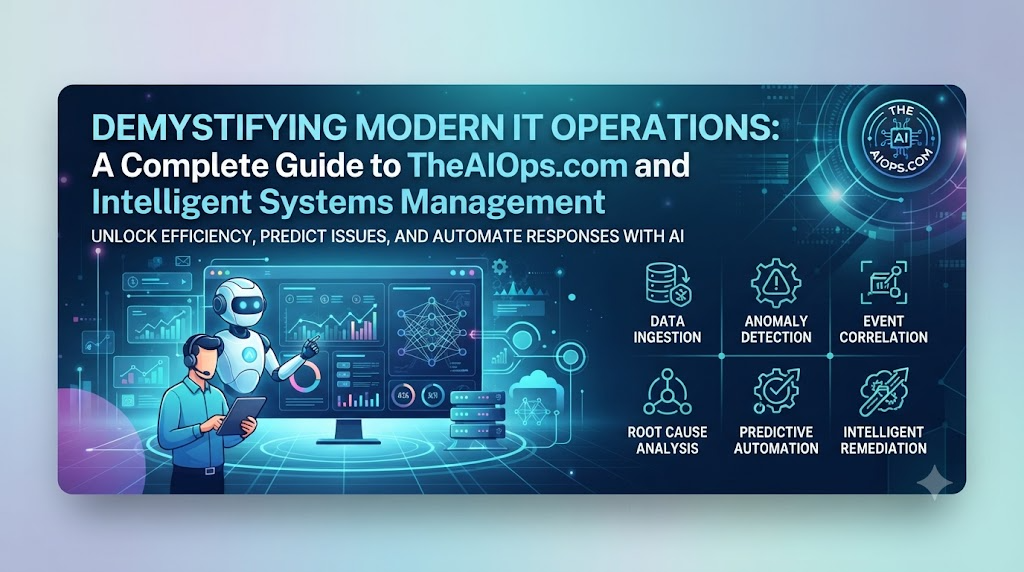
This is why the IT industry shifted toward Artificial Intelligence for IT Operations. To understand how this transition works, many professionals and organizations turn to TheAIOps.com, a specialized platform focused on intelligent monitoring, automation, and modern system management.
What Is TheAIOps.com?
TheAIOps.com is a dedicated learning, consulting, and knowledge hub built around Artificial Intelligence for IT Operations. It exists to help individuals and companies bridge the gap between traditional manual monitoring and modern automated problem-solving.
Rather than just talking about artificial intelligence in theory, the platform focuses on practical application. It looks at how machine learning, big data analysis, and modern observability tools can work together to keep digital services running smoothly.
Whether an engineer is trying to learn new skills or an organization is planning a major system upgrade, the platform provides educational pathways and structured guidance. It covers everything from fundamental monitoring concepts to advanced automated incident remediation.
Understanding Artificial Intelligence for IT Operations
To understand what Artificial Intelligence for IT Operations means, let us break the terms down into plain English.
- IT Operations: The daily work of keeping computer networks, servers, databases, and software applications running securely and reliably.
- Operational Data: The digital footprint left by these systems, including logs, metrics, traces, and events.
- Artificial Intelligence: Computer systems designed to mimic human reasoning, spot patterns, and make decisions.
When you combine these ideas, you get a system that can watch over your infrastructure just like a human engineer would—only much faster and across millions of data points at once.
A Practical Example
Imagine an online shopping website during a major holiday sale. Millions of users are browsing items at the same time. Suddenly, the payment page slows down.
In a traditional setup, fifty different monitoring tools will send fifty different alert emails to the on-call engineer’s phone. The engineer has to wake up, log in, and try to connect the dots between a database spike, a memory leak, and a network timeout.
With intelligent operations, the platform takes all those incoming data signals, instantly correlates them, filters out the noise, points directly to the root cause, and can even trigger an automated fix before the team has to manually intervene.
AIOps Training
Learning how to manage intelligent systems requires a solid educational foundation. AIOps Training is designed to help engineers move past basic server monitoring and learn how to work with data-driven operations.
Good training programs usually cover several core areas:
- Fundamentals: Understanding what operational data looks like and how machine learning models process it.
- Monitoring and Observability: Learning the difference between simply watching if a server is up and truly understanding how internal software components behave.
- Event Management: Learning how to capture and classify incoming alerts.
- Anomaly Detection: Studying how algorithms learn normal system behavior so they can spot unusual spikes or drops.
- Root-Cause Analysis: Practicing how to trace an error backward from the user interface down to the failing line of code or hardware component.
- Automation: Learning how to write scripts and workflows that fix known issues automatically.
The goal of this training is not to turn every engineer into a data scientist, but to help operations teams use smart tools effectively in daily work.
AIOps Certification
As technologies grow more complex, organizations want a reliable way to verify that their engineering teams possess real operational skills. This is where AIOps Certification comes into play.
A structured certification exam helps professionals organize their knowledge. It proves that a candidate understands architecture, data pipelines, alert management, and automation strategies.
However, a certificate is only as good as the practical experience behind it. Real operational skill comes from hands-on practice, troubleshooting live environments, and learning from past system outages. Certification acts as a roadmap for study and a professional credential, but it should always be paired with real-world exposure.
AIOps Course
A comprehensive AIOps Course provides a step-by-step path for learners who want to master intelligent infrastructure management. A well-designed curriculum typically follows a logical flow:
- Foundations of IT Operations: Reviewing traditional monitoring and why it struggles with modern scale.
- Data Collection: Learning how logs, metrics, and traces are generated and gathered.
- Observability vs. Monitoring: Understanding deep system visibility.
- Introduction to Machine Learning: Exploring how algorithms analyze patterns without human bias.
- Anomaly and Outlier Detection: Studying how models catch unexpected system behavior.
- Event Correlation: Grouping related alerts to stop alert fatigue.
- Root-Cause and Predictive Analysis: Moving from reactive fixing to proactive prevention.
- Automated Remediation: Building safe, controlled automated responses.
- Implementation Strategies: Planning how to introduce intelligent tools into a live business environment.
- Operational Challenges: Reviewing data quality issues, false positives, and maintenance requirements.
Each stage builds directly on the previous one, giving learners a complete picture of modern system operations.
AIOps Tools
You cannot manage complex cloud environments using basic command-line ping tools alone. AIOps Tools represent the specialized software categories that make modern monitoring and analysis possible.
Instead of looking at isolated software brands, it helps to understand tools by their operational purpose:
- Monitoring and Observability Tools: Software like Prometheus, Datadog, or OpenTelemetry that collect raw performance metrics and system logs.
- Log Management Tools: Systems that ingest and index gigabytes of text logs so engineers can search through them quickly during an incident.
- Incident Management Tools: Platforms that track alerts, assign tickets to on-call staff, and manage escalation paths.
- Analytics and Automation Engines: Specialized systems that run machine learning models over operational data to trigger automated fixes.
Tool Value in Practice
Tool Category: Log Management
Purpose: Collects, indexes, and stores text logs from every microservice in an application.
Example Use: Searching across fifty application containers to find the exact timestamp a database connection dropped.
Operational Value: Cuts down investigation time from hours to minutes.
AIOps Platform
An AIOps Platform acts as the central brain for an organization’s IT data. It brings together disparate monitoring systems and processes everything through a continuous data pipeline.
The platform workflow typically follows a clear path:
$$\text{Data Collection} \rightarrow \text{Processing} \rightarrow \text{Analysis} \rightarrow \text{Correlation} \rightarrow \text{Detection} \rightarrow \text{Prediction} \rightarrow \text{Action}$$
How the Components Work
- Data Collection: The platform ingests logs, metrics, traces, and events from all connected cloud services, servers, and networks.
- Processing and Filtering: It cleans the incoming stream, throwing away duplicate messages and routine system chatter.
- Machine Learning Analysis: Algorithms analyze historical baselines to understand what “normal” looks like for every hour of the day.
- Correlation: When hundreds of alerts fire at once during an outage, the platform groups them into a single, cohesive incident ticket.
- Prediction and Action: Based on past patterns, the platform can warn engineers that a storage disk is about to fill up, or automatically restart a failing background service before users experience downtime.
Platform capabilities vary widely. Some tools focus strictly on alert noise reduction, while others offer deep predictive analytics and full workflow automation.
AIOps Implementation
Moving from traditional monitoring to an intelligent platform is an engineering project in its own right. AIOps Implementation requires careful planning and a step-by-step execution strategy.
Step-by-Step Implementation Roadmap
- Assess the Current Environment: Review existing monitoring tools, dashboard setups, and alert configurations.
- Identify Pain Points: Find out where your operations team spends the most time. Is it alert noise? Slow root-cause analysis? Frequent repeat outages?
- Audit Data Quality: Check whether your current logs and metrics are clean, accurate, and consistently formatted. Bad data will break machine learning models.
- Connect Key Systems: Integrate the platform with core infrastructure, cloud providers, and ticketing systems.
- Define Clear Use Cases: Start small. Do not try to automate everything on day one. Focus on a single high-value problem, such as reducing alert noise for database servers.
- Test Models and Rules: Run the system in observation mode first. Let the algorithms suggest findings without taking automated actions.
- Measure Results: Compare incident response times and alert volumes before and after implementation.
- Iterate and Expand: Gradually introduce automated remediation once the team trusts the platform’s insights.
Implementation fails when teams treat it as a plug-and-play software installation rather than an operational evolution.
AIOps Consulting
Many organizations know their current IT operations are too slow or noisy, but they are not sure where to start. This is where AIOps Consulting provides value.
Consultants help businesses evaluate their readiness for intelligent operations. Consulting engagements typically cover:
- Environment Assessment: Reviewing existing cloud architectures, monitoring tools, and team workflows.
- Data Readiness Review: Checking whether log collection and metric tracking meet the standards required for machine learning.
- Tool Evaluation: Helping leadership select software that matches the company’s specific technical needs and budget.
- Roadmap Planning: Designing a phased rollout plan that minimizes business disruption.
- Risk and Governance Planning: Establishing guardrails around automated actions to ensure scripts do not cause accidental outages.
Good consulting is educational and objective, focusing on long-term operational maturity rather than pushing specific software vendors.
AIOps Services
Beyond advisory work, organizations often require hands-on support to build and maintain their monitoring ecosystems. AIOps Services include the practical engineering tasks needed to keep these platforms running smoothly.
Common services include:
- Platform Setup and Integration: Installing and configuring data pipelines between cloud environments and analytics engines.
- Monitoring Fine-Tuning: Rewriting noisy alert rules and setting accurate performance thresholds.
- Custom Integration Development: Writing connectors for legacy internal applications that do not output standard logs or metrics.
- Ongoing Maintenance: Monitoring model accuracy, updating machine learning rules, and scaling data storage as the business grows.
Service requirements differ based on company size. A small startup may only need light advisory help, while a large enterprise bank might require full managed integration services.
AIOps Engineer
An AIOps Engineer sits at the intersection of traditional system administration, cloud infrastructure, data analysis, and software automation.
Core Skills Required
- IT Operations and Infrastructure: Deep understanding of Linux operating systems, networking, and server architecture.
- Cloud Platforms: Familiarity with major cloud environments like AWS, Azure, or Google Cloud Platform.
- Monitoring and Observability: Expertise in setting up metrics collectors, log aggregators, and tracing systems.
- Scripting and Automation: Strong coding skills in Python, Bash, or Go to build automated remediation workflows.
- Data Analysis Basics: Understanding how data pipelines function and how machine learning models process operational signals.
- Incident Management: Experience participating in on-call rotations and troubleshooting high-pressure production outages.
Building these skills takes time. A realistic path starts with basic system administration, moves into cloud engineering and monitoring, and eventually expands into data analysis and automated operations.
Monitoring, Observability, and AIOps
It is common to confuse monitoring, observability, and intelligent operations, but they represent distinct layers of system maturity.
- Monitoring tells you when something is broken. It checks whether a server is online or if a website returns an error code. It answers the question: “Is the system up or down?”
- Observability tells you why something is broken. By looking deep inside the application using logs, metrics, and traces, observability lets engineers inspect internal system states. It answers the question: “Why is the application behaving this way?”
- AIOps helps you understand and act on that data at scale. It uses machine learning to process the massive volume of observability data, spot hidden anomalies, correlate related events, and trigger automated responses.
Collecting data is only the first step. Understanding what that data means and acting on it quickly is where intelligent operations deliver real value.
Anomaly Detection
At the heart of many intelligent monitoring platforms lies anomaly detection.
An anomaly is any system behavior that departs significantly from normal patterns. For example, if a web server normally handles two hundred requests per minute at 3:00 PM on a Tuesday, seeing ten thousand requests—or zero requests—at that exact hour is an anomaly.
How It Works
Traditional monitoring relies on static thresholds (e.g., “trigger an alarm if CPU usage goes above 90%”). Static thresholds cause problems because normal system behavior changes constantly.
Machine learning anomaly detection builds dynamic baselines based on historical data. It learns that traffic spikes on Friday evenings, that database backups run slowly on Sundays, and that memory usage creeps up gradually over a week.
Challenges with Anomaly Detection
- False Positives: If a model is too sensitive, it will flag normal user behavior as an anomaly, creating unnecessary alert noise.
- Context Blindness: An algorithm might spot a sudden drop in transaction volume, but it does not automatically know that a scheduled payment gateway maintenance window is happening.
Human review and tuning remain essential to keep anomaly detection useful.
Event Correlation and Root-Cause Analysis
When a complex cloud application fails, it rarely happens in isolation. A single database timeout can cause fifty backend services to throw errors, which in turn causes hundreds of user-facing web pages to fail.
Event Correlation
Event correlation is the process of grouping related alerts together. Instead of sending five hundred individual alert notifications to an engineer’s phone, an intelligent system analyzes the underlying data signals, recognizes that all five hundred alerts stem from the same database failure, and bundles them into a single incident report.
Root-Cause Analysis
Root-cause analysis goes one step further. It traces the chain of events backward to find the original trigger. If an application crashes because a configuration file was updated incorrectly, correlation tools link the crash logs to the specific configuration change event, helping engineers identify the true source of the problem in minutes instead of hours.
Predictive Analytics and Automated Remediation
The ultimate goal of modern IT operations is to move from a reactive mindset (fixing things after they break) to a proactive mindset (preventing failures before they impact users).
Predictive Analytics
By analyzing historical performance trends, predictive analytics can forecast future capacity bottlenecks. If memory consumption on a critical cache server grows at a steady, measurable rate every month, the system can warn the infrastructure team weeks before the server actually runs out of memory.
Automated Remediation
Once an issue is detected and its root cause is understood, automated remediation can step in. Instead of waking an engineer up at 2:00 AM to restart a crashed service or clear a full disk partition, a pre-approved automation script can execute the fix safely.
Risks and Controls
Automated actions must be handled with extreme care. A poorly tested script running automatically during a production incident can easily make a bad situation worse.
Robust testing, staged rollouts, and human approval gates for high-risk actions are mandatory parts of safe automation design.
How TheAIOps.com Connects These Areas
The subjects covered in this guide do not exist in isolation. They form a connected professional ecosystem:
Platforms like TheAIOps.com bring these elements together. They provide the educational resources, training guides, and implementation frameworks that help professionals and organizations navigate the transition toward intelligent, data-driven IT operations.
Real-World AIOps Examples
To see how these concepts apply in practice, consider these common operational scenarios:
Scenario 1: Alert Noise Reduction
- Problem: An e-commerce platform experiences a brief network blip, triggering 800 separate alert notifications across three different teams.
- Data: Raw metric spikes, ICMP timeout logs, and HTTP 500 error events.
- Analysis: An AIOps platform ingests the alerts, groups them by network topology, and correlates them to a single upstream router failure.
- Possible Insight: The incident is isolated to the network layer, not application code.
- Possible Action: Send one consolidated incident ticket to the network operations team while suppressing downstream noise.
Scenario 2: Memory Leak Detection
- Problem: A backend microservice slows down very gradually over several days, eventually crashing every Thursday afternoon.
- Data: JVM heap metrics, garbage collection logs, and response time traces.
- Analysis: Anomaly detection models notice that memory consumption fails to reset after garbage collection cycles over a 72-hour window.
- Possible Insight: A slow memory leak is present in the latest code release.
- Possible Action: Alert the development team with a detailed trace report and automatically trigger a rolling service restart during a low-traffic window to maintain uptime.
Common AIOps Mistakes
When adopting intelligent operations, teams frequently run into practical pitfalls:
- Starting with Tools Instead of Problems: Buying expensive software before figuring out what operational problem you are trying to solve.
- Ignoring Data Quality: Feeding messy, unstructured, or incomplete logs into machine learning models and expecting accurate results.
- Treating AIOps as Purely an AI Project: Forgetting that IT operations requires deep infrastructure knowledge, not just data science algorithms.
- Expecting Full Automation Immediately: Turning on automated remediation before testing scripts thoroughly in staging environments.
- Neglecting Team Training: Installing new platforms without teaching operations staff how to interpret the generated insights.
Avoiding these mistakes requires a measured, step-by-step approach focused on clear operational goals.
Benefits and Limitations
Like any major operational shift, intelligent IT operations come with both clear advantages and realistic trade-offs.
Potential Benefits
- Faster Incident Resolution: Spotting and fixing problems before users notice slowdowns.
- Reduced Alert Fatigue: Cutting through noisy monitoring streams to highlight real issues.
- Proactive Problem Solving: Catching capacity limits and memory leaks before they cause outages.
- Better Use of Operational Data: Turning millions of raw log lines into actionable business insights.
Limitations and Challenges
- High Data Quality Requirements: Models require clean, consistent data to function correctly.
- Implementation Complexity: Connecting disparate monitoring tools takes significant engineering effort.
- False Positives: Poorly tuned anomaly detection can create new kinds of noise.
- Ongoing Maintenance: Models and rules must be updated as application architectures change.
Modern AIOps Developments
The field of IT operations continues to evolve alongside advances in artificial intelligence. Current developments focus heavily on:
- Intelligent Observability: Deeper integration between metrics, logs, and traces using advanced machine learning models.
- Generative AI Assistants: Using conversational AI to help on-call engineers query log files and summarize incident history during high-pressure outages.
- SRE Integration: Combining intelligent automation with Site Reliability Engineering practices to improve service level objectives.
- Human-AI Collaboration: Designing systems where AI handles repetitive analysis and routine remediation while human engineers retain final authority on complex architectural decisions.
Practical Learning Path
If you want to build a career or operational strategy around intelligent IT operations, follow a structured learning progression:
- IT Operations Basics: Learn how Linux, networking, and basic server administration work.
- Monitoring Fundamentals: Master tools like Prometheus and Grafana to track CPU, memory, and disk usage.
- Observability and Logs: Study how applications write logs and how to aggregate them across cloud services.
- Operational Data Analysis: Learn how metrics and traces flow through modern architectures.
- AIOps Concepts: Study anomaly detection, event correlation, and root-cause analysis theory.
- Machine Learning Basics: Understand how algorithms find patterns in large datasets.
- Automation and Scripting: Learn Python and infrastructure-as-code tools to build automated workflows.
- Implementation Strategy: Practice planning and executing monitoring upgrades in test environments.
Who Can Benefit?
Different professional roles interact with intelligent operations in unique ways:
- System Administrators: Learn how to move from reactive firefighting to automated system management.
- Cloud and DevOps Engineers: Understand how to build resilient, self-healing cloud architectures.
- SRE Professionals: Use data correlation and predictive analytics to protect service reliability and uptime.
- IT Managers and Leaders: Evaluate tools, consulting services, and training paths to improve team efficiency.
Frequently Asked Questions
1. What is TheAIOps.com?
It is a specialized learning, consulting, and knowledge platform focused on Artificial Intelligence for IT Operations, helping professionals and organizations master modern system monitoring and automation.
2. What does AIOps stand for?
It stands for Artificial Intelligence for IT Operations. It refers to the use of big data, analytics, and machine learning to automate and improve IT management tasks.
3. Why is traditional monitoring no longer enough?
Modern cloud systems generate millions of logs, metrics, and events every second. Manual monitoring creates overwhelming alert noise and makes it difficult for engineers to find the root cause of outages quickly.
4. What skills are taught in AIOps Training?
Training covers monitoring fundamentals, observability, event management, anomaly detection, root-cause analysis, predictive analytics, and automated incident remediation.
5. Does an AIOps Certification guarantee a job?
No certification can guarantee employment. Certifications help structure your learning and validate your knowledge, but practical hands-on experience and troubleshooting skills are essential.
6. What is the role of an AIOps Platform?
An AIOps platform collects operational data, filters out noise, detects anomalies using machine learning, correlates related events, and supports automated incident response.
7. What is the difference between monitoring and observability?
Monitoring tells you when a system is broken, while observability gives you the deep internal data (logs, metrics, and traces) needed to understand why it broke.
8. What is event correlation?
Event correlation is the process of grouping hundreds of individual alerts triggered during an outage into a single, related incident report to reduce alert noise.
9. Can AIOps completely replace human engineers?
No. While intelligent tools automate repetitive analysis and routine fixes, human review, architectural design, and complex problem-solving remain essential.
10. How should an organization start implementing AIOps?
Organizations should start by assessing their current monitoring setup, identifying specific pain points (such as alert noise), checking data quality, and starting with a small, focused use case before expanding automation.
Conclusion
Managing modern IT systems requires more than traditional dashboards and manual alerts. As cloud environments grow more complex, operational data volumes will only continue to increase.
By combining artificial intelligence, machine learning, deep observability, and smart automation, organizations can move from reactive firefighting to proactive system reliability.
Platforms like TheAIOps.com provide the educational foundation, training paths, and professional resources needed to navigate this shift. Whether you are an engineer building your skillset or an organization planning your automation roadmap, understanding the core principles of intelligent IT operations is an essential step toward building resilient digital services.