Modern IT operations are no longer limited to managing servers or deploying application code. Technology teams now work across cloud infrastructure, software delivery, containers, data pipelines, machine learning, artificial intelligence, security, observability, reliability, and technology costs.
These areas are closely connected. A software release can affect infrastructure. Infrastructure generates operational data. That data can support AI-based analysis. Machine-learning applications need reliable deployment and monitoring. Security controls must operate throughout the software lifecycle. Cloud usage also creates cost-management responsibilities.
This growing connection between technical disciplines has led to broader operational thinking under the term XOps.
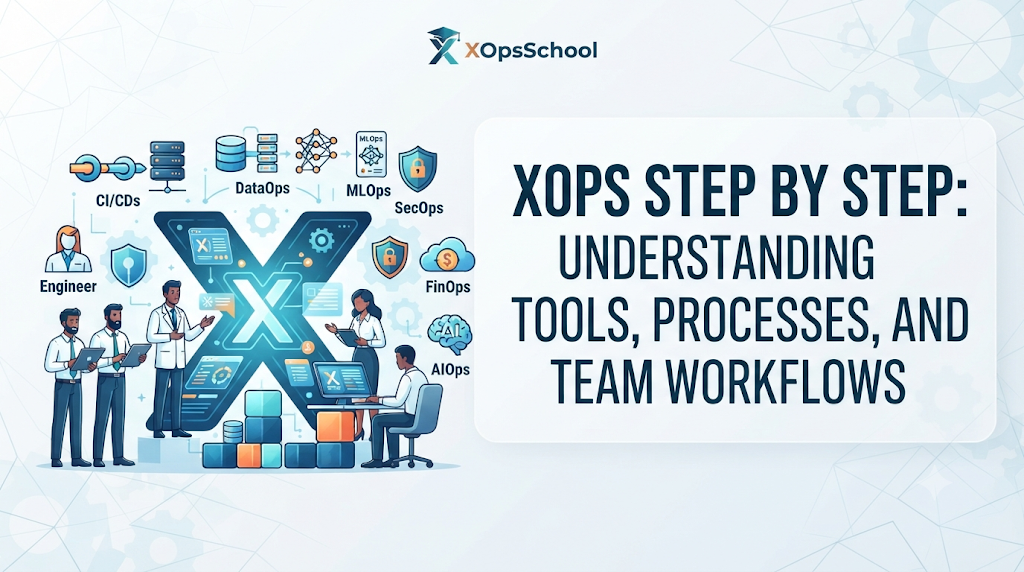
XOps is best understood as an umbrella approach for connecting different operational practices rather than as one specific product or technology. DevOps, DataOps, MLOps, AIOps, SecOps, FinOps, platform engineering, and reliability practices can all contribute to a broader XOps environment.
For people learning these concepts, XOpsSchool provides a useful technology-learning environment built around tutorials and practical technology courses. Its current course area includes subjects such as DevOps concepts, SRE concepts, Kubernetes, Docker, Terraform, Ansible, GitHub, GitOps, Argo CD, observability, Prometheus, Grafana, Splunk, Elastic, Dynatrace, AppDynamics, OpenShift, RunDeck, and HashiCorp Vault.
The important point is that learning XOps is not simply about collecting tool knowledge. It is about understanding how tools, automation, teams, infrastructure, data, applications, and operational feedback work together.
What Is XOps?
What is XOps? In simple terms, XOps describes a broader operational approach in which different technology operations disciplines are connected through common principles such as automation, monitoring, collaboration, governance, and continuous improvement.
The letter X acts as a flexible placeholder. Depending on the organization and context, it can represent areas such as development, data, machine learning, artificial intelligence, security, infrastructure, finance, or other operational domains.
This means XOps is not a single software package.
It is also not simply another name for DevOps.
DevOps focuses strongly on connecting software development and IT operations. DataOps applies operational principles to data workflows. MLOps addresses the operational lifecycle of machine-learning systems. AIOps applies AI and machine learning techniques to IT operations. SecOps connects security with operational processes, while FinOps brings financial accountability into cloud and technology operations.
XOps brings the broader idea of connected operations into focus.
For example, consider an organization running a machine-learning application in the cloud. Developers need a reliable software delivery pipeline. Infrastructure engineers need automated provisioning. Data engineers need dependable data pipelines. ML engineers need model deployment and monitoring. Security teams need appropriate controls. Operations teams need observability. Finance stakeholders may need visibility into cloud consumption.
None of these activities exists completely in isolation.
A mature operational environment therefore needs shared processes and feedback between them.
This is one reason XOps is useful as a learning concept. Instead of learning every discipline as a disconnected subject, professionals can understand where the disciplines overlap and where their responsibilities remain different.
Why XOps Matters in Modern IT
Modern applications often depend on distributed infrastructure, cloud services, APIs, databases, containers, data pipelines, and third-party systems.
When every team works independently, operational problems can cross organizational boundaries.
A deployment problem may look like an application issue but actually originate in infrastructure configuration. A machine-learning model may produce poor results because of data-quality problems. An infrastructure alert may be caused by a change in application behavior. A security event may require changes to deployment pipelines.
Connected operations can make these relationships easier to understand.
XOps thinking encourages teams to consider several principles.
Automation reduces repetitive manual work and improves consistency.
Observability gives teams visibility into application and infrastructure behavior through metrics, logs, traces, and other telemetry.
Standardization creates repeatable processes for common operational activities.
Collaboration reduces unnecessary boundaries between specialized teams.
Continuous improvement encourages teams to learn from incidents, deployments, performance data, and operational feedback.
Governance helps organizations apply appropriate security, compliance, reliability, and cost controls.
However, XOps should not be presented as a magic solution. Connected operational practices still require skilled people, appropriate architecture, good processes, and sensible technology decisions.
The objective is not to eliminate specialization.
The objective is to make specialization work better together.
Major XOps Disciplines
XOps becomes easier to understand when its major disciplines are viewed individually.
DevOps
DevOps connects software development and operations through shared responsibility, automation, continuous integration, continuous delivery, infrastructure automation, monitoring, and feedback.
Typical DevOps learning includes Git, CI/CD, containers, infrastructure as code, cloud platforms, Kubernetes, configuration management, and observability.
DevOps is an important foundation for XOps because many other operational disciplines borrow similar ideas around automation, repeatability, testing, monitoring, and continuous improvement.
DataOps
DataOps applies operational discipline to data workflows.
Its focus includes reliable data pipelines, data quality, orchestration, testing, monitoring, data observability, and dependable movement of information between systems.
A data pipeline that fails silently can affect analytics, reporting, machine-learning models, and business decisions. DataOps therefore treats operational reliability as an important part of the data lifecycle.
MLOps
MLOps connects machine-learning development with operational engineering.
Machine-learning systems have additional requirements beyond ordinary software deployment. Teams may need to manage datasets, experiments, models, model versions, validation, deployment, monitoring, and model performance.
MLOps helps establish repeatable processes around these activities.
AIOps
AIOps applies AI and machine-learning techniques to IT operations.
Common areas include anomaly detection, event correlation, alert analysis, operational intelligence, incident investigation, and automation.
AIOps can help teams process large volumes of operational information, but human judgment remains important, especially when automated actions could have significant consequences.
SecOps
SecOps connects security activities with operational processes.
Instead of treating security as a separate activity performed only before or after deployment, SecOps encourages security considerations throughout the technology lifecycle.
This can involve access controls, monitoring, vulnerability management, incident response, security automation, and policy enforcement.
FinOps
FinOps connects technology usage with financial accountability.
Cloud infrastructure can scale quickly, but that flexibility can also create unexpected spending. FinOps encourages teams to understand how technical decisions affect costs and business value.
It does not mean that engineers simply focus on reducing every bill. The objective is to make informed decisions about performance, reliability, scalability, and cost.
Platform Engineering
Platform engineering focuses on creating internal platforms and reusable capabilities that help developers and other technology teams work more efficiently.
Internal developer platforms can provide standardized deployment processes, infrastructure capabilities, templates, security controls, and self-service workflows.
Platform engineering can therefore support XOps by creating common operational foundations across teams.
XOps Training
A useful XOps Training path should begin with concepts rather than immediately jumping between dozens of tools.
A learner first needs to understand software delivery, infrastructure, automation, cloud environments, monitoring, and reliability.
From there, the learning path can expand into data operations, machine-learning operations, AI operations, security, governance, and cost management.
A practical learning progression can include:
- XOps fundamentals
- DevOps foundations
- Cloud infrastructure
- Infrastructure as code
- CI/CD
- Containers
- Kubernetes
- Observability
- Reliability engineering
- Data operations
- Machine-learning operations
- AI-assisted operations
- Security and governance
- FinOps concepts
The value of this approach is that learners understand relationships rather than memorizing isolated definitions.
XOpsSchool’s existing learning environment fits naturally into this type of exploration because its current course catalog includes foundational and operational technologies such as DevOps concepts, SRE concepts, Docker, Kubernetes, Terraform, Ansible, GitHub, GitOps, Argo CD, and observability-related technologies.
The best learning sequence will still depend on the learner’s current role.
A DevOps engineer may begin with Kubernetes and observability. A data engineer may begin with DataOps concepts. An ML professional may prioritize MLOps. An operations professional may start with observability, automation, AIOps, and reliability.
XOps Certification
XOps Certification can be useful when learners want structured validation of technical knowledge.
Certification preparation can encourage learners to organize concepts systematically, follow a defined learning structure, test their understanding, and identify gaps.
However, certification should not be confused with practical expertise.
A person can understand certification topics without being comfortable troubleshooting a production incident, designing a CI/CD pipeline, diagnosing Kubernetes problems, managing infrastructure, or maintaining a data workflow.
For that reason, certification preparation works best when combined with hands-on practice.
Learners should use certification study to strengthen conceptual knowledge while building practical ability through labs, projects, troubleshooting exercises, and real operational scenarios.
It is also important to verify the exact certification provider, syllabus, examination requirements, and validity information before making a certification decision. Those details can vary between certification programs and should not be assumed.
XOps Course
A good XOps Course should provide a logical progression rather than presenting an unrelated collection of technologies.
A sensible learning structure can move through:
- XOps fundamentals
- DevOps concepts
- Cloud and infrastructure
- Automation
- Data operations
- Machine-learning operations
- AI operations
- Observability and reliability
- Security and governance
- Integration of operational practices
The depth required at each stage depends on the learner.
A beginner may need more time with Linux, networking, Git, cloud fundamentals, and infrastructure concepts before moving into advanced operational topics.
An experienced cloud engineer may already understand infrastructure and automation and therefore spend more time exploring MLOps, AIOps, DataOps, or platform engineering.
The goal should not be to learn everything at once.
The goal should be to build a strong foundation and then expand into related areas.
XOps Tutorial
An XOps Tutorial is useful when a learner wants to understand how an operational concept works in practice.
Technical documentation can explain what a tool does, but a practical tutorial can provide the missing context: why a tool is being used, where it fits, what problems it addresses, and how it connects to other technologies.
Useful XOps tutorial subjects include:
- CI/CD
- Infrastructure automation
- Container management
- Kubernetes operations
- GitOps
- Monitoring
- Observability
- Infrastructure as code
- Data pipelines
- Model deployment
- AI-assisted operations
- Incident management
- Troubleshooting
XOpsSchool’s tutorial content includes dedicated educational material around XOps itself as well as modern DevOps, cloud, automation, AIOps, security, and related operational subjects.
Tutorials are especially useful when combined with practice.
Reading about Kubernetes does not create Kubernetes operational skill by itself. Similarly, reading about Terraform does not automatically develop infrastructure-as-code expertise.
The learner needs to experiment, make mistakes, investigate failures, and understand why particular approaches work.
XOps Tools
XOps Tools are not one category of software.
Different tools solve different operational problems.
Source Control and Collaboration
Git and platforms built around Git provide version control and collaboration for source code, configuration, infrastructure definitions, and automation.
CI/CD
Jenkins, GitHub Actions, GitLab CI/CD, and similar technologies can automate build, test, packaging, and deployment workflows.
Containers and Orchestration
Docker helps package applications into containers, while Kubernetes provides orchestration capabilities for containerized workloads.
Infrastructure Automation
Terraform supports infrastructure as code, while Ansible is commonly used for configuration and automation.
Observability
Prometheus, Grafana, OpenTelemetry, Elastic, Splunk, AppDynamics, and Dynatrace are examples of technologies associated with monitoring, telemetry, visualization, logging, application performance, or broader observability use cases.
XOpsSchool’s current course listing specifically includes Prometheus, Grafana, Elastic, Splunk, AppDynamics, Dynatrace, and Observability.
GitOps
Argo CD, Flux, and Helm are commonly associated with GitOps-style workflows and Kubernetes environments.
Data Operations
DataOps environments may use orchestration, transformation, testing, quality, lineage, and monitoring technologies. The specific toolset depends heavily on the data architecture.
MLOps
MLOps tools support activities such as experiment management, model versioning, deployment, monitoring, and lifecycle management.
AIOps
AIOps platforms focus on operational intelligence, anomaly detection, event correlation, alert analysis, and automation.
There is no universally best XOps tool.
Selection should depend on architecture, requirements, integration, security, team skills, scale, cost, and maintenance needs.
DevOps Training
DevOps Training forms an important part of broader XOps learning.
DevOps introduces many foundational practices that appear throughout modern operational engineering.
These include:
- Git and version control
- CI/CD
- Docker
- Kubernetes
- Terraform
- Ansible
- Cloud platforms
- Infrastructure as code
- Monitoring
- Automation
A learner who understands these foundations will have an easier time understanding how operational ideas extend into DataOps, MLOps, AIOps, and platform engineering.
XOpsSchool’s current learning catalog includes DevOps concepts together with GitHub, Docker, Kubernetes, Terraform, Ansible, GitOps, and Argo CD, giving learners access to several technologies commonly associated with modern DevOps workflows.
DevOps, however, should not be treated as the complete definition of XOps.
It is one major part of the wider picture.
AIOps Training
AIOps Training focuses on applying artificial intelligence and machine learning techniques to operational data.
Modern environments can generate enormous amounts of logs, metrics, traces, alerts, events, and other telemetry.
AIOps approaches can help with:
- Anomaly detection
- Event correlation
- Alert prioritization
- Incident analysis
- Pattern recognition
- Operational automation
For example, several alerts may actually be symptoms of one underlying problem. Correlating related events can help an operations team investigate the underlying issue instead of treating every alert as a separate incident.
AIOps does not remove the need for engineers.
Automated recommendations and actions need appropriate controls, context, and human oversight. Poorly designed automation can create additional operational risk.
The most useful AIOps learning therefore includes both the technology and the operational reasoning behind it.
MLOps Training
MLOps Training focuses on operating machine-learning systems reliably.
A machine-learning application may require continuous management of data, models, infrastructure, deployments, and monitoring.
Important MLOps concepts include:
- Model development lifecycle
- Data and model validation
- Model versioning
- Automated deployment
- Model monitoring
- Performance tracking
- Model maintenance
- Reproducibility
MLOps connects machine-learning work with engineering practices that are familiar from software operations.
However, different ML systems have different requirements. A recommendation system, forecasting model, computer-vision application, and language model may require different architectures and operational controls.
Therefore, MLOps should be learned as a set of principles and practices rather than one fixed architecture.
DataOps Training
DataOps Training focuses on making data workflows more reliable, observable, testable, and repeatable.
Important areas include:
- Data pipelines
- Data quality
- Data orchestration
- Pipeline testing
- Monitoring
- Data observability
- Automation
- Continuous data delivery
For example, a pipeline can technically complete successfully while still producing incorrect or incomplete data. Operational data quality checks are therefore just as important as simply confirming that a job ran.
DataOps connects data engineering with operational discipline.
This becomes especially important when data feeds analytics, reporting, machine-learning models, or business-critical applications.
How XOps Connects DevOps, DataOps, MLOps and AIOps
The easiest way to understand XOps is to see how the disciplines complement each other.
DevOps supports application development and delivery.
DataOps supports dependable data movement, quality, and operational data workflows.
MLOps supports machine-learning model lifecycle management.
AIOps applies AI techniques to operational monitoring, analysis, and automation.
These disciplines have different objectives, but they can share common operational principles.
Automation can exist in all four.
Observability can support all four.
Governance can apply across all four.
Cloud infrastructure can host workloads associated with all four.
CI/CD principles can influence software and model delivery.
Operational feedback can improve applications, pipelines, models, and infrastructure.
This does not mean that DevOps, DataOps, MLOps, and AIOps are interchangeable.
They solve different problems.
XOps provides a useful way of thinking about how those specialized practices can coexist within a larger operational ecosystem.
Who Can Benefit From XOpsSchool?
1. DevOps and Cloud Engineers
DevOps and cloud engineers can use broader XOps knowledge to understand how application delivery and infrastructure connect with data, AI, security, reliability, and cost management.
This wider perspective can help them work more effectively with specialized teams.
2. Data Engineers
Data engineers can explore how DataOps principles connect pipeline development with testing, monitoring, quality, automation, and operational reliability.
This can help move data engineering beyond pipeline construction toward dependable production operations.
3. Machine Learning Professionals
Machine-learning professionals can use MLOps concepts to understand deployment, monitoring, versioning, validation, automation, and model maintenance.
This helps connect experimental ML work with production engineering requirements.
4. IT Operations and SRE Professionals
Operations and SRE professionals can explore observability, automation, AIOps, reliability, platform engineering, and incident-management concepts.
These areas can complement existing operational responsibilities.
5. Developers and Technical Learners
Developers can benefit from understanding what happens after code is written.
Learning CI/CD, containers, infrastructure, monitoring, and operational feedback can provide a better understanding of how modern applications are actually delivered and operated.
6. Technology Teams and Organizations
Technology teams can use XOps knowledge to understand the relationships between development, infrastructure, data, AI, security, reliability, platforms, and technology costs.
The objective is not for every team member to become an expert in every discipline.
Instead, teams can develop enough shared understanding to collaborate more effectively.
XOps Disciplines at a Glance
| XOps Discipline | Main Focus | Common Learning Areas |
|---|---|---|
| DevOps | Software delivery and development-operations collaboration | CI/CD, Git, containers, automation, infrastructure as code |
| DataOps | Reliable data operations | Data pipelines, quality, orchestration, testing, monitoring |
| MLOps | Machine-learning lifecycle operations | Model deployment, versioning, validation, monitoring |
| AIOps | AI-assisted IT operations | Anomaly detection, event correlation, alert analysis, automation |
| SecOps | Security integrated with operations | Security monitoring, incident response, access control, automation |
| FinOps | Technology and cloud cost management | Cost visibility, allocation, optimization, financial accountability |
| Platform Engineering | Internal platforms and developer self-service | Platform automation, reusable infrastructure, self-service workflows |
Common Mistakes When Learning XOps
Treating XOps as a Single Tool
XOps is an umbrella approach. No individual product represents the entire discipline.
Better approach: learn the operational concepts first and then understand how different tools support them.
Learning Tools Without Understanding Concepts
Memorizing commands does not create operational understanding.
Better approach: learn what problem each tool solves and how it fits into a wider workflow.
Trying to Learn Everything at Once
DevOps, DataOps, MLOps, AIOps, SecOps, FinOps, and platform engineering each contain substantial subject matter.
Better approach: start with one foundation and gradually expand.
Ignoring DevOps Foundations
Many advanced operational practices depend on basic concepts such as version control, automation, deployment, infrastructure, and monitoring.
Better approach: build strong DevOps and infrastructure fundamentals first.
Focusing Only on Certification
Passing an exam does not prove that someone can operate a production environment.
Better approach: combine structured study with practical work.
Avoiding Practical Exercises
Reading can create familiarity, but operational skill develops through practice.
Better approach: build small environments, experiment with tools, and troubleshoot failures.
Ignoring Observability
Without useful telemetry, diagnosing production problems becomes much harder.
Better approach: learn metrics, logs, traces, dashboards, alerting, and operational context.
Ignoring Security
Security cannot always be added at the end of a delivery process.
Better approach: understand access control, secrets, vulnerability management, monitoring, and secure operational practices.
Ignoring Data Quality
Successful pipeline execution does not necessarily mean correct data.
Better approach: include validation, testing, quality checks, and monitoring.
Choosing Tools Without Understanding Requirements
A popular technology may not be appropriate for every environment.
Better approach: evaluate architecture, team capability, security, integration, cost, scale, and maintenance requirements.
Best Practices for Learning XOps
Start with fundamentals before advanced tools.
Build strong DevOps foundations and understand cloud infrastructure.
Learn automation instead of depending on repeated manual processes.
Practice infrastructure as code so infrastructure can be managed consistently.
Learn observability because operational decisions depend on reliable information.
Understand how data workflows operate.
Explore MLOps and AIOps after establishing relevant foundations.
Include security and governance in technical decision-making.
Build small projects instead of attempting a huge platform immediately.
Document what you learn.
Study real operational problems rather than focusing only on theoretical definitions.
A good learner should also become comfortable asking practical questions:
What happens when a deployment fails?
How is an incident detected?
Where does the telemetry come from?
How can infrastructure be reproduced?
How is data validated?
How is a model monitored?
How does a technical decision affect cost?
These questions build operational thinking.
Learning Goals and Recommended XOps Areas
| Learning Goal | Recommended XOps Area | Skills to Develop |
|---|---|---|
| Application delivery | DevOps | Git, CI/CD, containers, release automation |
| Cloud infrastructure | Cloud and InfraOps | Infrastructure as code, networking, automation |
| Data pipelines | DataOps | Orchestration, testing, quality, monitoring |
| Machine-learning deployment | MLOps | Model deployment, versioning, validation, monitoring |
| Intelligent operations | AIOps | Event correlation, anomaly detection, operational automation |
| Platform engineering | Platform Engineering | Self-service, reusable infrastructure, platform automation |
| Reliability | SRE and Observability | SLIs, SLOs, monitoring, incident response |
8-Step XOps Learning Guide
Step 1: Understand What XOps Means
Begin with the basic idea of connected operational disciplines.
Learn how DevOps, DataOps, MLOps, AIOps, SecOps, FinOps, and platform engineering address different operational needs.
Do not start by trying to memorize every tool.
Step 2: Build DevOps Foundations
Learn source control, CI/CD, automation, containers, infrastructure, and basic deployment practices.
These concepts provide useful foundations for many other XOps areas.
Step 3: Learn Cloud and Infrastructure
Study cloud platforms, networking basics, infrastructure as code, configuration, and automation.
Understand how applications actually run and how infrastructure is provisioned and managed.
Step 4: Learn Observability and Reliability
Understand monitoring, logs, metrics, traces, alerting, SLIs, SLOs, and incident practices.
The goal is to understand how teams know whether a system is working correctly.
Step 5: Explore DataOps
Learn how reliable data pipelines are designed and operated.
Focus on quality checks, orchestration, testing, monitoring, and data observability.
Step 6: Explore MLOps and AIOps
Study the operational lifecycle of machine-learning systems and the use of AI techniques in IT operations.
Understand both the benefits and limitations of operational automation.
Step 7: Learn Security, Governance and Cost Awareness
Explore SecOps, governance, compliance concepts, and FinOps fundamentals.
Technical systems need to be secure, manageable, and financially sustainable.
Step 8: Build an Integrated Practical Project
Combine several relevant disciplines in a practical project.
For example, a learner might connect application delivery, infrastructure automation, containers, monitoring, and operational analysis.
The objective is not to implement every XOps discipline.
It is to understand how selected practices work together.
A Practical XOps Learning Approach
The transition from theory to practical knowledge requires deliberate practice.
Start with small environments.
A learner could create a basic application deployment pipeline, automate infrastructure, deploy containers, add monitoring, and then intentionally introduce a failure to understand incident investigation.
Data-focused learners can experiment with pipeline validation, scheduling, monitoring, and data-quality checks.
ML-focused learners can study model versioning, deployment, monitoring, and performance changes.
Operations-focused learners can explore telemetry, dashboards, alerting, incident response, and automation.
Documentation should be part of every exercise.
Write down:
- What was built
- Why a tool was selected
- What failed
- How the problem was diagnosed
- What telemetry was useful
- What could be automated
- What security considerations existed
- What could be improved
This creates a much deeper learning experience than simply completing commands from a tutorial.
XOpsSchool can be used as part of this learning process by combining its tutorial-oriented material with its technology-focused course resources. Its current platform includes learning areas ranging from observability and monitoring technologies to containers, infrastructure automation, GitOps, DevOps, and SRE concepts.
How to Choose XOps Tools
Tool selection should begin with the problem rather than popularity.
Consider the following factors:
Business requirements: What operational problem needs to be solved?
Technical architecture: Does the tool fit the existing environment?
Team skills: Can the current team operate and maintain it?
Existing infrastructure: Does it integrate with the systems already in use?
Security: Does it support appropriate access controls and security requirements?
Scalability: Can it handle expected workloads?
Cost: What are licensing, infrastructure, operational, and maintenance costs?
Community and support: Is sufficient documentation and support available?
Maintenance: How much ongoing operational effort will the tool require?
For example, choosing a monitoring platform only because it is widely known may create problems if the team cannot integrate it properly or lacks the skills to operate it.
A smaller, well-supported solution may sometimes be more appropriate.
The right question is not “Which tool is the best?”
The better question is “Which tool is appropriate for this environment and this operational problem?”
XOps Career and Skill Development
XOps knowledge can broaden a technology professional’s understanding of modern systems.
A DevOps engineer may develop stronger knowledge of observability, platform engineering, AIOps, or FinOps.
A data engineer may learn more about infrastructure, automation, and reliability.
An ML professional may gain a better understanding of deployment, monitoring, and production operations.
An SRE may explore AI-assisted operations, data workflows, and platform engineering.
The relevant skill areas include:
- Automation
- Cloud
- Infrastructure
- CI/CD
- Data engineering
- Machine-learning operations
- AI operations
- Observability
- Security
- Reliability
- Platform engineering
However, career development is not determined by one course, certification, or technology.
Practical ability, communication, problem-solving, domain knowledge, system understanding, and professional experience also matter.
XOps should therefore be viewed as a way to expand technical capability rather than as a guaranteed career shortcut.
Using XOpsSchool as a Learning Resource
A sensible approach is to use XOpsSchool as one part of a broader technical learning journey.
Start with XOps fundamentals and understand the overall idea.
Next, identify the operational discipline closest to your current role.
A DevOps engineer might begin with DevOps, GitOps, Kubernetes, infrastructure automation, and observability.
A data engineer can focus on DataOps concepts and then explore infrastructure and reliability.
An ML professional can prioritize MLOps while building stronger cloud and DevOps foundations.
An operations professional can focus on observability, automation, SRE, and AIOps.
The current XOpsSchool course environment includes practical technology subjects such as Kubernetes, Docker, Terraform, Ansible, GitHub, GitOps, Argo CD, Prometheus, Grafana, Elastic, Splunk, Dynatrace, AppDynamics, OpenShift, RunDeck, HashiCorp Vault, DevOps concepts, and SRE concepts.
Tutorials can then be used when a specific concept needs deeper explanation.
Certification-related resources, where applicable, can provide structured revision and knowledge validation, but learners should continue developing practical skills through projects and experimentation.
The strongest learning path is usually iterative:
Learn → Practice → Troubleshoot → Document → Improve → Expand
That process is more valuable than trying to consume every available technology at once.
Frequently Asked Questions About XOps
1. What is XOps in simple terms?
XOps is an umbrella approach for connecting different technology operations practices. It can bring together areas such as DevOps, DataOps, MLOps, AIOps, SecOps, FinOps, reliability, and platform engineering.
2. How is XOps different from DevOps?
DevOps primarily focuses on collaboration and automation across software development and IT operations. XOps is broader and considers how multiple operational disciplines can work together.
3. What disciplines are included in XOps?
Commonly associated disciplines include DevOps, DataOps, MLOps, AIOps, SecOps, FinOps, infrastructure operations, platform engineering, and reliability practices. The exact scope can differ between organizations.
4. Is XOps suitable for beginners?
Yes. Beginners can start with foundational concepts such as DevOps, cloud infrastructure, automation, monitoring, and version control before gradually exploring specialized XOps areas.
5. What should an XOps training path include?
A useful path should cover XOps fundamentals, DevOps, cloud and infrastructure, automation, observability, reliability, data operations, MLOps, AIOps, security, governance, and practical integration.
6. What is the purpose of XOps certification?
Certification can provide structured learning and help validate knowledge against a defined body of material. It should complement rather than replace hands-on technical experience.
7. What should learners look for in an XOps course?
Look for clear fundamentals, logical progression, practical examples, relevant tools, automation concepts, observability, cloud knowledge, and opportunities to apply concepts rather than only memorize terminology.
8. Which tools are commonly associated with XOps?
Common technologies include Git, Jenkins, GitHub Actions, Docker, Kubernetes, Terraform, Ansible, Prometheus, Grafana, OpenTelemetry, Argo CD, and various observability, data, MLOps, and AIOps platforms.
9. How are DevOps, DataOps, MLOps, and AIOps connected?
They address different operational problems but can share automation, monitoring, observability, governance, infrastructure, and feedback practices. Their objectives and workflows remain different.
10. How can someone start learning XOps?
Start with XOps fundamentals and build strong DevOps and cloud foundations. Then choose an area related to your current role, practice with tools and projects, and gradually explore related disciplines.
Conclusion
XOps provides a useful way to understand how modern technology operations are becoming increasingly connected. Rather than treating DevOps, DataOps, MLOps, AIOps, SecOps, FinOps, reliability, and platform engineering as completely isolated subjects, XOps encourages organizations and professionals to understand the relationships between them. The value comes from shared automation, observability, governance, feedback, and operational practices while still respecting the specialized purpose of each discipline. Learning should therefore combine concepts, tools, troubleshooting, and practical projects. XOpsSchool can support this journey through its tutorials and technology-focused learning resources across areas such as DevOps, SRE, Kubernetes, Docker, Terraform, Ansible, GitOps, observability, monitoring, and related operational technologies.