Introduction
Most rural research starts with one small question. Which paddy variety suits my field? Is my scheme record correct? Where is the better price for my crop this week? Before long, one question becomes ten, and the answers sit in different places, written in different styles, with different dates.
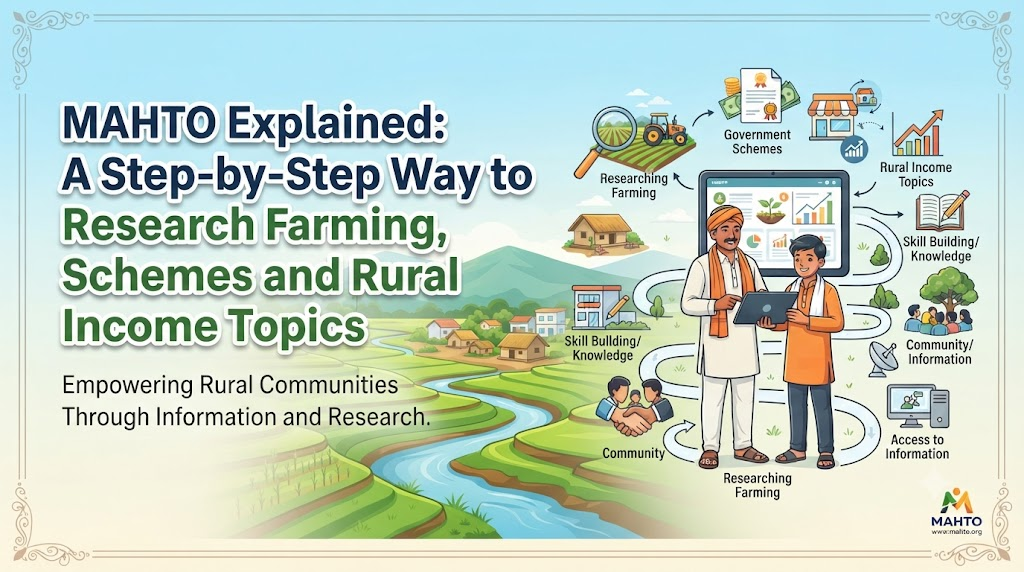
MAHTO is a Hindi-first rural knowledge platform for Indian farmers, agricultural families, rural entrepreneurs, and village communities. It covers agriculture, farmer schemes, livestock, mandi prices, weather-related farming guidance, and village business opportunities. This article looks at these subjects as a research journey and explains how a reader can move from a first question to a careful, informed decision.
What Is MAHTO?
MAHTO is an information platform for village life and farm work. It aims to explain useful topics in simple language instead of long official or technical wording.
Its main subject areas are:
- Agriculture and crop guidance, including irrigation, soil testing, fertilizers, pest control, crop calendars, and organic farming
- Government scheme topics such as PM-Kisan, PM Fasal Bima Yojana, Kisan Credit Card, Soil Health Card, and state-level farmer schemes
- Livestock topics such as dairy, poultry, fish, and goat farming, along with vaccination and animal nutrition
- Mandi-price information and weather-related farming guidance
- Rural income topics, including village business options
Simple explanations help because many readers already know their land and animals well. What they find hard is the paperwork, the technical terms, and the unclear steps around them. These subjects are also connected. A crop plan affects the money needed, a scheme may support a cost, and a market price decides what the harvest earns.
Why Reliable Rural Information Matters
A mistake in rural life is rarely small. An incomplete application can delay a benefit. A poor seed choice can affect a season. An unplanned investment can strain a household’s savings.
Reliable information protects against these risks by showing what to check first. It also reminds readers that scheme rules change, prices move daily, and soil and weather differ from one district to the next. Because of this, any article is best used as preparation. The final confirmation should come from official sources and local experts.
Understanding Agriculture Through Simple Guidance
Reading in one’s own language makes research faster. Clear farming information in Hindi can explain crop selection, soil preparation, irrigation, fertilizers, pest control, seasonal planning, and harvest preparation without confusing terms.
For example, a farmer who has a soil test report can read what the nutrient levels mean and then discuss fertilizer needs with an agricultural officer. A farmer who reads a crop calendar can plan seed purchase, labour, and cash before the season begins. The right choice still depends on the variety, soil type, rainfall, and local conditions, so general guidance should always be matched against local advice.
Understanding Farmer Welfare Schemes
When researching government schemes for farmers, a useful habit is to write down five questions before reading anything: who is eligible, what is offered, which documents are required, where to apply, and how to check the status. Answering these in order keeps the research organised and helps reveal gaps early.
Not every farmer qualifies for every scheme. Land details, state rules, and other conditions can change the answer. The official portal or the local agriculture office is the right place for final confirmation.
Verification Under PM-Kisan
PM-Kisan is an income-support scheme for eligible farmer families. In this context, eKYC means an identity verification step connected to a beneficiary’s record. When reading about PM Kisan eKYC, remember that methods and instructions can be updated. Only current official instructions should be followed. It also helps to confirm that the name, Aadhaar details, and bank account information are consistent across records, since mismatches are a common source of delay.
Understanding Agricultural Credit
A Kisan Credit Card is designed to help eligible farmers obtain credit from banks for farming-related needs. Research should cover current eligibility, required documents (commonly identity, address, and land records), interest conditions, repayment terms, and the branch that handles the process. The lender decides approval and amount, so neither can be promised. Farmers should also work out how much they would repay in total, and by when, before deciding to borrow.
Understanding Mandi Prices
Selling at the right time and place can change what a harvest earns. Readers who want to learn how to check mandi prices can use government market-information portals, mandi boards, farmer information services, and the local market committee.
A careful comparison looks at the crop and variety, the market, the date, the quality and grade, and the unit of price. Prices differ because supply, demand, transport cost, and quality are different in each market. A rate shared in a message or video is only useful if it is dated and comes from a verified source.
Important Steps in Paddy Cultivation
Paddy is grown across many regions, and methods vary. Those researching how to grow paddy can study it in stages:
- Variety: Choose one suited to local climate, water supply, and season.
- Field preparation: Ploughing, levelling, and bunding help hold water evenly.
- Seed and nursery: Where transplanting is used, healthy seed and a well-managed nursery matter.
- Planting: Seedlings are transplanted, or seed is sown directly.
- Water and nutrients: Water depth and fertilizer timing matter at different growth stages.
- Weeds and pests: Regular field visits help catch problems early.
- Harvest: Cutting at the right maturity and drying grain well protect quality.
Timing, water use, and methods depend on the region, soil, and variety. No single method suits every field.
Planning a Goat Farming Activity
Goat rearing can begin on a small scale. A person studying how to start goat farming should settle the purpose first, whether meat, milk, breeding, or a mix. Next come the breed for the local climate, a dry and airy shed, daily feed and clean water, and a nearby veterinarian for vaccination and treatment.
Simple records of births, health, feed, and spending show how the activity performs over time. Setup costs, running costs, and local demand should be understood in advance. Income varies and is never guaranteed.
Understanding Organic Farming
Organic farming gives priority to soil health and reduces synthetic inputs where suitable. Anyone exploring how to start organic farming should read about compost, farmyard manure, green manure, crop rotation, and careful pest management. The change from conventional farming can take time, and yields may shift in the meantime. Produce sold as certified organic must meet certification requirements, which should be checked with the proper authority. It is not automatically cheaper or more profitable, so a small trial plot is a sensible start.
Understanding Livestock Management
Animals stay productive when their basic needs are met. Good livestock farming information covers balanced feed and clean water, hygienic housing, timely vaccination, planned breeding with records, and regular veterinary care. These points apply to dairy animals, poultry, fish, and goats, with different details for each. When an animal is ill, a qualified veterinarian should be consulted, because unverified remedies can make a condition worse.
Rural Income Opportunities
Many families look for extra income beside farming. Commonly discussed village business ideas include dairy activities, poultry, goat rearing, food processing, local services, and agricultural support businesses. Before starting, a person should look at local demand, investment, skills, resources, running costs, and risks. Starting small limits the damage if an estimate proves wrong. Profit is never assured.
Who to Ask for What
Once the research is done, questions are best taken to the right person.
| Type of question | Who can help |
|---|---|
| Scheme eligibility, documents, status | Agriculture office, official portal |
| Loans and credit terms | Bank branch |
| Crop variety, soil, fertilizer | Agricultural extension office |
| Animal health and vaccination | Qualified veterinarian |
| Market rates and selling | Local mandi or market committee |
| Starting a small business | Relevant local department, experienced practitioners |
A Hypothetical Example
A family with a small plot wants to start dairy as an extra activity. They read general guidance on feed, housing, and vaccination. Then they list likely costs, visit a nearby veterinarian to ask about suitable animals, and check with a bank about credit terms. They also ask local buyers about milk demand. Only after comparing costs and risks do they decide how many animals to begin with, choosing a number small enough that a bad month would not threaten their savings.
A Simple Five-Step Research Process
- Write down the exact question. Decide whether it concerns a crop, a scheme, an animal, or a business.
- Read current, clear information. Prefer recent explanations and note their dates.
- Confirm with official or local sources. Check rules, prices, and recommendations.
- Compare options, costs, and risks. Put numbers on paper before spending.
- Ask a qualified person. Speak to an agricultural, veterinary, or banking professional before any major decision.
Common Mistakes to Avoid
- Using outdated scheme details: Procedures change, so check official sources.
- Missing a document: One mismatched paper can delay an application.
- Believing unverified prices: Shared messages may carry old rates.
- Copying one method everywhere: What suits one region may fail in another.
- Starting livestock without a cost plan: Feed, shelter, and medicine costs add up.
- Expecting guaranteed profit: Every business carries risk.
- Treating animals without a vet: Wrong treatment can worsen illness.
Frequently Asked Questions
What should be checked before applying to a scheme?
Eligibility, benefits, documents, application steps, and the latest official instructions.
What does eKYC mean for PM-Kisan?
It is an identity verification step linked to a beneficiary’s record. Confirm the current method on the official portal.
Does a Kisan Credit Card guarantee a loan?
No. The bank decides on approval, limits, and terms.
Why do mandi prices differ?
Supply, demand, quality, transport costs, and local conditions vary by market and by day.
What should be planned before keeping goats?
Purpose, breed, shelter, feed, veterinary support, vaccination, costs, and demand.
Is organic farming always more profitable?
Not necessarily. Costs, yields, and prices vary, and certification may be needed.
Conclusion
Good rural decisions usually come from a careful sequence: ask a clear question, read current information, confirm it locally, compare costs and risks, and then seek expert advice. MAHTO brings farming, schemes, livestock, mandi prices, and village business topics together in simple language, so readers can begin that process with a solid understanding. No article can replace official instructions or local advice, but clear information makes it easier to ask the right questions and avoid avoidable mistakes.