Introduction
Traditional financial markets rely on middlemen. When you buy a stock or trade currency, a centralized exchange matches your buy order with someone else’s sell order. This system works well, but it requires a central authority to run the matching engine and hold the funds.
Decentralized finance wanted to remove this central control. However, building an order book on a public blockchain is slow and expensive.
To solve this problem, developers created the Automated Market Maker. This invention changed how people trade digital assets without needing banks, brokers, or traditional stock exchanges.
What Is an Automated Market Maker?
An Automated Market Maker is a smart contract protocol that allows digital assets to be traded in a decentralized way.
Think of an AMM as an automated vending machine. A normal vending machine does not need a cashier. You put money in, select an item, and the machine calculates the price and gives you the product based on fixed rules.
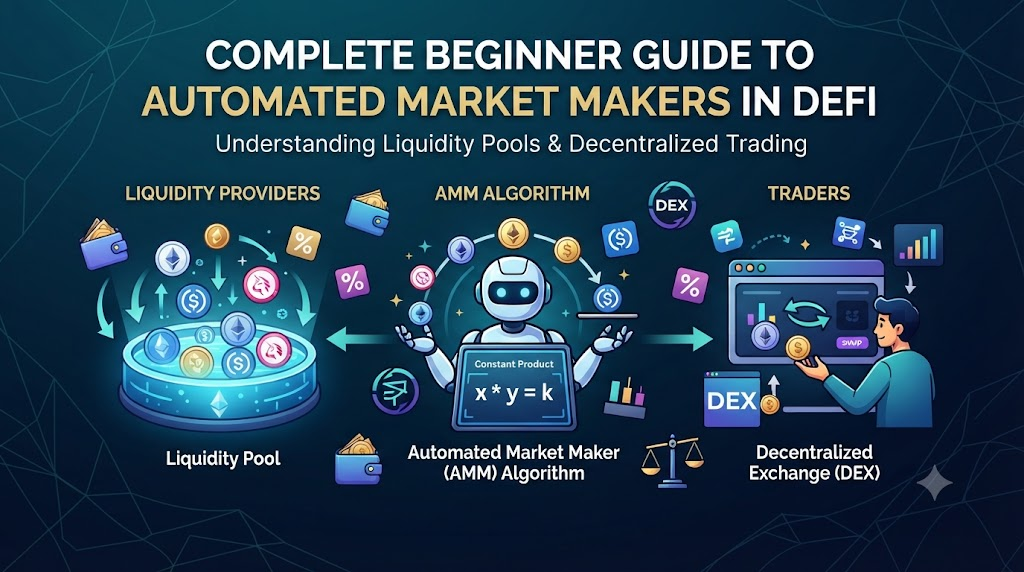
An AMM works in a similar way. It does not match a buyer with a specific seller. Instead, traders interact directly with a pool of tokens locked inside a smart contract. The price of the tokens adjusts automatically based on the ratio of tokens remaining in that pool.
Why Does It Matter?
Before AMMs, decentralized trading struggled with low volume and slow execution. AMMs made it possible for anyone to trade tokens instantly, 24 hours a day, without waiting for a counterparty to accept an order.
How AMMs Work: Liquidity Pools and Constant Products
To understand an AMM, you need to understand two main ideas: liquidity pools and pricing algorithms.
1. Liquidity Pools
A liquidity pool is a shared digital pile of two or more tokens locked in a smart contract. For example, a pool might hold Ethereum (ETH) and USD Coin (USDC).
Instead of buying ETH from another person, you buy it from this shared pool. The people who supply these tokens to the pool are called liquidity providers (LPs). In return for supplying their funds, liquidity providers earn a small percentage of every trade that happens in that pool.
2. The Constant Product Formula
Most popular AMMs use a simple mathematical formula to keep prices balanced:
$$x \times y = k$$
In this equation:
- x represents the quantity of the first token in the pool.
- y represents the quantity of the second token in the pool.
- k is a fixed constant number that must remain balanced after every trade.
When someone buys token $x$ from the pool, they remove $x$ and add token $y$. Because $k$ must stay the same, the pool automatically increases the price of token $x$ and decreases the price of token $y$ to reflect the new supply ratio.
Practical Example of an AMM Trade
Imagine a liquidity pool containing 10 ETH and 20,000 USDC.
- The constant $k$ is calculated as $10 \times 20,000 = 200,000$.
- This means the baseline exchange rate values 1 ETH at 2,000 USDC.
- A trader wants to buy 1 ETH using USDC. They deposit 2,000 USDC into the pool.
- The pool now holds 22,000 USDC and less than 10 ETH.
- To keep $k$ at 200,000, the remaining ETH in the pool drops, which automatically raises the price of the next fraction of ETH.
This automatic adjustment ensures that the pool never runs completely dry of either asset.
Real-World Considerations and Trade-Offs
While AMMs are powerful, they come with unique risks and trade-offs that every user and liquidity provider should understand.
Impermanent Loss
This is one of the most important risks for liquidity providers. If the market price of the tokens in a pool changes significantly compared to when you deposited them, you might end up with less total value than if you had simply held the tokens in your wallet.
Slippage
Slippage happens when your trade executes at a different price than expected. In low-liquidity pools, large trades can heavily shift the token ratio, causing the user to receive fewer tokens than anticipated.
Smart Contract Risk
Because AMMs run entirely on code, any bug or vulnerability in the smart contract can be exploited by hackers, potentially leading to the loss of pooled funds.
Common Mistakes Beginners Make
- Ignoring pool liquidity: Depositing funds into obscure or low-volume pools because of high advertised returns, which often leads to high slippage and impermanent loss.
- Forgetting about network fees: Forgetting that interacting with smart contracts on blockchains requires gas fees, which can eat into trading profits.
- Misunderstanding impermanent loss: Assuming that earning high trading fees always guarantees a profit, even when the underlying token prices crash.
Key Terms
- Liquidity Pool: A collection of funds locked in a smart contract used to facilitate trading.
- Liquidity Provider (LP): A user who deposits tokens into a pool to help enable trading and earns a fee in return.
- Smart Contract: Self-executing code stored on a blockchain that automatically carries out transactions when conditions are met.
- Slippage: The difference between the expected price of a trade and the price when the trade actually executes.
- Impermanent Loss: The temporary loss of funds experienced by liquidity providers due to market price shifts compared to holding tokens.
- Decentralized Finance (DeFi): Financial services built on public blockchains that do not rely on traditional intermediaries like banks.
FAQs
What is the main difference between an AMM and a traditional exchange?
Traditional exchanges use order books to match buyers and sellers directly. AMMs replace order books with liquidity pools and mathematical formulas, allowing automated trades without a direct counterparty.
Do I need to register an account to use an AMM?
No. AMMs run on decentralized applications (dApps). To use one, you simply connect a self-custody cryptocurrency wallet to the platform.
How do liquidity providers make money?
Liquidity providers earn a fractional share of the trading fees generated every time a user swaps tokens through their specific pool.
Is using an AMM safe?
AMMs are generally secure if built on reputable protocols, but they carry risks such as smart contract bugs, platform exploits, and market volatility like impermanent loss.
Can anyone become a liquidity provider?
Yes. Almost anyone with a Web3 wallet and digital assets can deposit funds into a liquidity pool and start earning fees.
Conclusion
Automated Market Makers transformed the cryptocurrency landscape by making token trading permissionless, continuous, and fully automated. By replacing central intermediaries with smart contracts and liquidity pools, AMMs allow anyone to trade assets or earn passive income. However, success in DeFi requires a clear understanding of risks like impermanent loss, smart contract vulnerabilities, and market slippage. Always assess these factors carefully before providing liquidity or trading in decentralized markets.