Introduction
Getting started with decentralized finance (DeFi) often feels like driving an expensive sports car through a tollbooth every single block. On older networks, moving funds or swapping tokens can cost hefty gas fees, turning a simple transaction into an expensive headache. These high costs and slow speeds push many everyday users away from exploring crypto apps.
Binance Smart Chain was built to solve this exact problem. It offers a fast, low-cost environment where anyone can trade, lend, or build digital assets without paying high fees. However, speed and low cost always come with hidden trade-offs. This guide explores how Binance Smart Chain works, why developers use it, what risks to watch out for, and how to navigate the network safely.
What Is Binance Smart Chain?
Binance Smart Chain is a blockchain network that supports smart contracts.
- Smart Contract: A self-executing digital agreement written in code that runs automatically when preset conditions are met.
- Why it matters: Smart contracts remove the need for middlemen like banks or brokers, allowing users to lend, borrow, and trade directly with one another.
- Example: Imagine an automated digital vending machine. Instead of handing cash to a clerk, you send cryptocurrency into the code, and the smart contract instantly releases your digital asset.
Binance Smart Chain was launched in September 2020 by Binance, one of the world’s largest cryptocurrency exchanges. It was designed to run alongside the original Binance Chain, which was optimized purely for fast token trading.
- Binance Chain: Focused strictly on high-speed asset trading.
- Binance Smart Chain: Added programmable smart contract capabilities to support decentralized applications.
How Binance Smart Chain Works
To understand how Binance Smart Chain processes transactions quickly, you need to look at its underlying engine and consensus mechanism.
The Consensus Mechanism: Proof of Staked Authority
Older networks often use Proof of Work, which requires massive computer power to solve complex math puzzles and secure the network. Binance Smart Chain uses a system called Proof of Staked Authority (PoSA).
- Proof of Staked Authority (PoSA): A hybrid consensus model that combines elements of Proof of Stake and Proof of Authority.
- Why it matters: Instead of thousands of computers competing to secure the network, BSC relies on a smaller, fixed group of active validators (currently around 21) to confirm transactions and create new blocks.
- Example: Think of it like a board of directors. Instead of asking every single employee to vote on a routine business expense, a trusted committee of 21 managers reviews and approves transactions in seconds.
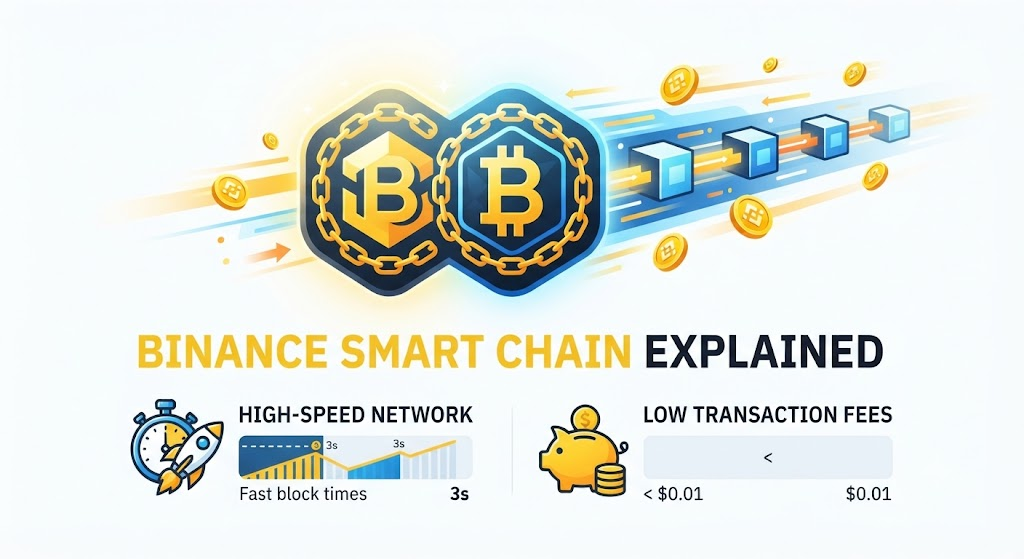
Because there are fewer validators to coordinate, blocks are created every three seconds. This makes the user experience exceptionally fast compared to legacy networks.
Dual-Chain Architecture
Binance Smart Chain uses a dual-chain system. Users can easily move assets back and forth between Binance Chain and Binance Smart Chain using specialized bridge technology. This lets traders take advantage of the ultra-fast trading speeds on Binance Chain while utilizing the complex financial applications available on Binance Smart Chain.
Why Binance Smart Chain Matters
The popularity of Binance Smart Chain stems from three major benefits that solve real-world frustrations for crypto users and developers.
1. Low Transaction Fees
On congested networks, gas fees can spike to unreasonable levels, making small transactions financially impractical. BSC keeps transaction fees remarkably low, often costing only a fraction of a cent per transfer. This makes decentralized finance accessible to users who do not want to risk losing large sums on network tolls.
2. High Transaction Speed
With a block time of roughly three seconds, transactions settle almost instantly. Users do not have to wait several minutes or hours to confirm whether a token swap or transfer went through.
3. Ethereum Compatibility (EVM Support)
Binance Smart Chain is fully compatible with the Ethereum Virtual Machine (EVM).
- EVM Compatibility: This means developers can easily copy code, smart contracts, and decentralized apps originally built for Ethereum and run them smoothly on Binance Smart Chain with little to no modification.
Practical Examples: How Users Interact With BSC
To see how Binance Smart Chain works in daily use, consider two common scenarios:
- The Retail Trader: Sarah wants to trade a newly launched digital token. On Ethereum, high gas fees might cost her more than the actual value of the trade. By using Binance Smart Chain, she connects a Web3 wallet, executes the swap in seconds, and pays a fee of less than one cent.
- The Yield Farmer: Mark wants to deposit his crypto into a liquidity pool to earn interest. Because BSC offers fast settlement and low overhead, he can compound his earnings multiple times a day without eating away his profits in network fees.
Real-World Considerations and Trade-Offs
While the speed and low cost are attractive, an experienced professional knows that no blockchain network is a silver bullet. Every architectural choice involves trade-offs.
Centralization vs. Decentralization
The biggest trade-off on Binance Smart Chain is centralization. Because the network relies on a small, restricted set of validators (often hovering around 21 active nodes), it is far more centralized than networks secured by tens of thousands of independent computers.
- The Risk: If a majority of these validators collude, experience technical downtime, or face external pressure, the network’s security and uptime could be compromised.
Security and Scam Risks
Because deploying smart contracts on BSC is cheap and easy, the network has historically attracted a higher volume of low-quality projects, copycat tokens, and malicious smart contracts (such as “rug pulls”). Users must exercise extreme caution and verify project code before interacting with unfamiliar decentralized applications.
Common Mistakes Beginners Should Make Sure to Avoid
Navigating a new blockchain network can be tricky. Beginners often make avoidable operational errors that lead to lost funds.
- Mistake: Sending assets across the wrong network bridge.
- Why it happens: Users often confuse Binance Chain, Binance Smart Chain, and Ethereum network addresses.
- What happens: Funds can become temporarily stuck or lost if sent to an incompatible deposit address format.
- What to do instead: Always double-check network compatibility before transferring assets, and perform a small test transaction first.
- Mistake: Ignoring token contract addresses.
- Why it happens: Searching for popular token names on decentralized exchanges often reveals multiple fake tokens with identical names.
- What happens: Purchasing a fake copycat token instead of the genuine asset.
- What to do instead: Always verify the official smart contract address from trusted tracking sites like BscScan or CoinMarketCap before trading.
- Mistake: Not keeping native gas tokens for fees.
- Why it happens: Users transfer all their funds into a specific token and forget to leave a small amount of BNB in their wallet.
- What happens: The wallet cannot pay the transaction fee to move or sell the tokens.
- What to do instead: Always keep a small reserve balance of the network’s native gas token (BNB) to cover future transaction fees.
Risks and Limitations
| Risk Factor | Why It Matters | How to Reduce the Risk |
| Validator Centralization | Fewer validators mean higher concentration of control over network consensus. | Diversify asset storage across multiple distinct blockchain ecosystems. |
| Smart Contract Exploits | Low deployment costs attract unverified code and experimental protocols prone to bugs. | Only interact with protocols that have undergone public security audits. |
| Phishing and Fake Apps | Malicious actors create clone websites mimicking popular decentralized exchanges. | Bookmark official dApp links and avoid clicking unverified links from social media. |
Decision-Making Framework: When to Use BSC
Before deciding to build or transact on Binance Smart Chain, evaluate your specific goals using this simple step-by-step framework:
- Assess Transaction Volume: Are you executing frequent, low-value transactions where high fees would destroy profitability? If yes, BSC is a strong candidate.
- Evaluate Security Requirements: Do you prioritize absolute decentralization and maximum censorship resistance, or are speed and low cost your primary drivers?
- Check Asset Availability: Are the tokens and liquidity pools you want to use natively supported on the network?
- Verify Ecosystem Support: Does your preferred crypto wallet and analytics tool fully support the network configuration?
Key Terms
- Validator: A specialized node operator responsible for verifying transactions and adding new blocks to the blockchain.
- Gas Fee: A small transaction fee paid to network validators to process and secure operations on the blockchain.
- DApp (Decentralized Application): An application built on top of a blockchain that runs automatically via smart contracts without a central authority.
- BscScan: The official block explorer used to search transactions, check wallet balances, and inspect smart contracts on Binance Smart Chain.
- BEP-20: The technical token standard used on Binance Smart Chain, similar to ERC-20 on Ethereum.
- Web3 Wallet: A digital cryptocurrency wallet that lets users interact with decentralized applications and store private keys securely.
FAQs
What is the difference between Binance Chain and Binance Smart Chain?
Binance Chain was built specifically for high-speed digital asset trading, while Binance Smart Chain was added later to support programmable smart contracts and decentralized applications.
Do I need BNB to use Binance Smart Chain?
Yes. Just as Ethereum requires ETH to pay for transaction fees, Binance Smart Chain requires a small amount of BNB to pay for gas fees when executing swaps or transfers.
Is Binance Smart Chain safe to use?
The underlying blockchain infrastructure is secure, but individual decentralized applications built on top of it vary wildly in quality and security. Users must exercise caution and avoid unverified projects.
Can I send Ethereum tokens directly to Binance Smart Chain?
No. Ethereum tokens use the ERC-20 standard, while BSC uses BEP-20. Sending assets directly across different networks without using a proper bridge will result in lost funds.
How do I add Binance Smart Chain to my crypto wallet?
Most modern Web3 wallets like MetaMask allow you to add Binance Smart Chain automatically by selecting it from the network dropdown menu or configuring custom Remote Procedure Call (RPC) settings.
Why are transaction fees so low on BSC?
Fees remain low because the network uses a Proof of Staked Authority model with a small number of validators, allowing high transaction throughput without bidding wars for block space.
What wallet should I use for Binance Smart Chain?
Any wallet that supports EVM-compatible networks—such as MetaMask, Trust Wallet, or Binance Web3 Wallet—can store assets and interact with applications on BSC.
Conclusion
Binance Smart Chain bridged a major gap in the cryptocurrency ecosystem by offering high-speed transactions and low fees without sacrificing compatibility with Ethereum-based developer tools. While its validator model introduces a higher degree of centralization, its practical utility for everyday users and developers remains undeniable. By understanding the underlying architecture, keeping sufficient gas reserves, and practicing basic operational security, you can explore the BSC ecosystem efficiently and safely.