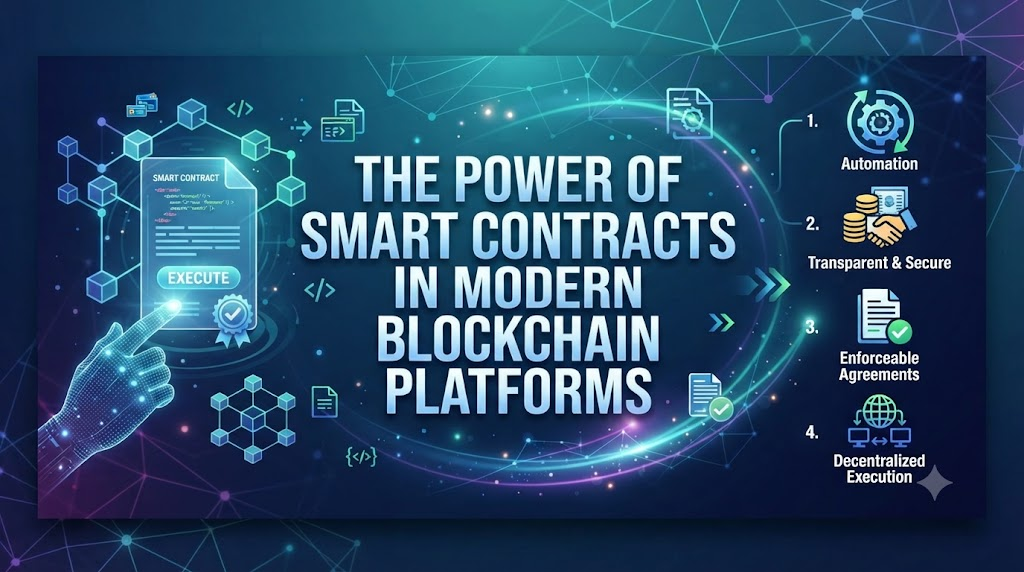
Introduction
Imagine buying a house the traditional way. You sign stacks of papers, send money to an escrow agent, wait for title searches, and pay various fees just to ensure the seller actually hands over the keys. This process involves multiple third parties, takes days or weeks, and costs extra money.
Now imagine a digital system where the rules of the sale are written directly into computer code. Once the buyer sends the money to the system, the digital ownership deed transfers instantly to the buyer, and the seller receives the funds. No middlemen. No waiting.
This is the power of smart contracts. They act as the hidden engine driving modern blockchain platforms, transforming simple currency networks into powerful programmable computers. Understanding how they work is essential for anyone looking to navigate the future of digital finance, decentralized apps, and digital ownership.
What Are Smart Contracts?
A smart contract is a digital agreement written as computer code and stored on a blockchain.
To understand the term, it helps to break it down:
- Smart: It can make decisions and trigger actions on its own based on inputs.
- Contract: It outlines terms, conditions, and outcomes agreed upon by different parties.
Why It Matters
Traditional contracts rely on trust and legal systems. If someone breaks a contract, you have to go to court, which is expensive and slow. Smart contracts remove the need for blind trust. Because they live on a blockchain, they cannot be changed or stopped once launched. The code becomes the ultimate authority.
Example
Think of a vending machine. You insert money, select a snack, and the machine drops the item. You do not need a cashier to verify your money or hand you the snack. A smart contract is simply a digital vending machine that can handle much more complex agreements, like insurance payouts or real estate transfers.
How Smart Contracts Work
Smart contracts operate through a straightforward process of automated logic. They sit quietly on the blockchain until an event wakes them up.
The Step-by-Step Process
- The Agreement: Two or more parties write down the business logic and terms of their agreement in code.
- Deployment: The code is uploaded and published to the blockchain network.
- Trigger Event: An external event occurs, such as a specific date arriving, a payment being received, or temperature data being sent from a sensor.
- Execution: The blockchain network automatically checks if the conditions are met. If they are, the code executes the outcome—such as releasing funds or issuing a digital token.
- Finality: The result is recorded permanently on the blockchain ledger, where it cannot be altered or deleted.
Why Smart Contracts Matter for Blockchain Platforms
Without smart contracts, a blockchain is basically a digital ledger that only tracks who owns a specific digital coin, much like a basic spreadsheet. Smart contracts turn that ledger into a global, decentralized computer.
Key Benefits
- Speed and Automation: Transactions happen instantly without manual review.
- Accuracy: Code does not make human errors or misread terms.
- Trustlessness: Participants do not need to know or trust each other; they only need to trust the code.
- Cost Reduction: Removing intermediaries eliminates heavy service fees.
Practical Examples of Smart Contracts in Action
Smart contracts power many industries today. Here is how they solve everyday problems.
Decentralized Finance (DeFi)
Imagine you want to borrow money. In traditional banking, you submit tax forms, employment history, and wait days for approval. With a DeFi lending platform powered by smart contracts, you deposit digital assets as collateral into a smart contract. The contract automatically locks your collateral and instantly releases a digital loan to your wallet. If you repay the loan plus interest, the contract unlocks your collateral. If you fail to repay, it automatically liquidates the collateral to cover the debt, requiring no human intervention.
Supply Chain Management
Consider a shipment of perishable medicine moving across the globe. A smart contract can be linked to an internet-connected temperature sensor inside the shipping container. If the temperature stays within safe limits, the contract automatically releases payment to the shipping company upon delivery. If the temperature rises too high, the contract flags a violation, automatically withholding payment or triggering a penalty.
Real-World Considerations and Challenges
While smart contracts offer incredible automation, they come with real operational challenges that builders and users must manage.
The Immutability Trap
Because blockchain records are permanent, immutability (the inability to change data once written) is a core feature. However, if a developer writes a bug into a smart contract, that bug is also permanent. Once deployed, flawed code cannot simply be edited like a traditional software update. Hackers often exploit these bugs to steal millions of dollars.
Oracle Problem
Smart contracts are isolated inside the blockchain network. They cannot natively look at the outside world to check if a flight was delayed or if a sports team won a game. To solve this, developers use oracles—secure bridges that feed external real-world data into the blockchain. If an oracle is compromised or provides false data, the smart contract will execute incorrectly based on that bad information.
Common Mistakes Beginners Make
When interacting with or designing smart contract platforms, beginners often run into avoidable pitfalls:
- Trusting Unaudited Code: Users often deposit money into decentralized apps without checking if independent security experts have reviewed the code. Solution: Only use platforms that have public security audit reports from reputable firms.
- Ignoring Gas Fees: Every action a smart contract performs requires computational power, paid for in network transaction fees (often called gas). Beginners sometimes execute transactions during peak network congestion, losing significant money in fees. Solution: Monitor network traffic and execute transactions during off-peak hours.
- Mistaking Code for Legal Protection: A smart contract is technically binding on-chain, but it may not comply with local legal frameworks, leaving users with little legal recourse if things go wrong. Solution: Understand the regulatory standing of the platform you use.
Risks and Limitations
| Risk / Limitation | Why It Matters | How to Reduce It |
| Coding Bugs | Flawed logic can lead to permanent loss of funds. | Use audited protocols and start with small amounts. |
| High Gas Costs | Complex operations can become very expensive during network congestion. | Optimize contract code or use layer-2 scaling networks. |
| Irreversible Errors | Sending funds to the wrong contract address means they are gone forever. | Double-check addresses and test with small transactions first. |
Decision-Making Framework: When to Use Smart Contracts
Before relying on or building a smart contract solution, evaluate your situation using these steps:
- Identify the Need: Do you need to remove a middleman or automate a trusted workflow?
- Evaluate Complexity: Can the agreement be translated cleanly into rigid, logical “if/then” computer rules?
- Assess Security Requirements: Can you afford the risk of potential code bugs or exploits?
- Check Cost vs. Benefit: Will the automation save more money and time than it costs in deployment and network fees?
- Verify Data Needs: Does the contract require real-world data feeds, and are those data sources secure?
Key Terms
- Blockchain: A shared, digital ledger that securely records transactions across a network of computers.
- Gas Fees: The transaction fees paid to compensate the computing network for executing smart contracts.
- Immutability: The characteristic of data that prevents it from being altered or deleted once recorded.
- Oracle: A secure tool that connects blockchains to external, real-world data sources.
- Decentralization: The transfer of control and decision-making from a central entity to a distributed network.
- Protocol: A set of rules governing how data is transmitted and executed on a network.
- Execution: The moment a computer program processes instructions and carries out a task.
- Collateral: An asset pledged as security for the repayment of a loan.
FAQs
Can a smart contract be changed after it is deployed?
No. Once a smart contract is published to the blockchain, its code is permanent. Developers must design upgradeable proxy patterns ahead of time if they want the ability to update certain parts of the contract later.
Who writes smart contracts?
Developers write smart contracts using specialized programming languages tailored for specific blockchain networks, such as Solidity for Ethereum or Rust for Solana.
Do smart contracts replace traditional legal contracts?
Not entirely. While they handle the execution of financial or digital terms efficiently, complex legal agreements involving human judgment, intent, and local jurisdiction still require traditional legal frameworks.
What happens if a smart contract fails or gets hacked?
Because blockchain transactions are final, stolen funds are rarely recoverable unless the community agrees to a rare network rollback or hackers voluntarily return the funds. This is why security audits are critical.
Are smart contracts legal?
Yes, in many jurisdictions, code-based agreements are recognized under electronic contract laws, though legal clarity varies depending on the specific use case and country.
Do I need to know how to code to use a smart contract?
No. End users interact with smart contracts through user-friendly interfaces, such as crypto wallets or decentralized app dashboards, without ever seeing the underlying code.
Why do smart contracts require fees?
Fees prevent bad actors from spamming the network with infinite loops or useless code, ensuring that the computers maintaining the blockchain are compensated for their work.
Conclusion
Smart contracts are much more than lines of code; they are the fundamental building blocks of a transparent, automated digital economy. By removing middlemen and executing agreements based on transparent logic, they bring unmatched efficiency to blockchain platforms. While risks like coding bugs and high fees require careful navigation, understanding how these digital engines work equips you to safely explore the future of decentralized technology.