Introduction
In some areas of the news, a claim can travel around the world before anyone has checked it. A screenshot is shared, a headline is repeated, and by the time the full report appears, the first version has already been quoted hundreds of times. Readers who want to stay informed are left to work out which version is current, which source is original, and which story deserves their time.
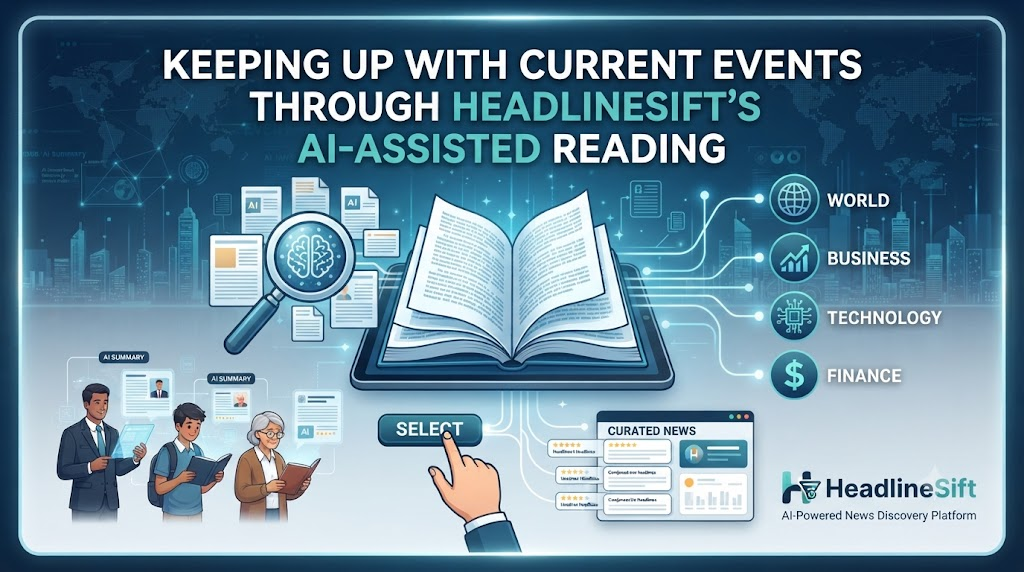
Organized news discovery tries to ease this pressure. Instead of visiting many websites one by one, a reader sees headlines from different publishers in a single place, grouped by subject, with short summaries that explain what each story is about. HeadlineSift is a platform built around this approach. It is an AI-powered service that collects headlines from hundreds of news sources and arranges them across countries and categories.
This article looks at how that process works, what AI summaries can and cannot do, and how careful readers can use them without lowering their standards for accuracy.
What HeadlineSift Aims to Do for Readers
HeadlineSift is a news discovery platform. It does not produce its own reporting. Its role is to gather headlines from many publishers, apply AI to merge duplicate coverage, and place stories in order according to how significant they appear. Readers can narrow the list by country and category, change the order to view top-ranked, latest or most covered stories, and limit results by time period. Each entry shows the publisher’s name and how many sources sit behind it.
Its categories include technology, business and economy, finance and stock market, health and wellness, science and space, education and careers, and breaking news.
The platform may suit readers such as:
- Professionals who need a brief morning scan of their field
- Analysts and researchers who track several subjects at once
- Students who follow current affairs alongside their studies
- Anyone who wants a calmer way to follow the news
Three different actions are involved, and keeping them apart is useful. Finding a story shows that something has been reported. Reading a summary shows what the report is mainly about. Opening the original article shows the evidence, the exact wording and the surrounding context.
HeadlineSift links each story to the publisher’s own report. It also provides separate pages explaining the limits of its AI summaries, how it credits sources, and how issues can be reported. This article describes the platform only within what it states publicly.
Why Staying Informed Can Feel Exhausting
Not every reader feels worn down by the news, but several pressures are common.
- Repeats take over the screen. One announcement can fill an entire page with near-identical headlines.
- A headline is a narrow window. “Review panel set up” says nothing about who sits on it or what it can decide.
- Facts arrive in stages. A first account is often corrected, extended or replaced later in the day.
- Reports differ in emphasis. Seeing the differences takes careful reading of more than one article.
- Everything claims to be urgent. With no clear signal, choosing what to read first becomes tiring.
Think of an analyst who hears that a regulator has issued new guidance. A search returns dozens of pages. Most reuse the same opening paragraph of the original notice. Only a few explain what changes in practice, who is affected, and by when. The real challenge is finding those few quickly and knowing which ones to trust.
A Detailed Look at How AI-Supported News Discovery Operates
How AI Brings Headlines From Different Outlets Together
An AI news aggregator collects headlines from many publishers and places them in one view. The software can sort stories by topic, region, how recent they are, or the event they describe. When several outlets report the same development, the system can combine them so the reader sees one story and not several copies. HeadlineSift states that it follows hundreds of sources and uses AI to merge duplicate coverage.
Gathering stories in one place does not make them independent. When a research institute publishes a report, many outlets will summarize that same document. Ten articles about one study still rest on one study. Seeing the number of sources behind a story is helpful, but readers should still ask whether those sources did their own checking or simply repeated the same material.
How AI Reduces a Long Article to Its Key Points
An AI news summarizer shortens a lengthy article by picking out its main points. Imagine a detailed report about a new ferry route. A good summary would keep the essentials: where the route runs, which ports it connects, and when the service is due to begin.
For readers with limited time, this makes it possible to review many stories quickly and open only the ones that matter to them.
Summaries come with known limitations:
- Conditions and exceptions can be lost when text is compressed.
- Words that show doubt, such as “provisional” or “pending review,” may be dropped.
- The reasons behind a decision are often the first thing to go.
- Software can misread an article, particularly when the wording is complex.
HeadlineSift reflects this honestly, since some stories show a note that AI analysis is still pending. A summary works best as a first look. When a detail will shape a decision, the original report is the right place to read it.
How Significant Headlines Are Identified and Arranged
Curated news headlines are chosen and arranged with a purpose instead of being listed in the order they arrive. A platform may consider how relevant a story is, how fresh it is, who published it, and how significant the event appears to be.
Significance and popularity are different measures. A viral clip of a celebrity can be watched by millions in a day, while a change to school examination dates may affect far more families and attract far less attention. Page views tell you what people found interesting. They do not tell you what is accurate or useful.
HeadlineSift says it ranks stories by significance. The exact method is not described here, and no ranking approach can honestly claim to be free from bias. A ranked list is best used as a starting filter, after which the reader decides what deserves a closer look.
Tracking a Story Through Its Early Reports and Updates
Some stories are rewritten as they unfold. After an earthquake, for example, the first magnitude estimate may be revised, and the first casualty figures may change many times as rescue teams reach affected areas.
A breaking news aggregator allows readers to see how different publishers cover the same developing event. Seeing their headlines next to each other makes it easier to notice which facts are shared and which appear in only one place. It does not confirm that any report is correct, and this article makes no claim about alerts or promised update times.
Some simple practices help more than any feature:
- Note the time a story was published and when it was last updated.
- Pay attention to cautious wording such as “early estimates” or “awaiting official figures.”
- Go back to the publisher’s page later and look for corrections.
- Wait before passing on details that rest on a single early report.
Following International Developments From One Place
Events in one country frequently reach others through trade, regulation, technology and prices. A global news aggregator supports awareness of this by collecting reports from many regions in a single place. HeadlineSift lets readers browse by country, including India, Japan, the United Kingdom and the United States, as well as a global view.
Local conditions change how a story should be understood. A new tariff on imports may look like a domestic matter in one country, yet it can affect exporters and their customers abroad. A report written for local readers may also assume background that outsiders do not have.
No one report can show an international event in full. On subjects that are serious or disputed, it helps to read reliable publishers from more than one country.
Making Sense of Technology and Artificial Intelligence News
Technology coverage often combines announcements, research and opinion within the same article. A technology news aggregator helps readers follow artificial intelligence, cybersecurity, software, cloud services and devices without searching many separate sites. On its technology stories, HeadlineSift adds a note that product and company information may change after publication.
It helps to separate the types of information:
- A company announcement states what the maker wants known about its product.
- A research finding describes results under specific test conditions.
- An independent test reports what an outside party measured.
- Expert commentary offers an informed view, which is still an opinion.
Suppose a laboratory announces a new battery design that lasts far longer than existing ones. That is a claim until independent researchers repeat the test and report similar results. Readers who keep these categories apart will judge technology stories more fairly.
Following Industry Trends and Company Decisions Carefully
Business coverage includes expansion plans, leadership changes, partnerships, results and trends across whole industries. A business news aggregator brings these reports together so readers can follow one sector or compare how different publishers describe the same announcement.
A headline is rarely enough. “Company to enter new market” does not say which countries, what the timetable is, how much will be invested, or which approvals are needed. The full article or the company’s own statement is where such details appear.
Business reporting describes what has been announced. It does not forecast what will happen. Facts should be confirmed before any view is formed, and assumptions about a company’s future should be avoided.
Handling Fast-Moving Market and Economic Headlines
Financial news headlines can cover stock markets, interest rates, inflation, government policy, company results and the prices of assets such as commodities or digital currencies. They are written quickly and invite over-reading.
Consider a sharp move in the price of a widely traded digital asset in a single day. It might reflect broad market sentiment, regulatory news, large trades, a technical problem at a trading venue, or economic data from elsewhere. A single headline usually points to one reason, while several often act together. It also cannot tell you whether a move will continue.
A news summary is not a personal investment recommendation. It cannot take account of anyone’s goals, finances or tolerance for risk. HeadlineSift marks its finance stories as informational only, and readers should treat them that way. No news source can promise returns or predict where a market will go.
Separating Confirmed Facts From Possible Outcomes
News impact analysis helps readers think about why an event matters and who may be affected. It is most helpful when it encourages a clear sequence of questions:
- What has happened?
- What has been confirmed?
- Who may be affected?
- What might follow?
- What is still missing?
The key is to keep established facts apart from possible outcomes. “A new rule on online advertising disclosures was announced” is a fact. “Smaller publishers may need to change how they label content” is a possible outcome. AI-generated analysis can help frame the second kind of statement, but it remains an interpretation and not a certainty. HeadlineSift cannot predict outcomes, and no tool can assess the effect of every event accurately.
Tailoring Your Reading to Subjects That Matter to You
News is more useful when it matches what a person needs to know. A student may follow education and careers. A founder may watch technology and funding news. A retired reader may care most about health and consumer prices.
A personalized news digest is a set of stories assembled around the interests of one reader. HeadlineSift describes this as a future direction, so it should not be treated as a current feature. For now, readers can approximate part of the benefit by selecting a country and a category and returning to them regularly.
Personalization has its own risks wherever it appears. A feed built only on past choices can hide viewpoints and developments a reader would have wanted to see. It may make reading easier, but it does not remove bias and does not replace looking beyond familiar subjects.
The Value of Knowing Where a Story Comes From
Readers should always be able to tell who published a story and find the full report. Three simple questions help with this. Who published it? What is the evidence behind it? When was it written?
The answers also help readers tell different kinds of content apart. An original report is produced by a newsroom and normally carries a byline or publication credit. A summary shortens someone else’s work. An opinion piece shares the writer’s view, and an AI-generated explanation is software’s reading of the material, which can contain errors.
HeadlineSift shows the publisher’s name and a link to the original report for each story, so readers can trace a claim to where it began. A link alone does not prove that a claim is true, because publishers can be wrong and important statements may need to be compared with other reliable reports. Naming the source makes checking possible, but it does not do the checking.
A Five-Step Routine for Reading the News Well
- Pick a headline from a subject you follow. Country and category filters keep the list short and the reading focused.
- Read the summary for the main idea. This shows whether the story needs more of your time.
- Check the date and who published it. Old stories can look new, and unfamiliar publishers deserve a closer look.
- Compare reliable reports on important stories. Two or three sources show where reports agree and where they differ.
- Read the full article before you act. Do not decide, publish or forward anything on the strength of a summary alone.
Pitfalls to Avoid When Reading AI-Summarized News
- Treating the summary as the whole account. Use it to choose what to read, then open the report for details.
- Trusting a headline on its own. Headlines are brief by design, so read the evidence beneath them.
- Mixing up analysis and fact. Ask whether a statement was reported by the publisher or produced by interpretation.
- Counting repeats as proof. Look at whether the articles rely on one shared source.
- Ignoring the date. Check when a story appeared and whether later reports changed the picture.
- Reading finance stories as advice. News describes events. Financial decisions should reflect your own situation and, where suitable, qualified guidance.
- Forwarding unfinished reports. Wait until the main facts have been confirmed.
A Hypothetical Example From Start to Finish
Imagine Karan, who runs a small online store and accepts digital payments. One evening he sees a headline saying that a regulator has published new rules for digital payments.
He reads the AI summary. It says the regulator has proposed new requirements for payment providers and that businesses may need to comply. That gives him the main point, but it does not say whether the rules are final.
Karan opens the original report from the publisher. The full article explains that the document is a draft released for public comment, and that the date on which any final rules would apply has not been announced. The summary had not mentioned that the rules are still a proposal.
Next, he looks for a second reliable report on the same announcement. It matches the first on the content of the draft and adds a comment from an industry group, which says some points need more clarity. Karan notes that both reports rely on the regulator’s published draft, so the second adds opinion but not new facts.
He can now separate what is known from what is not. The publication of a draft and the open comment period are confirmed. Whether the rules will change, and when they would start, are unknown. Higher compliance costs for small merchants are a possible effect and nothing more. Karan decides to watch for the final version and to check his payment provider’s own notices before changing anything. He used the summary to save time and the original sources to stay accurate.
Frequently Asked Questions Answered Simply
How can I spot a rumor before it spreads?
Look for the original source, a date, and confirmation from at least one reliable publisher. A claim with no named source, or one that only appears in forwarded images, deserves caution.
Why might an AI summary sound more certain than the article?
Shortening text often removes careful wording such as “reportedly” or “subject to approval.” Compare the summary with the article to see whether the original expressed more doubt.
What should I do when two reliable reports disagree?
Check each report’s date, see what each one cites, and look for an official document or later correction. Until the difference is settled, treat the disputed point as unconfirmed.
Is reading headlines every day enough?
Headlines give awareness, not understanding. Opening a few full reports each week on subjects that matter to you builds a much clearer picture.
What does “developing story” mean?
It means the report is still being updated as new information arrives. Details may change, so look at the update time and return later.
Why are screenshots and forwarded messages unreliable?
They often lose the date, the publisher and the surrounding text. Try to find the original report before relying on or sharing what they show.
Does reading news from several countries remove bias?
It reduces blind spots, but it does not remove bias. Each publisher still has its own perspective, so the aim is to compare, not to find a perfect source.
Can I rely on the “why it matters” notes that AI tools provide?
Treat them as prompts for thought and not as conclusions. They are interpretations that help frame questions, and the facts should still be checked in the original report. A personalized news digest, which HeadlineSift describes as a future direction, would not change that.
Closing Summary
Fast information is only useful when it is also checked. A single place for headlines, short summaries and links to the original publishers can help readers decide what to read first, and a few steady habits turn that starting point into reliable understanding. HeadlineSift supports this by collecting stories from many outlets, offering brief AI summaries, and pointing back to the reporting that each publisher produced. Used with care, it shortens the path to the stories that matter, while the final judgment about what is true and what to do with it remains with the reader.