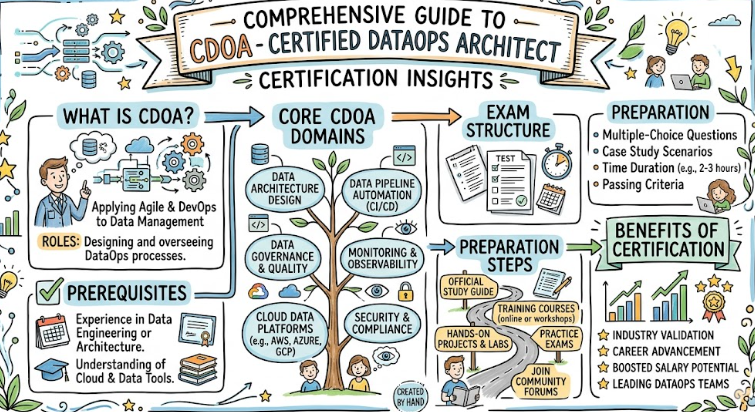
Introduction
In the world of modern technology, data is often called the new oil. However, raw data is not useful until it is refined and delivered to the right place at the right time. For years, companies struggled with “data silos” where information was stuck in one department and could not be used by others. This led to slow decision-making and many errors. To solve this, a new way of working was created, known as DataOps. It brings together data engineers, data scientists, and operations teams to make data flow smoothly. If you want to lead this change, becoming a Certified DataOps Architect (CDOA) is a powerful step for your career.
This guide is written to help you understand the path to becoming a DataOps expert. Whether you are a software engineer in India or a cloud architect working globally, the need for structured data delivery is growing every day. By the end of this article, the roadmap for mastering DataOps and the value of the CDOA certification will be fully understood.
What is CDOA – Certified DataOps Architect?
The CDOA – Certified DataOps Architect is a professional designation given to individuals who have mastered the art of automating data workflows. It is not just about knowing how to write code or manage a database. Instead, it is about designing a system where data is collected, cleaned, tested, and deployed automatically. This role is very similar to what a DevOps Architect does for software, but the focus here is entirely on the data pipeline.
A person with this certification is expected to understand how to reduce the time it takes to get insights from data. They use tools and processes to ensure that the data being used by a business is accurate and up to date. It is a high-level role that requires a mix of technical skill and strategic thinking.
Why It Matters Today?
In the current market, speed is everything. Companies are using Artificial Intelligence (AI) and Machine Learning (ML) to stay ahead of the competition. However, these technologies are useless if the data feeding them is bad or arrives too late. DataOps has become the bridge that connects data sources to the final business goal.
Today, data is being generated at an incredible rate. Traditional methods of managing data are failing. Businesses need architects who can build “pipelines” that do not break. The CDOA certification matters because it proves that a professional knows how to handle these modern challenges using automation and collaborative culture.
Why CDOA – Certified DataOps Architect Certifications are Important
Earning a certification like the CDOA is a clear signal to employers that your skills are validated by industry standards. Here is why this specific certification is important:
- Standardization: It provides a common language for data teams to work together.
- Trust: Employers feel more confident hiring someone whose skills have been tested.
- Career Growth: It opens doors to senior leadership roles in data engineering and platform architecture.
- Efficiency: Certified architects know how to eliminate waste in data processes, saving companies significant money.
Why Choose DataOpsSchool?
When looking for the right place to learn, DataOpsSchool stands out because the focus is entirely on practical, real-world skills. The curriculum is designed by people who have spent years solving complex data problems in big companies. Instead of just teaching theory, the school provides hands-on labs and projects that mimic actual industry challenges. Choosing DataOpsSchool ensures that the learning is relevant, up-to-date, and directly applicable to your daily job.
Certification Deep-Dive: CDOA – Certified DataOps Architect
What is this certification?
The CDOA certification is a professional program that teaches how to design and manage automated data pipelines. It focuses on the integration of data engineering with operational excellence to ensure high-quality data delivery.
Who should take this certification?
This program is ideal for Data Engineers, Cloud Architects, DevOps Engineers, and Senior Software Developers. It is also highly beneficial for Engineering Managers who oversee data-focused teams and want to understand the technical roadmap.
Certification Overview Table
| Track | Level | Who it’s for | Prerequisites | Skills Covered | Recommended Order |
| DataOps Foundation | Beginner | Developers | Basic SQL knowledge | Data Lifecycle, Automation | 1 |
| DataOps Engineer | Associate | Data Engineers | Python or Java | CI/CD for Data, ETL | 2 |
| DataOps Architect (CDOA) | Professional | Senior Engineers | Cloud experience | Pipeline Design, Governance | 3 |
| DataOps Leader | Executive | Managers | Team leadership | Strategy, ROI, Metrics | 4 |
| Specialized Data Security | Advanced | Security Pros | Security basics | Data Encryption, Privacy | 5 |
Skills You Will Gain
- Designing automated data pipelines from scratch.
- Implementing Continuous Integration and Continuous Deployment (CI/CD) for data.
- Monitoring data quality and performance in real-time.
- Managing data governance and compliance across different regions.
- Collaborating between data science and operations teams.
- Optimizing cloud costs related to data storage and processing.
Real-World Projects You Should Be Able to Do
- Build a fully automated ETL (Extract, Transform, Load) pipeline for a retail company.
- Create a “Data Lake” that automatically cleans and sorts incoming information.
- Setup an automated alerting system that detects “bad data” before it reaches the dashboard.
- Design a secure data sharing system for a healthcare provider.
Preparation Plan
7–14 Days Plan (The Quick Start)
- Days 1-3: Study the core principles of the DataOps Manifesto.
- Days 4-7: Learn the basics of data pipeline automation tools.
- Days 8-14: Take practice exams and review the key terminology used in the official guide.
30 Days Plan (The Deep Dive)
- Week 1: Focus on the “Data Lifecycle” and how data moves from source to user.
- Week 2: Practice setting up CI/CD pipelines using Git and automation servers.
- Week 3: Study data quality testing and how to write automated scripts for validation.
- Week 4: Review case studies and complete a mock project to test your architectural skills.
60 Days Plan (The Mastery Path)
- Month 1: Focus on the technical tools, including cloud platforms, containers, and orchestration.
- Month 2: Focus on “People and Process,” including how to build a DataOps culture and manage team workflows. Spend the final two weeks doing intense lab work.
Common Mistakes to Avoid
- Focusing only on tools and ignoring the “culture” aspect of DataOps.
- Skipping the basics of data security and compliance.
- Not practicing with real datasets during your study period.
- Trying to memorize answers instead of understanding the “why” behind the design.
Best Next Certification After This
- Same track: DataOps Leader (for those moving into management).
- Cross-track: MLOps Certification (to handle machine learning workflows).
- Leadership / Management: Engineering Management Professional.
Choose Your Learning Path
1. DevOps Path
This path is best for engineers who already manage software deployments but want to expand their skills into data systems. It focuses on using existing DevOps tools for data tasks.
2. DevSecOps Path
Best for professionals who are focused on safety. This path teaches how to build “Privacy by Design” into the data pipelines so that information is always secure.
3. Site Reliability Engineering (SRE) Path
Best for those who care about uptime. This path teaches how to make data pipelines “highly available” and how to handle failures without losing information.
4. AIOps / MLOps Path
Best for people working with Artificial Intelligence. It focuses on getting data ready specifically for training and deploying AI models.
5. DataOps Path
The primary path for data enthusiasts. It covers the entire journey of data, from the moment it is created until it is used for business decisions.
6. FinOps Path
Best for those who manage cloud budgets. It teaches how to run data pipelines in the cloud without spending more money than necessary.
Role → Recommended Certifications Mapping
| Role | Recommended Certification | Primary Goal |
| DevOps Engineer | CDOA | Automate data delivery |
| SRE | DataOps Specialist | Ensure data pipeline reliability |
| Platform Engineer | Cloud Data Architect | Build scalable data infrastructure |
| Cloud Engineer | CDOA | Manage cloud-native data services |
| Security Engineer | Data Security Expert | Protect sensitive user information |
| Data Engineer | CDOA | Professionalize data workflows |
| FinOps Practitioner | Data Cost Optimizer | Reduce data storage expenses |
| Engineering Manager | DataOps Leader | Strategic team alignment |
Next Certifications to Take
One Same-Track Certification
The Certified DataOps Professional is a great next step. This certification focuses on the day-to-day engineering tasks and deep technical implementation of the designs you create as an architect.
One Cross-Track Certification
The MLOps Architect certification is highly recommended. Since data and machine learning go hand-in-hand, knowing how to manage the models that use your data is a huge career advantage.
One Leadership-Focused Certification
The Digital Transformation Leader certification is excellent for moving into senior management. it helps you understand how to use technical tools like DataOps to change how a whole company functions.
Training & Certification Support Institutions
DevOpsSchool
This institution is a leader in providing hands-on training for DevOps and DataOps. They are known for their intensive lab sessions and experienced instructors who help students solve real-world problems.
Cotocus
Cotocus provides specialized consulting and training services focused on modern cloud technologies. They help professionals bridge the gap between traditional IT and automated cloud-native environments.
ScmGalaxy
ScmGalaxy is a global community and training platform that focuses on software configuration management. They provide a wealth of resources for anyone looking to master automation and CI/CD.
BestDevOps
This platform offers curated learning paths for engineers who want to stay updated with the latest industry trends. Their focus is on high-quality content that is easy to digest for busy professionals.
devsecopsschool.com
This site is dedicated to the integration of security into the DevOps process. It provides certifications and training for those who want to make “security” a core part of their delivery pipeline.
sreschool.com
A specialized institution focused on the principles of Site Reliability Engineering. They teach how to build systems that are stable, scalable, and easy to monitor.
aiopsschool.com
This school focuses on the future of operations, where AI is used to manage IT systems. It is the go-to place for learning how to use machine learning for system monitoring.
dataopsschool.com
The primary institution for DataOps education. They provide the CDOA certification and other data-focused programs designed to create the next generation of data architects.
finopsschool.com
This school teaches the art of cloud financial management. It helps engineers and managers understand how to balance technical performance with cloud spending.
FAQs Section
1. What is the difficulty level of the CDOA exam?
The exam is considered moderate to high difficulty. It requires a solid understanding of both data engineering and automation principles.
2. How much time is required to prepare for CDOA?
For most working professionals, 30 to 60 days of consistent study is sufficient to pass the exam and understand the concepts.
3. Are there any prerequisites for this certification?
While there are no strict requirements, it is highly recommended to have basic knowledge of SQL, cloud computing, and at least one programming language like Python.
4. What is the recommended certification sequence?
It is best to start with a Foundation level course, move to the Engineer level, and then take the Architect (CDOA) certification.
5. What is the career value of becoming a CDOA?
Certified architects often see a significant increase in salary and are eligible for senior roles like Lead Data Engineer or Head of Data Operations.
6. Which job roles can I apply for after this?
You can apply for roles such as DataOps Architect, Senior Data Engineer, Cloud Data Lead, and Platform Architect.
7. Does the certification expire?
Most professional certifications require renewal or continuing education every two to three years to ensure your skills stay current.
8. Is the CDOA certification recognized globally?
Yes, the principles taught in the CDOA program are based on global industry standards used by major tech companies worldwide.
9. Can I take the exam online?
Yes, the certification exam can be taken through the official portal from the comfort of your home or office.
10. What kind of growth can I expect in the DataOps field?
The demand for DataOps professionals is growing faster than traditional software roles as more companies become “data-driven.”
11. Is there a community for CDOA professionals?
Yes, once certified, you gain access to a global network of professionals for sharing knowledge and job opportunities.
12. How does DataOps differ from regular Data Engineering?
Data Engineering focuses on building the pipes, while DataOps focuses on making sure those pipes are automated, tested, and constantly improving.
Additional FAQs for CDOA – Certified DataOps Architect
1. What specific tools are covered in the CDOA program?
The program covers a variety of tools including orchestration engines, container platforms, cloud data warehouses, and automated testing frameworks.
2. How does the CDOA help in reducing “Data Debt”?
It teaches architects how to build clean, documented, and automated systems that prevent the buildup of messy, unmanageable data over time.
3. Can an Engineering Manager benefit from CDOA?
Yes, it provides the technical vocabulary and strategic framework needed to lead high-performing data teams.
4. Is Python mandatory for the CDOA certification?
While not mandatory for the certification itself, Python is the most common language used in the field, so knowing it is very helpful.
5. How does CDOA address data privacy?
The curriculum includes sections on how to build automated checks for data masking and compliance within the delivery pipeline.
6. What is the format of the CDOA exam?
The exam usually consists of multiple-choice questions and case-study-based scenarios that test your architectural decision-making.
7. Are there lab environments provided during the training?
Yes, the official training programs include cloud-based labs where you can practice building real pipelines.
8. Why is DataOps called the “DevOps for Data”?
Because it applies the same principles of automation, collaboration, and continuous improvement to data that DevOps applied to software code.
Testimonials
The CDOA program completely changed how I look at our data workflows. I now have the confidence to automate things I used to do manually every day.
— Arjun
After getting certified, I was able to lead a project that reduced our data processing time by 40%. The real-world application is immediate.
— Sarah
I finally have career clarity. I knew I liked data and automation, and this certification showed me exactly how to combine them into a senior role.
— Rohan
The skills I gained helped me secure a promotion to Lead Architect. The focus on data quality and testing was exactly what my company needed.
— Priya
As a manager, this certification helped me understand the technical hurdles my team faces. We are now much more aligned on our goals.
— Vikram
Conclusion
The journey to becoming a Certified DataOps Architect (CDOA) is an investment in your future. As the world becomes more reliant on data, the people who know how to manage its flow will be the most valuable professionals in the room. This certification is not just a piece of paper; it is a comprehensive learning path that prepares you for the challenges of modern engineering.
By choosing a strategic learning path and utilizing the resources at DataOpsSchool, you can position yourself at the forefront of the technology industry. Whether you are looking for career growth, a higher salary, or the ability to solve more complex problems, the CDOA is the right choice. Start your journey today, plan your studies carefully, and join the ranks of the world’s leading data architects.