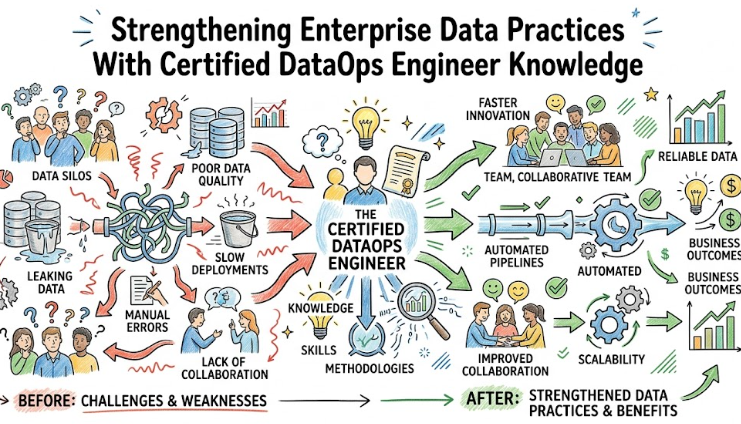
Information is being generated at a speed that has never been seen before. For many companies, the problem is no longer getting data, but making it useful. Data often gets stuck in silos, or the quality is too poor to use for making decisions. This is where DataOps comes in. It is a way of working that brings together data engineers, data scientists, and operations teams to make the flow of information smooth and reliable.
The CDOE – Certified DataOps Engineer program is designed to help professionals master this flow. It focuses on using automation and lean manufacturing principles to improve how data is managed. By following this guide, you will understand how this certification can change your career and help your company turn raw data into real value.
What is CDOE – Certified DataOps Engineer
The CDOE – Certified DataOps Engineer is a professional credential that proves a person knows how to manage data pipelines using modern DevOps practices. It is not just about knowing how to write code; it is about knowing how to create a system where data is tested, monitored, and delivered automatically. This certification ensures that a person can reduce the time it takes to get insights from data while keeping the quality high.
Why it matters today?
In the current market, data is the fuel for every major decision. However, many data projects fail because the manual work involved is too slow. Companies are looking for experts who can automate these processes. Being a CDOE means you have the skills to stop data bottlenecks. It matters because it bridges the gap between the people who create data and the people who need to use it to grow a business.
Why CDOE – Certified DataOps Engineer certifications are important
Having a certification like CDOE is important because it provides a standard way to measure your skills. It shows employers that you have been trained in a specific, proven methodology. In a crowded job market, it helps your resume stand out to hiring managers. It also gives you the confidence to lead big data projects because you have a clear roadmap to follow.
Why Choose DataOpsSchool?
DataOpsSchool is chosen by many professionals because the training is built on real-world experience. The focus is kept on practical skills that can be used on the job the very next day. Complex topics are broken down into simple steps that are easy to follow. Instead of just learning theory, students are shown how to solve the actual problems that data teams face. It is a place where learning is made simple, human, and effective for career growth.
Certification Deep-Dive: CDOE – Certified DataOps Engineer
What is this certification?
This is a professional program that teaches you how to apply DevOps principles to data management. It focuses on automating data pipelines and ensuring high data quality through continuous testing.
Who should take this certification?
This program is perfect for data engineers, software developers, and cloud architects. It is also very helpful for team leads who want to improve how their data departments operate.
Certification Overview Table
| Track | Level | Who it’s for | Prerequisites | Skills Covered | Recommended Order |
| DataOps Foundation | Beginner | New Data Engineers | Basic Data Knowledge | Data Lifecycle, Lean | 1st |
| CDOE – Professional | Intermediate | Working Engineers | DevOps Basics | Automation, Testing | 2nd |
| DataOps Security | Specialist | Security Engineers | CDOE Level 1 | Encryption, Governance | 3rd |
| DataOps Architect | Advanced | Senior Leads | 5+ Years Exp | Scaling, Strategy | 4th |
| MLOps Integration | Specialist | Data Scientists | Basic Python | Model Deployment | 5th |
Skills you will gain
- Automating data movement from one system to another.
- Writing automated tests to check data quality.
- Setting up monitoring tools to catch data errors early.
- Using version control for data sets and pipelines.
- Managing data infrastructure using code.
- Improving communication between data and operations teams.
Real-world projects you should be able to do after this certification
- Building a fully automated pipeline that moves data from a database to a dashboard.
- Setting up a system that alerts the team if data looks wrong or “dirty.”
- Creating a “sandbox” environment where data scientists can play with data safely.
- Reducing the time it takes to update a data warehouse from days to minutes.
Preparation plan
7–14 days plan:
Focus on the core concepts of DataOps and lean thinking. Read the official study guide and watch the basic introductory videos. Understand the vocabulary used in the exam.
30 days plan:
Spend two hours a day practicing with automation tools. Set up a simple data pipeline on your own computer. Review the security and compliance sections of the training.
60 days plan:
Take multiple practice exams to find your weak spots. Focus on scaling data systems and managing large teams. Complete all the lab exercises provided by the school.
Common mistakes to avoid
- Trying to memorize answers instead of understanding the process.
- Ignoring the cultural side of DataOps, which is about teamwork.
- Skipping the hands-on lab work.
- Not spending enough time learning about data testing.
Best next certification after this
Same track:
The Certified DataOps Architect is the best next step to move into high-level design roles.
Cross-track:
The Certified DevSecOps Professional helps you add a strong layer of security to your data pipelines.
Leadership / management:
The Engineering Manager Program is recommended for those who want to move into people management and strategy.
Choose Your Learning Path
- DevOps Path: Best for those who want to focus on the tools and speed of software delivery. It is great for engineers who love automation.
- DevSecOps Path: Best for professionals who want to make security a part of every step. It is for those who want to protect data from hackers.
- SRE Path: Best for people who care about making sure systems never go down. It focuses on reliability and performance.
- AIOps / MLOps Path: Best for those working with Artificial Intelligence. It helps you manage the models that power AI apps.
- DataOps Path: Best for engineers who want to specialize in the flow of information. It is the perfect choice for the modern data era.
- FinOps Path: Best for those who want to manage the costs of the cloud. It is for people who enjoy both finance and technology.
Role → Recommended Certifications Mapping
| Current Role | Recommended Certification | Primary Benefit |
| DevOps Engineer | CDOE | Learn to handle data pipelines |
| SRE | AIOps | Use AI to predict system failures |
| Platform Engineer | CDOE | Build better data platforms |
| Cloud Engineer | FinOps | Control cloud spending |
| Security Engineer | DevSecOps | Automate security checks |
| Data Engineer | CDOE | Automate data delivery |
| FinOps Practitioner | Cloud Economics | Optimize cloud value |
| Engineering Manager | Leadership | Lead technical teams better |
Next Certifications to Take
Same-track certification:
The Advanced DataOps Specialist is a great choice. It goes deeper into complex data structures and global data movement.
Cross-track certification:
The Certified MLOps Engineer is recommended. Since data and AI go together, knowing how to manage machine learning models is a huge advantage.
Leadership-focused certification:
The Digital Transformation Lead certification is perfect. it helps you understand how to change a whole company’s culture to be more data-driven.
Training & Certification Support Institutions
- DevOpsSchool: A leading place to learn automation and cloud skills. They offer very practical courses for working professionals.
- Cotocus: They provide specialized training and consulting for high-level tech roles. Their focus is on helping teams work better together.
- ScmGalaxy: This institution is known for its deep knowledge of source code management and delivery tools. They have a very large community.
- BestDevOps: They offer simplified training paths for those looking to enter the world of DevOps. Their materials are very beginner-friendly.
- devsecopsschool.com: A dedicated site for learning how to combine security with development. They focus on modern security tools.
- sreschool.com: This school focuses on site reliability. They teach you how to keep websites running 24/7.
- aiopsschool.com: They provide training on how to use AI to improve IT operations. It is a very forward-looking institution.
- dataopsschool.com: The primary source for CDOE training. They are the experts in the field of data operations.
- finopsschool.com: This school teaches you how to manage the financial side of the cloud. It is great for saving company money.
FAQs Section
- What is the difficulty level?
The CDOE exam is considered intermediate, requiring a solid understanding of both data and automation concepts. - How much time is required to prepare?
Most professionals need 30 to 45 days of consistent study to pass. - Are there any prerequisites?
Basic knowledge of data and some experience with cloud or Linux is helpful, though not strictly required. - What is the best certification sequence?
Recommended sequence: DataOps Foundation → CDOE → DataOps Architect. - Does this certification have career value?
Yes, it is highly valued, as companies are increasingly looking for expertise to manage big data projects efficiently. - Which job roles can I get after this?
Roles include DataOps Engineer, Data Pipeline Architect, or Senior Data Engineer. - Is there a lot of coding involved?
There is some scripting and configuration, but the focus is more on process and using tools effectively. - How long is the certification valid?
Typically valid for two years, after which renewal is recommended to stay current. - Can I take the exam online?
Yes, the exam can be taken securely from home or office. - Is the training included with the exam?
Most candidates choose a package that includes both training materials and exam voucher. - How much does it cost?
Prices vary depending on the training package, but it is considered an investment in your career. - Will this help me get a job in India?
Yes, demand for data experts in India is growing rapidly, especially in major tech hubs.
CDOE – Certified DataOps Engineer FAQs
- What is the main goal of CDOE?
To teach how to deliver high-quality data to users as quickly as possible. - Does CDOE cover cloud platforms?
Yes, it covers data management across major cloud providers like AWS and Azure. - Is CDOE better than a standard Data Engineering course?
CDOE focuses on the “Operations” and “Automation” side, which many traditional courses overlook. - What tools will I learn in CDOE?
You will learn tools for data integration, automated testing, and pipeline monitoring. - Is the CDOE community active?
Yes, there is a large, growing community of professionals who share tips and job openings. - Does the CDOE program include hands-on labs?
Yes, practical labs are a major part of the learning experience. - How does CDOE help with data quality?
It teaches how to build automated checks so that bad data never reaches the final user. - Can I move from DevOps to DataOps easily?
Yes, many DevOps skills are transferable, and CDOE provides the specific data knowledge needed.
Testimonials
The CDOE program helped me understand how to automate my data pipelines. My confidence in handling large data sets has grown significantly.
— Arjun
I was able to apply the testing techniques I learned immediately at work. Our data quality has improved, and the team is much happier.
— Sarah
This certification gave me a clear path to move from a general cloud role into a specialized data position. It was the best move for my career.
— Vikram
The focus on security in the CDOE track was exactly what I needed. I now feel much safer managing sensitive customer information.
— Priya
As a manager, I now have a better framework to lead my team. We have reduced our delivery time by half thanks to these principles.
— Mateo
Conclusion
In the fast-moving world of modern technology, being able to manage information quickly and safely is a skill that cannot be ignored. The CDOE – Certified DataOps Engineer certification provides you with a professional edge by teaching you how to turn messy data into a streamlined, automated success story. It is more than just a certificate; it is a complete shift in how you think about data delivery and teamwork. By focusing on automation and quality, you ensure that your career remains strong even as the industry changes. Companies will always need experts who can bridge the gap between technical code and business results. Choosing to follow the DataOps path is a strategic decision that leads to better job opportunities, higher confidence in your technical abilities, and the chance to lead the next generation of data-driven innovation.