Introduction
Imagine you want to trade your old video game with someone across town. You could use an online store that takes a fee, holds the game, and handles the trade. That is how traditional crypto exchanges work. Or, you could meet your friend in person and swap the game directly.
When people started buying and selling digital currency, they relied heavily on big companies to manage their trades. But these middlemen come with risks. If the company gets hacked, goes bankrupt, or freezes your account, your money is at risk.
To solve this problem, software developers built platforms that let computers handle trades automatically. This article explains what decentralized exchanges are, how they function behind the scenes, and what you need to know before using them.
What Is a Decentralized Exchange (DEX)?
A decentralized exchange, or DEX, is a peer-to-peer marketplace where users can buy and sell cryptocurrencies directly with one another. There is no boss, no customer service department, and no corporate bank account holding the deposits.
Simple Meaning
Think of a DEX as a digital vending machine. Instead of giving your money to a store cashier who hands you an item, you put your money into the machine, and the machine instantly gives you what you bought based on built-in rules.
Why It Matters
On standard exchanges, you must trust a third party with your private keys and your cash. With a DEX, you connect your personal crypto wallet directly to the network. You stay in control of your digital assets until the exact second a trade happens.
Example
If you want to trade Ethereum for another digital token, a traditional exchange requires you to deposit your Ethereum into their account first. On a DEX, your Ethereum stays safely in your own wallet until the computer code executes the swap.
How Decentralized Exchanges Work
Understanding a DEX requires looking at the core technology that makes peer-to-peer trading possible without human intervention.
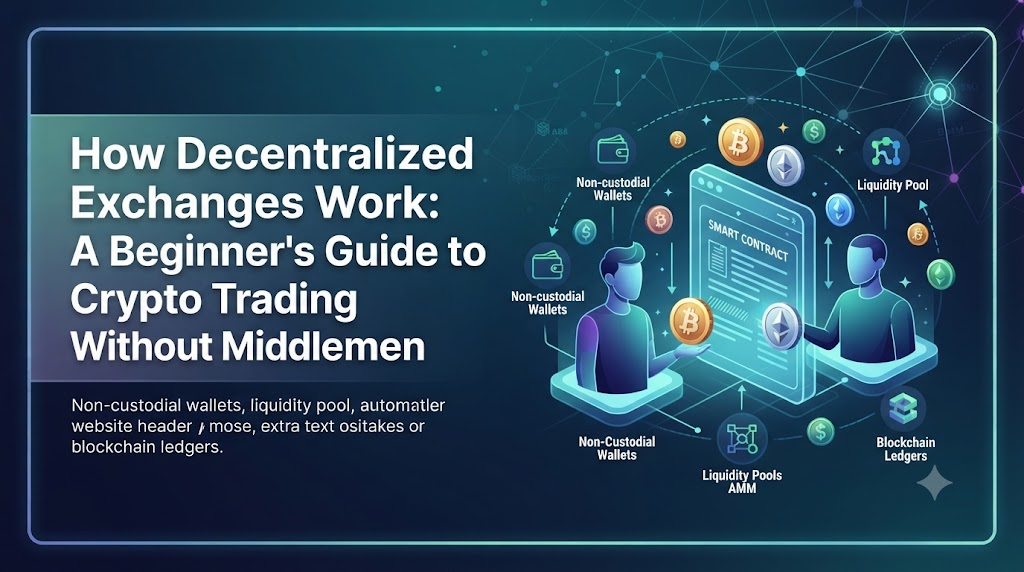
Automated Market Makers (AMMs)
Most modern DEXs do not use traditional order books—the long lists of buyers and sellers found on stock exchanges. Instead, they use Automated Market Makers, or AMMs.
An AMM uses mathematical formulas to price assets based on supply and demand. Instead of trading with another person directly, you trade against a pool of tokens locked in a smart contract.
Liquidity Pools
Liquidity pools are crowdsourced collections of digital tokens locked in a smart contract. Everyday users—called liquidity providers—deposit pairs of tokens into these pools so that other people can trade them easily. In return, these providers earn a small percentage of the trading fees collected by the platform.
Smart Contracts
A smart contract is a piece of computer code stored on a blockchain that automatically runs when specific conditions are met. No human needs to approve the trade. If you send the correct amount of token A into the contract, it instantly releases token B to your wallet.
Why DEXs Matter in Modern Finance
Decentralized exchanges shifted how people think about financial control and market access.
Global Access
Traditional financial systems require identity checks, bank accounts, and geographic approvals. Anyone with an internet connection and a digital wallet can access a DEX from anywhere in the world.
No Account Creation
You do not need to submit a passport, utility bill, or email address to use most DEXs. You simply link your self-custody wallet, and you are ready to trade.
Self-Custody Security
Because you never hand your funds over to a centralized company, you eliminate the risk of a corporate hack stealing your account balance.
Practical Examples of Using a DEX
To see how this works in daily life, consider two common scenarios.
Scenario A: Swapping Tokens
A beginner named Alex wants to trade a popular cryptocurrency for a newly launched project token that is not listed on major centralized apps. Alex connects a browser wallet to a popular DEX, selects the two tokens, reviews the network fee, and clicks swap. Within seconds, the smart contract completes the exchange directly in Alex’s wallet.
Scenario B: Providing Liquidity
An experienced user named Sam has extra crypto sitting idle. Instead of letting it rest, Sam deposits equal dollar amounts of two different tokens into a liquidity pool. Whenever other traders use that pool, Sam earns a tiny cut of the transaction fees.
Common Mistakes Beginners Make
Jumping into decentralized trading without preparation can lead to costly errors.
- Forgetting Gas Fees: Users often try to trade their entire crypto balance without keeping a small amount behind to pay network transaction fees.
- Why it happens: Beginners view gas fees as hidden costs rather than necessary fuel for the blockchain network.
- The problem: The transaction fails, and the user wastes money on the failed attempt.
- What to do instead: Always keep a small reserve of the native blockchain currency in your wallet to cover network transaction costs.
- Ignoring Slippage Settings: Users accept default platform settings without checking price movement tolerances.
- Why it happens: The interface looks simple, so people click through default settings quickly.
- The problem: Low-liquidity tokens can swing wildly in price during a trade, giving the user far fewer tokens than expected.
- What to do instead: Learn how to adjust slippage tolerance settings carefully, especially for smaller or newer digital assets.
- Connecting to Fake Websites: Users click search engine ads that lead to malicious copies of popular DEX platforms.
- Why it happens: Scammers buy ads mimicking legitimate project URLs to trick users.
- The problem: Approving a malicious smart contract can drain an entire wallet balance instantly.
- What to do instead: Bookmark official URLs and double-check browser links before connecting any wallet.
Risks and Limitations
While DEXs offer freedom and privacy, they come with unique risks that differ from traditional financial institutions.
| Risk Factor | Traditional Exchange | Decentralized Exchange (DEX) |
| Account Recovery | Customer support can reset passwords and recover locked accounts. | Impossible if you lose your private keys or seed phrase. |
| Transaction Errors | Support staff can sometimes reverse accidental transfers or trades. | Permanent and irreversible once the smart contract executes. |
| Regulatory Oversight | Bound by strict local consumer protection laws and insurance rules. | Often operates globally with minimal legal safety nets for users. |
| Smart Contract Bugs | N/A | Code errors can lead to exploits and loss of pooled funds. |
Decision-Making Framework: When to Use a DEX
Deciding whether to use a decentralized exchange depends on your goals, technical comfort level, and asset choices.
- Check Your Comfort with Self-Custody: Are you confident managing your own private keys and wallet security? If losing your password means losing everything permanently, ensure your backup habits are solid before using a DEX.
- Identify the Assets You Need: Are you looking for newer, community-driven tokens that centralized platforms do not list yet? DEXs offer access to a much wider variety of digital assets.
- Evaluate Fees: Compare the blockchain network gas fees against the trading fees charged by centralized platforms to see which option is more cost-effective for your trade size.
- Assess Security Knowledge: Do you know how to verify smart contract addresses and spot phishing attempts? If you are entirely new to crypto, practicing with small amounts first is a wise precaution.
Checklist for Safe DEX Trading
- Verify the exact URL of the decentralized exchange to avoid phishing scams.
- Check that your wallet contains enough native blockchain currency to cover gas fees.
- Review token contract addresses carefully to ensure you are trading the correct asset.
- Set appropriate slippage tolerance levels based on token market depth.
- Disconnect your wallet from the platform website immediately after completing your trade.
Key Terms
- Automated Market Maker (AMM): A protocol that prices assets mathematically using liquidity pools instead of matching individual buyers and sellers.
- Gas Fees: Transaction fees paid to network validators to process and record actions on a blockchain.
- Liquidity Pool: A collection of digital funds locked in a smart contract that enables automated trading.
- Private Key: A secret cryptographic code that proves ownership of your crypto assets and authorizes transactions.
- Seed Phrase: A sequence of random words generated by your crypto wallet used to back up and recover all your assets.
- Slippage: The difference between the expected price of a trade and the price at which the trade actually executes.
- Smart Contract: Self-executing computer code living on a blockchain that automates agreements without middlemen.
FAQs
What is the main difference between a centralized exchange and a DEX?
A centralized exchange is run by a company that holds your funds and matches your trades, similar to a traditional stock broker. A DEX runs entirely on blockchain code, allowing you to trade directly from your own wallet without giving up custody of your funds.
Do I need to verify my identity to use a DEX?
Most decentralized exchanges do not require identity verification or personal documents. You simply connect a self-custody wallet to interact with the platform smart contracts.
Are decentralized exchanges completely safe from hackers?
No. While DEXs protect you from corporate bankruptcies and platform-wide hacks of user deposits, they are vulnerable to smart contract bugs and code exploits. If the underlying code has a flaw, hackers can drain the liquidity pools.
What happens if I make a mistake during a trade on a DEX?
Transactions on a blockchain are permanent and irreversible. If you send funds to the wrong address or fall for a scam, there is no customer service department available to reverse the transaction or refund your money.
Why do some DEX trades fail?
Trades often fail because network gas fees spiked while the transaction was processing, or because the token price shifted beyond your set slippage tolerance before the smart contract could execute.
How do DEXs make money if there are no companies running them?
DEXs charge a small trading fee on every swap. On most platforms, these fees go directly to the liquidity providers who fund the pools, while a tiny fraction may support platform development or governance treasuries.
Conclusion
Decentralized exchanges represent a major shift in how digital assets move across the internet. By replacing corporate middlemen with transparent smart contracts, they give users complete financial autonomy and global market access.
At the same time, this freedom shifts all responsibility onto you. Understanding how liquidity pools function, managing network gas fees carefully, and protecting your private keys are essential skills for navigating the decentralized landscape safely. Take your time, start with small amounts, and always prioritize security over speed.