Introduction
Blockchains are changing how the world handles money, contracts, and digital ownership. But they have a famous bottleneck known as the blockchain trilemma: a network struggles to be completely secure, decentralized, and fast all at the same time.
Popular networks like Ethereum and Bitcoin are secure and decentralized, but they slow down when millions of people try to use them simultaneously. During peak times, sending a simple transaction can cost a fortune and take minutes or even hours.
To fix this, developers built extra layers on top of existing networks. Understanding how Layer 1 and Layer 2 blockchains work together is essential for anyone looking to navigate modern crypto apps, decentralized finance (DeFi), or digital assets efficiently.
What Is a Layer 1 Blockchain?
A Layer 1 blockchain is the base network—the foundational layer where all core rules live and transactions finally settle.
Why It Matters
Layer 1 is the ultimate source of truth. If a transaction happens on a Layer 1 network, it is permanently recorded on its public ledger. It does not rely on any other system to validate its state.
Examples of Layer 1 Networks
- Bitcoin: The first and most secure base layer designed primarily for digital gold and peer-to-peer transfers.
- Ethereum: A programmable base layer that introduced smart contracts, allowing developers to build decentralized applications (dApps).
- Solana and Avalanche: High-speed Layer 1 networks designed to handle heavy transaction volumes directly on the base chain.
How Layer 1 Networks Work
A Layer 1 network consists of a distributed network of computers called validators or nodes. When you send funds or interact with a smart contract:
- Broadcast: Your transaction is broadcast to the network.
- Validation: Nodes check your balance and verify that you have the right to make the transaction.
- Consensus: The network agrees on the order of transactions using a consensus mechanism (like Proof of Work or Proof of Stake).
- Finality: The transaction is permanently added to a block and written into the blockchain history.
Because every single node must verify every single transaction, the base layer becomes congested when demand spikes.
What Is a Layer 2 Blockchain?
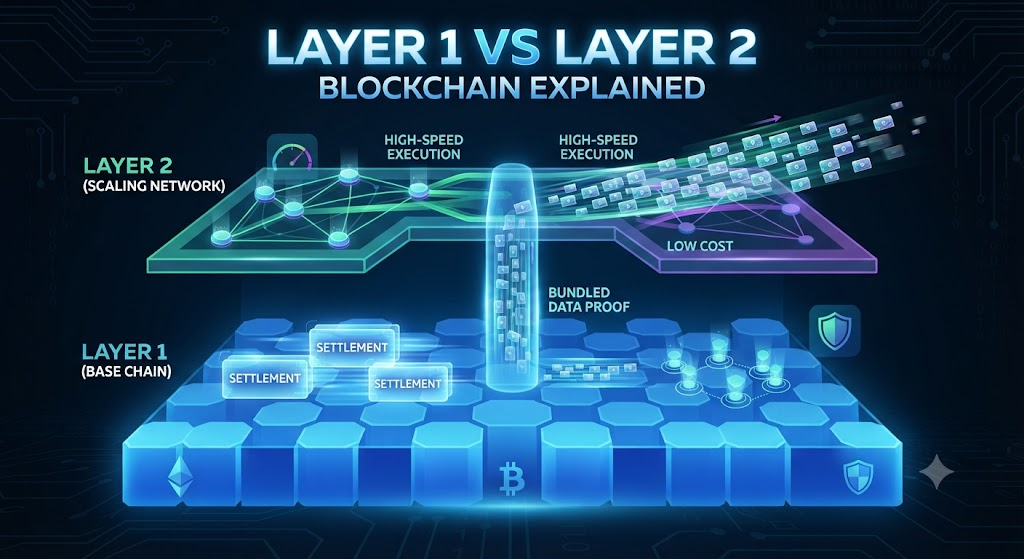
A Layer 2 blockchain is a separate network built on top of a Layer 1 base chain. Its main job is to take the heavy lifting away from the main highway.
Why It Matters
Layer 2 networks drastically increase transaction speed and lower costs while borrowing the strong security of the underlying Layer 1 network. Instead of forcing the main chain to process every click and trade, Layer 2 handles the work off-chain and only posts a summary back to Layer 1.
Popular Layer 2 Solutions
- Arbitrum: An optimistic rollup network designed to make Ethereum transactions fast and cheap.
- Optimism: Another major scaling network that uses rollups to process Ethereum ecosystem activity efficiently.
- Polygon (PoS / zkEVM): A multi-scaling suite offering high-speed sidechains and zero-knowledge scaling solutions.
- Base: An Ethereum Layer 2 incubated by Coinbase to bring mainstream users on-chain with minimal friction.
How Layer 2 Networks Work
Layer 2 networks use clever cryptographic math to speed things up. The most common method is called a rollup.
- Off-Chain Execution: Users send transactions on the Layer 2 network instead of the main Ethereum network. Transactions clear in seconds for pennies.
- Bundling: The Layer 2 network groups hundreds or thousands of individual transactions together into a single batch.
- Compression: It squashes the data down so it takes up minimal space.
- Settlement: It submits this compressed proof back to the Layer 1 base chain for permanent safekeeping.
Key Differences Between Layer 1 and Layer 2
| Feature | Layer 1 (Base Chain) | Layer 2 (Scaling Network) |
| Primary Role | Ultimate security, consensus, and final settlement | High-speed execution and low-cost scaling |
| Transaction Speed | Slower (seconds to minutes, depending on the chain) | Instantaneous (fraction of a second) |
| Transaction Fees | Higher during periods of network congestion | Extremely low (often pennies or fractions of a cent) |
| Security Model | Self-contained cryptographic security | Inherits security from the underlying Layer 1 |
| Examples | Bitcoin, Ethereum, Solana | Arbitrum, Optimism, Base |
Practical Examples
Example 1: Buying a Digital Coffee
Imagine buying a digital coffee for three dollars using an app built on Ethereum.
- If you process that transaction directly on the Layer 1 network, network fees might cost you five dollars. It makes no financial sense.
- If the app routes the payment through a Layer 2 network like Base or Arbitrum, the fee drops to less than a penny, and the coffee shop gets paid instantly.
Example 2: Trading Tokens on Decentralized Exchanges
Active traders execute dozens of trades daily. Doing this on a congested Layer 1 network would drain their wallet through gas fees alone. By using a Layer 2 scaling solution, traders can swap tokens quickly and keep their profit instead of losing it to network tolls.
Common Mistakes Beginners Make
- Assuming Layer 2 is an independent cryptocurrency: Many beginners think tokens native to Layer 2 networks are entirely separate coins with no connection to the base chain. In reality, their value is tied directly to the health and adoption of the underlying Layer 1 ecosystem.
- Forgetting about bridge fees: Moving funds from a Layer 1 wallet to a Layer 2 network (and back) requires interacting with a smart contract bridge. Doing this improperly or during peak congestion can result in unexpected base-layer gas fees.
- Ignoring network selection when withdrawing funds: When moving crypto out of an exchange, users often select the wrong network. Sending tokens meant for an Arbitrum wallet directly to a standard Ethereum mainnet address without proper bridging can cause temporary confusion or loss of funds.
Risks and Limitations
While Layer 2 networks offer incredible speed and savings, they introduce unique trade-offs:
- Smart Contract Risk: Layer 2 networks rely on complex bridge and rollup smart contracts. If a bug or vulnerability exists in the Layer 2 code, user funds could be exposed.
- Centralization Concerns: Many early-stage Layer 2 networks rely on a single entity called a “sequencer” to order transactions. If that sequencer goes offline, users may temporarily need to rely on the base layer to withdraw funds safely.
- User Experience Fragmentation: Users must manage different networks, configure custom RPC settings in wallets like MetaMask, and hold specific native tokens for gas fees on each separate layer.
Decision-Making Framework: When to Use Layer 1 vs Layer 2
Use this quick checklist to decide which network environment suits your activity:
- Check Your Transaction Size: For small transfers, everyday payments, or frequent NFT trading, Layer 2 is almost always the correct choice because of low fees.
- Evaluate Security Needs for Large Holdings: For long-term storage of high-value assets (like cold storage Bitcoin or large Ethereum holdings), keeping funds directly on a secure Layer 1 base chain is preferred.
- Verify App Support: Check whether your favorite wallet and decentralized application natively support the Layer 2 network you wish to use.
Key Terms
- Gas Fees: The transaction fees paid to network validators to process actions on a blockchain.
- Rollup: A scaling technique that processes transactions off the main chain and posts compressed data back to Layer 1.
- Consensus Mechanism: The rules and protocols computers use to agree on the valid state of a blockchain ledger.
- Smart Contract: Self-executing digital code stored on a blockchain that automatically runs when conditions are met.
- Validator: A node operator responsible for verifying transactions and securing the network.
- Finality: The moment a transaction becomes permanent and unchangeable on the blockchain.
- Bridge: A tool or protocol used to transfer digital assets and data between different blockchain networks.
- Sequencer: A specialized node on a Layer 2 network responsible for ordering and organizing user transactions.
FAQs
What is the main difference between Layer 1 and Layer 2?
Layer 1 is the main blockchain network where transactions ultimately settle and security is enforced. Layer 2 is a secondary network built on top of Layer 1 designed to handle high volumes of transactions quickly and cheaply.
Are Layer 2 blockchains less secure than Layer 1?
Generally, Layer 2 networks inherit their core security from the underlying Layer 1 blockchain through cryptographic proofs, making them much safer than standalone sidechains, though minor smart contract risks still apply.
Do I need to buy a different cryptocurrency to use Layer 2?
Usually, no. Most Ethereum Layer 2 networks still use standard Ethereum (ETH) to pay for transaction fees, though some platforms have their own governance tokens.
Can I send funds directly from an exchange to a Layer 2 network?
Many major cryptocurrency exchanges now allow direct withdrawals to popular Layer 2 networks like Arbitrum, Optimism, and Base, bypassing expensive base-layer withdrawal fees.
What happens to a Layer 2 network if the Layer 1 network goes down?
Because Layer 2 networks rely on the underlying base chain for ultimate data availability and security, an extended outage on a major Layer 1 network would freeze final settlement capabilities on Layer 2.
Do Bitcoin and Solana have Layer 2 networks?
Ethereum has the most active Layer 2 ecosystem, but Bitcoin utilizes Layer 2 networks like the Lightning Network for fast micro-payments, while high-throughput networks like Solana typically scale directly on their base layer.
Conclusion
Blockchain scaling used to be a massive hurdle for everyday adoption, forcing users to choose between exorbitant fees and sluggish speeds. The evolution of Layer 1 base chains paired with lightning-fast Layer 2 scaling networks has fundamentally changed that equation.
By keeping heavy computations off the main highway while anchoring security to the base layer, the crypto ecosystem can support millions of users worldwide. Understanding how these layers interact empowers you to navigate transactions smarter, save money on fees, and utilize modern decentralized applications with confidence.