Introduction
Ethereum is one of the most popular blockchain networks in the world. It lets developers build decentralized applications, run financial agreements, and trade digital assets. However, as more people use Ethereum, the network gets congested.
When traffic spikes, the cost to send transactions—known as gas fees—can skyrocket to levels that make everyday use expensive. A simple transfer might cost a few dollars, while complex actions can cost much more.
This problem happens because every single computer on the network must check and record every single transaction. While this keeps the network secure and decentralized, it creates a major bottleneck. To fix this, developers created scaling solutions. These tools keep Ethereum safe while allowing millions of people to use it at the same time without paying high fees.
What Are Ethereum Scaling Solutions?
Ethereum scaling solutions are methods and technologies designed to increase the number of transactions the network can handle per second while lowering costs.
To understand why they are needed, it helps to look at the blockchain trilemma. This is a common idea in crypto stating that a blockchain can usually only achieve two of three goals at the same time: decentralization, security, and scalability.
Ethereum chose to focus heavily on decentralization and security. Thousands of independent computers, called nodes, run the network. Because every node verifies everything, the system is secure and hard to hack, but it is slow.
Scaling solutions bridge this gap. They take the heavy lifting away from the main network, process the work efficiently elsewhere, and use clever cryptographic math to prove to the main network that everything was done correctly.
How Ethereum Scaling Works
Scaling solutions generally fall into different categories based on where the heavy lifting happens. The most popular and successful approach today is known as Layer 2.
Understanding Layer 1 vs. Layer 2
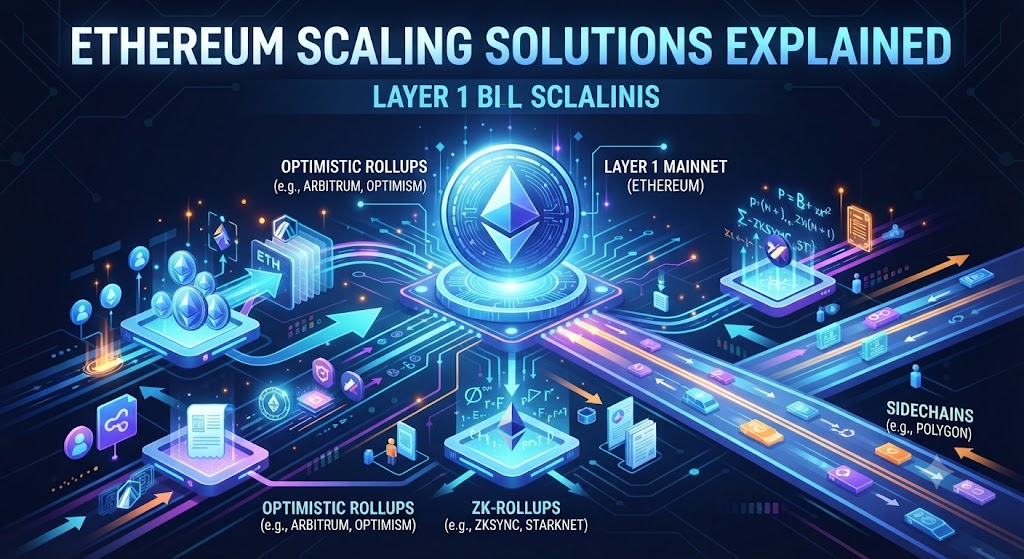
- Layer 1: This is the main Ethereum blockchain. It handles the final settlement of transactions and provides the ultimate security for the entire ecosystem.
- Layer 2: These are separate networks built on top of Layer 1. They group transactions together, process them off the main chain, and then send a summarized proof back to Layer 1.
Imagine a busy bank branch. Layer 1 is the main vault and the head accountant who records every single balance. Layer 2 is a team of fast-moving tellers outside the vault who handle hundreds of quick deposits and withdrawals. At the end of the day, the tellers hand a single balanced ledger to the head accountant instead of making the accountant watch every single coin change hands.
Major Types of Scaling Solutions
Different scaling approaches solve the congestion problem in unique ways.
Optimistic Rollups
Optimistic rollups bundle hundreds or thousands of transactions together and send them to the main Ethereum chain. They are called “optimistic” because the system assumes all bundled transactions are valid by default unless someone proves otherwise.
- How it works: The rollup posts transaction data to Layer 1 but processes the math off-chain. If someone spots a fraudulent transaction during a challenge period, they can submit proof and punish the bad actor.
- Examples: Arbitrum and Optimism.
Zero-Knowledge Rollups (ZK-Rollups)
ZK-rollups also bundle transactions off-chain, but they use advanced mathematical proofs—called zero-knowledge proofs—to prove that the transactions are correct before posting them to the main chain.
- How it works: Instead of assuming transactions are valid, the system generates a cryptographic receipt that mathematically proves the batch is correct. The main Ethereum chain checks this receipt instantly.
- Examples: zkSync and Starknet.
Sidechains
Sidechains are separate blockchains that run parallel to Ethereum. They have their own rules and consensus mechanisms, and they connect to Ethereum via a bridge that lets users move assets back and forth.
- How it works: Sidechains often use faster, centralized validation methods to achieve high speed and low fees.
- Trade-off: While very fast and cheap, sidechains usually rely on their own security rather than inheriting Ethereum’s full security.
Why Scaling Solutions Matter
Without scaling solutions, everyday users and developers would get priced out of using decentralized applications.
- Lower Fees: Gas fees on Layer 2 networks are often a fraction of a cent or just a few cents, compared to dollars or tens of dollars on the main chain.
- Faster Speeds: Transactions confirm in seconds rather than waiting minutes for main network block confirmations.
- Global Adoption: Higher capacity allows millions of new users to access financial tools, games, and digital marketplaces without delay.
Practical Examples
To see how this works in real life, consider two different users:
- Alice, the NFT Trader: Alice wants to buy digital art pieces that cost around $5. On the main Ethereum network, a single purchase might cost $10 in gas fees, making the trade unprofitable. By using a Layer 2 network like Arbitrum, her gas fee drops to $0.05, making her trade practical.
- Bob, the DeFi Investor: Bob wants to supply cryptocurrency to a lending protocol to earn interest. Moving his funds across a ZK-rollup allows him to deposit his assets quickly, securely, and with minimal transaction overhead.
Real-World Considerations
While scaling solutions offer incredible benefits, using them introduces new steps and choices.
- Bridging Assets: Moving funds from the main Ethereum network to a Layer 2 network requires using a bridge. This process can take anywhere from a few seconds to several minutes, and sometimes longer when withdrawing funds back to the main chain.
- Ecosystem Fragmentation: Liquidity and applications are spread across many different networks. A token on one Layer 2 network may not automatically be available on another without bridging.
- Network Trust Assumptions: Different scaling networks rely on different underlying technologies and assumptions. Users must understand whether a network inherits Ethereum’s exact security or relies on external validators.
Common Mistakes
- Mistake: Sending funds directly from an exchange to a Layer 2 network using the wrong network selection.
- Why it happens: Users often confuse the main network (Ethereum Mainnet) with Layer 2 networks when withdrawing from centralized platforms.
- Result: Funds can get stuck or require manual recovery steps.
- What to do instead: Always double-check that the withdrawal network matches the destination wallet network before confirming any transaction.
- Mistake: Forgetting to keep native ETH on the Layer 2 network to pay for gas fees.
- Why it happens: Users assume that having ETH on the main chain automatically pays for Layer 2 transactions.
- Result: Transactions fail because the wallet has no local gas token to execute the transfer.
- What to do instead: Ensure you bridge or buy a small amount of gas token directly on the specific Layer 2 network you plan to use.
Risks and Limitations
- Smart Contract Risk: Scaling solutions rely on complex smart contracts to manage funds and verify proofs. If a bug exists in these contracts, funds could theoretically be at risk.
- Centralization Vectors: Some Layer 2 networks currently rely on a single entity, called a sequencer, to order transactions. If the sequencer goes offline, transactions can be delayed until backup systems take over.
- Withdrawal Delays: Certain optimistic rollups have a challenge period (often lasting up to seven days) for withdrawals back to the main chain, though third-party fast bridges can sometimes bypass this delay for a small fee.
Comparison of Scaling Approaches
| Scaling Approach | Speed | Security Level | Withdrawal Time |
| Optimistic Rollups | Fast | High (Inherits Ethereum) | Minutes to 7 Days |
| ZK-Rollups | Very Fast | High (Cryptographic Proof) | Minutes |
| Sidechains | Extremely Fast | Medium (Independent Security) | Varies |
Decision-Making Framework
When deciding which scaling network to use, follow these steps:
- Identify your goal: Determine whether you are trading, gaming, or moving large amounts of capital.
- Check app support: Verify which scaling networks your favorite applications support.
- Evaluate costs: Compare the bridging and gas fees of different Layer 2 options.
- Assess security needs: For large sums, prioritize networks with strong mathematical proofs (like ZK-rollups) or established optimistic rollups.
- Review withdrawal times: Ensure you are comfortable with the time it takes to move funds back to the main network if needed.
Checklist for Using Scaling Solutions
- Choose a reputable Layer 2 network or scaling solution.
- Add the network configuration correctly to your cryptocurrency wallet.
- Confirm you have the correct gas token on the target network.
- Use official, trusted bridges to move funds.
- Test with a small transaction amount first before moving large sums.
Key Terms
- Gas Fees: The transaction fee paid to network validators to process actions on a blockchain.
- Layer 2 (L2): A secondary framework built on top of a blockchain to improve speed and reduce costs.
- Rollup: A technology that bundles multiple transactions together off-chain before submitting them as a single batch to the main chain.
- Bridge: A tool that allows the transfer of tokens and data between different blockchain networks.
- Zero-Knowledge Proof: A cryptographic method that lets one party prove to another that a statement is true without revealing any information beyond the statement itself.
- Sequencer: A node or entity responsible for ordering and organizing transactions on a Layer 2 network.
- Mainnet: The primary, live blockchain network where actual transactions take place with real economic value.
- Smart Contract: Self-executing code stored on a blockchain that automatically runs when predetermined conditions are met.
FAQs
What is the main difference between Layer 1 and Layer 2?
Layer 1 is the base blockchain where final settlements and core security happen. Layer 2 is an auxiliary network built on top of Layer 1 designed to handle high volumes of transactions quickly and cheaply.
Are Ethereum scaling solutions safe to use?
Most major scaling solutions inherit security guarantees from the underlying Ethereum network, making them significantly safer than using isolated, unverified blockchains. However, like all software involving smart contracts, small technical risks remain.
Why do I need to bridge my funds?
Bridges lock your assets on the main Ethereum network and mint equivalent assets on the Layer 2 network, allowing you to use them in high-speed environments without losing your original balance.
Do I need to pay gas fees in Ethereum on Layer 2?
Yes, most Ethereum-based Layer 2 networks use ETH as the primary token to pay for transaction gas fees, though some networks allow payments in alternative tokens.
How long does it take to withdraw funds from Layer 2 back to Ethereum?
With ZK-rollups and fast bridges, withdrawals can happen in minutes. Some optimistic rollups may take up to a week for standard trustless withdrawals, though third-party services can speed this up.
Conclusion
Ethereum scaling solutions have transformed blockchain technology from a slow, expensive experiment into a fast, practical environment for global applications. By moving transaction processing off the main chain while keeping the underlying security intact, these technologies solve the congestion crisis without compromising decentralization. Understanding how rollups, bridges, and gas fees work helps users navigate the modern blockchain ecosystem with confidence and efficiency.