Introduction
The cloud has completely changed how software infrastructure is built, but it has also introduced an unexpected challenge: highly unpredictable and spiraling cloud bills. In modern software engineering, operational efficiency is no longer just about application performance or high availability; it is equally about financial accountability. The speed of provisioning resources must be balanced with the discipline of cost optimization. This is where cloud financial operations become critical.
Managing variable cloud spending requires a specialized skill set that bridges the gap between engineering teams and corporate finance departments. For systems engineers, development teams, and technical leaders, developing a mastery of cloud financial management has become an essential career milestone. Navigating this landscape requires structured validation. The Certified FinOps Manager program has emerged as a premium credential that equips technical professionals with the exact strategies needed to establish visibility, maximize resource efficiency, and implement scalable cloud cost governance.
What is Certified FinOps Manager
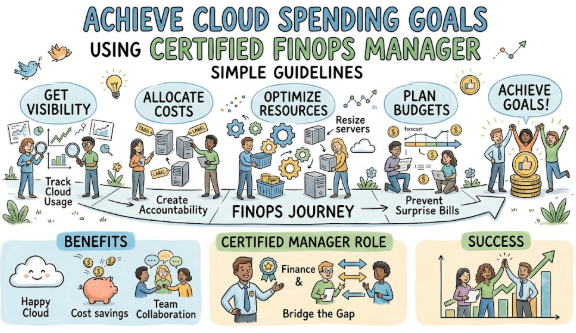
The Certified FinOps Manager is an advanced, production-grade certification program designed for individuals who oversee the cultural, operational, and financial practices of cloud cost optimization within an organization. It focuses heavily on the actual implementation of the three standard phases of cloud financial management: Inform, Optimize, and Operate.
Rather than treating cost management as a post-facto auditing exercise, this credential teaches professionals how to embed financial awareness directly into engineering workflows. It ensures that technical decisions are consistently made with clear visibility into their business value and cost impact.
Why it matters today’s?
Traditional IT procurement relied on fixed, predictable budgets where hardware was purchased upfront. In contrast, modern cloud architectures run on a variable, consumption-based model where a single line of bad code or an unoptimized microservices deployment can cost thousands of dollars overnight.
Organizations are rapidly realizing that automated cost-alerting tools are not enough to curb waste. True efficiency requires dedicated professionals who understand how to break down complex cloud invoices, allocate shared resources correctly, and foster a team culture where engineers take active ownership of their cloud spend. The ability to control infrastructure costs without sacrificing speed or performance is one of the most highly sought-after capabilities in contemporary corporate environments.
Why Certified FinOps Manager certifications are important
- Validates Real-World Cost Governance: It provides formal proof that an engineer or manager can build, enforce, and maintain automated cost-remediation systems across large, multi-account environments.
- Bridges the Tech-Finance Divide: It equips technical leaders with the financial vocabulary needed to communicate effectively with CFOs, procurement teams, and business unit heads.
- Drives Measurable Business ROI: Certified professionals can systematically identify architectural waste that generic automated tools miss, saving companies thousands of dollars in cloud overspend.
- Accelerates Professional Advancement: Holding a dedicated cloud financial credential distinguishes individuals in a competitive job market, preparing them for high-impact leadership roles.
Why choose Finopsschool?
FinOpsSchool stands out as a specialized, market-focused educational portal dedicated exclusively to cloud financial operations. All training programs are engineered by seasoned industry practitioners who deal with massive enterprise cloud budgets on a daily basis. The curriculum avoids purely theoretical lectures, focusing instead on production-grade case studies, interactive scenario evaluations, and deep technical strategies that can be deployed immediately in corporate settings. Choosing this institution ensures that learning is tightly aligned with current industry demands, giving professionals a highly practical roadmap to mastery.
Certification Deep-Dive
What is this certification?
The Certified FinOps Manager certification validates a professional’s capacity to design, lead, and automate comprehensive cloud financial management practices across complex multi-cloud deployments. It confirms absolute mastery over unit economics, multi-tenant cost allocation, automated governance policies, and organizational change management.
Who should take this certification?
This program is specifically structured for senior software engineers, DevOps practitioners, platform architects, site reliability engineers, engineering managers, and financial analysts who are directly tasked with controlling, reporting, and optimizing cloud infrastructure spending.
Certification Overview Table
| Track | Level | Who it’s for | Prerequisites | Skills Covered | Recommended Order |
| Cloud Financial Operations | Foundation | Newcomers, Analysts, Junior Devs | None | Core billing terms, basic metrics, tagging principles | First |
| Engineering Accountability | Professional | DevOps, SREs, Cloud Engineers | Foundation Level | Automation scripts, pipeline integration, tag enforcement | Second |
| Enterprise Management | Manager | Team Leads, Engineering Managers | Professional Level | Policy creation, forecasting, persona management | Third |
| Strategic Architecture | Advanced | Solutions Architects, Platform Leads | Professional Level | Multi-cloud optimization, unit economics, contract negotiation | Fourth |
Skills you will gain
- Advanced unit economics modeling to map specific cloud costs directly to business key performance indicators (KPIs).
- Deep expertise in configuring complex multi-tenant cloud cost allocation and automated shared-cost distribution rules.
- Proficiency in designing and deploying automated cost-remediation scripts to instantly eliminate orphaned or underutilized infrastructure.
- Strategic capacity planning and forecasting methodologies to eliminate unexpected cloud billing anomalies before they manifest.
- Ability to structure and implement organization-wide cloud tagging schemas and guardrails using Infrastructure as Code (IaC).
Real-world projects you should be able to do after this certification
- Design and execute an automated, cross-account tagging enforcement system that automatically isolates and stops un-tagged non-production cloud resources.
- Build custom enterprise cost-visibility dashboards that correlate real-time cloud infrastructure spending directly with transactional volume data.
- Establish a multi-cloud cost allocation framework that successfully attributes shared cluster infrastructure expenses across multiple internal engineering squads.
- Develop a comprehensive cloud migration financial roadmap that includes accurate workload forecasting and commitments for reserved capacity.
Preparation plan
7–14 days plan
Focus entirely on absorbing the official core vocabulary, learning paths, and standard framework definitions. Dedicate two hours daily to reviewing billing structures, common cost drivers, and standard provider discount programs. Take foundational practice questionnaires to identify knowledge gaps.
30 days plan
Transition into practical scenario analysis. Spend time reviewing comprehensive enterprise case studies centered around cloud cost optimization. Practice building basic mock billing dashboards, working through resource allocation exercises, and studying automated policy enforcement patterns.
60 days plan
Deep dive into high-level organizational change management, unit economics modeling, and automated script architecture. Set up a sandboxed environment to write baseline cost guardrails. Dedicate final weeks to taking comprehensive, timed mock examinations and practicing executive-level reporting strategies.
Common mistakes to avoid
- Treating cloud cost management as a purely financial task rather than a core engineering responsibility.
- Failing to implement a robust, standardized tagging schema across infrastructure before launching optimization scripts.
- Relying entirely on generic, automated vendor optimization suggestions without validating the actual technical application requirements.
- Over-committing to long-term cloud provider savings contracts before thoroughly analyzing workload utilization stability.
Best next certification after this
Same track
Expert Cloud Financial Operations Lead
Cross-track
Certified Kubernetes Administrator (CKA)
Leadership / management
Certified Platform Engineering Manager
Choose Your Learning Path
DevOps Path
This journey focuses heavily on shifting cost awareness left directly into the continuous integration and continuous deployment (CI/CD) pipelines. It is structured for engineers who want to embed automated financial guardrails into their deployment workflows. This ensures that infrastructure configuration files are validated for cost efficiency before code hits production systems.
DevSecOps Path
Perfect for professionals looking to merge cost optimization with automated compliance and security governance. This path teaches specialists how to write single policies that concurrently check for infrastructure security vulnerabilities and financial waste. This path ensures that security scanning tools and log storage frameworks are designed cost-effectively.
Site Reliability Engineering (SRE) Path
Tailored for engineers dedicated to balancing application reliability, performance, and financial efficiency. This path covers the intersection of system metrics with unit economics. Practitioners learn how to optimize spending on monitoring infrastructure, managing data ingress and egress fees, and aligning service level objectives (SLOs) with cost constraints.
AIOps / MLOps Path
Designed specifically for data professionals managing highly expensive artificial intelligence and machine learning training pipelines. This pathway guides engineers through the nuances of GPU utilization tracking, data management expenses, and deep-learning model inference cost optimization across distributed environments.
DataOps Path
Best for big data engineers, data warehouse architects, and analytics specialists who handle large-scale data storage and processing pipelines. It focuses heavily on managing storage tiers, optimizing query execution costs, and establishing financial accountability for distributed analytical compute clusters.
FinOps Path
The absolute core track designed for dedicated cloud cost optimization professionals, financial analysts, and corporate procurement specialists. This path guides candidates through advanced corporate forecasting, global cloud contract negotiations, cross-team persona management, and long-term enterprise financial strategy planning.
Role → Recommended Certifications Mapping
| Role | Recommended Certifications |
| DevOps Engineer | Certified FinOps Manager (Professional), SRE Foundation |
| Site Reliability Engineer (SRE) | Certified FinOps Manager (Advanced), Cloud Architecture Expert |
| Platform Engineer | Certified FinOps Manager (Manager), Platform Lead Practitioner |
| Cloud Engineer | Certified FinOps Manager (Foundation), Infrastructure Specialist |
| Security Engineer | Certified FinOps Manager (Professional), DevSecOps Professional |
| Data Engineer | Certified FinOps Manager (Professional), DataOps Architecture Practitioner |
| FinOps Practitioner | Certified FinOps Manager (Manager), Advanced Enterprise Strategy |
| Engineering Manager | Certified FinOps Manager (Manager), Leadership & Governance Lead |
Next Certifications to Take
One same-track certification
The Expert Cloud Financial Operations Lead certification represents the natural progression for professionals seeking to master advanced enterprise-scale budgeting, macro-level cloud contract negotiations, and multi-national corporate cost governance systems.
One cross-track certification
The Certified Kubernetes Administrator (CKA) credential stands out as the ideal cross-track choice, validating deep technical competence in running, scaling, and managing containerized infrastructure where cloud resource optimization is critical.
One leadership-focused certification
The Certified Platform Engineering Manager designation provides an excellent option for moving into leadership, preparing technical practitioners to construct scalable internal developer platforms that natively include financial transparency features.
Training & Certification Support Institutions
DevOpsSchool
This premier training partner is widely recognized for delivering comprehensive, production-grade educational programs across the entire spectrum of cloud infrastructure domains. Its bootcamps are fully tailored to industry demands, combining intensive live instructor sessions with extensive practical labs. This methodology ensures professionals build working skills that can be directly applied to corporate environments immediately upon completion.
Cotocus
Specializing in high-end corporate enablement and custom cloud transformation training, this institution focuses heavily on enterprise-scale technical paths. The courses are meticulously designed to assist large engineering departments in modernizing their operational paradigms. Highly structured modules help teams master complex cloud native tools, automated system compliance practices, and robust architectural governance models.
ScmGalaxy
A highly regarded knowledge repository and community-driven training portal, this platform serves as an invaluable asset for modern systems engineers. It offers deep-dive learning paths that simplify advanced configuration management, release orchestration, and automated pipeline construction. The focus is always placed squarely on providing clear, functional solutions to real-world deployment challenges.
BestDevOps
This specialized academy focuses completely on crafting highly accessible, beginner-friendly yet technically profound learning journeys for cloud enthusiasts. The instructional modules are organized sequentially to build up engineering competencies step by step. This structure allows working professionals to upscale their skill sets efficiently without disrupting their active job responsibilities.
devsecopsschool.com
This learning portal is completely dedicated to the critical discipline of shifting security practices left into modern deployment pipelines. The training material covers automated compliance scanning, vulnerability management workflows, and Security as Code principles. It provides practitioners with the exact strategies needed to secure enterprise software ecosystems without slowing down delivery speeds.
sreschool.com
Engineered exclusively to address the challenging domain of platform reliability and system availability, this digital academy offers targeted training on modern operations. The curriculum explores advanced application monitoring, automated incident response frameworks, and system scaling architectures. Learners are trained to maintain highly resilient corporate software platforms under intensive production workloads.
aiopsschool.com
This forward-looking educational platform concentrates on embedding machine learning and automated artificial intelligence models into standard system operations. The courses guide specialists through predictive telemetry tracking, automated anomaly detection patterns, and intelligent root-cause analysis systems. It bridges the gap between data science and automated infrastructure maintenance.
dataopsschool.com
Designed specifically to empower data professionals, this institution provides precise learning programs centered on building robust data pipelines. The instructional tracks cover the complete management of distributed data architectures, pipeline data reliability, and automated workflow scheduling. It ensures enterprise analytical infrastructures run smoothly and predictably.
finopsschool.com
The primary, authoritative digital academy focused entirely on the domain of cloud financial management and operational cost accountability. Its structured certification programs provide deep technical insights into breaking down complex provider invoices, building automated cost controls, and fostering financial discipline within engineering teams. It remains the gold standard for mastering modern cloud unit economics.
FAQs Section
- What is the difficulty level of the Certified FinOps Manager program?
The program is intermediate to advanced, requiring knowledge of both infrastructure engineering and corporate financial structures. - How much time is typically required to complete the certification preparation?
A preparation period of 30 to 60 days is recommended for working professionals, depending on prior hands-on cloud experience. - Are there any rigid prerequisites needed before taking the official exam?
No formal prerequisites are required, though familiarity with cloud billing metrics and basic system administration is advantageous. - What is the recommended certification sequence for a standard systems engineer?
Begin with the foundational track, progress through the engineering accountability level, and complete the manager-level credential. - What is the long-term career value of holding this specific cloud finance credential?
It validates the ability to protect corporate margins by eliminating structural infrastructure waste, establishing unique market relevance. - Which job roles can a certified professional confidently apply for?
Roles include Cloud FinOps Analyst, Lead DevOps Engineer, Cloud Infrastructure Manager, and Platform Architect. - How frequently must this professional certification be renewed?
The certification is valid for three years, after which a standard recertification is required. - Does the training cover multi-cloud environments or just a single cloud vendor?
The program is vendor-agnostic, covering AWS, Google Cloud, and Microsoft Azure cost governance strategies. - Is hands-on coding or scripting evaluated during the assessment process?
Yes, assessments at professional and manager levels evaluate designing automated cost guardrails and environment shutdown scripts. - How does this program address the challenge of untagged infrastructure assets?
It teaches strategies for implementing automated tagging compliance checks within the infrastructure provisioning pipeline. - Can financial analysts without an engineering background pass this program?
Yes, if they dedicate extra preparation time to learn core cloud compute, storage, and networking concepts. - What kind of career growth can be expected after obtaining this certification?
Certified professionals often advance faster into technical leadership, infrastructure management, and cloud director positions.
Certified FinOps Manager Specific FAQs
- What specific core domains are evaluated in the Certified FinOps Manager exam?
The assessment evaluates competence across the primary phases of cloud financial management, including detailed cost allocation, forecasting accuracy, and policy enforcement patterns.
- How does the Certified FinOps Manager course teach unit economics?
The training provides frameworks to bind infrastructure spending directly to business metrics, such as calculating the exact cloud infrastructure cost incurred per active user transaction.
- Are automated cost-remediation strategies covered in this specific managerial syllabus?
Yes, extensive focus is placed on designing policies that automatically clean up orphaned storage volumes and pause non-production compute resources off-hours.
- How does a Certified FinOps Manager handle budget anomalies within an organization?
The program teaches structured root-cause analysis methodologies to quickly identify, isolate, and remediate unexpected spikes in cloud resource billing.
- What is the format and duration of the official certification exam?
The evaluation is conducted via an online testing portal consisting of scenario-based multiple-choice questions that must be completed within a fixed two-hour window.
- How does this manager certification help in dealing with engineering resistance to cost limits?
It covers organizational change management strategies, teaching professionals how to incentivize cost efficiency among development teams without slowing engineering velocity.
- Is the concept of cloud provider commitment management covered in the curriculum?
Yes, advanced modules are included that teach how to evaluate, purchase, and balance long-term Savings Plans and Reserved Instances across large organizations.
- How does a Certified FinOps Manager optimize containerized and Kubernetes environments?
The syllabus covers modern cluster cost-distribution methods, explaining how to allocate shared namespace resources accurately to individual engineering teams.
Testimonials
The structured learning approach helped clarify how cloud spending can be managed directly within deployment pipelines. The strategies covering automated infrastructure cleanup were immediately deployed across our testing environments.
- Ananya I.
Balancing application reliability with tight financial constraints was always a struggle. This certification provided the exact framework needed to map infrastructure metrics to actual business transaction costs.
- Vikram S.
Navigating complex enterprise cloud bills used to be completely overwhelming. Clear pathways for tracking multi-tenant shared cluster costs were established, giving our entire engineering group absolute visibility.
- Deepak K.
Writing compliance policies that concurrently target security vulnerabilities and cloud infrastructure waste became simple. The training built immense confidence in setting up automated guardrails.
- Meera J.
Bridging the communication gap between our development squads and the corporate finance team was achieved. Long-term forecasting models were reconstructed, leading to highly predictable quarterly infrastructure spending.
- Sanjay R.
Conclusion
Developing a mastery of cloud financial management has evolved into a critical requirement for navigating modern cloud native environments. The Certified FinOps Manager certification provides a comprehensive, production-grade roadmap that empowers technical professionals to take complete control of variable cloud infrastructure costs. By validating advanced skills in unit economics, automated governance, and cross-team collaboration, this credential prepares engineers and managers to deliver measurable financial value to their organizations. Investing in this structured learning path ensures long-term career resilience, positioning professionals at the very forefront of modern operational leadership.