Introduction
New technologies often arrive with loud promises. People hear big words about digital ledgers and decentralized networks, but they rarely see how the technology solves everyday problems. This confusion leads to two extremes. Some believe blockchain is a magical fix for every business issue, while others think it is useless digital hype.
The truth sits in the middle. Blockchain is a specialized tool. It is not meant to replace traditional databases for everything. Instead, it shines when multiple independent parties need to trust shared data without trusting each other.
Understanding how this technology works in practice helps business owners, students, and professionals see past the marketing noise. This article explores genuine real-world use cases of blockchain technology, explaining how organizations use secure digital records to solve trust, speed, and transparency problems every day.
What Is Blockchain Technology?
To understand how blockchain works in the real world, you must first look past the complex jargon.
A blockchain is a shared, digital list of transactions or records that is copied across a large network of computers.
Professional term → Simple meaning → Why it matters → Example
- Distributed Ledger: A shared digital record book → No single company controls the data → If one computer hacks or crashes, the other thousands of computers keep the correct records safe.
- Cryptographic Hash: A secure mathematical fingerprint of data → It locks information so nobody can alter past records → Changing a single letter in an old transaction breaks the mathematical seal, alerting everyone immediately.
- Consensus Mechanism: Rules for agreeing on new records → Network participants verify transactions together → Instead of trusting a bank middleman, computers follow strict math rules to approve valid updates.
Think of it like a Google Doc that everyone in a neighborhood can view and add notes to, but nobody can erase or rewrite past lines. Once a paragraph is written and saved by the group, it stays there forever for everyone to see.
How Blockchain Works in Practice
Traditional databases rely on a central administrator. If you send money through a bank, the bank’s private computer updates your account balance and the receiver’s balance. You must trust that the bank’s internal database is accurate and secure.
Blockchain removes that single point of failure by bundling transactions into blocks and chaining them together chronologically.
- Transaction Request: A user initiates an action, such as sending data or transferring a digital asset.
- Broadcast and Verification: The request goes out to a network of computers, known as nodes. These computers check the rules to make sure the user has permission and valid funds.
- Block Creation: Once verified, the transaction groups together with other recent transactions into a new data block.
- Chaining: The network links this new block to the previous block using a secure mathematical code.
- Permanent Record: The updated ledger copies automatically to every computer in the network. The transaction is now complete and unchangeable.
Major Real-World Use Cases of Blockchain Technology
Organizations across multiple sectors deploy blockchain solutions to address specific operational bottlenecks. Here are the most impactful real-world applications operating today.
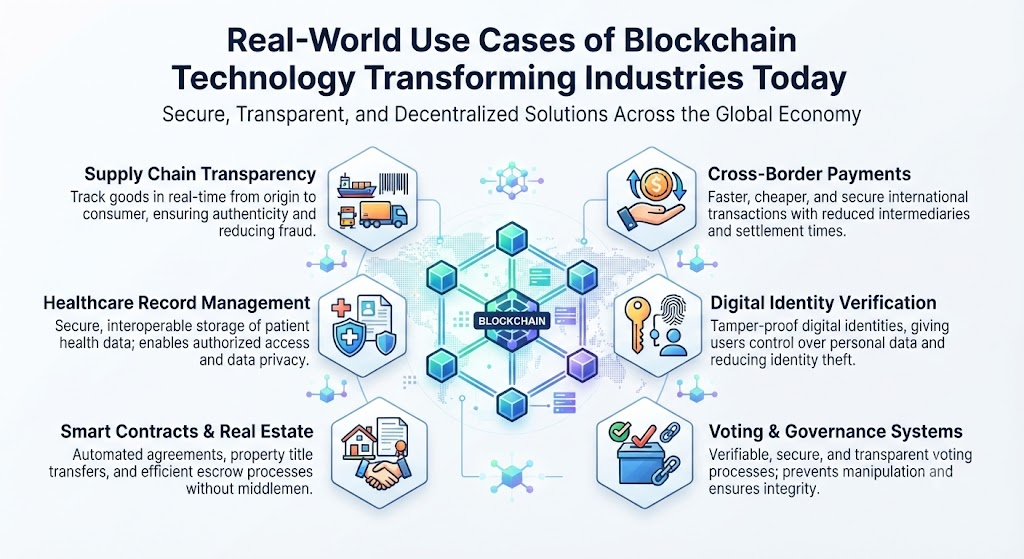
1. Supply Chain Transparency and Traceability
Global supply chains involve dozens of separate companies, including farmers, shipping lines, customs officials, warehouses, and retailers. Tracking an item from origin to store shelf is often slow and prone to paperwork errors.
- The Problem: When an outbreak of food poisoning happens, supermarkets take weeks to figure out which farm supplied the contaminated batch.
- The Blockchain Solution: Every time a shipment moves to a new checkpoint, workers scan a code that logs the event on a shared blockchain network.
- Why It Matters: Retailers can trace the exact path of a food item in seconds rather than days. Consumers scan product labels to verify fair-trade claims or organic origins with absolute certainty.
2. Cross-Border Payments and Remittances
Sending money across international borders traditionally involves multiple intermediary banks, high currency conversion fees, and processing times lasting several business days.
- The Problem: High fees eat into small international transfers, and funds remain stuck in transit pipelines.
- The Blockchain Solution: Financial networks use blockchain-based tokens to settle international payments directly between institutions.
- Why It Matters: Settlements happen in seconds instead of days. Transaction fees drop significantly because fewer intermediaries handle the funds along the route.
3. Digital Identity and Self-Sovereign Verification
Managing personal identification details across dozens of online accounts creates massive security risks. People store sensitive passwords and identity documents on vulnerable corporate servers that face constant cyber attacks.
- The Problem: Centralized identity databases leak millions of user records, leading to identity theft.
- The Blockchain Solution: Self-sovereign identity systems let users hold their encrypted credentials on their own devices. They share cryptographic proof of their age or identity without exposing raw documents like passports or social security numbers.
- Why It Matters: Users regain control over their personal data, and businesses reduce legal liabilities associated with storing sensitive customer files.
4. Healthcare Record Management and Interoperability
Hospitals, clinics, and insurance providers struggle to share patient medical records securely due to privacy laws and incompatible computer systems.
- The Problem: Fragmented medical histories lead to delayed treatments and repetitive diagnostic tests.
- The Blockchain Solution: Medical facilities record encrypted pointers and access permissions on a secure healthcare blockchain.
- Why It Matters: Patients authorize different doctors to view their complete, unalterable medical history instantly while keeping full control over who accesses their sensitive health data.
5. Smart Contracts in Real Estate and Insurance
Traditional agreements require lawyers, notaries, and escrow agents to ensure both sides follow the rules, adding heavy costs and delays to transactions.
- The Problem: Property purchases and insurance payouts involve lengthy paperwork and high administrative overhead.
- The Blockchain Solution: Smart Contracts—self-executing digital agreements written in code—automatically trigger actions when predetermined conditions are met.
- Why It Matters: Once a flight delay is verified via weather data feeds, an insurance smart contract instantly pays out compensation to the traveler’s digital wallet without requiring human paperwork claims.
Comparative Overview of Traditional Systems vs. Blockchain Solutions
| Feature | Traditional Centralized Systems | Blockchain-Based Systems |
| Control | Single authority or corporation | Distributed network of participants |
| Data Modification | Administrators can edit or delete records | Records are permanent and unalterable |
| Transparency | Restricted to internal database owners | Visible to permitted network participants |
| Intermediaries | Required for validation and trust | Eliminated through automated consensus rules |
| Speed | Dependent on business hours and batch processing | 24/7 continuous real-time settlement |
Common Mistakes When Implementing Blockchain
Organizations and developers frequently run into operational roadblocks when adopting decentralized technologies.
- Using Blockchain Where a Simple Database Fits: Building a blockchain when a standard SQL database or Google Sheet meets the requirement wastes time and money.
- Ignoring Privacy Regulations: Putting sensitive customer data directly onto a public, permanent ledger violates data privacy laws like GDPR, which mandate the right to be forgotten.
- Failing to Secure Smart Contract Code: Writing flawed code in automated agreements lets hackers drain funds, as software bugs cannot be easily reversed once deployed.
- Neglecting Scalability Limits: Public blockchain networks process fewer transactions per second than traditional credit card networks, causing congestion during high-demand periods.
Risks and Limitations
While blockchain offers powerful trust guarantees, it introduces distinct operational risks.
- Irreversibility Risk: If a user sends funds to the wrong wallet address on a decentralized network, no customer service department exists to reverse the transaction.
- Energy Consumption: Proof-of-work consensus models consume high amounts of electricity, though newer networks increasingly use energy-efficient validation methods.
- Integration Complexity: Connecting modern business software to decentralized ledgers requires specialized engineering talent and expensive infrastructure upgrades.
Decision-Making Framework for Blockchain Adoption
Before an organization adopts blockchain technology, leaders should walk through this practical evaluation framework:
- Identify the Problem: Does the project suffer from a lack of trust between multiple independent parties who do not know each other?
- Check for Intermediaries: Are third-party brokers currently slowing down the process or charging high fees?
- Evaluate Shared Writing Needs: Do multiple parties need to write and update the same data records simultaneously?
- Confirm Independence: Can all participants operate without a single trusted central authority managing the database?
- Assess Alternative Solutions: Would a traditional shared database with strict access permissions solve the problem faster and cheaper?
If the answer to the first four questions is yes, and a traditional database fails the test, blockchain technology is worth considering.
Checklist for Evaluating Blockchain Projects
- Defined clear business problem that requires decentralized trust.
- Verified that participants do not want a single administrator in charge.
- Checked data privacy laws to ensure no sensitive personal data lives on a public ledger.
- Audited smart contract code for security flaws before deployment.
- Calculated total operational and infrastructure maintenance costs.
- Assessed transaction speed and network scalability requirements.
Key Terms
- Decentralization: Spreading control and data storage across many independent computers instead of one central server.
- Node: An individual computer connected to a blockchain network that validates and stores a copy of the ledger.
- Smart Contract: A self-executing digital program stored on a blockchain that runs automatically when conditions are met.
- Public Key Cryptography: A secure encryption system using public and private keys to prove ownership and sign transactions securely.
- Consensus: The automated process where network computers agree on the validity of new transactions.
- Tokenization: The process of converting real-world assets or ownership rights into digital tokens on a blockchain.
- Immutability: The characteristic of data that makes it impossible to change or delete once recorded.
- Gas Fee: A transaction fee paid to network validators for processing computational tasks on a blockchain.
Frequently Asked Questions
Is blockchain the same thing as cryptocurrency?
No. Cryptocurrency is digital money built on top of blockchain technology. Blockchain is the underlying digital record-keeping system that can track many things besides money, including medical records, supply chain movements, and property titles.
Can blockchain data be hacked or modified?
Hacking a blockchain is extremely difficult because data is copied across thousands of computers. To alter a past record, a hacker would need to control more than half of all computers on the network simultaneously and recalculate every subsequent block, which requires massive computational power and cost.
Why do companies use traditional databases instead of blockchain?
Traditional databases are faster, cheaper to operate, easier to scale, and allow administrators to edit or delete records when errors happen. Blockchain is only useful when multiple independent groups need shared data security without trusting a central manager.
Are blockchain transactions completely anonymous?
Most public blockchains are pseudonymous rather than anonymous. Transactions link to public wallet addresses rather than real names, but data analysts can often trace transaction histories back to real individuals through exchange accounts and network analysis.
What is a smart contract and how does it work?
A smart contract is a computer program stored on a blockchain that executes actions automatically when preset conditions occur. For example, a crop insurance contract automatically pays out funds to a farmer if weather sensors record rainfall below a specific threshold.
Do all blockchains consume massive amounts of electricity?
No. Older networks like Bitcoin use energy-intensive validation methods, but modern blockchain networks use alternative consensus models that consume minimal energy, similar to standard cloud servers.
Can deleted data be recovered from a blockchain?
No. One of the core features of blockchain is immutability. Once information is written to the ledger, it cannot be deleted or modified, which protects records from tampering but creates challenges for privacy laws requiring data erasure.
How do businesses decide if they need a blockchain?
Businesses should ask if multiple parties need to share data without trusting a central authority. If all participants already trust a single database administrator, a traditional database is faster and more cost-effective.
Conclusion
Blockchain technology is no longer just a speculative financial trend. Practical real-world use cases show how secure digital ledgers solve genuine problems in supply chains, cross-border settlements, and identity verification.
While the technology is powerful, it is not a universal solution for every data management challenge. Successful adoption requires matching the right tool to the right problem, keeping operational costs in check, and understanding regulatory boundaries. By looking past the hype and focusing on practical value, organizations can use blockchain to build more transparent, efficient, and secure digital workflows.