Introduction
Mention Bitcoin to almost anyone, and you will likely hear stories of sudden wealth or dramatic market crashes. Yet, beneath the price charts lies a complex global machine operating 24 hours a day. At the heart of this machine is Bitcoin mining.
For beginners, the term “mining” creates a mental image of workers with pickaxes digging deep into digital earth. In reality, no gold is being chipped away, and no physical coins are being unearthed. Instead, it is an automated software process run by specialized computer hardware.
Understanding how this process works is vital. Without miners, the Bitcoin network would freeze, transactions would fail, and the system could be hacked. This article breaks down Bitcoin mining from the ground up, explaining the technology, the costs, the risks, and the real-world economics without the heavy technical jargon.
What Is Bitcoin Mining?
Bitcoin mining is a decentralized process that serves two main purposes: validating new transactions and securing the Bitcoin network against fraud.
In traditional finance, a bank acts as a central bookkeeper. When you send money from one account to another, the bank updates its private database to subtract funds from you and add them to the recipient. Bitcoin has no central bank. Instead, it relies on a shared public database called a blockchain.
Blockchain → A digital ledger shared across thousands of computers worldwide that records every Bitcoin transaction ever made.
Why it matters: Because there is no central authority, a decentralized group of computers must agree on which transactions are valid. Mining is the mechanism that achieves this agreement, preventing malicious actors from spending the same Bitcoin twice (a problem known as “double-spending”).
How Bitcoin Mining Works
The mining process relies on cryptography and immense computing power. When people send Bitcoin to each other, those transactions sit in a waiting area called the mempool (memory pool).
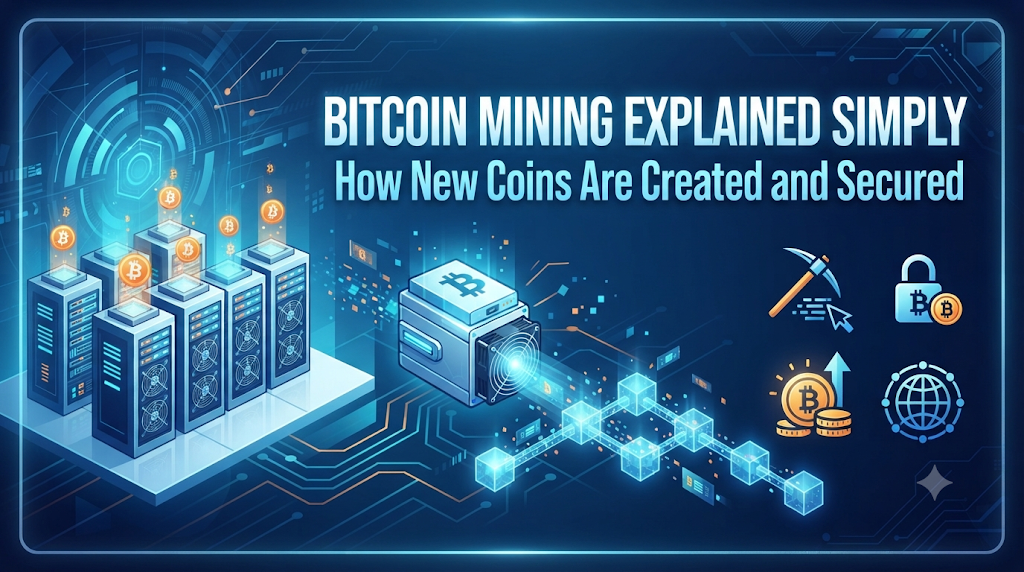
Miners group these pending transactions into a digital page called a “block.” Their goal is to seal this block and permanently attach it to the blockchain. To do this, mining hardware runs a mathematical function called SHA-256 repeatedly, trying to guess a specific random number (known as a nonce) that unlocks the block.
The Trial-and-Error Game
Think of it like trying to guess a 64-digit combination lock. There is no trick or shortcut; the computer must guess millions of combinations every second until it hits the correct one.
- Transaction Pooling: Transactions are gathered from the network.
- Block Assembly: Transactions are bundled into a candidate block.
- Hashing (The Guessing Game): The hardware runs billions of random guesses per second.
- Verification: Once a miner’s machine finds the winning combination, it broadcasts the solution to the rest of the network.
- Consensus: Other computers quickly verify the solution. If valid, the block is permanently added to the blockchain, and the miner receives their reward.
Why Bitcoin Mining Matters
Bitcoin mining is the backbone of the entire ecosystem. Without it, the cryptocurrency cannot function.
- Security: The computing power required to mine Bitcoin makes the network immensely secure. To hack the blockchain, an attacker would need to control more than 50% of the entire network’s computing power—an economically impossible feat.
- Issuance: Mining is the only way new Bitcoins enter circulation. There is no company or government printing money; instead, new coins are minted systematically through the mining process.
- Trustlessness: Users do not need to trust each other or a middleman. They only need to trust the mathematical rules governing the network.
Important Factors to Understand
To look past the surface of mining, you must understand a few core concepts that govern how the system behaves.
1. Hash Rate
Hash rate is the total measuring unit of processing power on the Bitcoin network. It measures how many guesses mining machines can make per second.
- Simple meaning: The speed at which a mining computer operates.
- Why it matters: Higher hash rate means the network is more secure against attacks.
2. Mining Difficulty
Bitcoin’s software is designed to automatically adjust how hard the math puzzles are every two weeks (specifically, every 2,016 blocks).
- Simple meaning: An automatic thermostat for the network’s math problems.
- Why it matters: If millions of new miners join the network, the puzzle gets harder so that a new block is found roughly every 10 minutes. If miners leave, the puzzle gets easier.
3. The Halving
The total supply of Bitcoin is capped at 21 million coins. To control inflation, the reward given to miners for finding a block cuts in half every four years.
- Simple meaning: A scheduled pay cut for miners.
- Example: When Bitcoin launched in 2009, miners received 50 Bitcoins per block. Through successive halvings, that reward dropped over time, reducing the rate at which new coins enter the market.
Practical Examples: How Mining Operates Today
In the early days of Bitcoin (around 2009 and 2010), a hobbyist could mine thousands of coins using a standard desktop computer in a bedroom.
Today, that is no longer possible.
Modern Reality Example:
Imagine trying to dig for gold with a garden shovel versus operating an industrial excavation plant. Today’s Bitcoin mining is dominated by massive industrial data centers. These facilities are filled with rows of specialized computers called ASICs (Application-Specific Integrated Circuits) built for one sole purpose: running the SHA-256 algorithm as fast as possible.
Individual hobbyists running single machines at home typically join a mining pool.
Mining Pool → A cooperative group where thousands of small miners combine their computing power to increase their chances of solving a block, splitting the resulting reward proportionally based on how much work each machine contributed.
Real-World Considerations and Costs
Before viewing mining as easy passive income, you must look at the real-world constraints that sink many unprofitable operations.
- Electricity Costs: Mining machines run 24/7 and consume massive amounts of electrical power. Power is the single largest expense for any miner. If electricity costs are too high, the cost of running the machine outweighs the value of the Bitcoin earned.
- Hardware Depreciation: ASIC machines are expensive. Worse yet, technology improves rapidly. A high-end machine bought today may become obsolete or inefficient within a few years as newer, faster models enter the market.
- Heat and Noise: Mining hardware generates intense heat and sounds like a jet engine taking off. Running them at home requires specialized cooling setups and soundproofing, which adds significant overhead.
Common Mistakes Beginners Make
Entering the mining space without proper preparation often leads to swift financial losses.
- Mistake: Buying used, outdated mining hardware online without calculating profitability.
- Why it happens: Sellers market cheap older machines to unsuspecting beginners.
- Why it fails: Older machines consume too much electricity relative to how many hashes they produce. They will lose money on every kilowatt-hour consumed.
- What to do instead: Use online Bitcoin mining profitability calculators (like NiceHash or Luxor) to input current electricity rates, hardware hash rates, and current difficulty before spending money.
- Mistake: Ignoring cooling and ventilation requirements.
- Why it happens: Beginners underestimate how quickly ASICs overheat.
- Why it fails: Overheating damages the hardware components permanently and triggers automatic shutdowns.
- What to do instead: Ensure a dedicated space with industrial-grade airflow or immersion cooling systems is in place.
Risks and Limitations
Mining carries distinct operational, financial, and regulatory risks.
| Risk Type | What Can Go Wrong | How to Reduce It |
| Market Volatility | The price of Bitcoin drops sharply while electricity and hardware costs remain fixed, wiping out profit margins. | Maintain cash reserves to cover operational costs during bear markets. |
| Regulatory Crackdowns | Local governments may ban mining due to high energy consumption or noise complaints. | Research local zoning laws and energy policies before setting up operations. |
| Hardware Failure | Power surges or component wear-and-tear can break expensive ASIC units prematurely. | Install surge protectors, backup power supplies, and maintain optimal ambient temperatures. |
Decision-Making Framework for Aspiring Miners
If you are considering getting into Bitcoin mining, walk through this practical decision framework before spending capital:
- Check Your Electricity Rate: Is your cost per kilowatt-hour (kWh) exceptionally low (typically under $0.06–$0.08)? If not, solo mining is rarely profitable.
- Calculate Upstream Costs: Add the total cost of hardware, shipping, electrical upgrades, and cooling systems.
- Assess Operational Constraints: Do you have a secure, well-ventilated, and noise-isolated location to house loud, hot equipment?
- Compare Alternatives: Determine whether purchasing Bitcoin directly on an exchange makes more financial sense than buying and maintaining physical mining hardware.
Key Terms
- ASIC: Specialized computer hardware designed to execute only one specific algorithm (SHA-256 for Bitcoin).
- Block Reward: The newly minted Bitcoins given to a miner who successfully validates a new block.
- Blockchain: A public digital ledger that permanently records all transactions across a decentralized network.
- Consensus: The method by which decentralized computers agree on the validity of transactions.
- Halving: A programmed event every four years where the Bitcoin block reward is cut in half.
- Hash Rate: The total computing processing speed used by the network to solve cryptographic puzzles.
- Mempool: The holding area where pending transactions wait before being picked up by miners and added to a block.
- Mining Pool: A cooperative group of miners who pool their computing power and share rewards.
- Nonce: An arbitrary random number used by miners in trial-and-error attempts to solve a block hash.
- SHA-256: The cryptographic hash function used by Bitcoin to secure data and power proof-of-work mining.
FAQs
Can I mine Bitcoin on my laptop or smartphone?
No. Standard laptops and phones do not have the specialized computing power (ASICs) required to compete on the Bitcoin network. Trying to mine on personal devices will overheat them and yield negligible results while consuming excessive electricity.
Is Bitcoin mining bad for the environment?
Mining consumes significant electricity, drawing criticism for its carbon footprint when powered by fossil fuels. However, a growing portion of global mining relies on renewable energy sources (hydro, wind, solar) or utilizes stranded energy—such as flared natural gas at oil fields—that would otherwise be wasted.
How much money do Bitcoin miners make?
Earnings depend entirely on the hash rate of your hardware, the cost of your electricity, the current difficulty of the network, and the market price of Bitcoin. Industrial miners with cheap power make consistent margins, while small-scale operations often struggle to break even.
What happens when all 21 million Bitcoins are mined?
Experts estimate the final Bitcoin will be mined around the year 2140. Once all 21 million coins are in circulation, miners will no longer receive new block rewards. Instead, they will earn revenue entirely through transaction fees paid by users sending Bitcoin across the network.
Do I need to pay taxes on mined Bitcoin?
In most major jurisdictions, mined Bitcoin is treated as taxable income at its fair market value on the day it is received. If you later sell that Bitcoin, you may also be subject to capital gains taxes. Consult a local tax professional for specific compliance rules.
Conclusion
Bitcoin mining is much more than a technical puzzle; it is the economic engine that secures the world’s most prominent decentralized monetary network. While industrial operations dominate the space today, understanding the underlying mechanics—from hash rates and difficulty adjustments to electricity costs and hardware constraints—helps separate internet myths from financial reality. Whether you choose to invest, build, or simply observe, recognizing how transactions are verified and new coins are minted gives you a clear lens into the future of digital currency.