Introduction
Crypto looks exciting, but beginners can make risky decisions without understanding the basics of asset custody. Many new investors enter the digital asset market with high enthusiasm, purchasing their first fractions of Bitcoin or Ethereum directly through a centralized mobile exchange app. The user interface feels smooth, the digital dashboard shows immediate updates, and the process mirrors standard retail banking. However, beneath this polished exterior lies an invisible, foundational vulnerability that catches millions of participants off guard every single year.
Unlike traditional fiat currencies held in a commercial bank, where deposits are structurally insured up to government limits and fraud can often be reversed with a phone call, cryptocurrency operates on an immutable, absolute rule of direct ownership. When you leave your digital assets sitting on a centralized platform, you do not actually possess the underlying cryptographic keys to those assets. You are essentially holding a digital IOU. If that platform faces a sudden liquidity freeze, experiences a catastrophic internal smart contract exploit, or falls victim to targeted regulatory enforcement, your access to those funds can vanish in an instant.
This reality creates intense confusion and anxiety for beginners. The sheer volume of technical jargon—seed phrases, public keys, browser extensions, hardware signers, and multi-signature scripts—can easily paralyze an investor. This confusion frequently leads to one of two costly financial mistakes: either keeping life-changing sums of money on highly exposed, internet-connected software extensions, or mismanaging physical storage devices to the point where assets are permanently locked out due to human error.
This educational guide is built specifically to bridge that knowledge gap. We will break down the structural differences between hot wallets (software connected to the internet) and cold wallets (hardware completely isolated from the internet). We will explore the mechanics of how these tools interact with the blockchain, evaluate their distinct risk profiles, and outline practical steps you can take to protect your assets. Taking the time to build a deep, practical understanding of self-custody is vastly superior to making rushed storage decisions based on short-term convenience. This blog will guide you safely through the architectural landscape of crypto asset security, ensuring your hard-earned capital is structurally defended.
2. Understanding Hot and Cold Wallets in Simple Words
To truly grasp how a cryptocurrency wallet functions, you must first unlearn a common misconception: a crypto wallet does not actually store any digital coins. Your assets live permanently as data entries on a decentralized, public blockchain ledger. Instead, a crypto wallet is a specialized software tool or physical device that stores your private keys.
Think of a public blockchain as a vast grid of secure, transparent glass lockers.
- Your Public Key (or wallet address) is the locker number written clearly on the outside. Anyone can look through the glass to see what is inside, and anyone can drop digital coins through a mail slot into the locker.
- Your Private Key is the physical, uncopyable key that opens the lock. Whoever holds that private key has absolute control over the contents of the locker. They can pull assets out, transfer them to another destination, or empty the locker completely.
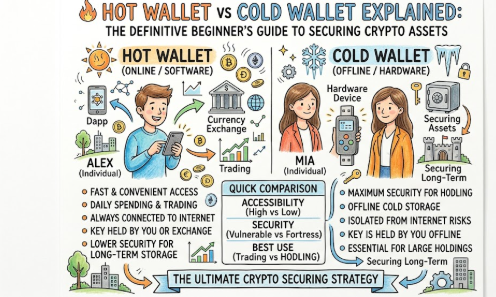
What is a Hot Wallet?
A hot wallet is any cryptocurrency wallet that is actively connected to the internet. This includes mobile apps downloaded to your smartphone, desktop applications installed on your computer, web browser extensions used to interact with decentralized applications (dApps), and the custodial wallets built directly into centralized trading exchanges.
What is a Cold Wallet?
A cold wallet is a physical storage device or specialized system that holds private keys completely isolated from the internet. The most common form of a cold wallet is a hardware signer (often resembling a specialized USB drive or a sleek, small screen device like a Ledger Flex or Trezor Safe 5). Because it has no native, active connection to the web, it is physically immune to online hacking attempts, malware injections, and remote exploits.
Where It Connects Real Life to Money
In your everyday financial life, you likely already use a dual-storage system without realizing it. You carry a physical leather wallet or a digital mobile app on your smartphone containing a small amount of cash or a debit card for quick daily transactions. This is your “hot wallet”—it is highly accessible, convenient, but carries a higher risk if lost or stolen. Conversely, your life savings are kept in a deeply secured bank account, a fixed deposit, or a heavy home safe. This is your “cold storage”—it requires extra steps to access, but it protects your core wealth from opportunistic theft.
One Critical Takeaway: Hot wallets are engineered for immediate convenience, speed, and active trading liquidity. Cold wallets are engineered purely for uncompromised security, absolute custody control, and long-term asset preservation.
3. Why Crypto Wallet Infrastructure Is Crucial for Financial Decisions
Your choice of wallet infrastructure acts as the ultimate foundation for your entire digital financial footprint. It directly influences how you navigate risk, manage your long-term savings, execute trades, and maintain emotional discipline during periods of high market volatility.
The Intersections of Custody and Finance:
- Risk Awareness and Capital Preservation: In traditional investing, your risk is usually tied to market price movements. In crypto, you face an entirely separate layer of operational risk: custody risk. If your wallet infrastructure is weak, your portfolio value can drop to zero overnight due to a software exploit, independent of asset performance.
- Mitigating Emotional Decision-Making: When market volatility spikes, investors holding assets directly on hot exchange platforms are highly susceptible to panic-selling or chasing sudden, speculative market trends. The natural physical friction required to move assets out of an offline cold wallet forces a mandatory cooling-off period. This friction shields your portfolio from impulsive, emotionally driven market moves.
- Long-Term Financial Discipline: Utilizing a dedicated cold storage system signals a shift from short-term speculation to systematic wealth accumulation. It establishes a structural boundary around your core capital, ensuring that funds earmarked for long-term horizons are physically separated from your daily trading or experimental activities.
A Short Practical Scenario
Consider an investor named Sarah. She keeps her entire crypto allocation on a popular web browser hot wallet extension because she enjoys interacting with decentralized finance platforms. One evening, while searching for a premium trading chart tool, she unknowingly downloads a malicious software package bundled with an advanced data-harvesting script. Within minutes, the script scans her computer’s active memory, copies her unencrypted hot wallet credentials, and drains her entire balance to an anonymous address.
Had Sarah utilized an offline hardware wallet, the private keys would have remained safely sealed inside a dedicated cryptographic chip. Even with full access to her computer, the remote attacker would have been completely unable to sign the transaction without physically pressing the confirmation buttons on her offline device.
4. The Real Problem Readers Face With Crypto Custody
The core challenge facing retail market participants today is not a lack of access to technology; it is the overwhelming mountain of conflicting, highly technical advice scattered across social media and web forums.
[Conflicting Online Advice] ──> [Analysis Paralysis] ──> [Security Short-Cuts] ──> [Exploits/Loss]
Beginners find themselves caught in severe analysis paralysis. They read complex debates regarding open-source vs. closed-source secure elements, or manual seed phrases vs. multi-party computation cloud backups. Frustrated by the steep learning curve, many users take dangerous security short-cuts. They take digital screenshots of their 24-word recovery seed phrases, save them directly into unencrypted cloud storage accounts, or reuse weak passwords across multiple centralized platforms.
Furthermore, the industry is saturated with aggressive marketing campaigns that intentionally downplay operational risks. New users are often enticed by platforms promising optimized transaction speeds or seamless mobile access, without being told that these features require giving up direct control of their private keys.
By treating cryptocurrency like a legacy bank account, investors completely overlook the reality that there is no customer support line to reverse a blockchain transaction. This systemic lack of deep custody education creates an environment where preventable phishing attacks, malicious smart contract permissions, and simple human formatting errors continuously drain retail capital. To break this cycle, you must look past the flashy user interfaces and understand the exact mechanics of how transactions are securely generated and transmitted.
5. How Crypto Wallets Work Step by Step
Understanding the precise, chronological lifecycle of wallet setup and transaction execution is essential for maintaining operational safety. Here is how the process works from scratch:
1.Cryptographic Seed Generation:Step 1: The Foundation.
When you turn on a non-custodial wallet for the first time, it uses an internal random number generator to create a massive, unique binary number. This data is converted into a readable sequence of 12 or 24 words using the standard BIP39 protocol. This sequence is your Secret Recovery Phrase (or seed phrase).
Practical Example: A device generates 24 random words on its screen. You write them down immediately on a physical piece of paper.
Common Mistake: Taking a smartphone photo or saving the words into a digital text document.
Better Approach: Transcribe the words manually onto paper or a dedicated metal storage plate, completely offline.
2.Deriving Private and Public Keys:Step 2: Key Creation.
The wallet uses mathematical algorithms (specifically Elliptic Curve Cryptography) to translate your seed phrase into a master private key. From this master private key, the system derives individual public keys.
Practical Example: The wallet app automatically builds public tracking addresses for Bitcoin, Ethereum, and Solana behind the scenes.
Common Mistake: Believing that you need a completely separate seed phrase for every individual asset type.
Better Approach: Understand that one single master seed phrase manages your entire multi-chain portfolio architecture.
3.Generating the Public Wallet Address:Step 3: External Facing Address.
The derived public key undergoes a final hashing process to create the shorter, alphanumeric wallet address that you share with the world to receive incoming payments.
Practical Example: An address string resembling 0x71C...3A9f is generated for your public Ethereum profile.
Common Mistake: Manually typing out the long alphanumeric string letter-by-letter during a transfer.
Better Approach: Always use native QR code scanning features or copy-and-paste functions, combined with visual verification of the first and last five characters.
4.Initiating an Outbound Transaction:Step 4: Expressing Intent.
When you decide to send funds, you fill out the recipient’s public wallet address and the exact asset amount inside your chosen wallet’s interface.
Practical Example: You use a mobile wallet app to input a friend’s address to send them 0.05 ETH.
Common Mistake: Failing to verify the destination address after copying it, leaving you open to clipboard-modifying malware.
Better Approach: Double-check every single character on an independent screen before advancing to the signing screen.
5.Cryptographic Transaction Signing:Step 5: Applying the Private Key.
The wallet takes the unconfirmed transaction data and processes it using your hidden private key. This creates an unforgeable, unique digital signature that proves you own the assets, without ever exposing the private key itself to the broader network.
Practical Example: In a hot wallet, this signature occurs inside your computer’s browser memory. In a cold wallet, this occurs entirely offline within the physical chip.
Common Mistake: Signing a transaction prompted by an unverified website or a random pop-up window.
Better Approach: Read the raw data breakdown on your hardware wallet’s trusted screen to verify what you are actually approving.
6.Broadcasting to the Network Ledger:Step 6: Public Propagation.
The freshly signed digital transaction is pushed from your wallet out to the global internet, where it enters a public pool of unconfirmed transactions (the mempool).
Practical Example: The transaction status changes to “Pending” within your software interface.
Common Mistake: Panic-sending the exact same transaction multiple times if the network experiences temporary congestion.
Better Approach: Monitor the transaction hash on an independent public blockchain explorer until it processes.
7.Blockchain Confirmation and Settlement:Step 7: Final Validation.
Decentralized network validators (miners or stakers) pull your signed transaction from the mempool, verify that your digital signature matches your public address, and permanently batch it into a new block on the immutable ledger.
Practical Example: The ledger records that your balance decreased by 0.05 ETH, and the recipient’s balance increased by the exact same amount.
Common Mistake: Assuming a transaction can be stopped or recalled while it is being processed by validators.
Better Approach: Accept that blockchain architecture is entirely permanent; double-check everything before broadcasting.
Key Factors That Influence Crypto Wallet Safety
When determining how to configure your cryptocurrency custody setup, several real-world variables must be analyzed in parallel to maintain effective operational security.
- Private Key Custody (Who Controls the Keys): This is the core variable of digital asset ownership. In a custodial setup (like a centralized exchange), a third-party corporation manages the private keys on your behalf. In a non-custodial setup (like a hot mobile app or cold hardware device), you hold absolute, unilateral control over the cryptographic keys.
- Network Isolation (The Attack Surface): This factor measures how exposed your keys are to online vectors. Hot wallets have zero isolation; their operational environment is continuously exposed to operating system vulnerabilities, malicious web code, and phishing vectors. Cold wallets enforce physical isolation, restricting the key’s environment completely from the web.
- Seed Phrase Lifecycle Management: Your security is only as strong as your seed phrase storage method. If an investor buys a high-end cold wallet but types their recovery seed phrase into a cloud-connected note-taking app, they have effectively converted their cold wallet into an incredibly insecure hot wallet.
- Smart Contract Interaction Risk: Modern digital assets frequently interact with complex decentralized applications. If you sign a malicious transaction approval that gives an external smart contract permission to spend your tokens, an attacker can drain your wallet instantly—regardless of whether you are using a hot or cold wallet framework.
- Physical Device Integrity and Supply Chain Paths: For cold hardware wallets, safety begins during production. Purchasing a hardware device from unverified third-party discount retailers introduces the massive risk of receiving a pre-configured or physically tampered device designed to steal your assets.
Detailed Breakdown of Hot and Cold Wallets
To build an optimized custody strategy, we must systematically explore both wallet architectures across their distinct sub-categories.
Deep Dive: Hot Wallets (Internet-Connected)
Hot wallets exist in several distinct configurations, each optimized for speed, daily utility, and convenience.
1. Centralized Exchange Wallets (Custodial)
These are the default balances inside accounts like Binance, Coinbase, or Kraken. They require no technical blockchain knowledge to operate.
- The Structural Risk: You do not own the underlying keys. If the exchange halts withdrawals, goes bankrupt, or experiences an internal system failure, your portfolio can be frozen or permanently lost.
2. Software / Mobile Wallets (Non-Custodial App)
Applications installed directly on your iOS or Android smartphone (such as Trust Wallet or Phantom). They give you direct custody of your seed phrase.
- The Structural Risk: Smartphones are consistently connected to cell networks and public Wi-Fi, making them vulnerable to targeted SIM-swapping attacks, zero-day operating system exploits, and physical phone theft.
3. Browser Extension Wallets (Web3 Gateways)
Extensions installed into browsers like Chrome or Brave (such as MetaMask or Backpack). They are built to interact smoothly with decentralized finance (DeFi) platforms and NFT marketplaces.
- The Structural Risk: They operate in a highly exposed environment. Malicious search engine ads frequently redirect users to spoofed websites that mimic clean user interfaces to drain browser memory assets.
Deep Dive: Cold Wallets (Completely Offline)
Cold wallets are designed to withstand advanced physical and digital attack vectors by eliminating constant internet connectivity.
1. Hardware Signers (Specialized Secure Electronics)
Dedicated physical units manufactured by industry-standard firms (such as Ledger or Trezor). These devices utilize a specialized Secure Element (SE) microchip—the exact same high-grade security technology found in modern biometric passports and credit cards.
- How They Operate: The private key never leaves the secure boundaries of the physical microchip. When an outbound transaction is requested, the unconfirmed data packet is sent down the USB or Bluetooth cable into the hardware device. The chip signs the data internally and sends only the completed signature back up to the computer.
2. Paper Wallets (Legacy Cold Storage)
An older method where a private key and a public address are printed directly onto a physical sheet of paper, often as QR codes, generated by an offline computer.
- The Structural Risk: While immune to digital hacks, paper degradation, ink fading, moisture damage, and house fires represent severe, irreversible risks. Furthermore, importing a paper wallet incorrectly into an online device can instantly compromise its security.
3. Air-Gapped Systems (No Physical Wire Connections)
Advanced hardware setups that completely eliminate USB or Bluetooth connections. They communicate exclusively via optical QR Code Scanning using a built-in camera, or via micro-SD cards (such as the Keystone or BitBox02 systems). This architecture guarantees that there is zero electronic wire connection between your private keys and an internet-connected computer.
Common Mistakes Beginners Make With Crypto Storage
Understanding what not to do is often more valuable than buying the most expensive security tools. Below are the most frequent structural security failures committed by newcomers:
- Storing the Recovery Seed Phrase Digitally: This is the absolute single point of failure for millions of dollars in lost retail crypto. Saving a seed phrase in a smartphone photo album, email draft, Google Drive folder, or unencrypted text file means that if an attacker ever gains access to your cloud account, your funds are gone.
- Blind-Signing Unverified Smart Contract Transactions: New users often click through smart contract confirmation prompts without reading the raw permission data. Malicious contracts will frequently display an innocent-looking text box that secretly masks an “Approve Unlimited Spending” command for your highest-value tokens.
- Reusing Account Passwords Across Exchanges: Relying on identical, simple passwords across multiple centralized platforms leaves you completely exposed to credential-stuffing attacks following routine third-party data breaches.
- Purchasing Hardware Devices from Unofficial Secondary Channels: Buying a cold storage hardware wallet from a discount marketplace or an auction site to save money can be catastrophic. Attackers frequently buy these devices, record the seed phrase, reseal the packaging, and resell them to unsuspecting buyers to drain their funds down the road.
The “Don’t Do This” Checklist
- Do not take a digital screenshot or photo of your seed phrase under any circumstances.
- Do not type your 12 or 24-word recovery phrase into any website, form, or popup window.
- Do not store your physical backup papers in an unlocked drawer where visitors or roommates can see them.
- Do not use public Wi-Fi networks to execute significant crypto transactions without a secure, trusted virtual private network (VPN).
- Do not answer unsolicited direct messages on social media platforms offering technical wallet troubleshooting support.
Practical Real-Life Examples of Crypto Wallet Usage
To contextualize these concepts, let us review five realistic, everyday scenarios that illustrate proper and improper wallet utilization:
- Scenario 1: Daily Active Token Trader
- Situation: An investor wants to swap tokens daily on decentralized decentralized exchanges (DEXs).
- The Wrong Path: Connecting a deep multi-year savings cold wallet directly to high-risk experimental trading platforms.
- The Better Path: Setting up a separate, low-balance browser hot wallet as an isolated “spending account,” funding it only with small amounts when needed.
- Core Learning: Segment your capital based on activity to protect your core wealth from unexpected smart contract exploits.
- Scenario 2: Long-Term Passive Investor
- Situation: A salaried employee buys $200 worth of Bitcoin every single month for a five-year holding plan.
- The Wrong Path: Leaving the accumulating balance on a centralized exchange app, completely ignoring counterparty risk.
- The Better Path: Accumulating on the exchange for a few months, then transferring the lump sum to a personal hardware cold wallet.
- Core Learning: Long-term holdings must be protected by absolute, personal ownership of the private keys.
- Scenario 3: Mobile DeFi User
- Situation: A user wants to manage their portfolio entirely on their smartphone while commuting.
- The Wrong Path: Storing their master seed phrase inside an unencrypted note-taking app for easy copy-pasting.
- The Better Path: Using a reputable mobile hot wallet app secured by biometric authentication, and linking it to an hardware device via Bluetooth for transaction approval.
- Core Learning: Convenience should never come at the expense of fundamental cryptographic key isolation.
- Scenario 4: Handling a Device Loss
- Situation: An investor accidentally drops their hardware wallet into water, destroying the electronics completely.
- The Wrong Path: Panicking and assuming their cryptocurrency assets are gone forever.
- The Better Path: Buying a new hardware signer and typing their securely stored physical 24-word seed phrase into it to restore full access.
- Core Learning: The physical device is entirely replaceable; your true ownership lies completely within your offline seed phrase backup.
- Scenario 5: Navigating a Sudden Fork or Airdrop
- Situation: A popular blockchain project announces an asset airdrop that requires users to connect a wallet to claim free tokens.
- The Wrong Path: Rushing to input their main wallet’s private key directly into a new, unverified website interface out of fear of missing out.
- The Better Path: Waiting for community security audits, analyzing the site’s legitimacy, and testing the claim process using an empty, secondary burner wallet.
- Core Learning: Financial greed is the primary vector used by phishing scammers to bypass robust hardware defenses.
10. Comparative Frameworks: Two Educational Tables
Table 1: Structural Feature and Risk Comparison
| Structural Characteristic | Centralized Exchange Wallet (Custodial) | Software / Mobile Wallet (Hot Non-Custodial) | Hardware Signer (Cold Storage Device) |
| Private Key Ownership | Kept entirely by the exchange platform | Held by you on an internet-connected device | Held by you on an offline cryptographic chip |
| Online Hack Vulnerability | High (Target for platform exploits) | High (Target for malware and scripts) | None (Keys remain isolated from the web) |
| Physical Loss Impact | None (Recoverable via company KYC) | Low (Recoverable via seed phrase backup) | Low (Recoverable via seed phrase backup) |
| Setup Complexity | Very Low (Standard email and password) | Low (App download and seed generation) | Moderate (Device initialization and verification) |
| Transaction Speed / Utility | Instant internal matching engines | Fast external blockchain broadcasting | Requires physical button presses to sign |
| Financial Counterparty Risk | Complete dependence on platform solvency | None (Direct interaction with ledger) | None (Direct interaction with ledger) |
Table 2: Common Operational Failures vs. Defensive Best Practices
| Vulnerability Vector | The Incorrect / Dangerous Action | The Correct / Professional Defense |
| Seed Phrase Storage | Saving the phrase inside a desktop file or cloud storage app | Stamping the phrase into a solid metal plate stored in a secure location |
| Address Verification | Assuming clipboard copy-paste function is always 100% accurate | Confirming every character on a physical hardware screen before signing |
| DeFi Protocol Interactivity | Granting infinite token spend approvals to unverified platforms | Regularly revoking spending allowances using tools like Revoke.cash |
| Hardware Acquisition | Buying a pre-owned device from discount auction sites | Ordering directly from the official manufacturer’s main website |
| Account Recovery Setup | Sharing account backup details with family members or friends | Maintaining a redundant physical backup in a fireproof home safe |
Tools, Methods, and Frameworks Readers Can Use
- Metal Seed Phrase Storage Plates: Instead of relying purely on paper, which can disintegrate during a flood or home fire, utilize a solid stainless steel or titanium seed backup plate. These tools allow you to slide or stamp your 12 or 24 words into metal, ensuring they can withstand extreme environments.
- On-Chain Allowance Revocation Interfaces: Websites such as Revoke.cash or the approval tracking dashboards built natively into block explorers (like Etherscan) are vital operational tools. They allow you to look at every smart contract approval you have ever granted and manually cancel permissions for apps you no longer use.
- The “First-and-Last” Address Matching Method: A security protocol where you physically read and match the first five characters and the final five characters of a destination address across two completely independent screens before approving any transfer. This simple check neutralizes address-poisoning and clipboard-hijacking malware.
- Dedicated Cold Storage “Signer” Setup: Utilizing a hardware device that runs a completely custom, isolated operating system (like Ledger OS) paired with a native companion application (like Ledger Live or Trezor Suite). This approach keeps your asset management centralized within a heavily audited, authentic digital ecosystem.
Expert Tips to Make Better Decisions
- Treat Every Digital Note as Public: Assume that any text typed into an internet-connected computer or smartphone will eventually be leaked or scraped by data-harvesting software. Keep your seed phrase entirely offline.
- Establish a Routine Custody Audit: Set a recurring calendar reminder every six months to review your active smart contract allowances, inspect your physical backup storage locations, and update your hardware wallet firmware.
- Utilize a Test Transaction Protocol: When moving substantial sums of digital capital to a new wallet address, always send a tiny, non-consequential test amount first. Confirm that the funds arrived safely before sending the remaining balance.
- Implement a Strict Device Isolation Policy: Never connect a high-security hardware wallet to a computer that is actively being used for high-risk downloads, pirated media streaming, or experimental software testing.
- Never Liquidate Your Emergency Savings: Do not allocate capital needed for real-world living expenses, mortgages, or emergency funds into volatile digital assets, regardless of how secure your wallet infrastructure is.
- Establish a Clear Crypto Inheritance Plan: Ensure a trusted family member knows where your physical seed backups are stored and understands the basic steps required to recover them, preventing your assets from being permanently lost in an emergency.
- Avoid Discussing Wealth Online: Sharing your exact cryptocurrency holdings or investment success on public social media forums transforms you into a prime target for sophisticated spear-phishing and SIM-swapping operations.
- Accept Natural UI Friction as a Feature: Do not view the manual step of plugging in a hardware wallet and clicking buttons as an annoying inconvenience. That physical friction is the exact barrier keeping your lifework safe from remote thieves.
- Maintain Separate Accounts for Separate Goals: Keep your speculative, experimental trading capital completely separated from your long-term wealth accumulation vaults.
- Rely Only on Official Customer Channels: If a hardware device requires technical maintenance, contact the official manufacturing company through their verified corporate portal. Never engage with self-proclaimed support agents on public messaging boards.
Case Studies: How Storage Decisions Impact Portfolio Safety
Case Study 1: The Browser Extension Exploitation
- Profile: Freelance Web Designer (Retail Investor)
- Situation: Accumulated a balance of $12,500 in various tokens over two years, storing them inside a popular hot wallet web extension for quick decentralized trading access.
- The Core Problem: The user clicked on a malicious, sponsored search engine link that perfectly cloned a popular automated trading platform. The site prompted an unexpected “Session Timeout” and requested the user to input their 12-word recovery phrase to log back in.
- The Outcome: The user typed the phrase into the web form. Within 45 seconds, an automated script drained their entire portfolio balance.
- Key Takeaway: Hot wallets offer zero structural protection against phishing sites when a user manually inputs their seed phrase into a digital input box.
Case Study 2: The Exchange Liquidity Freeze
- Profile: Salaried IT Project Manager
- Situation: Kept an active balance of $42,000 across Bitcoin and stablecoins sitting directly on a major centralized cryptocurrency exchange to earn a passive interest yield.
- The Core Problem: The centralized exchange platform faced severe, sudden macroeconomic liquidity constraints and abruptly suspended all customer withdrawals without prior warning.
- The Outcome: The investor’s account balance was frozen for a prolonged restructuring process, leaving them with zero operational access to their capital.
- Key Takeaway: Leaving digital wealth on a centralized exchange introduces immense counterparty risk. True asset ownership requires direct, non-custodial private key management.
Case Study 3: The Cold Storage Success
- Profile: Small Retail Business Owner
- Situation: Held a long-term retirement portfolio of $85,000 in digital assets, managed completely through an offline hardware wallet secured with a metal seed backup.
- The Core Problem: The user’s primary desktop computer suffered a severe ransomware infection that completely locked down their local operating system and gave remote hackers full access to their desktop apps.
- The Outcome: The remote attackers attempted to force multiple outbound crypto transactions. However, because the private keys were physically sealed inside the disconnected hardware device, no transactions could be signed without a physical button press. The user wiped their computer clean, and their funds remained completely safe.
- Key Takeaway: Hardware signers create an absolute physical barrier that remote digital malware simply cannot breach.
Risk Awareness: What Readers Must Check First
Navigating cryptocurrency custody requires managing distinct types of systemic risk. Below is a breakdown of the core operational risks you must monitor:
                  ┌──► 1. Network Vulnerabilities (Malware, Phishing)
                  │
[Crypto Risks] ───┼──► 2. Counterparty Risk (Exchange Bankruptcies)
                  │
                  └──► 3. Human Error (Lost Seeds, Wrong Addresses)
- Network and Smart Contract Exploits: Even if your keys are offline, interacting with a compromised or poorly audited decentralized protocol can lead to a complete loss of capital. Always limit smart contract permissions.
- Financial Counterparty Failure: Keeping your assets on any third-party app or exchange means your financial safety is tied directly to that company’s internal management, regulatory compliance, and solvency.
- Irreversible Human Execution Errors: Blockchain ledgers are built to be completely final. If you send funds to the wrong address or permanently misplace your recovery phrase without an offline backup, there is no central authority that can restore your wealth.
- Advanced Physical Extortion and Targeted Theft: If you store massive amounts of capital on a mobile wallet and publicly brag about your balances, you face real-world security risks, including targeted device theft or physical coercion.
Checklist Before Taking Action
Before moving any significant capital into a hot or cold wallet setup, run through the following operational checklist:
- I have verified that my chosen wallet is entirely non-custodial and gives me full, exclusive access to my private keys.
- My 12 or 24-word recovery phrase has been written down completely offline on a physical surface, with zero digital copies made.
- I have verified that any hardware device I use was purchased directly from the official manufacturer’s main website, and the box arrived with all tamper-evident seals intact.
- I have configured a complex, unique PIN or password on my wallet app that is completely different from my regular smartphone lock code.
- I have successfully tested the backup system by performing a tiny test transaction and verifying its successful arrival via an independent block explorer.
- I have confirmed that all cloud-connected auto-backup features on my smartphone are completely disabled for my wallet apps.
Use this verification framework before funding any new wallet setup. Taking five minutes to confirm these points protects you from catastrophic operational oversights.
Strategic Insights for Advanced Decision-Making
For readers seeking a more professional approach to digital asset preservation, security can be significantly enhanced by adopting an advanced Multi-Tiered Custody Architecture. Rather than relying on a single wallet, experienced market participants split their capital across three distinct operational layers based on intent:
[Level 1: Hot Web Wallet] ───> Daily Utility / Experimental DeFi (Minimal Funds)
       ▲
       │ (Manual Refunding)
       │
[Level 2: Main Cold Signer] ──> Intermediate Portfolio / Staking Vault
       ▲
       │ (Periodic Vaulting)
       │
[Level 3: Multi-Sig/Passphrase] ──> Generational Wealth / Cold Storage Vault
- The Transactional Layer (Hot Wallet): This is a browser extension or mobile app holding less than 5% of your total crypto net worth. It is used exclusively for quick marketplace transactions, minting NFTs, or interacting with new DeFi apps. If it gets compromised, your broader financial health is completely unaffected.
- The Accumulation Layer (Standard Cold Wallet): A dedicated hardware device holding 70-80% of your crypto capital. This device is strictly restricted from interacting with unverified or experimental smart contracts. Its sole purpose is to securely sign basic transfer transactions to hold, stake, or compound major baseline digital assets.
- The Generational Layer (Advanced Cold Storage): For substantial balances, advanced users deploy a hidden BIP39 Passphrase (often called a “25th word”). This feature adds a custom alphanumeric word of your own choosing on top of your 24-word seed phrase, creating a completely separate, invisible wallet layout. Even if a physical thief steals your 24-word paper backup, they cannot access this hidden vault without knowing your custom passphrase.
Key Terms Explained for Beginners
- Private Key: A secret, mathematical alphanumeric string that grants absolute ownership and control over a specific blockchain address. It must never be shared with anyone.
- Public Key: An alphanumeric string derived from a private key that serves as your public address. It acts like a bank routing number, allowing other users to send assets to your wallet.
- Secret Recovery Phrase (Seed Phrase): A readable sequence of 12 or 24 words generated by your wallet using the BIP39 standard. It is a human-friendly representation of your master private key used to restore your wallet if your device breaks or is lost.
- Secure Element (SE): A specialized, tamper-resistant microchip embedded inside premium hardware wallets. It isolates your private keys from the device’s external ports and protects against physical side-channel hacking attacks.
- Air-Gap Storage: A security framework where a device is completely physically isolated from the internet, local networks, Bluetooth, and cables. Data transfers are handled exclusively via offline physical methods like scanning QR codes.
- Smart Contract Allowance: A digital permission signed by a user that grants an external decentralized application the structural authority to move a specific quantity of tokens out of that user’s wallet address.
- Phishing Scam: A deceptive attack vector where malicious actors set up fake websites, apps, or ads that perfectly mimic trusted brands, designed to trick users into typing in their secret recovery phrases.
- Non-Custodial Wallet: A wallet infrastructure where you retain absolute ownership and control of your cryptographic keys, meaning no third-party corporation can freeze or manage your funds.
- Centralized Exchange (CEX): A commercial platform run by a corporate entity that allows users to buy, sell, and trade digital assets. CEXs hold your private keys on your behalf within a custodial framework.
- Blockchain Ledger: A decentralized, transparent, and completely unchangeable digital ledger that tracks and records transactions across a distributed computer network.
Who Should Read This Blog
- Crypto Beginners: Individuals who have recently bought their first digital assets and need a clear, non-technical roadmap to protect their funds from common mistakes.
- Salaried Employees: Long-term retail savers looking to build a structured, automated crypto savings system while keeping their core capital safe from online hacks.
- Small Business Owners: Professionals integrating digital assets into their business operations who require an institutional-grade understanding of self-custody risk management.
- Active Web3 Traders: Short-term market participants who need to understand how to balance daily trading convenience with cold storage asset preservation.
Frequently Asked Questions
What is the fundamental difference between a hot wallet and a cold wallet?
The core difference lies entirely in internet connectivity. A hot wallet is constantly connected to the web via software apps, making it fast but vulnerable to remote digital hacking. A cold wallet keeps your private keys completely isolated offline on physical hardware chips, providing strong security against online exploits.
Will I lose my cryptocurrency if I accidentally misplace my physical cold wallet device?
No, your crypto is never stored inside the physical device itself; it lives permanently on the blockchain ledger. Your hardware device simply holds the private key to access those assets. As long as you have your physical 12 or 24-word Secret Recovery Phrase safely written down offline, you can enter those words into a new device to recover your entire portfolio.
Can a hot wallet app be successfully hacked by a remote digital attacker?
Yes, hot wallets are software programs running on internet-connected smartphones or computers. If your operating system is infected with data-harvesting malware, keyloggers, or malicious browser scripts, an attacker can extract your private key data from your device’s active memory and drain your funds remotely.
Is it safe for beginners to store their entire crypto portfolio on a centralized exchange?
No, leaving your assets on a centralized platform means you do not own the underlying cryptographic keys. If the exchange experiences financial insolvency, halts user withdrawals, or suffers an internal smart contract exploit, your assets can be completely frozen or lost without any legal recourse.
What exactly happens if someone discovers my 24-word Secret Recovery Phrase?
If an attacker gets access to your recovery phrase, they can instantly recreate your private keys on their own device from anywhere in the world. They can then drain your entire portfolio balance immediately. Your recovery phrase must be guarded with absolute, uncompromised offline confidentiality.
Can a hardware wallet protect my funds if I interact with a malicious smart contract?
No, a hardware wallet prevents attackers from stealing your private keys remotely, but it cannot save you from your own decisions. If you manually confirm a transaction that gives a malicious smart contract explicit permission to spend your tokens, the contract can drain those assets directly on the blockchain.
Why are official hardware wallets consistently called “signers” by modern security experts?
They are called signers because they do not store physical coins. Their sole technical function is to use your isolated private key to cryptographically “sign” outbound data packets completely offline, verifying your transaction intent without ever exposing your keys to the internet.
Should I take professional legal advice before setting up a major crypto custody system?
Yes, if you are managing substantial allocations of digital wealth, you should consult a qualified financial planner or tax specialist. This ensures your custody framework complies with local tax laws, financial disclosure frameworks, and inheritance estate planning regulations.
How often should I update the firmware on my hardware cold storage wallet?
You should check for official firmware updates every three to six months through your wallet’s verified companion app. These updates contain critical security patches against newly discovered vulnerabilities, along with optimizations for performance and asset compatibility.
What should I avoid doing immediately after initializing my recovery seed phrase?
Never type those words into any computer keyboard, never take a digital photo of them with your smartphone, and never upload them to a cloud backup platform. Your seed phrase must move directly from the device’s screen onto a physical, offline storage medium like paper or metal.
How does choosing a secure wallet framework fit into a broader personal financial plan?
Securing your digital assets acts as the ultimate defensive anchor for your broader financial portfolio. By eliminating custody risk and preventing remote theft, you ensure that your volatile investment capital is preserved over a multi-year horizon, allowing you to build sustainable wealth.
What is the single best next step to take after reading this educational blog?
The ideal next step is to evaluate your current asset distribution. If you hold significant value on a hot wallet extension or a centralized exchange app, purchase a reputable hardware cold wallet from an official manufacturer and transfer your long-term assets entirely offline.
Conclusion and Next Steps
Building a deep, practical understanding of cryptocurrency custody is one of the most important steps you can take to secure your digital financial future. As we have explored throughout this guide, the debate between hot and cold wallets is not about choosing one over the other; it is about understanding how to use both effectively within a balanced, multi-layered security plan. Hot wallets offer excellent speed, fluid market liquidity, and seamless access to the expanding world of decentralized applications. Cold wallets provide an uncompromised physical fortress that isolates your private keys from the digital vulnerabilities of the internet.
True financial empowerment in the digital asset space requires moving past the initial excitement of market trading and taking serious, personal responsibility for asset protection. Relying on centralized third-party platforms or keeping large balances on exposed software apps introduces unnecessary counterparty and malware risks that can completely wipe out your hard-earned savings overnight.
As you move forward, remember that the most secure hardware devices are only as strong as the human procedures behind them. Commit to keeping your recovery seed phrases completely offline, double-check every address character before approving a transfer, and treat your long-term capital with the strict operational discipline it deserves. By shifting from short-term convenience to structured self-custody, you remove single points of failure and ensure your digital wealth remains firmly under your own control for years to come.