Introduction
Crypto looks exciting, but beginners can make risky decisions without understanding the basics. Bitcoin halving attracts particular attention because social media posts often present it as a guaranteed signal that prices will rise. In reality, halving is a technical change in Bitcoin’s issuance process, not a promise of investment returns. It reduces the block subsidy received by miners, influences the creation of new bitcoins, and may affect mining economics and market expectations. Understanding these connections helps beginners separate protocol facts from price speculation. This guide explains Bitcoin halving in practical language so crypto learners, investors, traders, students, and financially curious readers can evaluate the event carefully instead of acting through fear, hype, or pressure.
What is Bitcoin Halving
Bitcoin halving is a programmed reduction in the number of new bitcoins awarded to a miner for producing a valid block.
Bitcoin miners confirm transactions, organize them into blocks, and compete to add those blocks to the blockchain. When a valid block is accepted, the successful miner can receive:
- A block subsidy consisting of newly issued bitcoins
- Transaction fees paid by users whose transactions appear in the block
During a halving, only the block subsidy is reduced by half. Transaction fees are not automatically cut in half.
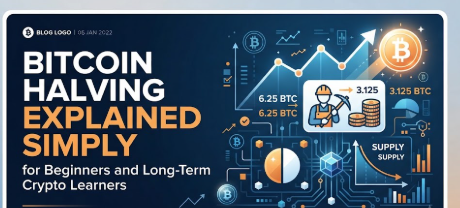
The Bitcoin protocol schedules this reduction every 210,000 blocks, which has historically worked out to approximately four years. Bitcoin’s original block subsidy was 50 BTC, and the amount has continued to decline through successive halvings.
Why Does Bitcoin Have Halving?
Bitcoin was designed with a predictable monetary issuance system. New coins cannot be created simply because a company, miner, government, or individual wants more supply.
The halving mechanism gradually reduces issuance and supports Bitcoin’s maximum supply rule. Bitcoin’s protocol limits the total supply to approximately 21 million coins.
This does not mean that 21 million bitcoins are currently available for sale. Some coins may be held for long periods, inaccessible because of lost private keys, or unavailable at current market prices.
Common Misunderstanding
A common misunderstanding is that halving cuts the total Bitcoin supply in half.
It does not remove half of the existing bitcoins. It does not cut anyone’s wallet balance. It does not divide the market price by two.
Halving only reduces the block subsidy available for newly mined blocks.
Practical Takeaway
Think of halving as a change in Bitcoin’s new supply flow, not a change in the ownership of existing coins.
Why Bitcoin Halving Is Important
Bitcoin halving matters because it connects monetary supply, mining operations, network incentives, investor expectations, and market psychology.
It Changes the New Supply Rate
Before a halving, miners receive a particular block subsidy for each valid block. After the halving, they receive half that amount.
As a result, fewer new bitcoins are created during an equivalent number of future blocks.
This issuance change is built into Bitcoin’s rules. It is not introduced suddenly by a central authority.
It Affects Miner Revenue
Mining businesses usually earn income from two sources:
- Newly issued bitcoins from the block subsidy
- Transaction fees
When the subsidy falls, miners may experience lower revenue unless other factors compensate for it. Possible compensating factors include:
- A higher Bitcoin market price
- More transaction fee revenue
- Lower electricity costs
- More efficient mining machines
- Better operational management
- Access to cheaper capital
- Participation in mining pools
Less efficient miners may face greater pressure after a halving.
It Influences Investor Expectations
Many investors associate halving with scarcity because the rate of new issuance decreases.
However, reduced new supply is only one part of the market. Bitcoin’s price also depends on demand, liquidity, economic conditions, investor sentiment, regulation, institutional activity, leverage, and many other factors.
A supply reduction cannot guarantee a price increase if demand weakens or sellers become more active.
It Encourages Risk Awareness
Halving periods often attract:
- Price predictions
- Influencer campaigns
- Fake investment schemes
- Mining package promotions
- High-leverage trading
- Fear of missing out
- Misleading historical comparisons
Understanding the mechanism helps readers identify the difference between a protocol event and a speculative investment claim.
Practical Scenario
Suppose an employee sees several posts claiming Bitcoin must double after the next halving. The employee uses emergency savings to buy Bitcoin immediately.
The halving occurs, but the market becomes volatile and the price falls in the short term. The employee then needs money for a medical expense and sells at a loss.
The mistake was not learning about halving. The mistake was assuming that a known supply event guaranteed a specific price result and using money that was needed for essential expenses.
The Real Problems Readers Face With Bitcoin Halving
Confusing Technical Language
Terms such as block subsidy, hash rate, difficulty adjustment, proof of work, issuance, and network security can make Bitcoin halving seem difficult.
When beginners do not understand these terms, they may rely on simplified social media claims.
Too Much Price-Focused Content
A large part of online halving content concentrates on one question: Will Bitcoin rise?
This narrow focus ignores more important educational questions:
- What exactly changes?
- What remains unchanged?
- How are miners affected?
- What could influence demand?
- Which risks become more visible?
- How should investors manage uncertainty?
Emotional Decision-Making
Halving discussions can produce greed during rising markets and panic during corrections.
People may buy because they fear missing an opportunity, not because they have assessed their finances, risk capacity, and investment horizon.
Weak Historical Comparisons
Previous Bitcoin cycles are often used as proof of what will happen next.
Historical data can provide context, but each market cycle has different conditions, including:
- Bitcoin’s size
- Market liquidity
- Interest rates
- regulations
- Institutional participation
- Trading products
- Global economic confidence
- Leverage levels
- Investor composition
Past performance does not establish a guaranteed future pattern.
Unrealistic Mining Expectations
Beginners sometimes believe halving automatically makes mining more profitable because Bitcoin becomes scarcer.
In practice, the block subsidy declines. Mining profitability depends on energy costs, equipment efficiency, operational expenses, network difficulty, pool fees, Bitcoin price, and transaction fee income.
Depending Only on Influencers
A large follower count does not prove financial expertise, neutrality, or accuracy.
Some content creators may hold Bitcoin, receive sponsorship payments, promote exchanges, or benefit from increased trading activity.
Not Knowing the Next Step
Many readers understand that a halving happens but do not know how to use that information responsibly.
The better next step is not automatically buying or selling. It is reviewing:
- Personal finances
- Emergency savings
- Investment goals
- Risk tolerance
- Position size
- Custody method
- Tax responsibilities
- Information quality
How Bitcoin Halving Works Step by Step
Step 1: Bitcoin Transactions Are Broadcast
When a person sends Bitcoin, the transaction is broadcast to the network. It waits for miners to include it in a block.
This matters because miners do more than create new coins. They help order transactions and support Bitcoin’s proof-of-work process.
For example, a customer may send Bitcoin to a merchant and include a transaction fee. A miner can select that transaction for a future block.
A common mistake is believing miners only create bitcoins. A better approach is to understand that mining also supports block production and transaction confirmation.
Step 2: Miners Compete to Produce a Valid Block
Miners use specialized computing equipment to perform repeated calculations. Their goal is to find a block header that satisfies the network’s proof-of-work requirement.
This competition makes block production costly in terms of equipment, energy, infrastructure, and operations.
For example, a mining company may operate many application-specific integrated circuit machines in a facility with industrial electricity access.
A common mistake is comparing Bitcoin mining with ordinary laptop-based work. A better approach is to recognize that competitive Bitcoin mining normally requires specialized equipment and professional cost management.
Step 3: The Successful Miner Proposes a Block
A miner that finds a valid solution broadcasts the block to the Bitcoin network.
Bitcoin nodes independently check whether the block follows consensus rules. They review matters such as transaction validity, proof of work, and whether the miner has claimed an acceptable reward.
The block reward consists of the block subsidy plus eligible transaction fees.
A common mistake is assuming that miners can reward themselves with any number of bitcoins. A better approach is to understand that nodes reject blocks that violate Bitcoin’s supply and reward rules.
Step 4: The Block Height Continues Increasing
Each accepted block receives a position in Bitcoin’s chain, commonly described through block height.
The halving schedule is based on the number of blocks, not a fixed calendar appointment.
This distinction matters because blocks do not always arrive at exactly the same interval. Therefore, the precise halving time can only be estimated in advance.
A common mistake is treating an estimated halving countdown as a guaranteed clock time. A better approach is to watch the block height and treat calendar estimates as approximate.
Step 5: The Network Reaches the Halving Block
After another 210,000 blocks have been added since the previous reward period began, the next subsidy reduction takes effect.
The protocol does not require miners, investors, exchanges, or governments to vote on the scheduled reduction.
For example, if the block subsidy during one period is 6.25 BTC, the next scheduled subsidy becomes 3.125 BTC.
A common mistake is believing that all miner income is halved. A better approach is to separate the block subsidy from transaction fees.
Step 6: New Bitcoin Issuance Slows
After the halving, each new block produces fewer new bitcoins.
Existing wallet balances remain unchanged. Previously mined bitcoins continue to exist, and normal transactions can continue.
The important economic change is that less newly issued Bitcoin becomes available through mining rewards.
A common mistake is saying “Bitcoin’s supply has been cut in half.” A better statement is “Bitcoin’s new issuance per block has been reduced by half.”
Step 7: Miners Reassess Their Economics
Miners review whether their operations remain profitable under the lower subsidy.
They may respond by:
- Upgrading equipment
- Seeking cheaper electricity
- Closing inefficient machines
- Joining different mining pools
- Relocating operations
- Using energy-management strategies
- Selling reserves
- Waiting for better market conditions
A common mistake is assuming every miner faces identical costs. A better approach is to recognize that mining economics vary significantly by location, machine efficiency, financing, cooling, maintenance, and electricity contracts.
Step 8: The Market Interprets the Event
Investors, traders, institutions, miners, analysts, and media outlets form different expectations around the halving.
Some may buy in advance. Some may sell after the event. Some may hold for years. Others may use derivatives or avoid the market entirely.
A common mistake is believing that one technical event controls every participant’s behavior. A better approach is to treat halving as one factor within a larger market system.
Key Factors That Influence Bitcoin Halving Outcomes
Bitcoin Demand
Halving changes new issuance, but price outcomes also require demand.
Demand can be influenced by:
- Public interest
- Institutional participation
- Regulatory clarity
- Global liquidity
- Economic uncertainty
- Payment adoption
- Market confidence
- Availability through regulated products
- Competition from other assets
A lower issuance rate combined with strong demand can produce different conditions from a lower issuance rate combined with weak demand.
Market Volatility
Bitcoin can experience rapid price movements before and after major events.
Volatility may be increased by speculation, leverage, liquidations, headlines, and large market orders.
Beginners should not interpret volatility as proof that a predicted long-term outcome is happening.
Miner Operating Costs
Electricity is a major mining expense, but it is not the only one.
Miners may also face:
- Machine acquisition costs
- Facility rent
- Cooling expenses
- Repairs
- Staff expenses
- Financing costs
- Pool fees
- Internet and security costs
- Regulatory costs
A miner with modern equipment and low-cost electricity may remain operational when an inefficient competitor cannot.
Mining Difficulty
Bitcoin adjusts mining difficulty to respond to changes in the computational power participating in the network.
If substantial mining capacity leaves, future difficulty adjustments can help bring average block production back toward the intended range.
This does not guarantee that every miner becomes profitable. It affects competition at the network level.
Transaction Fees
As the block subsidy declines over time, transaction fees become an increasingly important part of miner compensation.
Fee revenue can vary considerably depending on network demand and how much users are willing to pay for block space.
A brief fee increase does not prove that high revenue will continue permanently.
Exchange Reliability
Halving periods may attract new exchange users.
An exchange provides a convenient way to buy or trade Bitcoin, but users can face:
- Withdrawal restrictions
- Account security problems
- Operational failures
- Liquidity problems
- Regulatory disruption
- Counterparty risk
- Fraudulent platforms
Investors should review custody and platform risk separately from Bitcoin’s protocol design.
Wallet and Private-Key Safety
Owning Bitcoin exposure through an exchange account is different from controlling Bitcoin through private keys.
Self-custody gives the user greater control but also greater personal responsibility.
Losing a seed phrase, exposing private keys, signing a malicious transaction, or using an unsafe device can cause permanent losses.
Investor Psychology
Expectations can sometimes become more influential than the event itself.
Fear of missing out may lead people to buy after a sharp rise. Panic may lead them to sell after a sudden decline.
A written plan helps separate financial decisions from emotional market movements.
Regulation and Tax
Bitcoin ownership, trading, mining, reporting, and taxation may be treated differently across jurisdictions.
Halving does not cancel legal obligations.
Readers should keep transaction records and consult qualified professionals for local tax, legal, or compliance guidance.
Detailed Breakdown of Bitcoin Halving
Bitcoin and Blockchain Basics
Bitcoin is a digital monetary network that records transactions on a distributed blockchain.
The blockchain is a chronological history of accepted blocks. Each block contains transaction information and references the previous block, creating a connected record.
Participants commonly include:
- Users sending and receiving Bitcoin
- Wallet operators
- Full nodes validating rules
- Miners producing blocks
- Exchanges facilitating trading
- Developers maintaining compatible software
- Businesses accepting or holding Bitcoin
No single participant type should be confused with complete control over Bitcoin.
What Is the Bitcoin Block Subsidy?
The block subsidy is the new Bitcoin that a valid block is allowed to create under the protocol’s rules.
It is different from transaction fees.
A miner’s total eligible block reward can be expressed simply as:
Block reward = Block subsidy + transaction fees
Halving reduces the subsidy component. Fee income continues to depend on the transactions included in the block.
Why the Supply Limit Matters
Bitcoin’s issuance schedule is designed to reduce the creation of new units over time until issuance becomes extremely small and eventually stops under the programmed schedule.
This predictable policy is one reason people compare Bitcoin with scarce assets.
However, scarcity alone does not create guaranteed value. An asset also requires sustained demand, confidence, usability, liquidity, security, and willingness among participants to hold or acquire it.
Halving and Scarcity
Scarcity means limited availability relative to potential demand.
After a halving, new bitcoins enter the system more slowly. This can reduce the amount of newly mined Bitcoin that miners may potentially sell.
But market supply includes more than new mining output. Existing holders can sell their coins at any time.
Therefore, the market can still experience heavy selling even when new issuance is lower.
Halving and Bitcoin Price
Halving does not contain a command that raises the Bitcoin price.
Bitcoin’s market price is formed through buyers and sellers across trading venues.
Potential price influences include:
- Spot buying and selling
- Derivatives activity
- Leverage
- Institutional allocation
- Miner selling
- Long-term holder behavior
- Economic policy
- Market liquidity
- Regulatory news
- Security incidents
- General risk appetite
A halving may influence expectations, but expectations can already be reflected in the market before the event.
Can Halving Be Priced In?
“Priced in” means traders may have already adjusted their positions based on known information.
Because the halving schedule is publicly known, market participants can prepare far in advance.
However, markets do not share one opinion. Some participants may expect a large impact, others a limited impact, and others may focus on unrelated risks.
It is therefore difficult to prove that an event is completely priced in or completely ignored.
Halving and Mining Profitability
A miner’s basic profitability depends on whether revenue exceeds costs.
Revenue may be influenced by:
- Bitcoin earned through the subsidy
- Transaction fees
- Bitcoin’s market value
- Pool payout structure
- Uptime
- Machine performance
Costs may include:
- Electricity
- Hardware
- Repairs
- Cooling
- Rent
- Staff
- Financing
- Taxes
- Compliance
- Pool charges
After halving, the same mining equipment may earn fewer newly issued bitcoins under otherwise similar conditions.
Does Halving Reduce Network Security?
Halving reduces the subsidy, which can pressure miner revenue. However, network security cannot be evaluated through the subsidy alone.
Other relevant factors include:
- Bitcoin price
- Transaction fees
- Mining difficulty
- Total computational participation
- Mining hardware efficiency
- Geographic distribution
- Pool concentration
- Cost of attacking the network
- Miner incentives
Some inefficient miners may switch off equipment, while efficient miners may continue or expand.
Rather than making absolute claims, beginners should understand that Bitcoin’s long-term security model increasingly depends on the relationship between transaction fees, market value, mining economics, and network participation.
What Happens When Block Subsidies Become Very Small?
As subsidy payments continue declining, transaction fees are expected to form a larger share of miner income.
This creates important long-term questions:
- Will transaction demand create sufficient fee revenue?
- How competitive will mining remain?
- How will layer-two payment systems affect on-chain activity?
- What level of security spending will users and markets support?
- How will mining technology evolve?
These are legitimate economic and technical questions. They should not be answered with certainty when long-term conditions remain unknown.
Bitcoin Investing Versus Bitcoin Trading
Bitcoin investors generally focus on a longer time horizon. They may evaluate Bitcoin’s supply policy, adoption, risks, custody, and role within a diversified portfolio.
Bitcoin traders focus more on shorter-term price movements, market structure, volume, momentum, and risk controls.
Halving information can be relevant to both, but their actions should differ.
An investor may review whether Bitcoin fits a long-term allocation. A trader may examine whether halving-related volatility changes the risk of a particular setup.
Neither approach guarantees profit.
Wallet and Exchange Basics
A Bitcoin wallet manages the keys required to authorize transactions.
Wallet choices include:
- Mobile wallets
- Desktop wallets
- Hardware wallets
- Multisignature arrangements
- Custodial wallets
- Exchange accounts
Each option has trade-offs involving convenience, control, security, cost, and responsibility.
A beginner should not move large amounts into self-custody without understanding seed phrase protection, address verification, backups, and transaction finality.
Transaction and Network Fees
Bitcoin users may attach transaction fees to encourage miners to include their transactions in blocks.
Fees can vary depending on network demand, transaction size, and how urgently the user wants confirmation.
Halving does not directly divide individual transaction fees by two.
Users should check fee estimates and verify addresses before sending because Bitcoin transactions are generally difficult or impossible to reverse once confirmed.
Why Bitcoin Is Not Guaranteed Income
Bitcoin does not pay a guaranteed return simply because its supply is limited.
Its market price can rise, fall, or remain weak for long periods.
Risks include:
- Severe volatility
- Regulatory changes
- Exchange failures
- Fraud
- Theft
- Custody mistakes
- Liquidity pressure
- Leverage losses
- Tax consequences
- Technology-related uncertainty
- Market sentiment changes
Bitcoin should not be treated as a substitute for emergency savings or assured income.
Common Mistakes Beginners Make With Bitcoin Halving
Treating Halving as a Guaranteed Buy Signal
This happens because previous market cycles are presented as simple cause-and-effect stories.
It is risky because markets can behave differently, and a known event may already influence expectations.
Instead, assess financial goals, valuation concerns, risk capacity, position size, and time horizon.
Investing Emergency Money
Some beginners use rent money, medical savings, or emergency funds because they fear missing a price rise.
This can force them to sell during a decline when an urgent expense appears.
Keep emergency funds in suitable liquid and lower-risk arrangements separate from speculative assets.
Using High Leverage
Leverage allows traders to control a larger position using a smaller amount of capital.
It can also produce rapid losses or liquidation when Bitcoin moves against the position.
Beginners should avoid confusing a strong market opinion with reliable risk control.
Following Random Price Targets
Online predictions may have no transparent method, evidence, or accountability.
A precise target can create false confidence even when it is only an opinion.
Use scenario planning instead of depending on one forecast.
Ignoring Custody Risk
A correct market prediction cannot protect funds from a hacked account, exposed seed phrase, phishing attack, or fraudulent platform.
Review security before increasing exposure.
Sending Bitcoin Without Verification
Users sometimes copy the wrong address, use the wrong network, or fail to check the full destination.
Crypto transactions may not be reversible.
Always verify the address, network, amount, and fee. A small test transaction may be appropriate before a large transfer.
Trusting Fake Halving Investments
Scammers may advertise special halving packages, guaranteed mining returns, doubling schemes, or limited-time access.
Bitcoin halving does not create an official investment program.
Avoid anyone demanding private keys, seed phrases, remote device access, or urgent payment.
Assuming Mining Is Easy Passive Income
Mining profitability can be difficult to estimate and may change as Bitcoin price, difficulty, electricity costs, and equipment performance change.
Promoters may show gross revenue while hiding electricity, cooling, repairs, downtime, and machine depreciation.
Calculate total costs rather than relying on advertised income.
Ignoring Tax Responsibilities
Buying, selling, exchanging, receiving, or mining Bitcoin may create reporting obligations depending on local law.
Poor records can make compliance more difficult.
Maintain dates, amounts, transaction identifiers, fees, purchase costs, and disposal details.
Copying Historical Patterns Blindly
Past cycles can help explain market behavior, but they cannot guarantee timing or returns.
Each halving occurs under different economic and market conditions.
Use history as context, not certainty.
Acting After a Sudden Price Move
Buying after a major rise or selling after a sharp decline often reflects emotion rather than a plan.
Create rules before volatility appears.
Ignoring Portfolio Concentration
A person may gradually place too much of their savings into Bitcoin because the price rises.
Concentration increases the effect of one asset’s decline on the entire financial plan.
Set a risk-based allocation and review it periodically.
Don’t Do This Checklist
- Do not borrow money only to speculate on a halving.
- Do not use rent, medical, education, or emergency funds.
- Do not assume past price cycles must repeat.
- Do not share a seed phrase or private key.
- Do not trust guaranteed mining or trading returns.
- Do not use an unknown exchange without checking it.
- Do not open highly leveraged positions because of online predictions.
- Do not send Bitcoin without verifying the address and network.
- Do not ignore taxes or transaction records.
- Do not panic because of short-term volatility.
- Do not follow anonymous social media accounts blindly.
- Do not make a large purchase before testing your security process.
Practical Real-Life Examples of Bitcoin Halving
Example 1: Salaried Employee Protecting Emergency Savings
Situation: A salaried employee expects Bitcoin to rise after halving and considers investing an entire emergency fund.
Challenge: The employee may need the money for rent, healthcare, or family expenses.
Better action: Keep emergency savings separate and use only a limited amount that can remain invested through volatility.
Learning: An investment event should not weaken basic financial protection.
Example 2: Beginner Investor Avoiding Social Media Hype
Situation: A beginner sees a viral post claiming a fixed Bitcoin price after halving.
Mistake: The investor assumes the prediction is based on certainty.
Better action: Review the source, assumptions, risks, and alternative outcomes before investing.
Learning: A confident prediction is not the same as reliable evidence.
Example 3: Trader Managing Halving Volatility
Situation: A trader expects a sharp upward move and opens a highly leveraged long position.
Challenge: A temporary decline could liquidate the position even if the long-term view later proves correct.
Better action: Reduce leverage, define the maximum acceptable loss, and place risk controls before entering.
Learning: Directional belief cannot replace position sizing.
Example 4: Small Mining Operator Reviewing Costs
Situation: A small operator calculates revenue using the pre-halving subsidy.
Mistake: Electricity, cooling, downtime, pool fees, and subsidy reduction are not fully considered.
Better action: Model several Bitcoin prices, difficulty levels, fee conditions, and energy costs.
Learning: Mining decisions require complete cost analysis, not headline revenue.
Example 5: Crypto Learner Avoiding a Fake Scheme
Situation: A beginner receives a message offering guaranteed returns from a “halving mining pool.”
Challenge: The promoter asks for an upfront transfer and wallet recovery phrase.
Better action: Refuse the offer, block the sender, and never disclose wallet credentials.
Learning: No legitimate service needs a wallet seed phrase to generate returns.
Table 1: What Bitcoin Halving Changes and Does Not Change
| Area | What Halving Changes | What Halving Does Not Automatically Change |
|---|---|---|
| Block subsidy | Reduces newly issued BTC per valid block | Does not remove existing bitcoins |
| Miner revenue | Reduces the subsidy portion of income | Does not automatically halve transaction fees |
| New supply | Slows the rate of new issuance | Does not guarantee lower market selling |
| Bitcoin price | May influence expectations and market behavior | Does not force the price upward |
| Wallet balances | No direct change | Does not cut user balances in half |
| Mining economics | Increases pressure on inefficient operations | Does not make every miner unprofitable |
| Network activity | May influence fees and miner decisions | Does not stop normal Bitcoin transactions |
| Investor decisions | Provides information for analysis | Does not provide a guaranteed trading signal |
Table 2: Beginner Mistakes and Better Approaches
| Beginner Mistake | Main Risk | Better Approach |
|---|---|---|
| Buying only because halving is near | Emotion-driven entry | Use a written investment plan |
| Using emergency money | Forced selling during hardship | Keep essential savings separate |
| Trusting a fixed price prediction | False confidence | Compare multiple scenarios |
| Using high leverage | Rapid loss or liquidation | Limit position size and leverage |
| Ignoring custody | Theft or permanent loss | Build a wallet security process |
| Buying through an unknown platform | Fraud or withdrawal problems | Review regulation, reputation, and withdrawal access |
| Assuming mining guarantees income | Operating losses | Calculate full costs and changing rewards |
| Copying previous cycles | Misreading current conditions | Treat history as context only |
| Ignoring taxes | Reporting or penalty problems | Maintain complete transaction records |
| Sharing a seed phrase | Total wallet loss | Keep recovery information private and offline |
Tools, Methods, and Frameworks Readers Can Use
Bitcoin Halving Fact Sheet
Create a one-page fact sheet containing:
- Current block subsidy
- Halving interval
- Difference between subsidy and transaction fees
- Bitcoin supply limit
- Main miner revenue sources
- Key risks
- Trusted technical terms
This prevents basic facts from becoming mixed with price predictions.
Personal Risk-Capacity Review
Risk capacity means how much financial loss a person can absorb without damaging essential goals.
Review:
- Monthly income
- Essential expenses
- Emergency savings
- Existing debt
- Insurance needs
- Dependants
- Short-term goals
- Current investments
This method helps prevent the mistake of investing money that may be needed soon.
Position-Sizing Framework
Set a maximum Bitcoin allocation based on personal risk rather than excitement.
For example, a person might decide that speculative assets must remain a limited percentage of investable assets. The appropriate amount varies by financial condition and should not be copied from another investor.
Position sizing helps limit the damage if Bitcoin declines sharply.
Scenario Planning
Instead of predicting one outcome, write at least three:
- Bitcoin rises after halving
- Bitcoin remains within a range
- Bitcoin falls significantly
For each scenario, decide what action would be appropriate.
This reduces panic because the investor has considered uncertainty before acting.
Dollar-Cost Averaging Review
Dollar-cost averaging involves investing fixed amounts at planned intervals rather than investing everything at one market price.
It may reduce timing pressure, but it does not remove market risk or guarantee profit.
Beginners should still review allocation limits, fees, taxation, and long-term affordability.
Investment Journal
An investment journal records:
- Why a position was opened
- Expected holding period
- Risks considered
- Position size
- Exit conditions
- Information sources
- Emotional state
- Final result
It helps identify repeated mistakes such as chasing rallies or abandoning plans during corrections.
Exchange Comparison Checklist
Before choosing a platform, check:
- Legal availability
- Security history
- Account protection
- Withdrawal process
- Fee structure
- Liquidity
- Customer support
- Custody arrangements
- Identity-verification requirements
- Geographic restrictions
This helps reduce platform and counterparty risk.
Wallet Safety Checklist
A wallet safety method should include:
- Downloading software from the correct source
- Verifying the receiving address
- Protecting the seed phrase
- Keeping secure backups
- Using device security
- Avoiding public screenshots
- Testing with a small amount
- Understanding transaction finality
- Planning inheritance or recovery carefully
The method helps prevent irreversible operational mistakes.
Mining Profitability Model
A mining model should consider:
- Machine purchase cost
- Machine efficiency
- Electricity rate
- Cooling
- Facility expenses
- Maintenance
- Downtime
- Pool fees
- Network difficulty
- Bitcoin price
- Block subsidy
- Transaction fee revenue
- Taxes and financing
A single online revenue estimate is not sufficient for a serious mining decision.
Source-Verification Framework
Before trusting halving content, ask:
- Is the claim about protocol mechanics or future price?
- Is the source qualified to discuss the subject?
- Does the person disclose financial interests?
- Is evidence provided?
- Are risks and limitations mentioned?
- Can the technical claim be confirmed independently?
- Is urgency being used to pressure the reader?
This framework helps separate education from promotion.
Expert Tips to Make Better Bitcoin Halving Decisions
1. Understand the Mechanism Before the Market Narrative
Learn what block subsidy, transaction fees, block height, and mining mean before reading price predictions.
This gives you a factual base and makes misleading claims easier to identify.
2. Separate Protocol Certainty From Price Uncertainty
The halving schedule is part of Bitcoin’s programmed monetary rules, but future market demand is uncertain.
Write these as two separate statements in your notes to avoid treating a technical event as a guaranteed financial result.
3. Keep Emergency Funds Outside Bitcoin
Bitcoin may experience large and sudden declines.
Maintain enough suitable emergency savings for essential expenses before considering speculative exposure.
4. Decide Your Maximum Allocation in Advance
Set an allocation limit when you are calm, not after a rapid price increase.
Review the effect of a major Bitcoin decline on your overall financial position.
5. Avoid Borrowing to Buy Bitcoin
Debt creates repayment obligations regardless of Bitcoin’s performance.
Interest costs and market losses can combine to create significant pressure.
6. Use Multiple Market Scenarios
Prepare for bullish, neutral, and bearish outcomes.
This makes your plan more realistic than depending on a single forecast.
7. Treat Historical Cycles Carefully
Study previous halvings for education, but also examine differences in liquidity, adoption, regulation, and the wider economy.
Never assume that similar charts prove an identical future.
8. Review Exchange Withdrawal Access
A platform may make buying easy but withdrawals difficult.
Test the withdrawal process with a small amount before keeping significant value on an exchange.
9. Protect Seed Phrases Completely
A seed phrase can provide control over a wallet.
Never share it with customer support, investment managers, mining companies, friends, or people claiming to verify an account.
10. Avoid Unnecessary Leverage
Halving-related volatility can move quickly in both directions.
Leverage may liquidate a position before a long-term view has any opportunity to develop.
11. Maintain Tax Records From the Beginning
Record purchases, sales, transfers, fees, and transaction identifiers.
Organized records are easier to review than rebuilding an entire history later.
12. Check Conflicts of Interest
An influencer promoting a price target may own Bitcoin, receive exchange commissions, or sell a trading service.
A conflict does not automatically make a claim false, but it should influence how critically you assess it.
13. Use Small Test Transactions
When moving Bitcoin to a new wallet, confirm the network and address with a small transfer first.
This helps identify setup errors before a larger amount is at risk.
14. Review Your Plan, Not the Price, Every Hour
Constant price checking can encourage emotional decisions.
Use planned review intervals based on your strategy and time horizon.
15. Consult Qualified Professionals When Needed
Tax, legal, inheritance, business accounting, and large investment decisions may require professional guidance.
General educational content cannot evaluate your complete personal circumstances.
Case Studies: How Better Understanding Changes Decisions
Case Study 1: The First-Time Long-Term Investor
Profile: Arjun is a salaried professional who has recently started learning about crypto.
Situation: He reads that Bitcoin’s block subsidy will fall and believes scarcity must immediately increase the price.
Problem: He plans to invest most of the money saved for a home deposit.
Wrong approach: Arjun treats halving as a guaranteed return event and ignores his short-term financial goal.
Better approach: He first builds an emergency reserve, protects the home deposit, studies custody, and sets a small allocation from long-term investable money.
Result or learning: Arjun remains exposed to Bitcoin’s potential without risking an important near-term goal.
Key takeaway: Investment size should be based on financial capacity, not confidence in one event.
Case Study 2: The Leverage-Focused Trader
Profile: Neha has traded crypto for several months and follows market commentary online.
Situation: Several analysts predict a strong rally around the halving.
Problem: She believes the prediction is reliable enough to justify a highly leveraged position.
Wrong approach: Neha concentrates on potential profit while ignoring liquidation risk and short-term volatility.
Better approach: She calculates the maximum acceptable loss, reduces leverage, uses a smaller position, and defines invalidation conditions before entering.
Result or learning: The market initially moves against her view, but the limited position prevents a damaging loss.
Key takeaway: Risk control matters more than confidence in market direction.
Case Study 3: The Small Mining Business
Profile: A small technology business is considering purchasing several Bitcoin mining machines.
Situation: A seller promotes mining as an automatic way to benefit from post-halving scarcity.
Problem: The seller’s projection uses optimistic Bitcoin prices and excludes cooling, downtime, repairs, and financing.
Wrong approach: The business considers equipment based on gross revenue alone.
Better approach: It builds conservative, moderate, and optimistic models using the reduced subsidy, different difficulty levels, full energy costs, maintenance, pool fees, and machine resale risk.
Result or learning: The conservative model shows that the project may not meet the business’s return requirements, so the owners avoid a poorly evaluated purchase.
Key takeaway: Mining is an operational business, not a guaranteed passive-income scheme.
Risk Awareness: What Readers Must Check First
Market Risk
Market risk is the possibility that Bitcoin’s price may decline.
Halving does not remove this risk. Reduce exposure by choosing an affordable position size, maintaining diversification, and avoiding money needed for essential goals.
Volatility Risk
Volatility refers to rapid and substantial price movement.
It can cause panic selling, poor timing, and leveraged liquidations. Reduce it by avoiding excessive leverage and following a written plan.
Liquidity Risk
Liquidity risk means a person may not be able to buy or sell at the expected price, especially during disorderly markets or on weak platforms.
Use reputable, sufficiently liquid venues and understand order types before trading.
Platform Risk
An exchange or service may suffer operational failure, hacking, restrictions, insolvency, or legal problems.
Review where assets are held and avoid keeping unnecessary balances on platforms you do not fully trust.
Custody Risk
Custody risk involves losing access to Bitcoin or allowing another person to gain control.
Use secure backups, strong device protection, careful wallet practices, and appropriate professional assistance for complex custody arrangements.
Fraud Risk
Scammers may use halving-related excitement to promote fake investments, mining contracts, giveaways, and account-verification messages.
Avoid guarantees, urgency, secret methods, and requests for seed phrases.
Cybersecurity Risk
Phishing pages, malicious wallet software, clipboard-replacement malware, and fake applications can steal funds.
Check sources carefully, keep devices updated, and verify addresses before transactions.
Misinformation Risk
Confident statements can spread quickly even when they are incomplete or false.
Confirm technical facts through reliable documentation and treat price forecasts as opinions rather than protocol guarantees.
Mining Business Risk
Mining revenue can decline while costs remain high.
Evaluate the reduced subsidy, electricity contracts, equipment efficiency, network difficulty, maintenance, cooling, financing, and regulatory conditions.
Regulatory Risk
Rules affecting exchanges, taxation, reporting, mining, or crypto businesses can change.
Check the requirements that apply in your jurisdiction and avoid assuming that online advice from another country applies to you.
Tax Risk
Poor transaction records or misunderstanding taxable events can create reporting problems.
Maintain organized records and seek qualified tax advice when necessary.
Emotional Risk
Fear, greed, regret, and social pressure can damage decision quality.
Use waiting periods, allocation limits, and written reasons before making large transactions.
Concentration Risk
Holding too much wealth in Bitcoin makes financial results highly dependent on one volatile asset.
Review Bitcoin within the entire portfolio, not as an isolated opportunity.
Opportunity-Cost Risk
Money committed to Bitcoin cannot simultaneously support another goal.
Compare the potential investment with debt repayment, business needs, education, insurance, emergency savings, and diversified investments.
Readers should verify current technical, legal, tax, and platform details independently. Major financial decisions may require guidance from qualified financial, legal, tax, or investment professionals.
Checklist Before Taking Action
- I understand that halving reduces the block subsidy, not existing wallet balances.
- I understand the difference between block subsidy and transaction fees.
- I have separated protocol facts from price predictions.
- I have reviewed market, volatility, custody, platform, fraud, and tax risks.
- I have compared bullish, neutral, and bearish scenarios.
- My emergency fund is kept separate.
- I am not using borrowed money for speculation.
- My planned position size is affordable.
- A major Bitcoin decline would not damage essential goals.
- I have compared suitable exchanges or service providers.
- I understand the platform’s fees and withdrawal process.
- I have activated appropriate account-security protections.
- I understand how to secure a wallet and seed phrase.
- I will verify the address and network before transferring funds.
- I will consider a small test transaction.
- I have avoided guaranteed-return claims.
- I have checked whether promoters have financial conflicts.
- I am not relying only on social media advice.
- I have considered local tax and reporting requirements.
- I will keep complete transaction records.
- I have written my investment or trading plan.
- I know when I would reduce, hold, or exit the position.
- I understand that historical cycles may not repeat.
- I have considered professional advice for major decisions.
Use this checklist before buying Bitcoin, trading halving-related volatility, purchasing mining equipment, or moving funds into self-custody. A missing item does not automatically mean an action is wrong, but it identifies an area requiring more research.
Strategic Insights for Better Decision-Making
Analyze Issuance and Available Market Supply Separately
Halving lowers newly issued Bitcoin per block. It does not measure how many existing holders may sell.
A strong analysis should consider both new issuance and the behavior of existing holders.
Understand Miner Selling Pressure
Miners may sell some Bitcoin to cover electricity, payroll, debt, equipment, and facility costs.
After halving, they receive fewer new coins per block, but their need for operating cash does not automatically fall by the same amount.
Miner behavior may therefore depend on reserves, costs, financing, price, and efficiency.
Think in Probabilities
Strategic investors do not need complete certainty. They need a plan that remains manageable across several outcomes.
Instead of saying, “Bitcoin will rise,” consider:
- What evidence supports a rise?
- What evidence could weaken that view?
- How much could be lost?
- How long can the position be held?
- What would change the original reasoning?
Review Portfolio Correlation
Bitcoin may behave differently from traditional assets during some periods and similarly to high-risk assets during others.
Do not assume it will always provide protection when stocks or other investments decline.
Evaluate how Bitcoin affects the risk of the entire portfolio.
Distinguish Investment Thesis From Entry Timing
A person may believe in Bitcoin’s long-term supply model but still choose a poor entry size or use money needed too soon.
A long-term thesis does not make every price, position size, or purchase method appropriate.
Plan Custody Before Accumulation
People often buy first and learn security later.
A better approach is to decide:
- Where the Bitcoin will be purchased
- How long it will remain on an exchange
- Whether self-custody is suitable
- How backups will be protected
- Who can recover funds during an emergency
- How inheritance will be managed
Monitor Fees Without Making Permanent Assumptions
Transaction fees can rise during periods of high demand and fall during quieter conditions.
Miners should not assume one temporary fee environment will continue forever. Users should avoid assuming transfers will always cost the same.
Evaluate Mining With Sensitivity Analysis
Sensitivity analysis tests how a business performs when important assumptions change.
A mining model should examine the effect of:
- Lower Bitcoin prices
- Higher electricity rates
- Rising difficulty
- Equipment downtime
- Lower transaction fees
- Unexpected repairs
- Financing costs
- Delayed installation
This is more reliable than using one optimistic revenue figure.
Avoid Herd Mentality
Herd mentality means making a decision because many other people appear to be doing the same thing.
A large crowd can still be early, late, misinformed, overleveraged, or motivated by different financial circumstances.
Document your own reasoning before acting.
Use Long-Term Discipline
Long-term discipline does not mean holding every position forever.
It means following a clear process, reviewing new evidence, managing risk, and avoiding impulsive decisions based on temporary excitement.
Key Terms Explained for Beginners
- Bitcoin: A decentralized digital monetary network and asset that records transactions on a blockchain.
- Bitcoin halving: A programmed event that reduces Bitcoin’s block subsidy by half after every 210,000 blocks.
- Blockchain: A chronological record of accepted transaction blocks connected through cryptographic references.
- Block: A group of validated Bitcoin transactions added to the blockchain.
- Block height: The numerical position of a block within the Bitcoin blockchain.
- Miner: A participant that uses specialized computing resources to compete in Bitcoin’s proof-of-work block-production process.
- Mining: The process through which miners compete to produce valid blocks and earn eligible rewards.
- Block subsidy: Newly issued Bitcoin that a valid block is permitted to create under the protocol rules.
- Block reward: The combined value of the block subsidy and transaction fees collected through a valid block.
- Transaction fee: An amount paid by a Bitcoin user that may be collected by the miner who includes the transaction in a block.
- Proof of work: Bitcoin’s system in which miners perform computational work to compete for block production.
- Hash rate: A measure associated with the total computational activity used for Bitcoin mining.
- Mining difficulty: A protocol-controlled measure that adjusts how difficult it is to produce a valid proof-of-work block.
- Private key: Secret cryptographic information used to authorize the spending of Bitcoin. It must never be shared.
- Seed phrase: A series of words used by many wallets to recover access. Anyone who obtains it may be able to control the wallet.
Who Should Read This Blog
Beginners
Beginners can understand what halving actually changes without needing advanced technical knowledge.
Students
Students studying blockchain, economics, financial technology, or digital assets can use this guide as an introduction to Bitcoin’s supply system.
Salaried Employees
Employees can learn why emergency savings and essential financial goals should remain separate from volatile crypto investments.
Small Business Owners
Business owners considering Bitcoin payments, treasury exposure, or mining can understand the operational and financial risks.
New Investors
New investors can distinguish a long-term Bitcoin thesis from halving-related market hype.
Traders
Traders can review volatility, leverage, position sizing, and event-risk principles.
Loan Seekers
Loan seekers can understand why borrowing money to speculate on Bitcoin can create dangerous repayment pressure.
Crypto Learners
Crypto learners can study block subsidies, mining rewards, transaction fees, supply, wallets, and exchanges together.
Casino Content Creators
Casino and affiliate-content creators who also cover crypto can use the risk-aware explanations to avoid misleading claims about guaranteed returns.
Finance Bloggers
Finance writers can develop more responsible Bitcoin halving content based on education rather than sensational predictions.
People Improving Money Awareness
Readers building financial knowledge can see how budgeting, diversification, security, tax records, and emotional control apply to crypto decisions.
People Trying to Avoid Financial Mistakes
Anyone concerned about scams, leverage, fake promises, or social media pressure can use the practical checklists before acting.
Frequently Asked Questions
1. What Is Bitcoin Halving Explained Simply?
Bitcoin Halving Explained Simply means understanding that Bitcoin’s reward for newly mined blocks is periodically reduced by half. The event slows new coin issuance but does not remove existing bitcoins or guarantee that the market price will rise.
2. How Often Does Bitcoin Halving Happen?
Bitcoin halving occurs every 210,000 blocks. This has generally taken approximately four years, but the exact date and time depend on block production rather than a fixed calendar schedule.
3. Does Bitcoin Halving Cut My Wallet Balance in Half?
No. A halving does not change the balance in an existing Bitcoin wallet. It only reduces the block subsidy available for future valid blocks.
4. Does Bitcoin Always Rise After a Halving?
No price outcome is guaranteed. Halving reduces new issuance, but Bitcoin’s price also depends on demand, liquidity, investor sentiment, regulation, leverage, economic conditions, and selling activity.
5. Why Is Bitcoin Halving Important for Beginners?
Bitcoin Halving Explained Simply helps beginners separate protocol facts from investment predictions. This can reduce emotional buying, excessive leverage, unsafe custody decisions, and dependence on unsupported social media claims.
6. What Happens to Bitcoin Miners After Halving?
Miners receive a smaller block subsidy. Their profitability then depends on Bitcoin’s price, transaction fees, equipment efficiency, electricity costs, mining difficulty, financing, and operating expenses.
7. Are Bitcoin Transaction Fees Halved Too?
No. The scheduled halving applies to the block subsidy. Transaction fees depend on user demand, transaction characteristics, and competition for block space.
8. Should Beginners Buy Bitcoin Before a Halving?
There is no universally correct answer. Beginners should first assess emergency savings, debt, risk tolerance, time horizon, custody knowledge, tax obligations, and affordable position size.
9. Can I Make Guaranteed Profit From Bitcoin Halving?
No legitimate person can guarantee profit from Bitcoin’s halving. The event is known in advance, and Bitcoin remains volatile. Guaranteed-return claims should be treated as warning signs.
10. Is Bitcoin Mining Profitable After Halving?
Mining may be profitable for some operators and unprofitable for others. Results depend on electricity rates, machine efficiency, difficulty, Bitcoin price, transaction fees, uptime, maintenance, and financing.
11. What Is the Biggest Bitcoin Halving Mistake?
The biggest mistake is treating halving as certainty about future price. A better approach is to consider multiple outcomes, protect essential savings, limit position size, and manage custody carefully.
12. What Is the Best Next Step After Reading Bitcoin Halving Explained Simply?
Review your financial position and write down what you understand about supply, mining, market risk, custody, and taxes. Research carefully before buying, trading, mining, or transferring Bitcoin.
Conclusion
Bitcoin halving is best understood as a predictable change in Bitcoin’s issuance system rather than a guaranteed investment opportunity. After every 210,000 blocks, the block subsidy is reduced, meaning miners can create fewer new bitcoins through future blocks. This supports Bitcoin’s limited and gradually declining supply schedule, but it does not control market demand, prevent existing holders from selling, or force the price to increase. Beginners should therefore separate what is technically known from what remains financially uncertain. The halving rule, block interval, subsidy reduction, and supply limit are protocol matters; future price, demand, transaction fees, mining profitability, regulation, and investor behavior remain uncertain. Before acting, readers should protect emergency savings, avoid borrowed money, choose an affordable position size, compare multiple scenarios, secure accounts and wallets, maintain tax records, and reject guaranteed-return claims. Investors should consider how Bitcoin fits within a diversified financial plan, while traders should pay particular attention to volatility, leverage, liquidation risk, and predetermined loss limits. Anyone considering mining should calculate the reduced subsidy together with electricity, equipment, cooling, repairs, downtime, network difficulty, fees, financing, and compliance expenses. Practical understanding is more valuable than reacting to countdowns, predictions, or social media pressure.