Introduction
Getting a box of fresh fruit from a farm in another country to your local grocery store is a massive logistical puzzle. Along the way, that fruit passes through farmers, truck drivers, customs officers, cargo ship operators, and warehouse managers.
In the current system, every business keeps its own private records. When something goes wrong—like contaminated food or lost cargo—finding the exact source is like finding a needle in a haystack. Companies spend weeks making phone calls, checking paper receipts, and arguing over who made a mistake.
This lack of visibility causes huge problems. It allows counterfeit goods to enter the market, makes food safety recalls slow and dangerous, and hides unfair labor practices.
Blockchain offers a fix. By connecting everyone to a single, unchangeable digital record, it changes how physical goods move around the globe. This guide breaks down what blockchain supply chain tracking is, how it works, and what challenges companies face when using it.
What Is Blockchain in Supply Chain Management?
At its core, blockchain is a type of database. But unlike a standard database stored on one company’s private computer, a blockchain is shared across a network of computers.
Breaking Down the Concepts
- Blockchain: A digital chain of information where data is grouped into “blocks” and securely locked together using cryptography. Once data is written, it cannot be erased or changed.
- Supply Chain: The entire network of people, companies, technology, and resources required to make and deliver a product.
- Shared Ledger: A master record book that every authorized partner in the supply chain can see at the same time.
When these two concepts combine, every participant adds new updates—such as “Container #402 loaded onto ship” or “Temperature dropped below freezing”—directly to the shared ledger. Because every partner has an identical copy of the history, no single company can alter past records to hide a mistake or shift blame.
How Blockchain Supply Chains Work
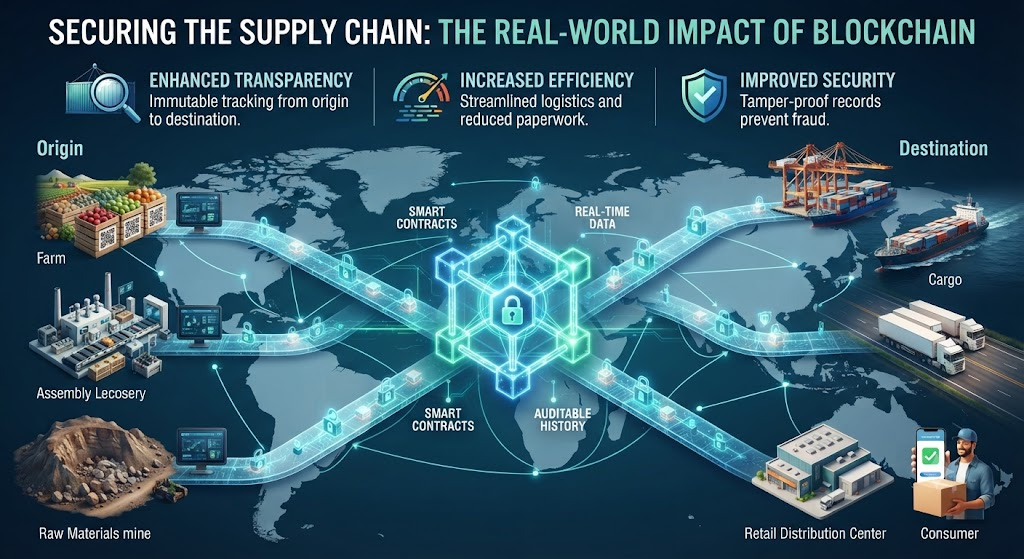
To understand how this technology functions in the real world, look at the step-by-step digital trail of a product:
- Digitizing the Asset: When a product is created, it gets a unique digital ID. This can be a barcode, an RFID tag, or a secure QR code.
- Recording the First Event: The farmer or manufacturer scans the item and enters its details—like harvest date or batch number—into the blockchain network.
- Moving Through the Chain: As the product changes hands, each handler scans the tag. The system automatically records the time, location, and handler identity.
- Smart Contracts (Automation): Many systems use smart contracts, which are self-executing computer programs. For example, a smart contract can automatically release payment to a supplier the exact moment a cargo shipment passes a specific GPS checkpoint.
- Final Delivery: The retailer or consumer scans the final code, instantly viewing the entire verified history of the product.
Why Blockchain Matters in Logistics
Traditional supply chains are built on silos. Each business protects its own data, which creates blind spots. Blockchain solves several core industry challenges:
- Speed: Paperwork that used to take days of faxing and emailing now happens instantly on a shared screen.
- Trust: Partners who do not know or trust each other can safely do business because the system relies on math and cryptography rather than human promises.
- Accountability: If a batch of medicine spoils because of heat exposure, the data shows exactly which warehouse turned off the cooling unit.
Practical Examples
Example 1: Food Safety and Traceability
Imagine an outbreak of food poisoning traced to bagged spinach. In an old supply chain, health officials might take two weeks to trace the spinach back to the correct farm, forcing stores to throw away all spinach nationwide. With a blockchain-enabled supply chain, a grocery store can scan the package code and trace the exact farm, truck, and processing plant in two seconds. They only recall the tainted batch, saving money and preventing widespread illness.
Example 2: Stopping Counterfeit Luxury Goods
High-end handbags and designer watches are frequent targets for counterfeiters. By registering each authentic item on a blockchain registry, buyers can scan a hidden chip with their smartphone. If the digital history does not match the official brand record, the buyer instantly knows the item is fake before spending money.
Real-World Considerations and Challenges
Despite the benefits, blockchain is not a magic fix for every logistics problem. Adopting the technology comes with clear hurdles:
- Partner Cooperation: A blockchain only works if every single company in the chain participates. If one supplier refuses to digitize their records, the chain is broken.
- Cost and Setup: Building and integrating blockchain tools with older legacy software requires significant financial investment and technical skill.
- Data Entry Errors: Blockchain secures data after it enters the system. If a worker types the wrong weight or scans a fake box at the very beginning, the blockchain will securely store that false information.
Common Mistakes
- Treating Blockchain Like a Regular Database: Companies sometimes try to use blockchain for simple data storage where a standard, cheaper cloud database would work better. Use blockchain only when multiple untrusted parties need to share data securely.
- Ignoring User Adoption: Businesses buy expensive blockchain software without training warehouse staff or truck drivers on how to scan and log items correctly.
- Expecting Instant ROI: Blockchain is a long-term infrastructure upgrade. Companies that expect immediate profits often abandon projects too early.
Risks and Limitations
| Risk | Why It Matters | How to Reduce It |
|---|---|---|
| Privacy Leaks | Competitors might see sensitive supplier pricing or shipping volumes on a shared network. | Use private, permissioned blockchains where only authorized parties view specific data fields. |
| System Complexity | Technical bugs in smart contracts can cause automated payments to fail or lock up funds. | Conduct rigorous code audits before launching smart contracts in live operations. |
| Scalability Limits | Processing thousands of global shipments per second can slow down some blockchain networks. | Choose enterprise-grade consensus models designed for high-speed industrial throughput. |
Decision-Making Framework: Is Blockchain Right for Your Supply Chain?
Before investing time and money into a blockchain pilot project, decision-makers should run through this simple checklist:
- Do you share data with multiple distrusted parties? If you are the only company managing the process, a standard database is enough.
- Is there a major problem with fraud, delays, or disputes? Blockchain provides the most value where trust and verification are expensive.
- Are your supply chain partners willing to change their software? Everyone involved must agree to adopt the same digital standards.
- Can you afford the upfront integration costs? Make sure the long-term savings outweigh the initial setup expenses.
Key Terms
- Cryptocurrency: Digital money that uses encryption for security; often confused with blockchain, which is the underlying technology that can be used for much more than money.
- Decentralization: Spreading data across many computers instead of storing it in one central server owned by a single company.
- Immutable: Unable to be changed, altered, or deleted once recorded.
- Permissioned Blockchain: A private network where participants must be approved and granted specific viewing or editing rights.
- RFID Tag: A small electronic chip that uses radio waves to track items automatically as they pass scanning stations.
- Smart Contract: A computer program that runs automatically when preset conditions are met, such as releasing payment upon delivery.
- Traceability: The ability to track the complete history, location, and path of a product from origin to final destination.
FAQs
Does blockchain require cryptocurrency to work in a supply chain?
No. Many enterprise supply chain platforms run on private, permissioned networks that use standard digital tokens or access permissions rather than public cryptocurrencies like Bitcoin.
What happens if a physical product is stolen or lost?
Blockchain tracks digital records of physical events. If an item is stolen, the system will show the exact last checkpoint where it was scanned, helping investigators narrow down where the loss happened.
Can a hacker alter past supply chain records on a blockchain?
No. Because the data is copied across thousands of independent computers simultaneously, changing a past record on one computer requires changing it on all computers at the same time, which is mathematically impossible under normal network security.
How do small suppliers keep up with blockchain technology?
Most platforms provide simple mobile apps or web portals. Small suppliers do not need to build their own blockchain; they just need a smartphone or scanner to update shipment statuses.
Is blockchain environmentally friendly?
Enterprise supply chains generally use permission-less or consortium consensus models that require very little energy, unlike the energy-heavy mining systems used by public cryptocurrencies.
Conclusion
Blockchain in supply chain management moves business operations away from messy paper trails and isolated databases. By creating a shared, unchangeable record of every step, it gives companies the visibility they need to stop fraud, protect consumers, and speed up global trade. While setup requires careful planning and partner cooperation, the long-term result is a cleaner, faster, and more accountable logistics network.