Introduction
Technology in India has changed at a rapid pace over the last decade. From Unified Payments Interface (UPI) handling billions of digital transactions to Aadhaar securing digital identities, the country loves scalable digital solutions.
Yet, when people hear the word “blockchain,” they often think only of volatile digital tokens or online trading. This narrow view misses the bigger picture.
Blockchain is fundamentally a secure, shared digital notebook. It lets different groups share data safely without needing a central boss. In India, this technology is slowly changing how businesses track goods, how banks verify documents, and how the government stores public records.
This article looks past the hype. We will explore how blockchain works in the Indian context, where it is actually being used, what hurdles stand in its way, and what the future holds for developers, businesses, and everyday citizens.
What Is Blockchain Technology?
To understand the future of blockchain in India, we must first look at what the technology actually is, stripped of financial hype.
A blockchain is a type of database. However, unlike a normal database where one company or person holds all the data on a single server, a blockchain spreads copies of its data across many different computers worldwide.
Key Concepts in Simple Words
- Decentralization: No single entity controls the network. If one computer fails or gets hacked, the other computers keep the system safe and running.
- Immutability: Once information is written to the blockchain, it is extremely difficult to change. It acts like carving data into digital stone.
- Smart Contracts: These are digital agreements written in code. They run automatically when specific conditions are met. For example, a smart contract can release a supplier’s payment the exact moment a shipment arrives and scans at a warehouse.
Think of it like a shared Google Doc that everyone can view and add to, but nobody can delete or secretly rewrite past entries.
Why Blockchain Matters for India
India has a massive digital economy, a young population, and a rapidly growing tech sector. Blockchain matters here because it addresses very real, everyday operational problems.
1. Transparency and Trust
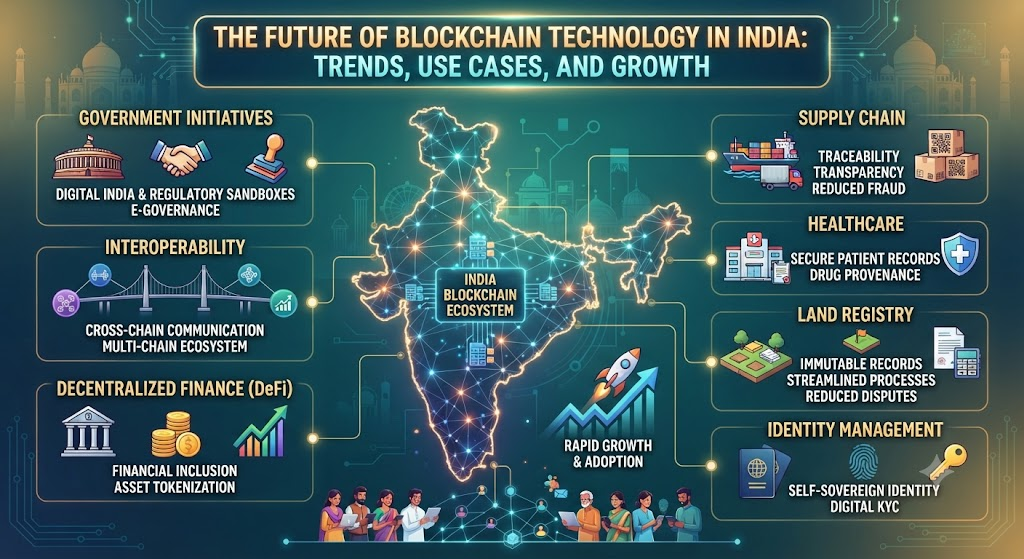
In large supply chains—such as moving farm produce from rural villages to city supermarkets—goods change hands many times. Blockchain helps track every step. If a shipment of organic mangoes spoils, the supply chain participants can look at the blockchain ledger to see exactly where the delay or temperature failure happened.
2. Reducing Fraud and Paperwork
Paper documents can be forged, lost, or damaged. Digitizing land titles, educational certificates, and corporate compliance records on a blockchain makes tampering nearly impossible. This saves millions of hours in court disputes and verification processes.
3. Financial Inclusion and Efficiency
While retail cryptocurrency trading faces heavy restrictions in India, enterprise blockchain networks help banks settle cross-border payments in seconds rather than days, cutting out expensive middlemen.
Current Landscape of Blockchain in India
India holds a unique position in the global blockchain ecosystem. On one hand, the country boasts one of the largest pools of software developers and Web3 talent in the world. On the other hand, policymakers maintain a cautious stance due to financial stability and consumer protection concerns.
Government and Enterprise Adoption
State governments are actively experimenting with blockchain:
- Telangana and Maharashtra: These states have launched blockchain districts and sandbox environments to incubate startups.
- Karnataka and Tamil Nadu: They use blockchain pilots for land registry management and supply chain tracking for pharmaceuticals.
- Banking Sector: The Reserve Bank of India (RBI) has been testing the Digital Rupee (CBDC), which relies on underlying distributed ledger technology (DLT) principles, even if it is centrally controlled.
Real-World Use Cases in India
Blockchain is not just a theoretical concept in India anymore. Several practical use cases are proving their worth across different industries.
Agriculture and Supply Chain Tracking
India’s agricultural sector loses significant value due to waste and inefficient logistics. Blockchain pilots allow farmers to register their produce, track transit conditions, and prove the authenticity of geographical indication (GI) tagged items like Darjeeling tea or Kashmiri saffron to global buyers.
Healthcare and Fake Medicines
Counterfeit medicine is a serious global hazard. Pharmaceutical companies in India are testing blockchain solutions to track medicine packaging from the factory floor down to the local pharmacy. If a batch is recalled, the system flags it instantly.
Digital Identity and Credential Verification
Verifying job applicants’ university degrees or professional certificates often takes weeks. Several startups and state boards are building blockchain-based credential lockers. Employers can verify a candidate’s degree in seconds with absolute cryptographic certainty.
Common Mistakes to Avoid
When businesses and developers enter the blockchain space, they often make predictable errors.
| What People Do | Why They Do It | Why It Causes Problems | What They Should Do Instead |
|---|---|---|---|
| Using blockchain for everything | They want to ride the tech hype train. | Standard databases are cheaper, faster, and easier to manage for simple data storage. | Use blockchain only when multiple untrusted parties need to share data without a central authority. |
| Ignoring regulatory compliance | They assume decentralized apps operate outside local laws. | Indian regulators strictly monitor financial flows, data localization, and tax compliance. | Consult legal experts early to align projects with Indian IT and financial laws. |
| Neglecting user experience (UX) | They focus only on the backend code. | Complex crypto wallets and gas fees confuse everyday users. | Build simple front-end interfaces that hide complex blockchain mechanics from the user. |
Regulatory Hurdles and Challenges
Growth does not happen without friction. The future of blockchain technology in India faces several hurdles:
- Taxation and Compliance: India imposes a flat 30% tax on digital asset transfers and a 1% Tax Deducted at Source (TDS) on crypto transactions. While this targets speculative trading, it also impacts startup liquidity and developer retention.
- Scalability and Speed: Public blockchains can be slow and expensive when handling millions of transactions. Layer-2 scaling solutions and private enterprise networks are helping solve this, but adoption takes time.
- Lack of Awareness: Outside tech hubs like Bengaluru, Pune, and Hyderabad, business leaders still view blockchain as a mysterious buzzword rather than a practical business tool.
Decision-Making Framework for Adopting Blockchain
If you are a business owner or technology manager in India wondering whether your project needs blockchain, run through this quick framework:
- Do multiple parties need to write to the same database? If only one company owns the data, use a standard cloud database.
- Do the parties trust each other? If there is already high mutual trust, a centralized server is faster and cheaper.
- Is there a requirement for a permanent, unchangeable audit trail? If compliance, auditing, or fraud prevention is critical, blockchain is a strong candidate.
- Does the solution require disintermediation? If you need to cut out expensive middlemen, explore smart contracts.
Key Terms
- Cryptographic Hash: A mathematical algorithm that turns data into a fixed string of characters. Any tiny change in the data completely changes the hash, making tampering instantly visible.
- Distributed Ledger Technology (DLT): The broader umbrella term for technology that allows multiple entities to access, record, and synchronize data across a decentralized network.
- Node: An individual computer connected to a blockchain network that maintains a copy of the ledger and validates transactions.
- Permissioned Blockchain: A private or enterprise blockchain where only approved participants can join the network and view data.
- Smart Contract: Self-executing code stored on a blockchain that automatically carries out agreement terms when pre-set conditions are met.
- Tokenization: The process of converting rights to an asset (like real estate or company shares) into a digital token on a blockchain.
Frequently Asked Questions
Is cryptocurrency the same as blockchain?
No. Cryptocurrency is a digital currency that often uses blockchain technology. However, blockchain is an underlying database technology that can be used for many non-financial purposes, such as tracking supply chains or securing medical records.
Is blockchain legal in India?
Yes. Blockchain technology itself is completely legal in India. The government actively encourages blockchain innovation, research, and enterprise use cases. However, retail cryptocurrency trading and exchanges face strict tax laws and anti-money laundering (AML) compliance rules.
Which Indian cities are leading in blockchain development?
Bengaluru, Hyderabad, Pune, Mumbai, and Chennai are major hubs for blockchain talent, hosting offices for global tech giants, Web3 startups, and specialized developer communities.
Can blockchain completely replace traditional databases?
No. Traditional databases are much faster, cheaper, and easier to scale for private applications where data is controlled by a single organization. Blockchain is only useful when multiple independent parties need shared, trustless data management.
How are Indian universities preparing students for blockchain?
Many top Indian Institutes of Technology (IITs) and private engineering colleges now offer specialized courses, research labs, and hackathons focused on cryptography, smart contract development, and distributed systems.
Conclusion
The future of blockchain technology in India is practical, enterprise-focused, and deeply intertwined with the country’s broader digital transformation. While early excitement centered heavily on speculative tokens, the real value moving forward lies in supply chain transparency, secure digital identity, and streamlined enterprise workflows.
For developers, entrepreneurs, and business leaders, success will come from focusing on real-world utility rather than tech trends. By solving actual operational friction points, blockchain can quietly become a reliable backbone of India’s digital economy.