Introduction
Every time you sign up for a new website, you hand over your name, email, phone number, and birth date. You trust that company to keep your information safe.
Then, you read the news. Another major data breach has happened. Millions of usernames, passwords, and personal records are exposed online.
This happens because the modern internet relies on a centralized system. A few large companies act as gatekeepers for your identity. If their servers fall, your data falls with them.
Blockchain and digital identity offer a better way. They shift power away from central servers and put it back into your hands. This guide explains how this technology works, why it matters, and how it protects your online privacy.
What Is Digital Identity?
Your digital identity is the collection of data that proves who you are in the digital world.
Think of your physical identity as your passport or driver’s license. You carry it in your wallet. When a bouncer or a bank teller asks to see it, you show the specific document. You do not hand over your whole wallet.
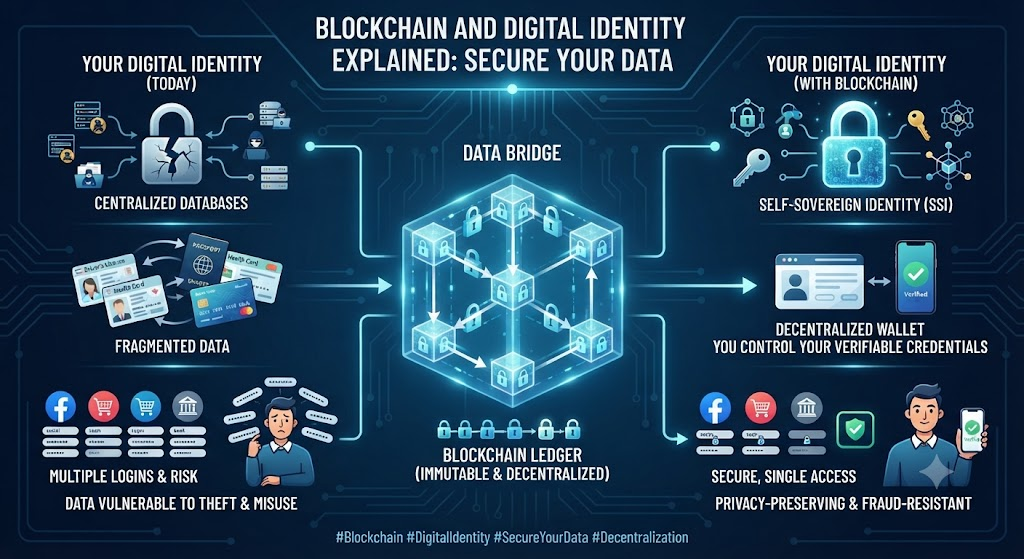
Traditional online identity works differently. When you log into a website using a social media account, that platform acts as the bouncer and the record keeper.
- Traditional Identity: Companies store your data on their private computers. You do not truly own your username, password, or profile information.
- Digital Identity (Self-Sovereign): You own and control your data. You store your identity credentials on your own phone or secure device.
How Blockchain and Digital Identity Work Together
Blockchain is a secure, shared digital ledger. Think of it as a notebook that multiple computers copy and check. Once someone writes a page in this notebook, no one can erase or change it.
When you combine blockchain with digital identity, you get a system built on three core pillars:
- Decentralization: No single company or government controls the network. Data lives across many independent computers.
- Cryptographic Proofs: The system uses advanced math to verify who you are without revealing your actual secret passwords or data.
- User Control: You hold the digital keys to your own information.
The Three Main Actors
A blockchain identity system usually involves three parties:
- The Issuer: An organization that gives you an official credential. For example, a university gives you a digital degree, or a government gives you a digital ID.
- The Holder: You. You receive the credential and store it securely in a digital wallet on your phone.
- The Verifier: A website, bank, or service that wants to check your information. For example, a bank wants to check if you are over 18.
Why Traditional Online Identity Is Broken
To understand why blockchain identity matters, look at the flaws in how we log in today.
1. Password Fatigue
Most people use weak passwords or reuse the same password across multiple websites. If hackers steal your password from a small shopping site, they can often access your email or bank account.
2. Massive Data Honey pots
Companies collect everything about you and store it in one giant database. Hackers love these databases because a single successful attack yields millions of user records.
3. Lack of Privacy
When you use a standard login button from a major tech platform, that company tracks every website you visit and every service you use. You trade your privacy just for convenience.
Practical Examples: How Decentralized Identity Changes Daily Life
To see how this works in practice, look at two everyday scenarios: Opening a bank account and renting an apartment.
Example 1: Opening a Bank Account
- The Old Way: You walk into a branch or fill out an online form. You upload copies of your passport, utility bill, and tax identification number. The bank stores these copies in their filing system. If the bank suffers a data breach, your sensitive documents are exposed.
- The Blockchain Way: The bank asks to verify that you are a legal adult and a citizen. Your phone sends a cryptographic proof signed by the government. The bank instantly knows you meet the requirements, but they never receive or store a copy of your passport.
Example 2: Proving Your Age
- The Old Way: You want to buy a restricted product online. Fulfilling the age check requires uploading a photo of your driver’s license. The website now has your home address, license number, and full birth date—far more information than they actually need.
- The Blockchain Way: Your digital wallet sends a simple “Yes/No” answer confirming you are over 18. The website gets the confirmation it needs, and your personal details stay private.
Key Benefits of Blockchain Digital Identity
Switching to a decentralized identity model offers clear advantages for both users and businesses.
- Enhanced Privacy: You share only the minimum required data for any given transaction.
- Reduced Fraud: Because cryptographic keys secure every credential, bad actors cannot easily fake or forge digital identities.
- User Ownership: You do not lose your identity if a company goes out of business or bans your account.
- Fewer Passwords: You can log into websites securely using your digital wallet, eliminating the need to remember dozens of complex passwords.
Risks, Limitations, and Challenges
Blockchain identity is powerful, but it is not a magic fix. Several hurdles remain before it becomes mainstream.
1. Losing Your Private Key
If you lose the recovery phrase or private key to your digital wallet, you may lose access to your identity credentials. There is no central customer support desk to click “Reset Password.”
2. User Adoption and Complexity
Most people are comfortable using standard usernames and passwords. Learning how to manage a digital identity wallet requires a learning curve for everyday users.
3. Regulatory and Legal Hurdles
Governments have strict rules about how financial institutions verify customer identities (known as KYC, or Know Your Customer laws). Integrating blockchain proofs into traditional legal frameworks takes time.
Common Mistakes to Avoid
When exploring blockchain and digital identity, beginners often make a few avoidable errors:
- Mistake: Treating a digital wallet like a normal website login.
- Why it causes problems: If you share your recovery phrase with anyone, they control your identity.
- What to do instead: Write your recovery phrase on physical paper and store it in a secure, offline location.
- Mistake: Assuming blockchain identity means total anonymity.
- Why it causes problems: Blockchain ledgers are transparent. While your data is encrypted, careless sharing can still link your real-world identity to your digital actions.
- What to do instead: Understand what data your credentials expose before approving a request.
Decision Framework: When to Use Decentralized Identity
| Feature | Traditional Identity | Blockchain Digital Identity |
| Data Storage | Centralized company servers | User-controlled secure device |
| Privacy Risk | High (frequent data breaches) | Low (minimal data sharing) |
| Control | Owned by platforms | Owned completely by the user |
| Recovery | Email password reset link | Secure recovery phrase |
If you value privacy, want to reduce your digital footprint, and want protection against identity theft, exploring decentralized identity tools is a smart step forward. If you prefer the convenience of letting third-party platforms manage your logins and do not mind sharing personal data, traditional systems may still feel easier for now.
Key Terms
- Decentralized Identifier (DID): A unique web-like address that lets you prove your identity without relying on a central registry.
- Verifiable Credential: A tamper-proof digital certificate issued to you that you can share and prove instantly.
- Private Key: A secret cryptographic code that proves you own your digital identity wallet.
- Public Key: A shareable code that others use to verify the signatures and proofs made by your private key.
- Zero-Knowledge Proof: A clever mathematical method that lets you prove you know a fact without revealing the fact itself.
- Self-Sovereign Identity (SSI): A model where individuals have sole ownership and control over their digital identities.
FAQs
Can someone steal my digital identity on a blockchain?
It is extremely difficult. Because your identity is secured with advanced cryptography and stored on your own device, a hacker cannot steal it unless they physically gain access to your private keys or recovery phrase.
Do I need cryptocurrency to use a digital identity?
Not necessarily. While many decentralized identity systems are built on blockchain networks, many modern applications run on permissioned or gas-optimized networks where users do not need to buy crypto tokens just to log in or verify credentials.
What happens if I lose my phone?
If you back up your digital identity wallet using your secure recovery phrase, you can restore your identity credentials on a new device.
Are digital identities legally recognized?
Governments around the world are currently working on legal frameworks. The European Union, for example, is rolling out digital identity wallets for citizens, and other regions are testing blockchain-based credentials for official documents.
How is this different from “Sign in with Google” or “Apple ID”?
When you use a tech giant’s login button, that company tracks you and controls your access. If they disable your account, you lose access to every app connected to it. With a true decentralized identity, no single company can lock you out or track your browsing habits.
Conclusion
The way we manage our online identity is fundamentally broken. Centralized databases make convenient targets for hackers, and tech monopolies control too much of our personal lives.
Blockchain and digital identity flip this model on its head. By putting credentials directly on your own device and letting you share only what is necessary, this technology restores privacy and security to the web. While user adoption and legal standards are still evolving, decentralized identity represents the future of trust online. Protect your keys, control your data, and take charge of your digital footprint.