Introduction
Modern software systems are complex. When millions of users access an application at the same time, things can go wrong. Servers crash, databases slow down, and code updates fail.
In the past, system administrators spent their days fixing these problems by hand. Today, that manual approach is too slow. Companies need a smarter way to keep digital services running smoothly.
This is where Site Reliability Engineering comes in.
An SRE Engineer bridges the gap between software development and IT operations. Instead of just fixing broken servers, they write code and build tools to prevent failures before they happen.
Whether you are looking for structured SRE Training in India or exploring an in-depth SRE Course, understanding this discipline is essential for building dependable modern technology.
What Is Site Reliability Engineering?
Site Reliability Engineering is a discipline created to run large-scale systems reliably. It applies software engineering principles to infrastructure and operations problems.
Think of it this way: traditional IT operations teams manage servers manually. SRE teams treat operations as a software problem. If a task is repetitive, an SRE writes a program to automate it.
Why Does It Matter?
Downtime is expensive. When an online banking app or an e-commerce website goes down, the company loses money and trust. SRE practices minimize downtime and ensure systems can handle sudden spikes in user traffic.
Core Concepts of SRE Training
A comprehensive Site Reliability Engineering Training program covers several foundational concepts. These concepts help teams measure and improve system health.
Service-Level Indicators (SLIs)
An SLI measures how well your service is performing. For example, it might measure the percentage of successful web requests or how fast a page loads.
Service-Level Objectives (SLOs)
An SLO is the target goal for your SLI. If your SLI is page load time, your SLO might be that 99% of pages must load in under two seconds.
Service-Level Agreements (SLAs)
An SLA is a business contract with customers. It promises a specific level of reliability. If the team breaks the SLA, the company may have to pay financial penalties.
Error Budgets
An error budget is the amount of downtime a system is allowed to have over a specific period. If your SLO is 99.9% uptime, your error budget is 0.1%. Teams use this budget to balance speed (releasing new features) with stability (keeping the system up).
How SRE Works in the Real World
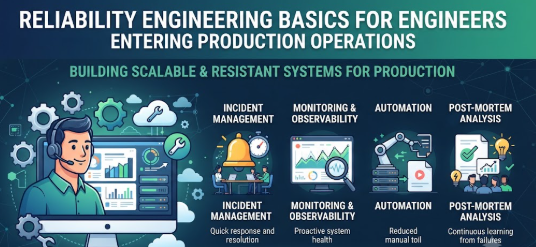
In daily operations, an SRE team focuses on reducing toil. Toil is repetitive, manual work that does not add long-term value.
Automation
Instead of restarting crashed servers by hand, engineers build automated scripts that detect failures and restart services instantly.
Incident Management
When a major outage happens, SREs follow a structured response plan. They isolate the problem, fix the root cause, and write a post-mortem report to ensure the same failure never happens again.
Capacity Planning
SREs analyze traffic trends to predict when the system will need more server space or computing power, preventing surprise crashes during peak events.
Essential SRE Tools and Technologies
Professionals pursuing an SRE Certification need to master various SRE Tools used for observability, automation, and infrastructure management.
- Monitoring & Observability: Tools like Prometheus, Grafana, and Datadog help teams track system performance and spot unusual behavior.
- Infrastructure as Code (IaC): Tools like Terraform allow engineers to set up and manage cloud servers using code files instead of manual clicks.
- Containerization & Orchestration: Docker and Kubernetes help package and manage applications across different computing environments.
- Alerting & Incident Response: Platforms like PagerDuty notify engineers immediately when a system failure occurs.
Common Mistakes in Reliability Engineering
When organizations or beginners start adopting SRE practices, they often make avoidable mistakes.
- Treating SRE as Traditional Operations: Merely changing an administrator’s job title to “SRE” without introducing automation or software development practices defeats the purpose.
- Ignoring the Error Budget: Treating error budgets as optional targets rather than strict rules leads to unstable software releases.
- Too Much Manual Work: Spending all day putting out fires instead of writing code to automate fixes keeps the team stuck in a reactive loop.
- Lack of Observability: Trying to fix problems without proper monitoring tools is like driving a car at night without headlights.
Risks and Limitations
While SRE brings immense value, it is not a magic fix for every organization.
- High Skill Requirement: SRE requires a strong mix of software coding and system administration skills, making it difficult for absolute beginners.
- Cultural Resistance: Traditional development and operations teams may resist working together under SRE principles.
- Setup Complexity: Implementing robust monitoring, automation, and error budgeting takes time and initial effort.
Decision Framework: Is SRE Right for Your Organization?
Before adopting SRE practices or investing in training, consider these steps:
- Assess System Complexity: If your application runs on a single server with low traffic, full SRE may be overkill. If you run distributed cloud systems with thousands of users, SRE is essential.
- Evaluate Team Skills: Check if your team has basic coding and automation skills or if they need foundational training first.
- Define Reliability Goals: Determine what level of uptime your business actually needs.
- Start Small: Implement basic monitoring and error budgeting before moving to advanced automation and orchestration.
Checklist for Aspiring SRE Engineers
- Learn basic programming (Python or Go).
- Understand Linux operating systems and networking fundamentals.
- Explore cloud computing platforms (AWS, Azure, or Google Cloud).
- Master container tools like Docker and Kubernetes.
- Learn infrastructure automation using Terraform.
- Study monitoring and logging tools like Prometheus and Grafana.
- Practice incident management and root-cause analysis.
Key Terms
- Observability: The ability to measure the internal state of a system by examining its outputs.
- Toil: Manual, repetitive operational work that provides no enduring value.
- Post-Mortem: A blameless analysis of an outage to understand what went wrong and how to prevent it.
- Telemetry: The collection of measurements and data from remote systems.
- Scalability: The ability of a system to handle growing amounts of work by adding resources.
FAQs
What is the difference between DevOps and SRE?
DevOps focuses on speeding up software delivery through collaboration and automation. SRE focuses specifically on system reliability, uptime, and operational health, often using software engineering to solve operations problems.
Do I need coding skills to become an SRE?
Yes. An SRE Engineer must write code to automate tasks, build monitoring tools, and handle infrastructure management.
How do I start learning Site Reliability Engineering?
You can start by exploring an SRE Tutorial, learning Linux and networking basics, and pursuing structured SRE Training courses that cover cloud infrastructure and automation tools.
Is an SRE certification valuable?
An SRE Certification helps validate your operational knowledge and practical skills, making it easier to demonstrate your expertise to employers.
Conclusion
Site Reliability Engineering transforms how organizations build and run digital systems. By replacing manual firefighting with automation, observability, and clear error budgets, engineers can create dependable applications that scale effortlessly. Whether you are taking an introductory SRE Course or mastering advanced SRE Best Practices, investing in this skill set opens up strong career opportunities in modern technology platforms.