Introduction
Buying a house is famously stressful. If you have ever bought property, you know the routine: mountains of paperwork, waiting weeks for wire transfers, paying heavy fees to middlemen, and worrying about hidden title flaws.
The traditional property market relies on slow, paper-heavy systems that were built decades ago. Because records are kept in separate places, mistakes happen, fraud slips through, and deals take months to close.
Blockchain technology offers a different path. It is not just for digital currencies or tech investors. At its core, a blockchain is simply a shared, secure digital notebook that multiple computers check and agree upon. When applied to real estate, this technology changes how property is bought, sold, and recorded. This article explores how blockchain works in real estate, why it matters, where it helps, and what risks you need to watch out for.
What Is Blockchain in Real Estate?
To understand blockchain in real estate, let us look at the basic building blocks.
Blockchain
Simple meaning: A shared digital database spread across many computers where no single person or company is in charge.Why it matters: Once information is written into a blockchain, it cannot be quietly changed or deleted. Everyone on the network sees the same exact history.Example: Think of a shared Google Doc that is locked after every sentence is typed so that everyone can read it, but no one can go back and secretly rewrite history.
Smart Contracts
Simple meaning: Computer programs that run automatically when certain conditions are met.Why it matters: They remove the need for a human middleman to hold money or approve steps.Example: A smart contract can automatically transfer property ownership to a buyer the exact second the final payment clears, without waiting for a bank or title officer to manually sign off.
Tokenization
Simple meaning: Dividing a physical asset, like an apartment building, into digital tokens (like digital shares).Why it matters: It lets normal people invest small amounts of money into expensive real estate.Example: Instead of needing $500,000 to buy a rental property, an investor can buy $500 worth of digital tokens tied to that property and earn a share of the rental income.
How Blockchain in Real Estate Works
In a traditional property sale, the process involves a chain of separate entities: real estate agents, lawyers, banks, title companies, and government registry offices. Each group checks the paperwork separately, which takes time and adds cost.
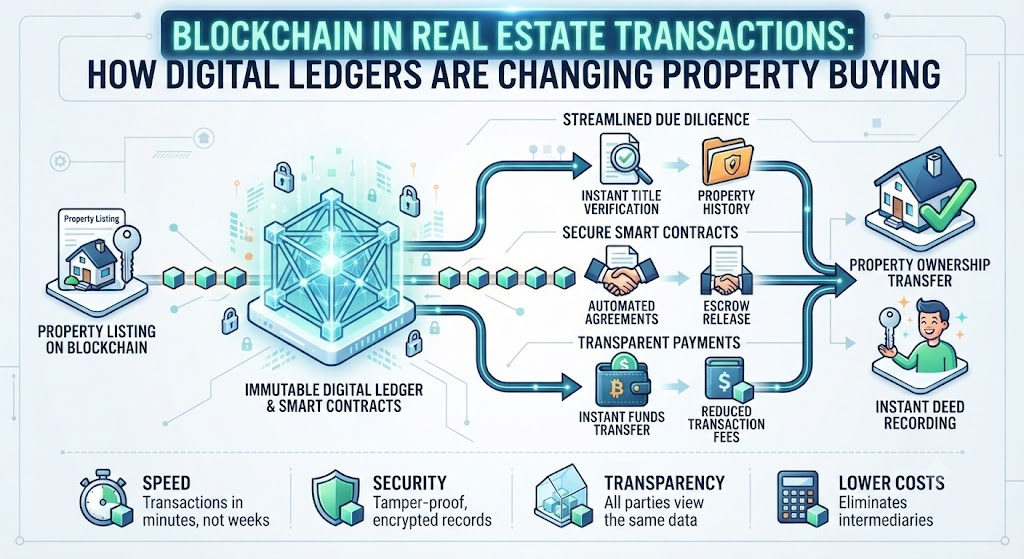
Blockchain streamlines this workflow into a single, shared digital process:
- Identity and Verification: The buyer and seller prove who they are using secure digital identities. Their credentials are checked against trusted databases.
- Property Listing: The property details, legal description, and historical records are attached to a unique digital token on the blockchain.
- Agreement and Smart Contract: The buyer and seller agree on a price. The terms are written into a smart contract.
- Funding: The buyer sends funds (either standard currency via digital rails or stablecoins) into an escrow smart contract.
- Automatic Execution: Once the funds arrive, the smart contract automatically updates the digital title to the buyer’s name and releases the money to the seller.
- Permanent Record: The transaction is permanently recorded on the ledger, creating an unchangeable history of ownership.
Why Blockchain Matters for Property Buyers and Sellers
Old systems are slow because every party involved keeps their own private notes. Blockchain fixes this by creating a single source of truth.
- Speed: Deals that normally take 30 to 60 days can happen in days or even hours because paperwork verification is automated.
- Cost Reduction: Fewer middlemen mean fewer fees. You save money on title insurance, wire fees, and administrative paperwork.
- Fraud Prevention: Because property history is transparent and cryptographically secured, bad actors cannot invent fake deeds or hide existing mortgages on a property.
- Global Access: Investors from different countries can buy property across borders without dealing with slow international banking rules and high currency exchange hurdles.
Practical Examples of Blockchain in Action
To see how this works in the real world, consider two scenarios: a traditional purchase versus a blockchain-powered purchase.
Example 1: Buying a Suburban Home (Traditional)
- The Situation: Sarah wants to buy a home.
- The Problem: Her mortgage approval takes three weeks. The title search uncovers an old, unresolved lien from a previous owner, delaying the closing by another month. Sarah and the seller pay thousands in total fees to agents, attorneys, and title companies.
Example 2: Buying a Suburban Home (Blockchain-Enabled)
- The Situation: Mark buys a home using a blockchain real estate platform.
- The Process: The property’s complete history, including past sales and cleared liens, is already verified on the ledger. Mark’s funds are locked in a smart contract. Once the funds verify, the smart contract updates the digital registry instantly.
- The Result: The transaction closes in three days, and total administrative fees drop significantly because no manual title search was required.
Common Mistakes to Avoid
When exploring blockchain real estate options, beginners often make a few critical errors:
- Mistake: Assuming blockchain removes all legal rules.
- Why it happens: People think digital technology replaces local property laws.
- The risk: Bypassing local zoning laws or legal registration requirements can make your purchase legally invalid.
- What to do instead: Always ensure that any blockchain transaction is officially recognized by your local government land registry.
- Mistake: Trusting unregulated tokenization platforms.
- Why it happens: Flashy websites promise high returns on fractional real estate tokens.
- The risk: Losing money to poorly managed or fraudulent digital projects with no legal recourse.
- What to do instead: Only use platforms that comply with financial regulations and work with licensed physical real estate assets.
- Mistake: Ignoring private key security.
- Why it happens: Treating digital wallet keys like normal website passwords.
- The risk: If someone steals your private key, they can access your digital assets and property tokens.
- What to do instead: Use hardware wallets and secure backup phrases just as you would protect high-value financial accounts.
Risks and Limitations
While blockchain offers major benefits, it is not a silver bullet. Several hurdles prevent it from taking over the entire real estate market overnight.
| Risk / Limitation | Why It Matters | How to Reduce the Risk |
|---|---|---|
| Regulatory Uncertainty | Laws vary heavily by country and city. A digital deed valid in one state might not be legally recognized in another. | Consult a real estate attorney familiar with both property law and digital assets. |
| Technology Adoption | Local government offices are slow to update their legacy computer systems. | Stick to jurisdictions and platforms that have official government backing or regulatory sandboxes. |
| Smart Contract Bugs | Code errors in a smart contract can cause funds or ownership tokens to get stuck or misrouted. | Use platforms that have undergone independent security audits. |
| Market Liquidity | Fractional tokens sound easy to sell, but if no buyers want those specific tokens, you cannot easily cash out. | Treat real estate tokens as long-term investments rather than quick cash. |
Decision Framework: Is Blockchain Right for Your Property Deal?
Before diving into a blockchain-based real estate platform, walk through this quick decision guide:
- Check Local Laws: Does your local government legally accept digital deeds or electronic signatures for property registration? If no, keep your transactions on the traditional paper track for now.
- Evaluate the Platform: Is the company operating in a regulated financial environment, or is it operating in a legal gray area?
- Assess the Asset: Are you buying physical property for personal use, or are you looking at fractional token investments?
- Calculate True Costs: Do the tech fees and platform costs actually save you money compared to traditional closing costs?
- Review Security: Are your digital accounts protected against theft and loss?
Key Terms
- Smart Contract: A self-running computer program that executes agreement terms automatically when conditions are met.
- Tokenization: The process of converting ownership rights of a physical asset into digital tokens on a blockchain.
- Ledger: A secure record-keeping book or database where transactions are permanently written.
- Escrow: A financial arrangement where a third party (or smart contract) holds funds until both sides fulfill their contract terms.
- Private Key: A secret digital password that gives you ownership and control over your digital assets and tokens.
- Decentralization: Spreading control across many independent computers instead of relying on a single central authority.
- Stablecoin: A digital currency whose value is pegged to a stable asset, like the US Dollar, to prevent wild price swings.
Frequently Asked Questions
Can I buy a house entirely on a blockchain today?
In most places, no. While you can use blockchain for parts of the process—like funding, contracts, and title tracking—local laws usually still require physical documents to be filed with a government land registry office.
Does blockchain replace real estate agents?
Not completely. While blockchain removes the need for certain middlemen like title officers and escrow agents, human agents still play a big role in property inspection, valuation, staging, and negotiation.
What happens if I lose the digital key to my property token?
If you lose your private key and have no backup, you may permanently lose access to your digital property rights. Unlike a bank password, there is usually no “forgot password” button on a blockchain.
Is blockchain real estate investing safe for beginners?
Only if you stick to regulated platforms. Unregulated tokenization projects carry high financial risks and lack consumer protection laws.
How does blockchain prevent title fraud?
Every transaction leaves a permanent, transparent, cryptographic trail. A seller cannot sell the same property to two different buyers because the network tracks ownership history instantly.
Conclusion
Blockchain in real estate is shifting property transactions from slow, paper-based routines into fast, transparent digital workflows. By cutting out unnecessary paperwork, lowering administrative costs, and automating title checks, digital ledgers solve many traditional headaches.
However, technology still has to catch up with local laws, and regulations take time to evolve. If you approach blockchain real estate with an eye on legal compliance, security, and realistic expectations, you can navigate the future of property buying safely and efficiently.