Introduction
Imagine waiting in a long line on a rainy Tuesday just to cast a paper ballot. By the time you get home, your feet hurt, and you wonder if your vote will even make a difference. Now, picture voting from your smartphone while sitting on your couch. Your vote is locked, counted instantly, and secure from tampering.
This is the promise of blockchain voting.
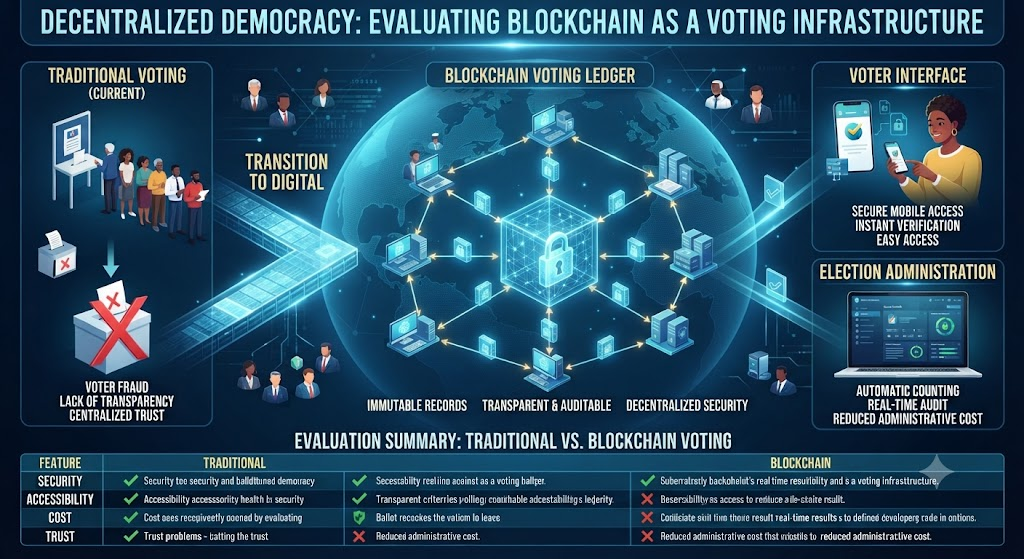
Traditional voting systems rely on paper ballots, voting machines, and centralized servers. These methods are expensive, slow to count, and vulnerable to human error. Governments and tech experts are looking at blockchain technology to fix these problems.
However, moving national elections to a digital ledger is not simple. People worry about hackers, privacy leaks, and lost phones. This article explores how blockchain works in voting, why it matters, its real-world trade-offs, and what the future looks like for digital democracy.
What Is Blockchain in Voting?
To understand blockchain voting, you first need to understand the core technology.
A blockchain is a shared, digital ledger. Think of it as a digital spreadsheet that is copied across thousands of computers worldwide. When someone adds new data—like a vote—it goes into a “block.” Once that block fills up, it links to the previous block in a permanent chain using complex math called cryptography.
Simple Meaning
Blockchain is like a public notebook stored in a thousand places at once. If someone tries to erase a page in one notebook, the other 999 notebooks will show the original text and reject the change.
Why It Matters
In regular voting, a single central authority—like an election board—controls the main database. If hackers or corrupt insiders break into that database, they can change the results. Blockchain removes this single point of failure.
Example
Think of a group of friends keeping track of who bought lunch. Instead of one person holding the notebook, everyone has an exact copy. If someone tries to write down that they paid $50 instead of $15, the rest of the group checks their copies and catches the lie immediately.
How Blockchain Voting Works
Moving an election onto a blockchain involves several distinct steps to ensure accuracy and voter anonymity.
- Voter Registration: Election officials verify your identity using government documents, biometrics, or secure digital IDs.
- Key Generation: The system gives the voter two cryptographic keys: a public key (your digital address) and a private key (your digital signature).
- Casting the Vote: The voter uses their private key to submit their choice. The vote turns into a secure code.
- Block Creation: The system packages the encrypted vote into a block along with other votes cast at the same time.
- Verification and Addition: Computers on the network check the block to make sure it follows all rules. Once approved, the block joins the permanent chain.
- Tallying Results: Smart programs count the votes automatically, giving instant, tamper-proof results.
Why Blockchain Voting Matters
Traditional voting systems struggle with high costs, slow counting times, and low trust. Blockchain offers several key advantages.
Transparency and Auditability
Anyone can verify that the system counted their vote correctly without revealing who they voted for. Auditors can trace the entire chain of events from start to finish.
Speed and Efficiency
Paper ballots take days or weeks to count by hand. Digital systems powered by smart code can tally millions of votes in seconds, saving millions of tax dollars.
Accessibility and Turnout
People with disabilities, military personnel stationed abroad, and citizens living in remote areas can vote easily from anywhere with an internet connection. Higher convenience often leads to higher voter turnout.
Important Factors to Understand
Before governments adopt blockchain voting, they must balance several technical and human factors.
- Anonymity vs. Verification: An election must keep your vote secret while proving that you were allowed to vote. Balancing privacy with accountability is difficult in digital systems.
- Network Consensus: A blockchain relies on multiple independent computers agreeing on the truth. Setting up trusted nodes across different organizations takes careful planning.
- Immutability: Once data goes onto a blockchain, nobody can change it. If a software bug logs votes incorrectly, fixing the mistake is extremely difficult.
Practical Examples
To see how this works in the real world, look at how different groups test digital voting.
- Local Municipal Elections: Small towns sometimes test blockchain apps for school board elections or advisory referendums. These small tests help developers spot bugs before scaling up.
- Shareholder Voting: Large corporations use private blockchains to let investors vote on company policies and board members from around the world securely.
- Overseas Military Voting: Governments have experimented with mobile apps using blockchain and facial recognition to let deployed soldiers cast ballots safely.
Real-World Considerations
Deploying blockchain in a national election brings heavy operational challenges.
Infrastructure and Costs
Building a secure blockchain network requires powerful servers, constant monitoring, and expensive security audits. Local governments often lack the budget and technical staff to maintain such systems.
Digital Divide
Not every citizen has a smartphone, reliable internet access, or the digital skills needed to manage cryptographic keys. If a system relies purely on digital access, it can accidentally push poor or elderly voters out of the process.
Public Trust
Even if a system is mathematically secure, average citizens may not trust code they cannot see or understand. Winning public confidence takes years of transparent testing.
Common Mistakes in Blockchain Voting Projects
Developers and election boards sometimes rush into digital voting without proper safeguards.
- Mistake: Treating blockchain as a magic fix for all election problems.
- Why it happens: People hear “blockchain” and assume it solves security and human corruption automatically.
- The problem: Blockchain only secures the data after it enters the system. If hackers steal a voter’s password or fake an identity during registration, the blockchain will securely record a fraudulent vote.
- What to do instead: Focus heavily on secure voter registration and identity verification before letting anyone cast a digital ballot.
- Mistake: Using public, open blockchains for sensitive elections.
- Why it happens: Developers want maximum decentralization.
- The problem: Public blockchains expose transaction data to the world, which can compromise voter privacy.
- What to do instead: Use permissioned, private blockchains where only verified, trusted nodes can validate blocks.
Risks and Limitations
Blockchain voting is not a silver bullet. Cybersecurity experts often warn against rushing into digital elections due to several persistent risks.
| Risk | Why It Matters | How to Reduce It |
|---|---|---|
| Endpoint Vulnerability | If a voter’s smartphone or computer has malware, hackers can steal their vote before it reaches the blockchain. | Require dedicated voting kiosks or multi-factor authentication on verified devices. |
| Denial of Service (DoS) | Attackers can flood the voting portal with traffic to block legitimate users from casting ballots. | Use decentralized cloud hosting and robust traffic filtering. |
| Lack of Recountability | Paper ballots leave a physical trail for manual recounts. Purely digital votes leave only digital logs. | Maintain a voter-verified paper audit trail (VVPAT) alongside digital records. |
Decision-Making Framework for Election Boards
Should an election board use blockchain? Officials can follow this simple framework to decide:
- Assess the Scale: Is this a low-stakes local vote or a high-stakes national election? Start small with advisory votes or shareholder meetings.
- Evaluate Security Readiness: Do you have internal cybersecurity experts who can audit the code and infrastructure?
- Check Legal Compliance: Do local laws allow electronic or remote voting, or do they strictly mandate paper ballots?
- Analyze Accessibility: Will digital voting leave vulnerable populations behind? Ensure hybrid options remain available.
- Plan for Failures: What is the backup plan if the digital network goes offline on election day?
Key Terms
- Block: A digital container that stores a batch of verified votes and links to the previous block.
- Cryptography: The science of using math to secure information so only authorized people can read it.
- Decentralization: Spreading data and control across many computers instead of keeping it in one central database.
- Ledger: A secure book or file that records all transactions permanently.
- Private Key: A secret password that lets a user sign and submit their digital vote securely.
- Public Key: A public digital address used to verify that a vote came from a legitimate participant.
- Smart Contract: Self-executing computer code that runs automatically when specific conditions are met.
- Immutability: The quality of data that makes it impossible to change or delete once recorded.
- Node: An individual computer connected to a blockchain network that helps verify and store data.
FAQs
Can blockchain voting completely replace paper ballots?
Not yet. While blockchain secures data in transit and storage, physical paper ballots still offer a foolproof backup that cannot be hacked remotely. Most experts recommend a hybrid approach.
Can anyone see who I voted for on a blockchain?
No. Good blockchain voting systems use cryptographic masking and zero-knowledge proofs to separate your identity from your choice, keeping your ballot private.
What happens if my phone loses connection while voting?
The system will not record your vote until the transaction finishes processing. If your connection drops, you simply log back in and try again safely.
Is blockchain voting immune to hacking?
No system is 100% hack-proof. While tampering with the blockchain ledger itself is nearly impossible, hackers can target user devices, servers, or registration databases.
Why do some cybersecurity experts oppose online voting?
They argue that remote devices connected to the internet are too vulnerable to malware, phishing, and spyware, making complete security nearly impossible to guarantee at scale.
Conclusion
Blockchain in voting systems represents a fascinating intersection of modern tech and civic duty. It offers incredible benefits, including faster results, transparent audits, and easier access for remote voters.
However, technology alone cannot solve political and security challenges. Endpoint security, voter privacy, and public trust remain major hurdles. For now, the most realistic path forward involves hybrid systems—using blockchain to streamline auditing and counting while keeping secure physical backups to protect democracy.