Introduction
Imagine you visit a new doctor in a different city. Instead of asking you to fill out endless paper forms or waiting weeks for your old hospital to fax your medical charts, your new doctor opens a secure portal. Instantly, they see your complete, unchangeable medical history, your past allergies, and your previous prescriptions.
Today, this seamless experience is rare. Healthcare data is often trapped in isolated computer systems that cannot talk to one another. Hospitals get hacked, patient files get lost, and vital test results get delayed.
Blockchain technology offers a realistic solution to these frustrating problems. While most people associate blockchain with cryptocurrencies like Bitcoin, its underlying architecture can completely transform how hospitals manage sensitive information. This guide explains how blockchain works in healthcare, why it matters, where it helps, and what challenges remain.
What Is Blockchain in Healthcare?
To understand blockchain in healthcare, you first need to look past the hype.
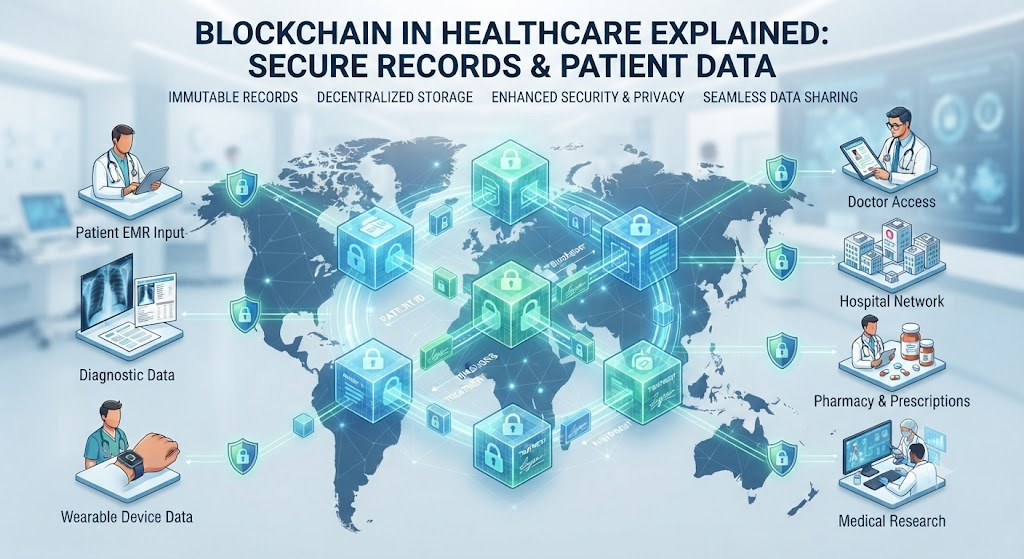
A blockchain is a decentralized digital database. In simple terms, decentralized means the data is not stored in one single office or server. Instead, identical copies are shared across a network of computers.
- Professional Term: Decentralized Ledger Technology (DLT)
- Simple Meaning: A shared digital notebook that everyone involved can see, but no single person can secretly edit.
- Why It Matters: If a hacker attacks one hospital server, they cannot change the records stored on the other computers in the network.
- Example: Think of a group project spreadsheet stored in the cloud where every edit is tracked. No single student can delete someone else’s work without everyone else seeing who did it.
In healthcare, this technology manages electronic health records, prescription tracking, and medical supply chains safely and transparently.
How Blockchain Works in Healthcare
Blockchain relies on a specific sequence of steps to keep data safe.
- Transaction Request: A new medical event occurs, such as a doctor updating a patient’s allergy list or a pharmacy dispensing a prescription.
- Data Packaging (Block): This update is bundled together with other recent updates into a digital page of data called a block.
- Verification: The network of computers checks the block to make sure the data is valid and authorized.
- Permanent Linking: Once verified, the block is permanently locked and chained to the previous block using a complex mathematical code called cryptography.
- Update Complete: The new record is added to every computer on the network simultaneously.
- Professional Term: Cryptographic Hash
- Simple Meaning: A unique digital fingerprint generated for every block of data.
- Why It Matters: If a hacker changes even a single letter in an old medical record, the digital fingerprint changes completely. The system instantly spots the mismatch and rejects the fake data.
Why Blockchain Matters
Healthcare systems face massive challenges with data privacy, security, and sharing. Blockchain addresses these core issues through three main benefits.
1. Enhanced Data Security
Hospitals are prime targets for cybercriminals because medical records contain valuable personal information, Social Security numbers, and insurance details. Blockchain uses advanced encryption, meaning data cannot be easily stolen or hacked from a single weak point.
2. Interoperability (System Communication)
Different clinics, labs, and insurance companies often use incompatible software. Blockchain acts as a secure bridge. It allows authorized organizations to read the same verified data source without needing custom software integrations for every single hospital.
3. Patient Control
Today, patients do not truly own their medical records; hospitals and insurance companies do. Blockchain allows patients to hold digital keys that grant or revoke access to their health records, giving them control over who sees their data and when.
Important Factors to Understand
Before assuming blockchain is a magic fix for every medical problem, you must understand a few core concepts and operational constraints.
- Immutability: Once data is written to a blockchain, it cannot be deleted or changed. While this is great for security, it creates problems if a doctor enters an accidental typo. Special correction blocks must be added instead.
- Permissioned Networks: Unlike public blockchains used for cryptocurrencies, healthcare blockchains are private and permissioned. Only authorized hospitals, doctors, and patients with specific digital keys can join the network.
- Smart Contracts: These are self-executing digital programs stored on the blockchain. For example, a smart contract can automatically release insurance payment to a clinic the moment a patient’s discharge papers are verified on the network.
Practical Examples
Example 1: Stopping Fake Drugs in the Supply Chain
Counterfeit medications are a major global danger. A pharmaceutical company can log every step of a vaccine or pill’s journey—from the factory to the shipping container, down to the local pharmacy—onto a blockchain. If a box of fake medicine enters the supply chain, the system flags the missing digital history immediately, protecting patients from dangerous fake drugs.
Example 2: Streamlining Clinical Trials
Medical researchers often struggle to verify data across different hospital trials. By recording clinical trial data on a secure blockchain, researchers ensure that patient results cannot be secretly altered or manipulated, making new drug approvals faster and more trustworthy.
Real-World Considerations
Implementing blockchain in a hospital setting is not easy. Healthcare organizations face major hurdles when moving away from legacy software systems.
- Cost: Building and maintaining a secure blockchain network requires specialized IT infrastructure and expensive software upgrades.
- Integration Hurdles: Most hospitals rely on decades-old computer systems that cannot easily connect with modern blockchain architectures.
- Staff Training: Doctors, nurses, and administrative staff must learn new digital workflows, which takes valuable time away from patient care.
Common Mistakes
- Mistake: Assuming blockchain replaces all existing hospital databases.
- Why it happens: People think blockchain is a standalone cure-all for database management.
- Why it causes problems: Blockchain is slow at handling large files like high-resolution X-ray images. Storing massive image files directly on a blockchain bloats the system and slows it down.
- What to do instead: Use blockchain to store data pointers, access logs, and verification hashes, while keeping heavy medical images in secure, encrypted cloud storage.
- Mistake: Believing blockchain eliminates the need for privacy laws like HIPAA.
- Why it happens: Misunderstanding transparency features.
- Why it causes problems: Publicly exposing private patient identities violates federal privacy laws.
- What to do instead: Ensure that only encrypted, anonymized data identifiers live on the blockchain ledger, while personal identifying information remains strictly protected off-chain.
Risks and Limitations
- Scalability Bottlenecks: Because every computer on the network must verify every new transaction, processing speeds can lag behind traditional database systems during peak hospital hours.
- Regulatory Uncertainty: Healthcare laws vary greatly by country and state. Clear legal frameworks regarding who owns a blockchain node or liability during a system error are still evolving.
- Human Error: If a patient or administrator loses their private access key, recovering locked medical data can be extremely difficult or impossible.
Comparison: Traditional Healthcare Databases vs. Blockchain
| Feature | Traditional Hospital Database | Healthcare Blockchain |
|---|---|---|
| Data Storage | Centralized server in one location | Decentralized copies across a trusted network |
| Security Risk | Single point of failure; vulnerable to targeted hacks | Highly secure; tampering requires cracking multiple nodes |
| Data Sharing | Slow, manual, often requires fax or insecure email | Instant, automated, and verified for authorized users |
| Data Editing | Database admins can alter or delete records unnoticed | Records are permanent; changes require transparent logs |
| Speed | Fast for local, single-facility queries | Slower due to network-wide verification requirements |
Checklist for Evaluating Healthcare Blockchain Projects
If you are a business owner or IT professional evaluating a blockchain healthcare solution, verify these items first:
- Define the Problem: Does the project actually require a shared, unchangeable ledger, or would a standard secure database work better?
- Check Privacy Compliance: Does the system protect patient identities and comply with local health data laws (like HIPAA or GDPR)?
- Evaluate Performance: Can the network handle the hospital’s peak transaction volume without slowing down patient care?
- Assess Integration: Does the blockchain solution connect smoothly with the hospital’s existing Electronic Health Record (EHR) software?
- Review Access Control: Are clear permission rules established so unauthorized staff or outsiders cannot view sensitive data?
Key Terms
- Block: A digital file containing a batch of verified medical transactions or record updates linked together in sequence.
- Cryptography: The science of protecting information using advanced mathematical codes and secure keys.
- Decentralization: Spreading data storage and control across multiple independent computers instead of relying on one central server.
- EHR (Electronic Health Record): A digital version of a patient’s medical history and clinical notes.
- Immutability: The ability of a database to remain permanently unaltered and unchangeable once written.
- Interoperability: The ability of different software systems and medical devices to communicate and exchange data seamlessly.
- Node: An individual computer connected to a blockchain network that stores a copy of the ledger and helps verify transactions.
- Permissioned Network: A restricted blockchain where participants must be verified and granted specific access rights before joining.
- Smart Contract: A self-executing computer program that runs automatically when predetermined medical or financial conditions are met.
FAQs
Can patients hack or change their own medical records on a blockchain?
No. Because healthcare blockchains are managed by multiple verified institutions (like hospitals and insurance companies), a patient cannot alter records on their own. Any unauthorized edit attempt is instantly rejected by the network.
Does blockchain replace electronic health record (EHR) software?
No. Blockchain works alongside existing EHR systems. The EHR software manages day-to-day clinical notes, while the blockchain secures and tracks data sharing, access permissions, and audit logs.
Is patient data visible to the public on a healthcare blockchain?
No. Healthcare blockchains are private and permissioned. Only authorized medical professionals and patients with the correct security keys can view or update the encrypted data.
Why don’t all hospitals use blockchain right now?
Implementing blockchain is expensive, requires complex software integration with legacy systems, and demands specialized IT staff. Many hospitals are still testing smaller pilot programs before committing to full adoption.
How does blockchain help prevent medical errors?
By creating a single, verified, up-to-date source of truth for patient allergies, prescriptions, and lab results, blockchain reduces the chances of doctors relying on outdated or missing information.
What happens if a doctor makes a mistake when entering data on a blockchain?
Because blockchain records are permanent, the original entry cannot be deleted. Instead, the doctor enters a new correction block that links to the original entry, creating a clear and transparent correction history.
Conclusion
Blockchain in healthcare is not a magical cure for every administrative headache, but it offers powerful solutions to longstanding problems in data security, record sharing, and supply chain tracking. By removing single points of failure and giving patients more control over their information, this technology builds trust in modern medicine. As hospitals upgrade their digital infrastructure, blockchain will likely play a quiet, vital role behind the scenes in keeping medical data accurate, private, and secure.