Introduction & Overview
What is a Hardware Wallet?
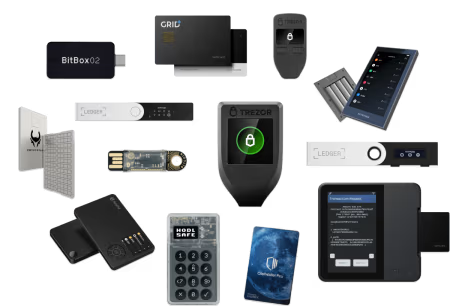
A hardware wallet is a physical, secure device that stores cryptographic keys offline, providing cold storage for digital assets such as cryptocurrencies and digital identities. These devices protect private keys from exposure to the internet, making them resilient against online threats.
History & Background
- Introduced in the early 2010s to secure Bitcoin and other cryptocurrencies
- Popularized by vendors like Ledger, Trezor, and KeepKey
- Evolved beyond just crypto – now also used for digital identity, code signing, multi-factor authentication, and DevSecOps secrets management
Why is it Relevant in DevSecOps?
In DevSecOps, protecting secrets such as API keys, SSH credentials, and signing keys is paramount. Hardware wallets:
- Offer tamper-proof storage for secrets
- Are air-gapped, reducing remote attack vectors
- Enable secure code signing and CI/CD secret injection
Core Concepts & Terminology
Key Terms and Definitions
| Term | Definition |
|---|---|
| Private Key | A cryptographic key used for decryption or signing, kept secret |
| Cold Storage | Offline storage, not connected to the internet |
| Secure Element | Tamper-resistant microchip that stores sensitive data securely |
| Code Signing | Process of digitally signing code to verify authenticity and integrity |
| U2F / FIDO2 | Protocols for hardware-based two-factor authentication |
| Seed Phrase | A human-readable backup of the private key |
Fit in DevSecOps Lifecycle
| DevSecOps Stage | Hardware Wallet Use Case |
|---|---|
| Plan | Secure design of secrets and identity storage |
| Develop | Secure code signing with hardware key |
| Build | Store signing credentials securely |
| Test | Authenticate tests that require secret access |
| Release | Use wallet-based signing in deployment validation |
| Deploy | Secure CI/CD deployment tokens |
| Operate/Monitor | Rotate and audit secrets using wallet interactions |
Architecture & How It Works
Key Components
- Hardware Device: USB or NFC-based, often with secure display and physical buttons
- Secure Element (Chip): Handles all cryptographic operations in a tamper-proof environment
- Host Interface: Communicates with PC or CI/CD agents using APIs or CLI tools
- Management Software: E.g., Ledger Live, Trezor Suite for wallet configuration
Internal Workflow
- Generate a new private key inside the wallet (never leaves the device)
- Host system sends a transaction/signature request to wallet
- User physically approves it (button press)
- Wallet returns the signed message/transaction
- Optional: Result is pushed to CI/CD or production system
Architecture Diagram (Descriptive)
[Developer/CI Agent] --> [USB Interface/API] --> [Hardware Wallet]
        |                                             |
   [Request Signature]                         [Secure Element]
        |                                             |
   <--- [Signed Output] <-----------------------------
Integration Points with CI/CD and Cloud
| Tool/Platform | Integration Use Case |
|---|---|
| GitHub Actions | Code signing in release workflows |
| GitLab CI | Secret signing for deployment |
| Jenkins | Secure parameter injection via CLI/U2F |
| AWS / GCP / Azure | Hardware-backed MFA or signing tokens |
Installation & Getting Started
Basic Setup & Prerequisites
- Hardware wallet device (Ledger, Trezor, etc.)
- USB port or NFC interface
- Supporting OS (Linux/macOS/Windows)
- Management software (e.g., Ledger Live)
- CLI tools (e.g.,
trezorctl,ledgerctl)
Step-by-Step Beginner-Friendly Setup (Example with Trezor)
- Purchase a Trezor device from official store
- Connect via USB and open https://suite.trezor.io/
- Initialize Wallet
- Generate new seed phrase
- Set PIN and passphrase (optional)
- Install CLI Tools
pip install trezor - Sign a File
trezorctl sign-message test@example.com "Build #1234 signed"
Real-World Use Cases
1. 🔐 CI/CD Code Signing
- Use Ledger to sign artifacts like
.jar,.exe, or Docker images - Ensure only authenticated builds are deployed
2. 🧾 Compliance-Driven Key Management
- PCI-DSS or HIPAA workflows demand secure key management
- Hardware wallet satisfies “hardware-backed storage” requirement
3. 🔁 Secret Rotation in Production
- Rotate deploy keys using a Trezor signing flow approved by admin
- Enforce dual control using wallet + multi-user confirmations
4. 🛡 Secure Dev Environments
- Use wallet-based SSH authentication for secure GitOps
- Developers access critical infra only with plugged-in wallet
Benefits & Limitations
Key Advantages
- Offline security: No direct internet exposure
- Tamper resistance: Protected against physical attacks
- Easy backup: Mnemonic seed phrases
- Compliance-friendly: Suits regulated industries
Common Challenges
| Challenge | Mitigation |
|---|---|
| Physical loss of device | Use backup seed phrase securely |
| Integration overhead | Use existing CLI tooling & SDKs |
| Limited automation | Leverage device in approval workflows |
| User interaction required | Use touch-to-approve for critical steps only |
Best Practices & Recommendations
Security Tips
- Always verify firmware before use
- Store seed phrases offline in fireproof safes
- Enable passphrase protection on top of PIN
- Set up multi-signature wallets for shared control
Performance & Maintenance
- Keep firmware updated
- Rotate keys periodically
- Use multiple devices for redundancy in team settings
Compliance & Automation
- Document key usage for audit trails
- Use automated CLI tools to fetch signatures
- Align with NIST SP 800-57 for key lifecycle
Comparison with Alternatives
| Feature | Hardware Wallet | Cloud KMS (e.g., AWS KMS) | Software Vault (e.g., HashiCorp Vault) |
|---|---|---|---|
| Air-gapped | ✅ | ❌ | ❌ |
| Tamper-proof hardware | ✅ | ✅ (with HSM) | ❌ |
| Automation-friendly | ⚠️ (limited) | ✅ | ✅ |
| Developer control | ✅ | ❌ | ✅ |
| Multi-sig support | ✅ | ⚠️ | ✅ |
When to Choose Hardware Wallets
- High-value secrets or digital assets
- Regulatory environments (e.g., finance, healthcare)
- Need for physical user verification (e.g., code sign-off)
Conclusion
Hardware wallets bring physical security to the DevSecOps pipeline by:
- Protecting sensitive keys from digital threats
- Ensuring auditability and regulatory compliance
- Supporting secure authentication and code signing
As DevSecOps evolves, hardware wallets are finding new roles in zero trust architecture, multi-sig governance, and digital identity management.
Next Steps
- Evaluate device (Ledger, Trezor) for your workflow
- Start with CI/CD code signing use case
- Explore multi-device setups for team environments
References & Resources
- Ledger Official Docs
- Trezor Developer Docs
- FIDO Alliance
- DevSecOps.org
- NIST Key Management Guidelines