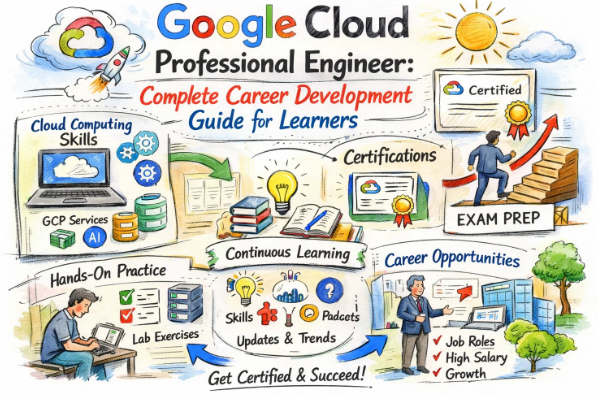
Introduction
Navigating the world of cloud engineering can be overwhelming. There are many tools to learn and many paths to take. However, a clear roadmap makes the journey easier. Google Cloud has designed specific certifications to validate the skills of technical professionals. One of the most respected tracks is the Professional Engineer path.
This guide is written for those who want to move beyond basic knowledge. It is intended for software engineers, site reliability experts, and managers who oversee technical teams. Practical wisdom is shared here to ensure that time is spent on what actually matters in a real-world production environment.
What is Google Cloud Professional Engineer
The Google Cloud Professional Engineer designation is a high-level certification. It is designed to prove that an individual can build and manage scalable systems. This role is not just about knowing which buttons to click in a console. It is about understanding how to design reliable, secure, and cost-effective solutions on the Google Cloud Platform (GCP).
Efficiency and reliability are the core pillars of this role. An engineer in this position is expected to handle automation, monitor system health, and manage incident responses. It is a bridge between software development and traditional IT operations.
Why it Matters in Today’s Ecosystem
Automation is the heartbeat of modern software delivery. In the current ecosystem, manual work is seen as a risk. Companies now look for professionals who can automate everything from deployment to scaling.
Google Cloud is known for its “Site Reliability Engineering” (SRE) philosophy. This certification is heavily influenced by those principles. By earning this, an engineer demonstrates that they understand how to keep services running even under high pressure. It is highly relevant for anyone working in DevOps, AIOps, or FinOps.
Why Certifications are Important for Engineers and Managers
Certifications are often debated, but their value in a competitive market is undeniable. For an engineer, it serves as a structured learning path. It forces one to learn features of the cloud that might not be used in a daily job.
For managers, certifications act as a benchmark. When a team is being built, certified professionals provide a level of confidence. It ensures that the team speaks a common technical language. Furthermore, many global clients require certified experts to handle their cloud infrastructure.
Why Choose DevOpsSchool?
When a certification is pursued, the choice of a training partner is vital. DevOpsSchool is recognized for its hands-on approach. The curriculum is designed by those who have handled complex systems in real-world scenarios.
- Practical Learning: The focus is kept on labs and projects rather than just theory.
- Community Support: A large network of professionals is available for guidance.
- Updated Content: The materials are regularly refreshed to match the latest cloud updates.
- Career Mentorship: Guidance is provided on how to apply these skills in a professional setting.
Certification Deep-Dive: Google Cloud Professional Engineer
What is this certification?
This is a professional-level credential that validates the ability to develop, deploy, and monitor cloud-native applications. It focuses heavily on the balance between feature delivery and system reliability.
Who should take this certification?
This path is recommended for DevOps engineers, SREs, and system administrators. It is also highly beneficial for software developers who want to take ownership of their deployment pipelines.
Certification Overview Table
| Track | Level | Who it’s for | Prerequisites | Skills Covered | Recommended Order |
| DevOps | Professional | Cloud Engineers | Basic Cloud Knowledge | CI/CD, SRE, Monitoring | 1 |
| DevSecOps | Professional | Security Experts | DevOps Knowledge | IAM, Security Scanning | 2 |
| SRE | Professional | Reliability Leads | DevOps Experience | SLIs/SLOs, Error Budgets | 1 |
| AIOps | Professional | Data Architects | Python/Data Skills | Vertex AI, Automation | 3 |
| DataOps | Professional | Data Engineers | SQL/Pipeline Skills | BigQuery, Dataflow | 2 |
| FinOps | Professional | Finance/Managers | Cloud Cost Basics | Billing, Cost Optimization | 3 |
Skills You Will Gain
- The ability to design and implement CI/CD pipelines.
- Proficiency in using Google Cloud monitoring and logging tools.
- Knowledge of managing service level objectives (SLOs) and indicators (SLIs).
- Expertise in managing microservices using Kubernetes (GKE).
- The skill to automate infrastructure using Terraform or Google Cloud Deployment Manager.
Real-World Projects for Practice
- Automated Deployment Pipeline: A project where a multi-tier application is automatically deployed to GKE.
- Centralized Logging System: Setting up a system to capture and analyze logs across multiple cloud projects.
- Auto-scaling Web Cluster: Building a web application that scales up or down based on real-time traffic.
- Incident Response Simulation: Creating a scenario where a system failure triggers automated alerts and recovery steps.
Preparation Plan
7–14 Days Plan (The Intensive Review)
This plan is for those who already have significant experience.
- Days 1-4: All core GCP services like GCE, GKE, and VPC are reviewed.
- Days 5-10: Focus is placed entirely on the SRE workbook and Google’s monitoring tools.
- Days 11-14: Practice exams are taken to identify weak spots.
30 Days Plan (The Balanced Approach)
- Week 1: Introduction to Google Cloud architecture and identity management.
- Week 2: Deep dive into Kubernetes and container orchestration.
- Week 3: Mastering CI/CD tools like Cloud Build and Artifact Registry.
- Week 4: Practice tests and hands-on labs on DevOpsSchool platforms.
60 Days Plan (The Comprehensive Journey)
- Month 1: Foundational knowledge of all GCP components and basic networking.
- Month 2: Advanced topics including SRE principles, security, and final revision.
Common Mistakes to Avoid
- Skipping Documentation: Relying only on videos is a mistake; official docs are crucial.
- Ignoring SRE Concepts: The exam is more about SRE than just “Cloud.”
- Lack of Hands-on Practice: Theory alone will not help in passing the professional labs.
- Overlooking IAM: Security and permissions are often the reason for failing specific scenarios.
Best Next Certification After This
- Same Track: Google Cloud Professional Cloud Architect.
- Cross-Track: Google Cloud Professional Security Engineer.
- Leadership: Google Cloud Digital Leader (for high-level strategy).
Choose Your Learning Path
1. DevOps Path
This is the standard path for those who want to automate everything. It starts with building pipelines and ends with managing complex environments. It is best for engineers who love coding and automation.
2. DevSecOps Path
Security is integrated into the DevOps lifecycle. This path is chosen by those who want to ensure that code is secure before it even reaches production. It is best for security-minded engineers.
3. Site Reliability Engineering (SRE) Path
The focus here is on uptime and performance. Concepts like error budgets and toil reduction are mastered. This is best for those who enjoy solving high-pressure production issues.
4. AIOps / MLOps Path
Artificial intelligence is used to manage operations. This path involves training models to predict system failures. It is best for data-driven engineers who want to use AI in infrastructure.
5. DataOps Path
Data pipelines are the focus here. The goal is to ensure that data flows smoothly from source to storage. It is best for data engineers and database administrators.
6. FinOps Path
The financial side of the cloud is managed here. Cloud waste is identified, and budgets are optimized. It is best for those who want to bridge the gap between engineering and finance.
Role → Recommended Certifications Mapping
| Role | Primary Certification | Secondary Certification |
| DevOps Engineer | Professional Cloud DevOps Engineer | Professional Cloud Architect |
| SRE | Professional Cloud DevOps Engineer | Professional Security Engineer |
| Platform Engineer | Professional Cloud Architect | Professional Data Engineer |
| Cloud Engineer | Associate Cloud Engineer | Professional Cloud DevOps Engineer |
| Security Engineer | Professional Security Engineer | Professional Cloud Architect |
| Data Engineer | Professional Data Engineer | Professional Database Engineer |
| FinOps Practitioner | Professional Cloud DevOps Engineer | Cloud Digital Leader |
| Engineering Manager | Cloud Digital Leader | Professional Cloud Architect |
Next Certifications to Take
For every learner, a strategic next step is suggested to ensure long-term career health.
- For the DevOps Learner:
- Same-track: Professional Cloud Architect.
- Cross-track: Professional Data Engineer.
- Leadership-focused: Project Management Professional (PMP).
- For the Security Learner:
- Same-track: Certified Information Systems Security Professional (CISSP).
- Cross-track: Professional Cloud DevOps Engineer.
- Leadership-focused: Certified Information Security Manager (CISM).
Training & Certification Support Institutions
Several institutions provide the guidance needed to succeed.
DevOpsSchool
This institution is known for its extensive library of technical content. Professional training is offered across various cloud tracks. A strong emphasis is placed on community interaction and career growth.
Cotocus
A focus is maintained on specialized technical training and consulting. Real-world scenarios are integrated into the learning process. It is a preferred choice for corporate teams looking for skill upgrades.
ScmGalaxy
Information on software configuration management is widely available here. It serves as a resource hub for DevOps tools and best practices. Many tutorials are provided for free to help the community.
BestDevOps
Curated learning paths for modern engineering roles are provided here. The focus is kept on high-quality content that is easy to digest. It is ideal for those who want a direct and focused learning experience.
devsecopsschool.com
This platform is dedicated to the intersection of security and operations. Training is provided on how to build secure pipelines. It is a niche resource for security professionals.
sreschool.com
Reliability is the core focus of this institution. The curriculum is built around the SRE principles pioneered by industry leaders. It is best for those aiming for high-availability roles.
aiopsschool.com
The use of machine learning in IT operations is taught here. It is a forward-looking platform for engineers interested in automation through AI.
dataopsschool.com
This site specializes in the management of data workflows. Training is provided on how to treat data as a product. It is essential for modern data teams.
finopsschool.com
Cloud financial management is the primary topic here. Lessons on how to reduce cloud bills and improve ROI are shared. It is vital for cloud architects and finance leads.
FAQs Section
1. Is the Google Cloud Professional Engineer exam difficult?
Yes, it is considered a professional-level exam. A mix of technical knowledge and situational judgment is required.
2. How much time is needed to prepare?
Usually, 2 to 3 months are recommended for a thorough understanding, depending on prior experience.
3. Are there any prerequisites for this certification?
No formal prerequisites are required, but 3 years of industry experience is suggested by Google.
4. What is the validity of this certification?
The certification is typically valid for two years. Re-certification is required after that period.
5. How does this help in career growth?
It opens doors to high-paying roles like Senior DevOps Engineer or Site Reliability Lead.
6. Can a beginner take this exam?
It is better to start with the Associate Cloud Engineer exam if one is a complete beginner.
7. Is coding knowledge required?
A basic understanding of scripting and Python is very helpful for the automation parts.
8. What is the format of the exam?
The exam consists of multiple-choice and multiple-select questions.
9. Can the exam be taken from home?
Yes, online proctored options are available globally.
10. Does this certification focus on Kubernetes?
Yes, GKE is a major component of the exam syllabus.
11. Is Terraform covered in the exam?
While Terraform is a third-party tool, the concepts of Infrastructure as Code are heavily tested.
12. Will this certification help in finding a job in India?
Google Cloud adoption is growing rapidly in India, making this a highly valuable credential in that market.
Google Cloud Professional Engineer Specific FAQs
1. What is the focus of the Professional Cloud DevOps Engineer exam?
The primary focus is on balancing service reliability with the speed of delivery.
2. How much of the exam covers SRE principles?
About 30% to 40% of the exam is based on SRE concepts like SLOs and incident management.
3. Are there labs in the actual exam?
The current format is question-based, but hands-on knowledge is needed to answer correctly.
4. Which Google Cloud tools are most important for this?
Cloud Build, GKE, Cloud Monitoring, Cloud Logging, and IAM are essential.
5. How are SLOs and SLIs tested?
Scenarios are provided where one must choose the correct metric to measure system health.
6. Is CI/CD a major topic?
Yes, designing and troubleshooting deployment pipelines is a core requirement.
7. Does the exam cover multi-cloud strategies?
The focus remains on Google Cloud, but knowledge of hybrid connectivity is often tested.
8. Is the cost of the exam the same everywhere?
The standard price is $200 USD, though it may vary slightly by region or through local partners.
Testimonials
Aarav
A huge improvement in my understanding of automation was noticed after completing the training. The complex concepts were explained in a very simple way.
Priya
Clear clarity regarding my career path was gained. The focus on real-world application helped me implement better monitoring in my current company.
Vikram
The confidence to lead cloud projects was built through this certification. The structure provided by the mentors was key to my success.
Sara
New skills in Kubernetes and SRE were acquired, which were immediately useful in my daily tasks. It was a very practical learning journey.
Michael
A strategic view of cloud infrastructure is now held. The ability to manage large-scale systems with less stress was the biggest outcome for me.
Conclusion
The Google Cloud Professional Engineer certification is more than just a badge. It is a comprehensive validation of the skills needed to thrive in the modern tech world. By focusing on reliability, automation, and scale, an engineer becomes an invaluable asset to any organization.
Long-term career benefits include higher salaries, better job security, and the ability to work on cutting-edge projects. Strategic planning and a commitment to continuous learning are highly encouraged. The path is challenging, but the rewards in the global market are significant.