Introduction
For a long time, the world of cryptocurrency felt like the Wild West. Anyone with an internet connection could create a token, launch an exchange, or trade digital coins with very few rules.
While this freedom fueled incredible innovation, it also attracted fraud, scams, and sudden market crashes. People lost billions of dollars when unregulated platforms collapsed.
Today, that era is ending. Governments, central banks, and financial watchdogs around the globe are writing new rulebooks for digital assets. For beginners and investors, this changing landscape can feel confusing. Do these rules ban crypto? Will they protect your money?
This article explores current crypto regulation trends around the world, what they mean for everyday users, and how the industry is adapting to a structured future.
What Is Crypto Regulation?
Crypto regulation refers to the laws and official rules set by governments to control how cryptocurrencies are bought, sold, held, and taxed.
Simple Meaning
Think of crypto regulation like traffic lights and speed limits on a highway. Before rules, people could drive any speed in any direction. It was fast, but dangerous. Regulations create lanes, stop signs, and police patrols to keep everyone safer—even if it slows down travel a little bit.
Why It Matters
Without clear rules, investors have little recourse if an exchange steals their funds or goes bankrupt. Regulations establish legal protections, prevent illegal money laundering, and give traditional financial institutions the confidence to enter the market.
Why Global Regulators Are Stepping In
Governments are no longer ignoring blockchain technology. Several key pressures are driving this regulatory shift:
- Consumer Protection: High-profile platform collapses left millions of retail investors stranded without funds. Regulators want to ensure companies keep user funds safe.
- Stopping Financial Crime: Bad actors use crypto to hide money, fund illegal activities, or bypass economic sanctions. Governments want strict tracking tools.
- Tax Collection: Billions of dollars in crypto profits go unreported. Tax agencies want clear rules so they can collect owed revenue.
- Protecting National Currencies: The rise of stablecoins (tokens tied to government money like the US Dollar) worries central banks, who fear losing control over national monetary policy.
Key Regulatory Trends Around the World
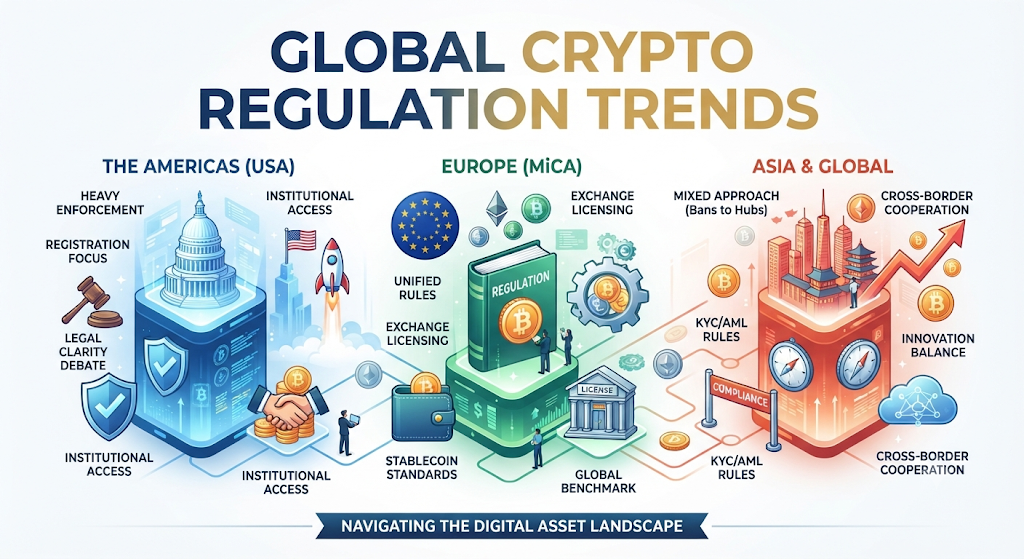
Different regions are handling digital assets in unique ways. Here is how major global markets are shaping the crypto space.
1. The United States: Enforcement and Legal Clarity
The United States takes a complex approach. Rather than passing one comprehensive crypto law, regulators like the Securities and Exchange Commission (SEC) and the Commodity Futures Trading Commission (CFTC) apply existing financial laws to digital tokens.
- The Trend: Heavy enforcement actions against unregistered token offerings and major exchanges, combined with ongoing debates over whether specific coins are securities or commodities.
- The Impact: Crypto companies face strict compliance checks, pushing some startups to build overseas while driving traditional financial giants to launch regulated crypto products like Bitcoin ETFs (Exchange-Traded Funds).
2. The European Union: Setting the Global Standard (MiCA)
The European Union took a major step forward by passing the Markets in Crypto-Assets (MiCA) regulation.
- The Trend: A single, unified rulebook that applies across all 27 EU member countries.
- The Impact: Crypto exchanges and stablecoin issuers now need official licenses to operate in Europe. Stablecoin issuers must hold reliable reserves to back their digital tokens, preventing sudden depegging panics. MiCA serves as a blueprint that other nations watch closely.
3. Asia: Balancing Innovation and Strict Control
Asian countries show vastly different approaches, ranging from total bans to enthusiastic embrace.
- China: Maintains a strict ban on crypto trading and mining, focusing instead on developing its own digital currency (the digital yuan).
- Singapore and Hong Kong: Position themselves as regulated crypto hubs. They welcome blockchain companies but demand rigorous compliance, especially regarding Know Your Customer (KYC) rules—where users must verify their identity before trading.
- Japan: Enforces some of the world’s strictest consumer protection laws, requiring exchanges to keep customer funds segregated from corporate money.
Crucial Concepts to Understand
To navigate regulated crypto markets, you should understand a few core terms:
- KYC (Know Your Customer): A process where financial platforms require you to provide a government ID and proof of address before opening an account. It stops criminals from hiding behind anonymous accounts.
- AML (Anti-Money Laundering): Laws that force companies to monitor transactions and report suspicious financial activity to authorities.
- Travel Rule: A global regulatory requirement where crypto businesses must share user sender and receiver information with each other when transferring funds above a certain threshold.
- Stablecoin Reserves: The actual cash, government bonds, or safe assets that a company holds in reserve to back the value of its digital stablecoin.
Practical Examples: How Regulation Changes the Experience
Example 1: Opening an Account
- The Old Way: You could open an account on an offshore crypto exchange with just an email address and start trading instantly.
- The Regulated Way: You must upload your passport, snap a live selfie, and verify your residential address (KYC). If your documents fail, access is denied.
Example 2: Buying a Stablecoin
- The Old Way: Issuers could claim their stablecoin was backed by “cash equivalents” without showing proof.
- The Regulated Way: Issuers must publish regular, audited financial reports proving they hold real US dollars or safe short-term government debt for every token in circulation.
Common Mistakes Beginners Make Under New Regulations
| What People Do | Why They Do It | What Happens Instead | What They Should Do Instead |
|---|---|---|---|
| Ignoring local tax laws | Thinking crypto profits are invisible to tax agencies. | Facing heavy fines, audits, or legal penalties. | Track every trade and report capital gains accurately using crypto tax software. |
| Using unregulated offshore platforms | Trying to avoid identity checks or access banned features. | Losing funds if the platform shuts down or gets blocked by local authorities. | Stick to licensed, regulated exchanges that operate legally in your jurisdiction. |
| Failing to back up transaction records | Assuming exchanges will store data forever. | Inability to prove tax basis or asset ownership during an audit. | Export CSV trading histories regularly from all platforms you use. |
Risks and Limitations of Current Crypto Regulation
While regulation brings safety, it also introduces challenges:
- Privacy Loss: Strict KYC and data-sharing rules reduce the financial privacy that drew many early users to cryptocurrency.
- Over-Compliance (Chokepoint Risks): If traditional banks fear government penalties, they may refuse to service legal crypto businesses entirely, slowing down legitimate innovation.
- Regulatory Fragmentation: Because laws differ vastly between countries, global projects struggle to comply with conflicting rules in every region.
Decision-Making Framework: Choosing a Regulated Platform
When deciding where to buy or store your digital assets, use this simple checklist:
- Check Licensing: Does the platform hold official licenses or registrations in your country or region?
- Review Security History: Has the platform suffered major hacks, or does it undergo regular third-party security audits?
- Understand Deposit Methods: Can you easily and legally deposit and withdraw your local fiat currency (like USD, EUR, or INR)?
- Evaluate Transparency: Does the company publish proof of reserves showing they hold user funds safely?
Checklist for Crypto Compliance and Safety
- Verify that your primary exchange complies with local KYC and AML laws.
- Maintain a detailed ledger or use crypto tax software to track all buys, sells, and trades.
- Avoid using VPNs to bypass regional restrictions on unregistered platforms.
- Store long-term holdings in a secure, self-custodied hardware wallet rather than leaving them on exchanges.
- Stay updated on upcoming tax policy changes in your local jurisdiction.
Key Terms
- Compliance: Operating according to established government laws and industry rules.
- Securities: Financial instruments like stocks or bonds that represent ownership value and face strict government oversight.
- Fiat Currency: Government-issued money that is not backed by a physical commodity, such as the US Dollar or Euro.
- Self-Custody: Holding your own crypto private keys directly, giving you complete control—and total responsibility—over your funds.
- ETF (Exchange-Traded Fund): An investment fund traded on traditional stock exchanges that tracks the price of an asset like Bitcoin.
FAQs
Will regulation ban cryptocurrency completely?
In most major economies, a total ban is unlikely. Instead of banning crypto, governments want to integrate it into the formal financial system by enforcing consumer protection, tax compliance, and anti-fraud rules.
Do I have to pay taxes on cryptocurrency?
Yes. In almost all major tax jurisdictions, trading, selling, or spending cryptocurrency is treated as a taxable event. You must report capital gains or losses on your annual tax returns.
What is the difference between a regulated and unregulated exchange?
Regulated exchanges follow local legal frameworks, require identity verification (KYC), and provide consumer safeguards. Unregulated exchanges operate outside official oversight, often offering higher risk and zero legal recourse if things go wrong.
How does regulation affect crypto prices?
In the short term, strict regulations or lawsuits can cause market dips due to uncertainty. In the long term, clear rules often boost prices by giving institutional investors and large corporations the legal safety net they need to enter the market.
Do I need to verify my identity on every crypto platform?
Most reputable platforms operating legally today require identity verification to comply with global anti-money laundering laws. Platforms that do not require ID often operate in legal gray areas and carry high risks.
Conclusion
Crypto regulation is changing the digital asset landscape from a chaotic experiment into a mature financial sector. While stricter rules, identity checks, and tax reporting require extra effort from users, they provide a vital foundation for safety and stability. By understanding these global trends, choosing compliant platforms, and keeping clear records, you can navigate the future of crypto with confidence and clarity.