Introduction
Imagine playing a playground game where nobody wrote down the rules. At first, it is exciting because you can do whatever you want. But soon, arguments start. People cheat, players get hurt, and nobody knows who is really in charge.
For many years, the world of cryptocurrency felt like that wild playground. Digital tokens moved across borders instantly without a bank or government saying yes or no. For investors and developers, this freedom was thrilling. But it also invited hackers, scammers, and sudden market crashes that wiped out billions of dollars of hard-earned money.
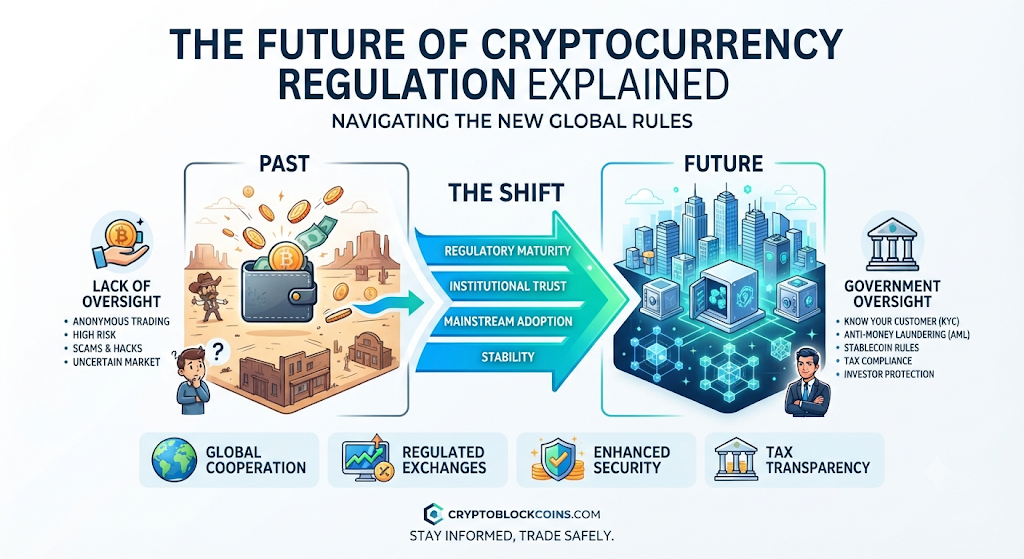
Today, that wild phase is ending. Governments, tax agencies, and global financial watchdogs are writing a new rulebook. This guide will break down the future of cryptocurrency regulation in plain English, explaining what it means for your portfolio, why it matters, and how to navigate the upcoming changes safely.
What Is Cryptocurrency Regulation?
Professional term: Cryptocurrency regulation refers to the legal frameworks, licensing requirements, and compliance standards enforced by government authorities over digital asset activities.
- Simple meaning: It is a set of government rules that tell crypto companies how they must run their businesses.
- Why it matters: Without rules, investors have little legal protection if a digital platform collapses or steals their funds.
- Example: Just as traditional stock markets require brokers to register with regulators like the SEC in the United States, crypto exchanges must now prove they keep customer funds safe and follow anti-fraud laws.
How Cryptocurrency Regulation Works
Governments do not regulate the math behind blockchain technology. Instead, they regulate the bridges where crypto meets traditional money—such as crypto exchanges, payment processors, and financial institutions.
Regulators typically focus on three main areas:
- Identity Verification (Know Your Customer / KYC): Platforms must verify who you are using government ID before letting you trade. This stops criminals from hiding behind anonymous accounts.
- Anti-Money Laundering (AML): Exchanges must monitor transactions for suspicious patterns to prevent illegal funds from being disguised as legitimate trading profits.
- Consumer Protection and Reserves: Companies that hold user funds must prove they have enough real money or assets in reserve to handle customer withdrawals, preventing sudden bankruptcy crises.
Why Regulation Matters for the Market
For a long time, many crypto users believed that digital assets should remain completely independent of governments. However, as the industry grew, the lack of oversight caused massive problems.
When major unregulated platforms collapsed in the past, millions of ordinary people lost their savings overnight with no legal recourse. Clear regulations bring stability. When institutional investors—like pension funds and large banks—know that clear legal rules protect their investments, they feel safe pouring trillions of dollars into the ecosystem. This influx of capital changes everything about how digital assets grow and mature.
Important Factors Shaping the Future of Crypto Laws
As lawmakers draft new legislation, several key forces are shaping the regulatory landscape:
- Cross-Border Cooperation: Because crypto moves instantly across national borders, global groups like the Financial Action Task Force (FATF) are pushing countries to adopt uniform rules so criminals cannot simply move to a “lax” country.
- Stablecoin Supervision: Stablecoins—digital tokens pegged to real-world currencies like the US Dollar—are under intense scrutiny. Regulators want to ensure these tokens are backed 1:1 by safe cash reserves, much like traditional commercial banks.
- Tax Transparency: Tax agencies now require exchanges to report user transactions, making it much harder to hide capital gains from digital asset trading.
Practical Examples: How Regulation Changes Daily Crypto Use
Let’s look at how these rules affect different people in the real world.
The Everyday Trader
- Before: You could open an account on an overseas exchange in two minutes with just an email address, trade anonymously, and withdraw funds instantly.
- Now: You must upload your driver’s license, verify your address, and wait for approval. When tax season arrives, your exchange automatically sends a transaction summary to your local tax authority.
The Small Business Owner
- Before: Accepting Bitcoin for online sales was risky because local tax laws were unclear and currency values swung wildly.
- Now: Regulated payment gateways convert customer crypto into local fiat currency instantly, automatically handle sales tax compliance, and protect the business from legal penalties.
Common Mistakes Beginners Make Regarding Regulation
1. Assuming Crypto Is Completely Anonymous
- What people do: They assume digital wallets protect their personal identity forever.
- Why it causes problems: Modern blockchain analysis tools and exchange KYC checks allow law enforcement to link wallet addresses back to real identities easily.
- What you should do instead: Keep clean financial records and assume that all your blockchain transactions can eventually be audited.
2. Ignoring Local Tax Obligations
- What people do: They treat crypto trading like a video game, ignoring taxes on profits because “it’s digital money.”
- Why it causes problems: Tax authorities treat cryptocurrency as property, meaning every trade or sale can trigger a taxable event. Failing to report can result in heavy fines or audits.
- What you should do instead: Use reputable crypto tax-tracking software to record every trade throughout the year.
Risks and Limitations of Heavy Regulation
While regulation brings safety, it also introduces challenges:
- Stifling Innovation: Excessive compliance costs can force small, innovative startup projects out of business, leaving the market dominated by massive financial institutions.
- Privacy Concerns: Strict data collection means centralized exchanges store vast amounts of sensitive user identity data, which can become targets for sophisticated hackers.
- Over-Centralization: The core promise of cryptocurrency was decentralization. Over-regulation can push activity into underground, unregulated shadows (often called decentralized grey markets), which can be even riskier for consumers.
The Decision-Making Framework for Crypto Investors
When choosing where to trade, store, or invest your assets under new regulatory frameworks, use this simple checklist:
- Check Exchange Compliance: Does the platform operate legally in your jurisdiction? Do they require proper identity verification?
- Review Asset Classification: Understand whether the token you are buying is viewed by regulators as a utility asset, a security, or a commodity.
- Prioritize Self-Custody for Long-Term Holding: For assets you plan to hold for years, consider moving them off regulated exchanges and into a secure hardware wallet where you control the private keys.
- Maintain Clean Records: Keep detailed logs of purchase prices, transaction dates, and exchange fees to simplify tax reporting.
Key Terms
- KYC (Know Your Customer): Identity verification rules that financial institutions and exchanges must follow to verify user identities.
- AML (Anti-Money Laundering): Laws designed to stop criminals from disguising illegally obtained funds as legitimate income.
- Stablecoin: A cryptocurrency whose value is pegged to another asset, usually a fiat currency like the US Dollar.
- Fiat Currency: Government-issued money that is not backed by a physical commodity like gold (e.g., US Dollar, Euro, Indian Rupee).
- Self-Custody: Storing your cryptocurrency in a personal wallet where you hold the private keys, rather than leaving it on a third-party exchange.
- Securities and Exchange Commission (SEC): A government regulatory agency responsible for protecting investors and regulating securities markets (primarily in the US).
- Compliance: The process of ensuring a business follows all applicable laws, regulations, and guidelines.
- Decentralization: The transfer of control and decision-making from a centralized entity (like a government or bank) to a distributed network.
Frequently Asked Questions
Will government regulation ban cryptocurrency entirely?
In most major economies, a total ban is unlikely. Instead of banning crypto, governments are choosing to regulate it so they can tax transactions, prevent financial crimes, and protect everyday consumers.
Do I have to pay taxes on crypto-to-crypto trades?
In many jurisdictions, trading one cryptocurrency for another (such as Bitcoin for Ethereum) is treated as selling the first asset and buying the second, which can trigger a taxable capital gains event. Always check local tax laws.
How does regulation affect the price of Bitcoin?
Regulation is a double-edged sword. In the short term, strict new rules can cause market uncertainty and price drops. In the long term, clear laws give large institutional investors the confidence to invest billions, which can support market growth.
What is a hardware wallet, and does regulation affect it?
A hardware wallet is a physical offline device used to store your crypto private keys securely. Because these devices do not hold customer funds on a company server, standard exchange regulations typically do not apply to personal self-custody.
Why are stablecoins facing strict rules from governments?
Governments worry that if a massive stablecoin issuer fails and cannot back its digital tokens with real cash, it could trigger a panic similar to a traditional bank run, harming the broader financial system.
Can regulators freeze or confiscate my cryptocurrency?
If your crypto is stored on a centralized exchange that must obey local court orders or government mandates, authorities can freeze your account. However, if your crypto is stored in a private self-custody wallet, external parties cannot freeze your funds directly.
Conclusion
The future of cryptocurrency regulation is shifting the industry from a wild west into a structured, mature financial market. While stricter rules mean more paperwork, identity checks, and tax responsibilities, they also provide the safety net needed for mainstream adoption. By understanding regulatory shifts, keeping clean records, and focusing on security, you can navigate the evolving digital asset landscape with confidence and clarity.