Introduction
When people first hear about cryptocurrency, they often think of total freedom and privacy. Because digital coins do not belong to a single bank or government, it is easy to imagine a world where anyone can send money anywhere instantly, without asking for permission.
However, total anonymity creates a major problem. If anyone can move money invisibly, it becomes very easy for criminals to hide stolen funds, avoid taxes, or fund illegal activities.
To solve this problem, governments and crypto companies use rules known as AML and KYC. While these checks can sometimes feel annoying—such as waiting for a photo ID to upload—they play an important role in making crypto legal, safe, and trusted around the world. This guide will break down what these terms mean, why they matter, and how they affect you as a user.
What Is KYC in Crypto?
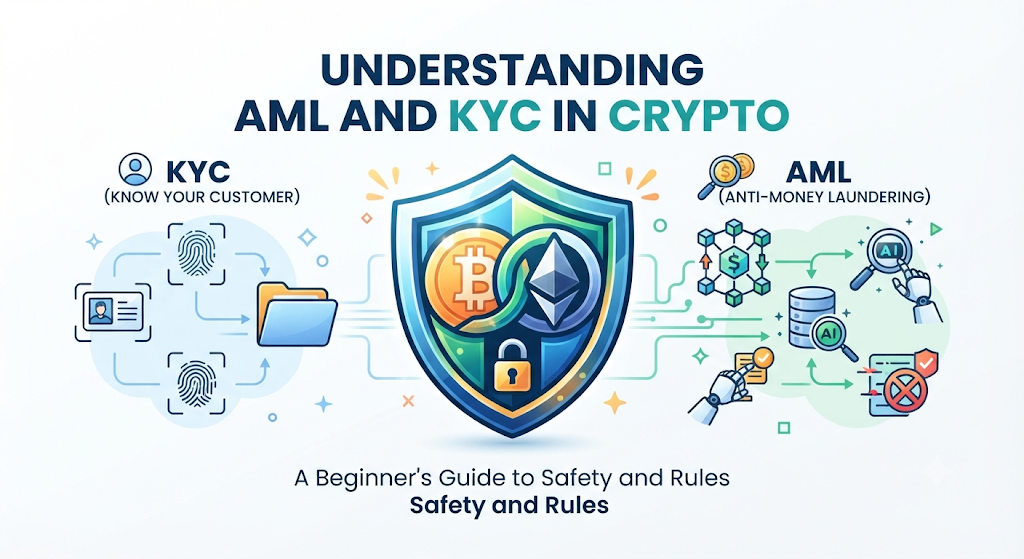
KYC stands for Know Your Customer.
- Simple Meaning: KYC is the process where a financial platform asks you to prove who you are before you can use their services.
- Why It Matters: It prevents bad actors from opening fake accounts, stealing someone else’s identity, or using anonymous accounts to move stolen money.
- Example: When you sign up for a popular crypto exchange like Coinbase or Binance and take a selfie while holding your driver’s license, you are completing a KYC check.
How the KYC Process Works
Most regulated crypto platforms require a few basic steps:
- Personal Information: You provide your full legal name, home address, and date of birth.
- Identity Document: You upload a clear photo of a government-issued ID, such as a passport or national identity card.
- Facial Verification: The platform uses software to match your live selfie with the photo on your ID to confirm you are a real person.
If a platform does not ask for any identification, it is usually unregulated, which can expose users to higher risks of scams or sudden platform shutdowns.
What Is AML in Crypto?
AML stands for Anti-Money Laundering.
- Simple Meaning: AML refers to the laws, rules, and technology systems used to stop people from disguising illegally obtained money as legitimate funds.
- Why It Matters: Criminals always look for ways to clean “dirty” money so they can spend it openly. AML rules force financial institutions to watch for these patterns and report suspicious activity.
- Example: If someone steals $1 million in digital assets and tries to break it into tiny pieces to send through hundreds of different accounts, AML tracking software flags that strange behavior for review.
The Three Steps of Money Laundering
To understand why AML is necessary, it helps to know how criminals try to launder money:
- Placement: Introducing illegal cash or crypto into the financial system.
- Layering: Moving funds around through complex transactions to hide the original source.
- Integration: Using the “cleaned” money to buy legal assets, like real estate or legitimate investments.
AML monitoring tools stop money laundering by catching unusual patterns during the placement and layering stages.
Why AML and KYC Matter for Everyday Crypto Users
You might wonder why these rules matter if you are just a regular person buying a small amount of crypto. Even if you have nothing to hide, AML and KYC protect you in several important ways:
- Safety from Scams: Platforms that enforce strict identity rules are harder for scammers to use freely. This reduces the number of fraudulent projects operating openly.
- Account Recovery: If you lose access to your account or get locked out, having verified KYC documents makes it much easier for customer support to prove you are the rightful owner and restore your access.
- Access to Traditional Banks: Without AML and KYC laws, traditional banks would refuse to work with crypto companies. These rules build a bridge between digital currencies and regular bank accounts, making it easy to cash out your profits.
Important Factors to Understand: On-Chain Analysis
Unlike traditional cash, which is hard to track once it changes hands, public blockchains like Bitcoin keep a permanent, public record of every single transaction. This creates a powerful tool for AML compliance called blockchain analytics.
- What it is: Specialized software companies (such as Chainalysis or Elliptic) scan public transaction ledgers to trace where funds come from and where they go.
- How it works: Every wallet address has a history. If a wallet interacts with known criminal sites, darknet markets, or stolen funds, analytics tools flag that address instantly.
- Why it matters: Even if a criminal tries to hide their identity behind a fake name, blockchain analytics can often trace the digital footprint across the public ledger.
Common Mistakes Beginners Make
When navigating KYC and AML rules, beginners often run into a few common pitfalls:
- Using Fake Information: Some users try to bypass KYC by entering fake names or using temporary documents. Why it causes problems: Platforms verify these details against databases. Using false info leads to instant account bans and the permanent loss of stored funds.
- Ignoring Privacy Risks: Users sometimes share sensitive ID documents with unverified, shady websites. Why it causes problems: This can lead to identity theft. Always verify that a crypto platform is legitimate and regulated before uploading personal documents.
- Assuming Crypto Is Completely Anonymous: Many people believe crypto has zero tracking. Why it causes problems: Public blockchains keep permanent records. Trying to hide illegal activities usually fails because the transaction trail remains visible forever.
Risks and Limitations of AML and KYC
While these regulations protect the financial system, they also come with valid criticisms and limitations:
- Privacy Concerns: Handing sensitive personal data to online companies creates a risk of data breaches. If a platform gets hacked, user ID documents can leak.
- Financial Exclusion: People in developing nations or areas without reliable government-issued IDs may struggle to pass KYC checks, cutting them off from modern digital finance.
- False Positives: Automated AML systems sometimes freeze innocent user accounts simply because a transaction looked unusual, causing frustrating delays in customer support.
Comparison: Regulated Exchanges vs. Unregulated Platforms
| Feature | Regulated Platforms (Centralized Exchanges) | Unregulated Platforms / Decentralized Services |
| KYC Requirement | Mandatory (ID verification needed) | Usually none (connects via self-custody wallet) |
| AML Monitoring | Active transaction monitoring | Minimal or protocol-based checks |
| Bank Integration | Easy to deposit and withdraw fiat currency (USD, EUR) | Difficult to link directly to traditional bank accounts |
| User Protection | Higher legal protections and account recovery options | Lower support; user bears full responsibility for security |
Checklist for Staying Safe and Compliant
Before using a new crypto platform or service, run through this quick checklist:
- Verify Regulation: Check if the platform is registered with financial authorities in your region.
- Protect Your Data: Only upload identity documents to secure, HTTPS-encrypted, well-known platforms.
- Understand the Terms: Read the platform’s deposit and withdrawal rules regarding KYC limits.
- Keep Records: Maintain clear records of where your funds originate in case a platform requests proof of funds for AML compliance.
Key Terms
- Fiat Currency: Government-issued money like the US Dollar, Euro, or Indian Rupee.
- Blockchain Analytics: Technology used to trace and investigate transaction paths on public ledgers.
- Self-Custody Wallet: A crypto wallet where you hold your own private keys without relying on a third-party exchange.
- Suspicious Activity Report (SAR): A document that financial institutions file with regulators when they spot unusual transactions that might indicate financial crime.
- Sanctions Screening: The process of checking user names against government lists of banned individuals, companies, or countries.
FAQs
Is KYC required for all crypto transactions?
No. KYC is generally required when using centralized exchanges, payment processors, or services that connect crypto to traditional fiat money. If you use a decentralized wallet to trade peer-to-peer without an intermediary, KYC is typically not required.
Can AML software see my private personal information?
AML software mostly analyzes transaction patterns, wallet connections, and amounts on the public blockchain. However, when paired with KYC data held by an exchange, investigators can link a wallet address to a real-world identity.
Why did a crypto exchange ask me for “Source of Funds”?
If you deposit or withdraw a very large amount of money, AML rules require platforms to verify where that wealth came from. You may need to provide a tax return, salary slip, or proof of sale to satisfy this requirement.
Does KYC ruin the original purpose of cryptocurrency?
It creates a trade-off. Satoshi Nakamoto originally designed Bitcoin for peer-to-peer digital cash without middlemen. However, mass adoption requires working within legal frameworks to prevent fraud, protect users, and keep financial systems stable.
What happens if I fail a KYC check?
If your documents are blurry, expired, or do not match your account details, the exchange will usually ask you to resubmit them. If fraud or false identity is suspected, the platform may close the account and return or freeze the funds according to local laws.
Conclusion
AML and KYC regulations form the bridge between the wild west of early digital money and the trusted global financial system of today. While uploading your ID and dealing with compliance checks can feel tedious, these rules protect everyday users from scams, prevent financial crime, and give digital currencies the legitimacy needed for widespread adoption. Understanding how these safeguards work helps you navigate the crypto space safely, legally, and with confidence.