Introduction
The promise of digital wealth draws millions of people into the cryptocurrency market every day. Social media feeds are full of success stories about ordinary people turning small amounts of money into fortunes through new digital tokens, decentralized finance apps, and unregulated trading platforms.
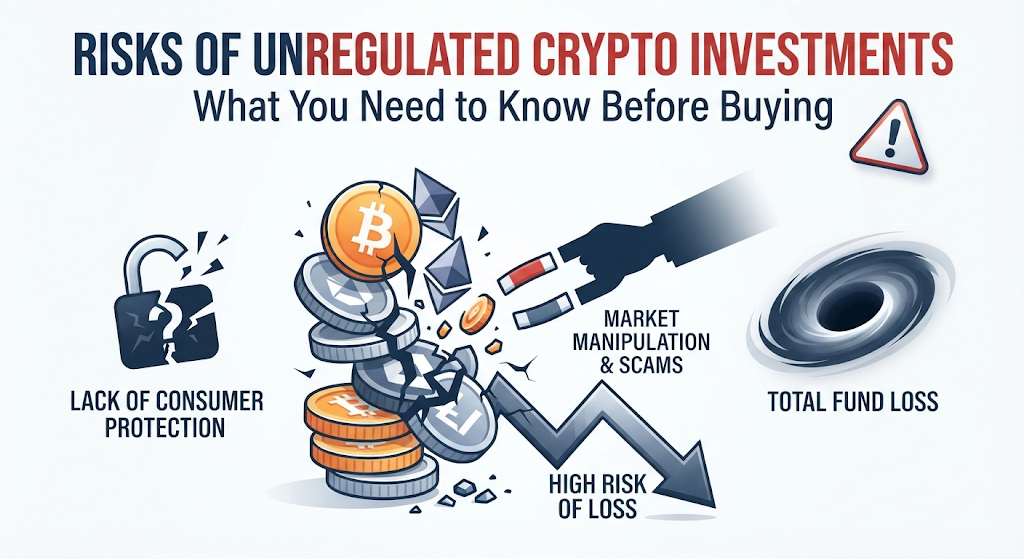
For beginners, the crypto world can feel exciting, modern, and full of opportunity. However, beneath the surface lies a massive hidden danger: unregulated crypto investments.
Many investors do not realize the difference between regulated exchanges that follow strict government consumer protection laws and unregulated platforms that operate without any legal oversight. When things go wrong, the consequences are severe.
This guide explains what unregulated crypto investments are, how they work, the hidden risks involved, and how you can protect your hard-earned money from total loss.
What Are Unregulated Crypto Investments?
To understand the risk, you first need to understand the basic concept of regulation.
- Professional Term: Financial Regulation refers to rules and laws set by government agencies (such as the SEC or financial conduct authorities) to protect consumers, ensure fair markets, and prevent fraud.
- Simple Meaning: Rules created by governments to keep financial markets honest and safe for everyday people.
- Why It Matters: Regulated companies must prove they have enough money to stay afloat, keep customer funds separate from company money, and follow strict anti-fraud rules. Unregulated entities do not have to follow any of these rules.
- Example: If you put money in a traditional bank, government insurance usually protects your deposits even if the bank goes bankrupt. If you put money into an unregulated crypto platform that goes bankrupt, your money simply disappears.
Unregulated crypto investments include obscure alternative tokens (often called altcoins), decentralized finance (DeFi) platforms with no legal entity behind them, peer-to-peer lending pools, and offshore cryptocurrency exchanges that refuse to follow local securities laws.
How Unregulated Crypto Markets Work
Traditional stock markets have gatekeepers, brokers, and clearinghouses that make sure trades are real and companies are honest. Unregulated crypto markets operate very differently.
The Decentralized Nature
Many crypto projects are built on blockchain technology—a shared, digital public ledger that records transactions across a network of computers. While blockchain itself is transparent, the people and companies building projects on top of it often operate in complete secrecy.
The Appeal of High Risk and High Reward
Unregulated markets thrive on speculation. Because there are no listing requirements or audits, anyone with a computer can create a new cryptocurrency in minutes. They can market it heavily online, attract buyers, and inflate the price before disappearing with the investors’ money.
Why People Invest in Unregulated Crypto (And Why It Is Dangerous)
Investors are often drawn to unregulated crypto investments because they offer features that traditional financial systems cannot match.
| Feature | The Attraction | The Hidden Danger |
|---|---|---|
| Anonymity & Privacy | No identity checks or government tracking required. | Perfect for money launderers, scammers, and hackers with zero legal recourse for victims. |
| High Yields (APY) | Promises of 20% to 100% annual returns on deposits. | Classic hallmark of Ponzi schemes; money is paid out of new investors’ pockets until the system collapses. |
| Early Access | Buying brand-new tokens before they hit major exchanges. | Most early-stage tokens are “rug pulls” where creators sell all their tokens instantly, crashing the price to zero. |
Major Risks of Unregulated Crypto Investments
Investing outside the bounds of financial regulation exposes you to specific, severe hazards that do not exist in traditional investing.
1. Total Loss from Fraud and Scams
Because unregulated platforms operate without legal oversight, bad actors face very few consequences for stealing funds. Common scams include:
- Rug Pulls: Developers create a new token, build hype, let investors buy in, and then drain all the liquidity pool, leaving investors with worthless digital tokens.
- Fake Exchanges: Sophisticated websites that look like legitimate trading platforms show fake profits in your account, but block you the moment you try to withdraw your real money.
2. Market Manipulation and “Pump and Dump” Schemes
In a Pump and Dump scheme, a group of organizers artificially inflate the price of an unregulated, low-value cryptocurrency through false hype and social media excitement.
- How it works: Organizers buy cheap tokens, convince beginners that the price is going to skyrocket, and then sell their own shares once the price peaks, causing the value to crash instantly.
3. Complete Lack of Legal Recourse
If a regulated broker cheats you, you can file a complaint with government regulators or sue them in court. If an unregulated offshore crypto platform freezes your account or disappears, you have no legal standing, no customer service department to call, and no government agency capable of freezing their assets.
4. Severe Counterparty Risk
- Professional Term: Counterparty Risk is the probability that the other party in an agreement will default on their contractual obligation.
- Simple Meaning: The risk that the company holding your money goes bankrupt or refuses to give it back.
- Why It Matters: Many unregulated crypto lenders and platforms lend user funds out to risky third parties. When those third parties fail, the platform collapses instantly.
Common Mistakes Beginners Make
- Mistake: Trusting flashy websites and celebrity endorsements.
- Why it happens: Scammers spend thousands of dollars making professional websites and paying influencers to look legitimate.
- What happens instead: The endorsement was paid advertising, and the platform has no real business operations.
- What to do instead: Research the actual founders, check if the entity is registered with financial regulators, and ignore social media hype.
- Mistake: Chasing unrealistic financial returns.
- Why it happens: Desperation or excitement leads people to believe that 50% monthly returns are normal in crypto.
- What happens instead: High returns always mean dangerously high risk. If it sounds too good to be true, it is a scam.
- What to do instead: Stick to well-established, regulated platforms and realistic growth expectations.
A Simple Decision-Making Framework for Crypto Investing
Before putting money into any digital asset or platform, run through this quick checklist to evaluate your safety:
- Check Regulation: Is the platform registered with recognized financial regulatory bodies in your country? If no, stop.
- Examine Transparency: Can you easily find the real names, backgrounds, and legal addresses of the team behind the project? If it is completely anonymous, walk away.
- Analyze the Value Proposition: Does the token solve a real-world problem, or does its value depend entirely on convincing other people to pay more for it later (the “Greater Fool Theory”)?
- Evaluate Custody: Do you control the private keys to your digital assets, or are you leaving your money on a random exchange? (Remember: Not your keys, not your coins).
- Assess Affordability: Are you investing money that you can afford to lose entirely without harming your daily life or financial future?
Key Terms
- Altcoin: Any cryptocurrency other than Bitcoin, including thousands of smaller, unregulated tokens.
- Blockchain: A digital, decentralized public ledger that securely records transactions across multiple computers.
- DeFi (Decentralized Finance): Financial services (like lending and borrowing) run on public blockchains without traditional banks or intermediaries.
- Liquidity Pool: A collection of funds locked in a digital contract that allows users to trade tokens on decentralized exchanges.
- Private Key: A secret cryptographic code that proves ownership of your crypto assets and allows you to spend or transfer them.
- Rug Pull: A malicious crypto scam where developers abandon a project and run away with investors’ funds.
- Wallet: A digital tool (software or hardware) used to store your public and private keys and manage your cryptocurrency.
FAQs
What makes a cryptocurrency investment “unregulated”?
An investment is unregulated if it is issued, traded, or managed by entities that do not comply with government financial laws, do not require customer identity verification (KYC), and are not supervised by financial watchdogs like the SEC or FCA.
Can I get my money back if I get scammed on an unregulated crypto platform?
In almost all cases, no. Transactions on blockchains are irreversible, and because unregulated platforms operate anonymously or in foreign jurisdictions with weak laws, law enforcement has very little ability to recover stolen funds.
Are all cryptocurrencies unregulated?
No. While Bitcoin and many altcoins started as decentralized and unregulated assets, many countries now regulate centralized crypto exchanges, crypto exchange-traded funds (ETFs), and specific digital asset service providers under existing financial laws.
How can I tell if a crypto platform is safe to use?
Check if the platform is registered with major financial regulators, requires proper identity verification (Know Your Customer / KYC), has a transparent leadership team, and has operated successfully for many years with a strong security track record.
Is Bitcoin considered an unregulated investment?
Bitcoin itself is a decentralized digital asset with no central issuing company, meaning it is not regulated in the traditional corporate sense. However, buying Bitcoin through a regulated brokerage or a regulated ETF provides legal consumer protections that buying on a shady offshore exchange does not.
Conclusion
The cryptocurrency market offers genuine technological innovation, but it also attracts dishonest operators looking to exploit inexperienced investors. Unregulated crypto investments strip away every safety net that modern financial systems provide.
Before putting money into digital assets, prioritize safety over speed. Stick to regulated platforms, ignore promises of guaranteed wealth, and remember that protecting your capital is always more important than chasing speculative hype.