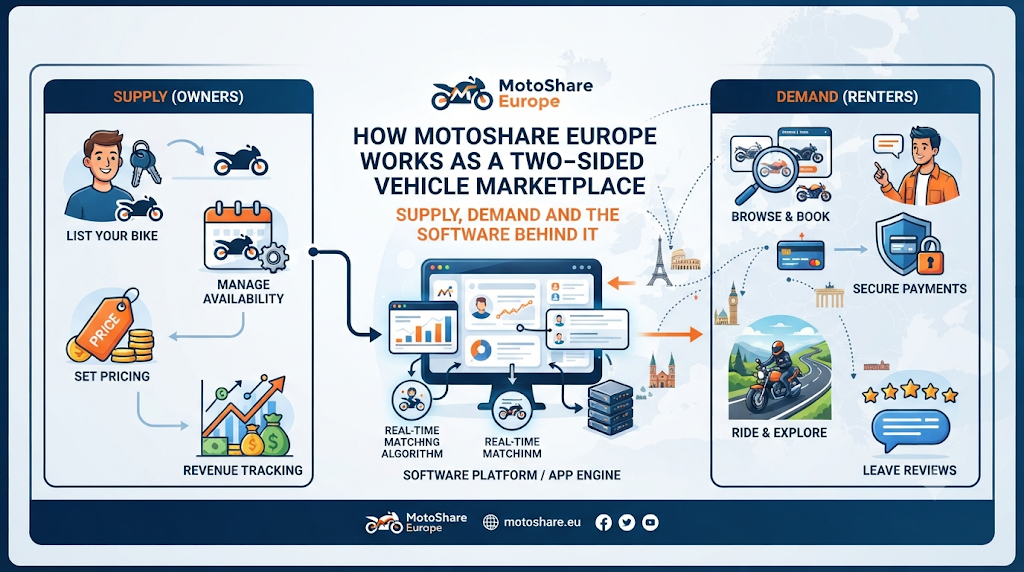
Every rental market starts with a simple mismatch. Somewhere a motorcycle sits in a garage for most of the week. Somewhere else a traveler needs two wheels for three days. Neither knows the other exists. A marketplace tries to close that gap by putting both sides on the same screen.
MotoShare Europe is built on this idea. It covers motorcycles, bikes, scooters and cars, and it describes a peer-to-peer model in which independent owners and renters can connect. It also advertises tools for the businesses that stand behind many rentals. This article looks at the platform as an economist might: who supplies, who asks, and what keeps the machinery in order. It avoids sales language and points out where the website’s claims still need checking.
MotoShare Europe on One Page
MotoShare Europe is an online marketplace for vehicle rentals. A visitor searches by location and travel dates, reads the listings, compares rental options and sends a booking request to a participating local provider. Collection is arranged through that provider.
The marketplace label is important. A conventional rental company owns its fleet, sets its own prices and deals with every customer itself. A marketplace owns none of that by default. It hosts listings from owners and partners, and each of them sets the terms of their own offer. So MotoShare Europe should not be described as the owner or operator of the vehicles on its pages. Some listings may come from private owners and others from rental businesses.
A second offer sits beside the marketplace. The website advertises free vehicle rental management software for independent shops and fleet operators. It lists tools for vehicle listings, reservations, customer records, fleet availability, payments, revenue and operational reports. All of this is advertised. Its full functionality has not been independently verified.
One limit on scale deserves a mention. The platform positions itself across Europe, but the inventory visible today is smaller than that wide claim implies. No reader should assume vehicles exist in every country or city.
Why the Marketplace Idea Fits Vehicles
Vehicles are unusual assets. They cost a lot to own and sit unused for long stretches, yet the need to borrow one tends to be short and sudden. That pattern suits a matching platform. Owners and small providers gain a way to be found. Renters gain a place to compare options without calling around.
Europe adds its own flavor. City centers reward small, nimble vehicles. Scenic regions reward motorcycles. Road trips reward flexibility in dates. Locals, too, need a car now and then. A single marketplace can serve all of these needs, provided that listings exist for the place and season in question.
The weakness is the flip side of the strength. Because every provider sets their own terms, a marketplace cannot promise uniform prices, availability or conditions. Everything depends on the individual listing.
Reading the Platform Through Three Questions
Who Is Asking for Vehicles?
Start with demand. A rider hunting for motorcycle rental Europe wide begins with two inputs, a pick-up place and travel dates. The results are then a matter of reading: the vehicle details, the rental period, the collection arrangement and the provider behind each listing. The site’s wider coverage claim does not guarantee any particular model, country or stock level, so only what the search shows should be trusted.
Cost is the next worry for most people. Motorcycle rental cost Europe wide has no single answer, because the price on a listing reflects many inputs. These include the type of motorcycle, the rental length, the place, the season, the provider’s pricing, the insurance and other conditions, and how pick-up and return are handled. Because an average from an article would be a guess, the listing is the only reliable source. It is also worth asking what the price includes.
Bikes and scooters serve a smaller radius. A scooter suits a crowded old town or a few stops in one day. Whether a given category exists in a given place is for the listing to say. Cars complete the picture and suit travelers who need space, locals who need a car for a few days, and business visitors with a short trip. The platform’s pages do not specify car types or prices.
Who Is Supplying Them?
Now turn to supply. In peer to peer motorcycle rental Europe visitors read about, an owner lists a motorcycle, a renter reviews it, picks a rental period and sends a request, and the owner or a partner replies and arranges the handover. Three roles appear: the owner who supplies the vehicle, the renter who uses it for an agreed time and the rental partner who may stand in for the owner. Because partners can be involved, not every rental is between two private people.
Someone who thinks, “I want to rent out my motorcycle,” faces a short list of tasks. The details must be accurate, the photographs clear, the conditions written in plain words, the availability current and the enquiries answered quickly. Demand and income are never guaranteed by any platform.
Car owners face the same list. A person asking whether they could list my car for rent should write a clear listing, set the rental periods and conditions, add useful photos, review booking requests and keep details current. The platform’s information does not describe payouts, insurance arrangements or approval rules, so those need direct confirmation before anything goes live.
What Keeps the Back Office Running?
Behind many rentals stands a small business with a lot of records. It needs to know which vehicle is free, who booked it, who the customer is and how the week went. Management software exists to hold these facts in one place.
The platform advertises free vehicle rental management software for this job, with tools for listings, reservations, customer records, fleet availability, payment-related management, revenue information and operational reports. For a small shop the likely gain is order, since scattered notes become one record. Whether each tool works as advertised, and whether it is open to every account, is something a business should test before it moves its daily work over.
Small car businesses often search for free car rental software because early budgets are tight. The needs are modest: organize reservations, track vehicles, keep customer records and review activity. The platform advertises its tools as free but describes no limits, paid upgrades or conditions, so a business should ask rather than assume unlimited use.
Shops with two-wheelers ask the same daily questions, which is why terms such as bike rental software and scooter rental software are common searches. The platform’s description does not name functions aimed at bikes or scooters. A shop should confirm what is included for its own fleet.
At the core of every shop sits a vehicle rental booking system, the part that answers one question: which vehicle is free on which dates, and who has it? It depends on availability data, rental dates, reservation records, customer details and coordination with providers. The platform’s management offer touches the same ground, but it does not describe automated workflows or links to other tools. None should be assumed.
For independent shops and fleet operators, the value is steadier records. Organized vehicle records, a clear view of availability and tidy reservations reduce double bookings. These are the problems the advertised tools aim at, and their real performance is for each business to judge.
Three Journeys in Five Moves
A renter moves from choosing a vehicle category, to searching by place and dates, to browsing participating listings, to reading the details, price and conditions, and finally to sending the booking request and following the collection steps. The exact process can vary by vehicle and provider.
A rental business gathers accurate vehicle and company details, adds or organizes its listings, records each reservation with the customer’s information, reviews availability and recent activity, and keeps its fleet records current. These moves match the advertised capabilities, though exact screens and menus are not described.
An owner picks a vehicle to list, prepares accurate information and photographs, submits the listing through the platform’s process, reads enquiries and booking requests, and keeps dates and conditions up to date. Approval and bookings are not promised.
Where Things Tend to Go Wrong
Most trouble comes from small gaps in information. Renters skip the listing details, mismatch their dates and the collection arrangement, assume that a place has vehicles because the site talks about Europe, pass over the conditions and insurance notes, or compare two prices without checking what each covers. The remedy is plain: read the full listing and compare like with like.
Owners lose bookings through weak listings. A thin description, an old photograph, stale availability, vague conditions or a slow reply each cost trust. A weekly look at the listing and the inbox solves most of it.
Businesses suffer when records slip. Missing customer details, out-of-date fleet data and unchecked reservations lead to double bookings, and assuming that a software feature exists without trying it is a quieter version of the same problem. A short weekly review and a small trial of any new tool keep the data honest.
A Notebook and a Search Bar
Picture two people on the same afternoon. Lena is planning a ten-day ride. She types in a pick-up place and her dates, opens three motorcycle listings and writes down the rental period and handover details of each. She reads the conditions, checks what each price includes and sends a request for the best fit.
Across town, Tomas runs a small scooter shop and keeps his bookings in a paper notebook. Twice this season he has promised the same scooter to two customers. He decides to try the advertised management tools. First he checks what is actually included for his fleet. Then he enters his vehicles, records each booking with the customer’s name and looks each morning at what is free. If the tools work as described, the notebook becomes a single record and the double bookings should fade.
Objections, Answered
But is this just another rental company?
No. It is a marketplace where owners and partners list vehicles and set their own terms.
Is every rental between two private people?
Not necessarily. Rental partners can be involved, so read each listing.
Can I trust a price I read in an article?
No. Price depends on the type, length, place, season, provider and conditions. Read the listing.
Is the software really free?
The website advertises it as free. Limits, upgrades and conditions are not confirmed, so ask first.
Has anyone verified the software?
Its full functionality has not been independently verified. Test it on a small scale.
Will I find vehicles in any European city?
Not necessarily. Visible inventory is smaller than the coverage claim.
Can I list my own vehicle?
The marketplace is built around owner and provider listings. Confirm the listing steps, approval rules, payouts and insurance directly.
What should a booking system track?
Availability, rental dates, reservation records, customer details and provider coordination.
What to Take Away
MotoShare Europe links three pieces: a search tool for renters, a listing route for owners and a set of advertised tools for small rental businesses. Each piece makes sense on its own, and together they cover motorcycles, bikes, scooters and cars.
The sound way to use any such platform is the same each time. Ask who supplies the vehicle, read what the price includes and test what the software really does. Clear answers to those three questions matter more than any promise on a home page.