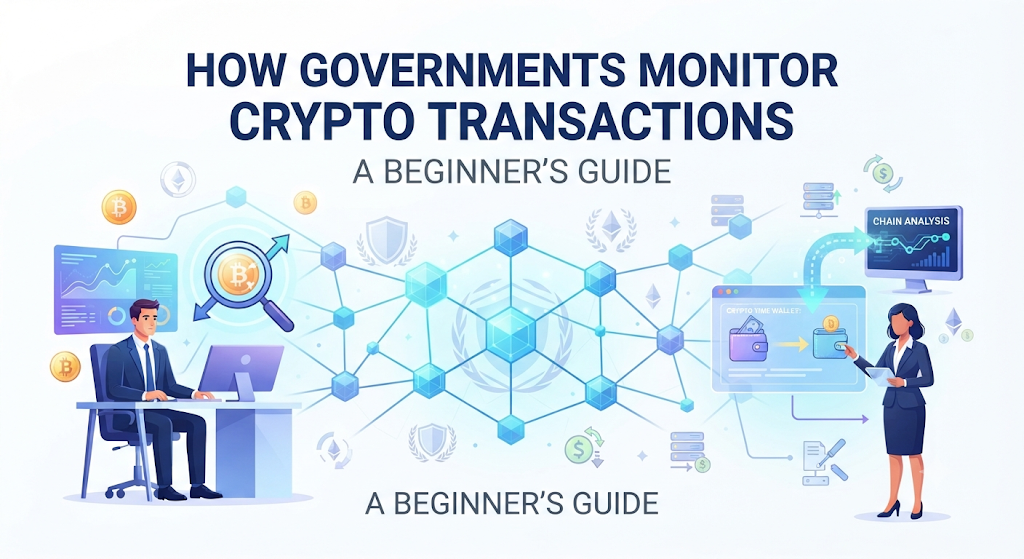
Introduction
When Bitcoin was created, it promised a new way to send money across the world without needing a traditional bank. Because transactions use long strings of letters and numbers instead of your actual name, many early users assumed cryptocurrency was completely private—almost like digital cash handed over in a dark alley.
Over the years, this idea of total anonymity led to major misunderstandings. People sometimes wonder how law enforcement agencies manage to catch hackers, track ransom payments, or investigate financial crimes involving crypto.
The truth is surprising to many beginners: public blockchains are actually some of the most transparent financial ledgers in human history. Every single movement of funds leaves a permanent digital footprint.
This guide breaks down how governments monitor cryptocurrency transactions, the tools agencies use, and what it all means for everyday crypto users who value their privacy.
What Is Blockchain Surveillance?
Professional term: Blockchain Surveillance
Simple meaning: The process of watching, recording, and analyzing data on public crypto ledgers to trace where funds come from and where they go.
Why it matters: It allows regulators and law enforcement to spot illegal financial activities, tax evasion, and money laundering.
Example: If a hacker steals funds from an exchange, blockchain surveillance teams can watch those exact digital coins move from wallet to wallet in real time.
Unlike cash, which disappears when you hand it to a stranger, a blockchain keeps a permanent public record. Every transaction is like a line in a giant digital accounting book that anyone in the world can open and read.
However, reading that book is not easy. It contains millions of wallet addresses—long codes like 1A1zP1eP5QGefi2DMPTfTL5SLmv7DivfNa—instead of names. Blockchain surveillance is the process of connecting those mysterious codes back to real human identities.
How Governments Monitor Crypto Transactions
Governments do not sit around staring at raw code all day. Instead, they rely on a combination of technology, legal rules, and partnerships with private companies. Here is how the monitoring process actually works in practice.
1. Public Ledgers and Transparent Data
The foundation of government monitoring is simple: the blockchain itself.
- How it works: Every public blockchain keeps a permanent history of all transactions.
- Why it matters: Because the data is public, anyone—including government tax agencies and police departments—can download the entire history and analyze it.
- Limitation: A wallet address is just a number. By itself, it does not tell you who owns it. That is where tracking tools come in.
2. Blockchain Analytics Software
To make sense of public data, government agencies use specialized software created by firms like Chainalysis, Elliptic, and TRM Labs.
- Professional term: Blockchain Analytics
- Simple meaning: High-tech computer software that scans public blockchains to find patterns, cluster related wallet addresses, and link digital funds to real-world entities.
- Why it matters: Tracing thousands of transactions manually is impossible. Analytics software automates the detective work.
- Example: If a company receives payments from hundreds of customers, software can analyze transaction sizes and timing to prove those wallets belong to a single business.
3. Know Your Customer (KYC) and Anti-Money Laundering (AML) Laws
Technology alone cannot link a wallet address to a passport. To solve this, governments use traditional financial rules.
- Professional term: KYC (Know Your Customer)
- Simple meaning: The identity verification process required by financial institutions, such as uploading a photo ID and proof of address.
- Why it matters: Most people buy crypto through centralized exchanges (like Coinbase or Binance). These exchanges are legally required to collect your real identity. If a government agency suspects a specific wallet address of illegal activity, they can legally request the user’s identity from the exchange.
4. Cross-Chain Tracking (Bridge Monitoring)
Cryptocurrency users often move funds from one blockchain to another (for example, moving Bitcoin to Ethereum) to hide their tracks.
- Professional term: Cross-Chain Bridge
- Simple meaning: A digital tool that lets you swap tokens from one blockchain network to another.
- Why it matters: Advanced analytics tools can follow funds across different blockchains, watching money jump from network to network just like following a car across state lines.
Why Government Crypto Monitoring Matters
Understanding how monitoring works is important for several reasons, whether you are a casual investor, a business owner, or a student of finance.
- Tax Compliance: Tax authorities worldwide now view crypto as property or currency. They expect capital gains and income to be reported. Monitoring tools help tax agencies catch unreported crypto profits.
- Consumer Protection: Tracking stolen funds helps law enforcement freeze assets on centralized exchanges before hackers can cash them out.
- Financial Crime Prevention: Stopping illegal activities like ransomware, drug trafficking, and terrorist financing relies heavily on tracing illicit blockchain transactions.
Common Methods Used to Evade Monitoring (and Why They Often Fail)
Some users attempt to hide their crypto transactions using various privacy techniques. However, government agencies are well-aware of these methods.
| Privacy Method | What People Do | Why It Often Fails |
|---|---|---|
| Crypto Mixers | Pooling funds together with other users to scramble the transaction trail. | Analytics firms track deposit and withdrawal patterns using advanced math; law enforcement regularly seize mixer servers. |
| Privacy Coins | Using specialized cryptocurrencies (like Monero) designed to hide sender and receiver details. | Exchanges face heavy regulatory pressure to delist privacy coins, making them hard to buy or sell legally. |
| Multiple Wallets | Creating dozens of different wallet addresses to scatter funds. | Behavioral analysis software can link wallets together if they frequently interact or send funds to the same destination. |
Common Mistakes Beginners Make
- Assuming pseudonyms mean anonymity: Believing that using a wallet address instead of your name keeps your financial life completely hidden from tax authorities.
- Using unregulated platforms: Trading on shady peer-to-peer platforms without realizing that interacting with a compromised wallet can flag your own funds during AML reviews.
- Forgetting about tax reporting: Failing to keep records of crypto-to-crypto trades, assuming taxes are only owed when converting back to cash.
- Overlooking exchange KYC requirements: Thinking you can bypass identity checks by using fake details, which usually leads to frozen accounts during routine security audits.
Checklist for Crypto Privacy and Compliance
Use this practical checklist to ensure your crypto activities remain legal, transparent, and properly managed:
- Use Regulated Exchanges: Stick to licensed platforms that protect your funds and comply with local financial laws.
- Keep Accurate Records: Track every trade, purchase, and transfer for tax reporting purposes.
- Understand Public Visibility: Remember that every transaction on public blockchains like Bitcoin and Ethereum is permanent and viewable by anyone.
- Separate Wallets Wisely: Consider using different wallets for long-term savings (cold storage) and daily trading to protect your main holdings.
- Consult a Tax Professional: Speak with a qualified accountant familiar with digital assets if you have complex trading history.
Key Terms
- Blockchain: A shared, public digital ledger that records transactions across a network of computers.
- Wallet Address: A public string of letters and numbers used to send and receive cryptocurrency (similar to a bank account number).
- KYC (Know Your Customer): Identity verification rules that financial institutions and crypto exchanges must follow.
- Blockchain Analytics: Specialized software used to trace, analyze, and visualize cryptocurrency transactions.
- Centralized Exchange: A commercial platform where users buy and sell crypto using traditional money or other digital assets (e.g., Coinbase, Kraken).
- Public Ledger: An open database where every transaction is recorded and can be viewed by anyone in the world.
- AML (Anti-Money Laundering): Laws and procedures designed to prevent criminals from disguising illegally obtained funds as legitimate income.
- Cold Storage: Storing cryptocurrency offline on a hardware device disconnected from the internet for maximum security.
FAQs
Is cryptocurrency completely anonymous?
No. Most major cryptocurrencies like Bitcoin and Ethereum use pseudonymous addresses, not anonymous ones. While your real name isn’t written on the blockchain directly, your transactions can often be linked back to your identity through exchange records and advanced analysis software.
Can the government see my crypto wallet balance?
Yes. Because public blockchains are fully transparent, anyone—including government agencies—can look up the exact balance and transaction history of any public wallet address if they know what it is.
Do I have to pay taxes on cryptocurrency transactions?
In most jurisdictions, yes. Tax authorities view cryptocurrency as property. This means you generally owe capital gains tax when you sell crypto for a profit, trade one crypto for another, or earn crypto through staking or mining.
What is a blockchain analytics company?
These are private firms (such as Chainalysis or Elliptic) that build software tools to track, map, and investigate cryptocurrency flows. Government agencies, banks, and law enforcement frequently hire these companies to help track illicit financial flows.
Can privacy coins completely hide transactions?
Privacy coins like Monero use built-in cryptographic technology to obscure transaction amounts, senders, and receivers. However, because of strict anti-money laundering regulations, many major regulated exchanges refuse to list them, making them difficult to convert back into regular cash.
Conclusion
Cryptocurrency monitoring is a reality of the modern digital financial system. While blockchain technology was designed to operate without middlemen, the transparency of public ledgers makes it uniquely trackable. Governments and law enforcement agencies combine open blockchain data with advanced analytics software and traditional identity checks to monitor financial activity.
For everyday users, understanding how this monitoring works highlights the importance of financial compliance, careful record-keeping, and realistic expectations regarding digital privacy.