Introduction
Imagine waking up to find your crypto exchange account empty. Someone guessed your password, bypassed your login check, and sent your savings to an unknown wallet. Because blockchain transfers cannot be reversed like a credit card charge, getting that money back is nearly impossible once it leaves the platform.
This risk is why exchanges, payment apps, and DeFi platforms rely on crypto fraud detection systems. To a beginner, it might seem strange that anyone can track fraud on a network built for privacy. After all, crypto wallets do not display a person’s real name or home address.
Yet blockchains leave a permanent public trail of every coin ever moved. Without strong detection tools, criminal groups could easily cash out stolen funds through legitimate exchanges, and everyday users would face constant account takeovers. Understanding how these systems work helps investors protect their own wallets and helps builders choose the right security setup.
What Is a Crypto Fraud Detection System?
A crypto fraud detection system is a set of automated rules, data tools, and software models that check digital asset activity for signs of crime or unauthorized access. It acts like a digital security guard watching both the user’s app behavior and the public blockchain at the same time.
To understand how these tools operate, it helps to separate two core terms:
- On-chain analytics (Blockchain analysis): Checking public transaction records directly on the blockchain. It matters because every crypto transfer leaves a permanent receipt showing which wallet sent funds, which wallet received them, and when it happened. For example, if a hacker steals coins from a bridge, on-chain analytics tracks those exact coins as they hop from wallet to wallet.
- Off-chain monitoring: Watching actions that happen outside the blockchain, such as login attempts, IP addresses, device types, and password resets on an exchange website. It matters because hackers often break into an account before they ever touch the blockchain. For example, if someone logs into your account from a new phone in another country and immediately tries to withdraw everything, off-chain monitoring catches the mismatch.
Modern detection platforms combine both views. By linking off-chain user behavior with on-chain wallet history, security teams see the full picture of a transaction.
Why Crypto Fraud Detection Matters
Traditional banks rely on chargebacks, account freezes, and central clearinghouses to stop fraud. Crypto networks work differently. Once a valid transaction is confirmed on a blockchain, no central bank can undo it.
This design creates three urgent pressures:
- Speed of theft: A thief can move stolen tokens across three different blockchains in under two minutes. Detection must happen in milliseconds before a withdrawal is approved.
- Regulatory compliance: Governments require licensed crypto businesses to follow Anti-Money Laundering (AML) rules—laws designed to stop criminals from hiding illegal profits. If an exchange processes funds from sanctioned hackers, regulators can fine the company or shut it down.
- User trust: Everyday investors will not keep funds on a platform if scams, fake tokens, and account takeovers run unchecked.
How Crypto Fraud Detection Systems Work
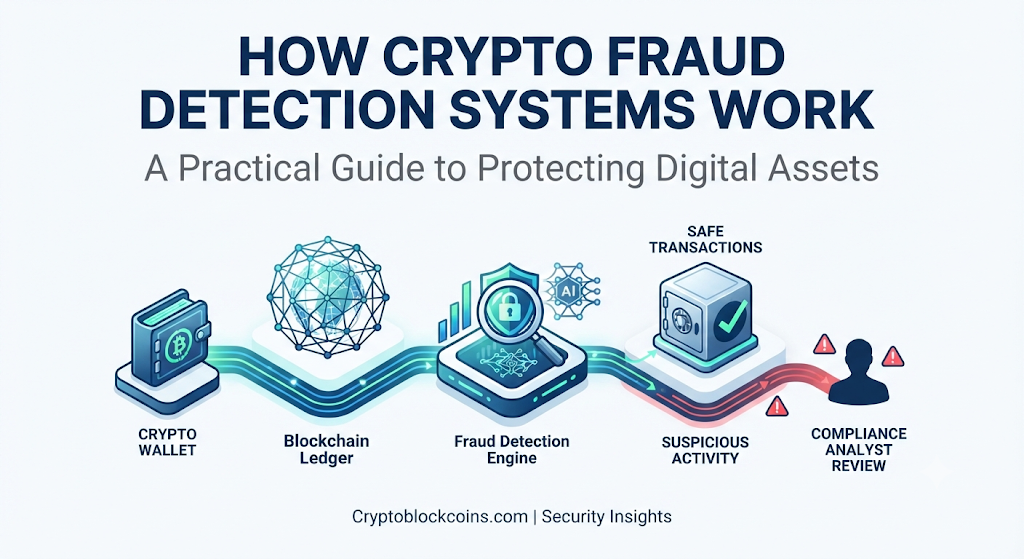
Most professional detection systems process data through four connected layers before allowing a high-value transaction to go through.
1. Data Collection and Wallet Clustering
First, the system pulls live data from multiple blockchains and pairs it with internal user logs. Because one person can create thousands of free wallet addresses, detection tools use wallet clustering—a method of grouping separate addresses that likely belong to the same owner.
For instance, if five different addresses all send small amounts of crypto into one single address to pay a transaction fee at the exact same moment, the software groups them together. This helps investigators map out entire criminal networks rather than chasing one random address at a time.
2. Risk Scoring and Address Screening
Next, the system checks the wallets involved against known threat databases. Security firms label millions of addresses tied to ransomware gangs, darknet markets, phishing scams, and sanctioned entities.
Every wallet receives a risk score—a number (often from 0 to 100) showing how likely it is that the funds are linked to illegal activity. If a user tries to deposit coins that recently passed through a known scam wallet, the risk score spikes.
3. Behavioral and Anomaly Detection
Static blacklists are not enough because criminals create brand-new wallets every day. To catch fresh attacks, systems use anomaly detection—software trained to spot behavior that breaks a user’s normal pattern.
Consider a user who normally buys $100 of Bitcoin once a month from a laptop in Mumbai. Suddenly, at 3:00 AM, their account sells all holdings, converts them to a privacy-focused asset, and requests a full withdrawal from an unrecognized browser. Even if the destination wallet has zero criminal history, the sudden behavior shift triggers an alert.
4. Automated Action and Human Review
Once the system calculates the risk, it takes one of three actions:
- Approve: Low-risk activity passes through immediately with zero delay.
- Step-up authentication: Medium-risk activity forces the user to complete an extra security check, such as a hardware security key tap or a live video check.
- Block and escalate: High-risk transfers are paused automatically and sent to a human compliance analyst—a trained investigator who reviews the evidence before deciding whether to release or freeze the funds.
Key Types of Crypto Fraud Detected
Different scams leave very different footprints. Good detection systems look for specific patterns tied to common attacks:
| Fraud Type | How It Happens | How Detection Systems Spot It |
| Account Takeover (ATO) | A thief steals a user’s login details via phishing or malware and drains the account. | Matches new IP addresses, unfamiliar device fingerprints, and sudden password or email changes right before a withdrawal. |
| Address Poisoning | A scammer sends a tiny dust transfer from a wallet that looks nearly identical to one you used recently, hoping you copy the wrong address later. | Flags zero-value or tiny transfers from newly created wallets whose first and last characters mimic a user’s frequent contacts. |
| Rug Pulls and Scam Tokens | Creators launch a fake token, hype the price, and suddenly drain all liquidity or lock buyers from selling. | Scans smart contract code for hidden mint functions, disabled sell buttons, or single wallets holding most of the token supply. |
| Pig Butchering Scams | Scammers build fake romantic or business trust over weeks and convince victims to send crypto to a fake trading site. | Identifies victim accounts making repeated, escalating deposits to newly flagged scam clusters after long periods of normal activity. |
| Peel Chains (Laundering) | Criminals move a large pile of stolen crypto through dozens of wallets, peeling off small amounts at each step to cash out quietly. | Traces automated splitting patterns where one large balance repeatedly sends a small slice to an exchange and the rest to a fresh wallet. |
Practical Examples in Action
Example 1: Stopping an Account Takeover
Maya is a salaried investor who uses a crypto exchange every payday. One evening, she clicks a fake email link and enters her password on a lookalike website. Within seconds, an attacker logs into Maya’s real account from a data center server and tries to withdraw her entire balance.
The fraud system notices three red flags at once: a data center IP address, a brand-new browser fingerprint, and a withdrawal request happening 40 seconds after login. Instead of sending the coins, the system locks the withdrawal and sends Maya an urgent alert on her registered phone. Her funds stay safe.
Example 2: Flagging Indirect Exposure on a DeFi App
A small business accepts stablecoin payments from overseas clients. One client pays an invoice using a wallet that looks clean on the surface. However, the payment gateway’s on-chain tool traces the coins three hops backward and discovers they came from a hacked decentralized exchange two days earlier.
Because of indirect exposure—receiving funds that passed through a criminal wallet a few steps earlier—the system flags the deposit for review. The business holds off on shipping the order until compliance checks confirm whether the client is an innocent buyer or part of the laundering chain.
Trade-Offs: Rule-Based Systems vs. Machine Learning
Platforms rarely rely on a single method to catch fraud. Instead, they balance two main approaches, each with clear strengths and weaknesses.
Rule-Based Systems
These use fixed “if-this-then-that” instructions written by security experts. For example: “If a user changes their two-factor authentication and withdraws over $5,000 within 10 minutes, freeze the transfer.”
- Advantages: Easy to understand, fast to run, and simple to explain to regulators.
- Limitations: Rigid. Once criminals learn a rule, they adjust their behavior—such as withdrawing $4,900 instead—to slip right past it.
Machine Learning (ML) Models
These systems study millions of past transactions to learn subtle patterns of fraud on their own, adapting as new attack styles appear.
- Advantages: Catches complex, hidden patterns that human rule-writers would never think of, such as coordinated bot rings.
- Limitations: Expensive to build, requires massive amounts of clean historical data, and can act like a “black box” where investigators struggle to see why a specific user was flagged.
Most reliable platforms start with strict rules for obvious threats and layer machine learning on top to catch evolving scams.
Common Mistakes Platforms and Users Make
Even strong detection systems fail when people misunderstand how they work.
- Blocking too aggressively (High false positives): Platforms sometimes set risk thresholds too low out of fear of regulators. This freezes innocent users’ accounts over harmless actions, like using a VPN while traveling. Users get frustrated and leave. Instead, teams should use step-up verification for medium-risk alerts rather than instant account bans.
- Checking only direct wallet neighbors: Beginners building basic screening tools often check only whether the immediate sending wallet is on a blacklist. Criminals easily defeat this by passing stolen coins through two empty “burner” wallets first. Effective screening traces at least three to five hops backward.
- Ignoring smart contract risk: Focusing only on wallet addresses misses malicious smart contracts—programs on the blockchain designed to drain user wallets the moment they click “Approve.” Detection must inspect contract permissions, not just wallet balances.
- Assuming privacy tools guarantee safety—or guilt: Some users think using a privacy mixer hides funds forever, while some platforms automatically ban every user who ever touched one. In reality, investigators can often trace funds entering and exiting mixers using timing and amount patterns, while legitimate users sometimes use privacy tools for personal safety.
Risks, Limitations, and Failure Modes
No crypto fraud detection system catches 100% of attacks. Anyone using or building these tools must plan for real-world failure points:
- Zero-day exploits: When a hacker discovers a brand-new bug in a protocol, the attacker’s wallet has zero prior history. Until security researchers label the address, automated blacklists will treat it as clean.
- Cross-chain bridge blind spots: Criminals frequently move stolen assets across cross-chain bridges—tools that convert tokens from one blockchain (like Ethereum) to another (like Solana). If a detection tool only watches one blockchain, the trail goes cold at the bridge.
- Data labeling errors: If an analytics provider mistakenly tags a legitimate merchant wallet as a scam address, downstream exchanges may unfairly freeze thousands of innocent customer deposits.
- Latency under heavy load: During market crashes, transaction volume surges. If a detection engine takes too long to score transactions, either legitimate trades fail due to timeouts or platforms temporarily weaken checks to keep systems running.
How to Evaluate or Choose a Detection Approach
If you are a builder, business owner, or technical lead selecting a fraud detection setup, follow these steps:
- Define your exposure: A non-custodial wallet app mainly needs phishing domain warnings and malicious smart contract alerts. A regulated exchange holding customer cash needs full AML transaction monitoring and login security.
- Check multi-chain coverage: Confirm the tool tracks all blockchains, layer-2 networks, and cross-chain bridges your users actually use.
- Test false-positive rates: Ask providers how often their system flags clean transactions and how customizable the risk thresholds are.
- Verify response speed: For live trading or instant payments, on-chain and off-chain checks must finish in under a second so users do not abandon checkout.
- Plan for human review: Software only raises flags; trained staff must investigate edge cases. Factor the ongoing cost of compliance analysts into your budget alongside software licensing fees.
Practical Safety Checklist for Everyday Crypto Users
While platforms run heavy backend detection, individual investors can prevent most fraud before it reaches a blockchain:
- Verify full wallet addresses: Check the first six and last six characters before sending funds to avoid address poisoning traps.
- Use hardware security keys: Replace SMS two-factor codes with a physical security key or authenticator app to block SIM-swap account takeovers.
- Revoke old token approvals: Regularly check and cancel unused smart contract permissions on your wallet so an old, compromised app cannot drain your tokens later.
- Test with a small transfer first: Send a tiny test amount before moving large sums to a new address or exchange.
- Pause on urgent messages: Treat any message claiming your wallet is “compromised” and asking you to connect to a verification link as a phishing scam.
Key Terms
- AML (Anti-Money Laundering): Laws and procedures requiring financial platforms to detect and report suspicious funds linked to criminal activity.
- Address Poisoning: A scam where attackers send tiny transactions from lookalike wallet addresses to trick users into copying the wrong address from their history.
- Anomaly Detection: Software that spots unusual user actions—like strange login locations or sudden large withdrawals—by comparing them against normal habits.
- Cross-Chain Bridge: A service that lets users transfer tokens or data from one independent blockchain network to another.
- False Positive: When a security system wrongly flags a safe, legitimate transaction or user as fraudulent.
- Off-Chain Monitoring: Tracking user behavior outside the blockchain, such as device data, IP addresses, and login speed.
- On-Chain Analytics: Inspecting public blockchain records to trace where digital assets move and identify wallets linked to known entities.
- Peel Chain: A laundering technique where a large amount of stolen crypto is moved through many wallets, peeling off small portions at each step.
- Risk Score: A numerical rating given to a wallet or transaction to estimate the likelihood of fraud or illegal origin.
- Wallet Clustering: Grouping multiple blockchain addresses together based on transaction patterns that show they are controlled by the same person or group.
Frequently Asked Questions
Can crypto fraud detection systems recover stolen cryptocurrency?
No. Detection systems can only identify, flag, and trace stolen funds. Once a transaction is confirmed on a public blockchain, it cannot be reversed. However, if a detection system alerts a centralized exchange before the thief cashes out, the exchange can freeze the account so law enforcement can pursue recovery.
How can systems track fraud if crypto wallets are anonymous?
Most blockchains are pseudonymous, not truly anonymous. While your wallet address does not display your name, every transaction is recorded publicly forever. Once a wallet interacts with a regulated exchange that requires identity verification, or exhibits clear clustering patterns, investigators can connect the dots.
Why did an exchange freeze my account when I did nothing wrong?
This usually happens due to a false positive or indirect exposure. For example, if you sold an item peer-to-peer and the buyer paid you with coins that came from a scam two transactions earlier, the exchange’s automated system may temporarily pause your account while a compliance officer reviews the trail.
Do decentralized finance (DeFi) platforms use fraud detection?
Yes, though differently than centralized exchanges. Because DeFi protocols do not hold user accounts or passwords, they focus on front-end wallet screening—blocking known sanctioned addresses from connecting to their website—and smart contract security monitoring to detect exploits in real time.
What is the difference between KYT and KYC?
KYC (Know Your Customer) checks a person’s real-world identity when they sign up for a platform using documents like a passport. KYT (Know Your Transaction) continuously monitors the crypto transactions moving in and out of wallets to spot suspicious behavior after onboarding is complete.
How fast do crypto fraud detection systems work?
Modern API-based screening tools evaluate wallet risk scores and login anomalies in milliseconds. This allows exchanges and payment processors to approve safe transactions instantly while holding back high-risk transfers before they broadcast to the blockchain.
Can criminals bypass crypto fraud detection using mixers or privacy coins?
Privacy tools make tracing harder, which is why many regulated exchanges treat funds coming directly from mixers as high risk and require extra verification. Furthermore, investigators often use timing analysis and behavioral clues to trace funds even after they pass through privacy tools.
Are free blockchain explorers the same as fraud detection systems?
No. A public block explorer lets anyone view raw transactions and balances, much like reading a public receipt book. Fraud detection systems layer massive databases of labeled criminal wallets, clustering algorithms, and real-time login analytics on top of that raw data to spot threats automatically.
Conclusion
Crypto fraud detection systems bridge the gap between open, irreversible blockchains and the real-world need for security. By combining on-chain transaction tracing with off-chain behavioral checks, these tools catch account takeovers, expose laundering trails, and protect everyday users from interacting with known scams.
Still, no automated tool is perfect. False positives can inconvenience honest users, and fast-moving attackers constantly test new blind spots across cross-chain bridges and smart contracts. Platforms get the best results when they pair smart automation with clear human review, while individual investors stay safest by practicing basic wallet hygiene—verifying addresses, securing logins, and questioning urgent links before signing any transaction.