Introduction
Every technology team will face an incident sooner or later. A service slows down, a database fills up, a release goes wrong, or a partner system stops responding. What separates strong teams from weaker ones is not that they avoid every problem. It is how they notice, handle, and learn from problems.
For platforms that hold or move digital assets, such as exchanges, wallets, and payment services, the stakes are higher than usual. Many actions on a blockchain cannot be reversed once they are confirmed. A security weakness and a reliability problem can look similar at first. Customers expect accurate information quickly, and they notice silence.
An incident management maturity model gives teams a way to describe how well they handle these moments today and what to improve next. This article follows the life of an incident from first signal to final lesson. At each step, it explains what good practice looks like, what teams often miss, and how to move forward. It is written in plain language for engineers, managers, and technology leaders, and it contains no code.
What Is an Incident, and What Is Maturity?
An incident is an unplanned event that harms, or could harm, the service your users depend on. It might be a full outage, a slow response, wrong data, or a security concern.
Maturity describes how reliable and repeatable your response is. A team with low maturity depends on a few heroic individuals and improvised choices. A team with higher maturity has shared habits: clear roles, tested procedures, honest communication, and a routine for learning.
Maturity is not about having the most tools or the longest documents. It is about whether your habits work under pressure.
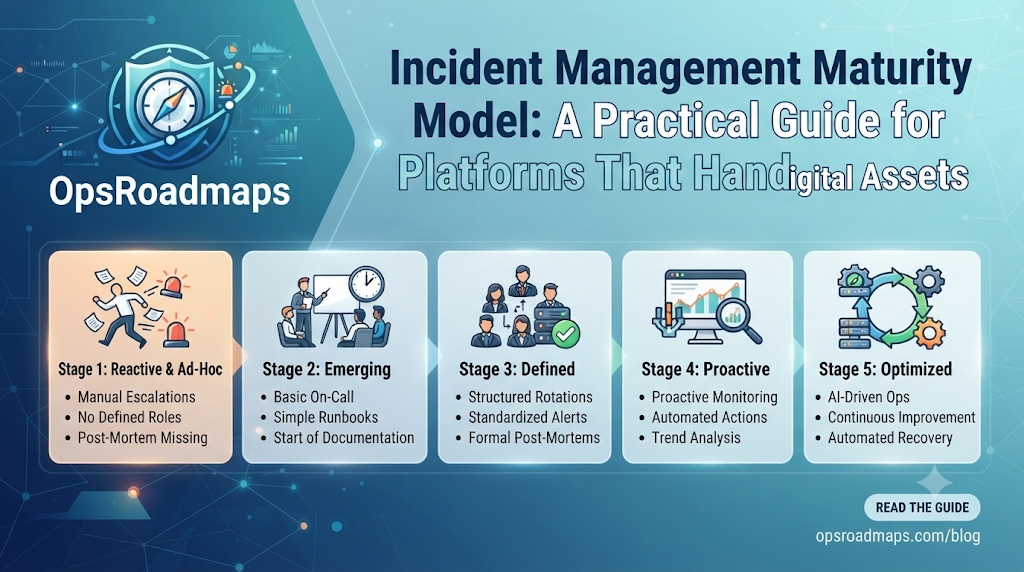
An Illustrative Ladder
The stages below are a teaching tool. They are not the official levels of any platform or standard. Different frameworks define their own stages and scoring, so always read the definitions before comparing results.
| Stage | How incidents are handled |
|---|---|
| 1. Ad hoc | Response depends on who happens to notice; no written process |
| 2. Defined | Basic roles, a contact list, and simple procedures exist |
| 3. Practiced | Procedures are tested through drills; reviews happen after serious incidents |
| 4. Measured | The team tracks detection time, recovery time, and repeat problems |
| 5. Learning | Reviews drive real changes, and lessons spread across teams |
A single organization can sit at different stages for different services. A busy core service may be at Stage 3 while a newer internal tool is still at Stage 1.
Step One: Detection
What good looks like: The team finds out about a problem before customers report it. Alerts are tied to what users experience, such as failed transfers or delayed confirmations, not just to server health.
What is often missing: Alerts that fire constantly, or not at all. Teams also forget to watch the systems they depend on, such as outside blockchain data providers, node services, and payment partners.
How to improve: Strong visibility is the foundation. An observability maturity model can help you describe your progress in measurement, logging, and tracing. Without good signals, every later step becomes slower.
Step Two: Triage and Severity
Once an alert arrives, someone must decide how serious it is. A shared severity scale removes guesswork and arguments.
| Severity | Plain description | Typical response |
|---|---|---|
| Critical | Customers cannot complete key actions, or there is a possible security risk or loss of funds | Immediate, with leadership informed |
| High | Important features are degraded for many users | Fast response, active updates |
| Medium | A limited impact or a workaround exists | Handled in working hours |
| Low | Minor issue with no clear customer effect | Tracked and scheduled |
The exact definitions should be written by your team and agreed in advance. For digital-asset platforms, many teams treat anything that might involve unauthorized access or unexpected movement of funds as the highest level until it is proven otherwise. This is a cautious habit, not a rule from any regulator.
Step Three: Roles and Coordination
Chaos grows when many people try to do everything at once. Mature teams assign clear roles for each serious incident:
- Incident lead: Directs the response and makes decisions. This person usually does not do the hands-on fixing.
- Technical responders: Investigate and carry out fixes.
- Communications owner: Updates customers, support staff, and leaders.
- Scribe: Records what happened and when, which makes the later review far easier.
In a small team, one person may hold more than one role. The key is that every role has an owner, even for a short time.
A shared channel, such as one chat room or call for each incident, keeps information in one place. Side conversations should be summarized back into it.
Step Four: Investigation and Runbooks
A runbook is a short, tested guide for a known problem. Good runbooks save minutes when minutes matter.
Useful topics for runbooks include containers that keep restarting, a message queue falling behind, a database that slows down, and a cloud service failing in one region. Teams using Kubernetes should document Kubernetes CrashLoopBackOff troubleshooting. CrashLoopBackOff is a status showing that a container starts, fails, and tries again. A sound runbook tells the responder to read the pod’s status, events, and earlier logs before changing anything.
Runbooks should clearly separate two kinds of actions:
- Read-only checks, which look at the system without changing it.
- Actions that change production, such as reverting a release, restarting services, or moving traffic.
The second kind should include a note about who must approve it and what impact to expect. Never improvise destructive actions during a stressful moment.
If the incident touches keys, wallets, or signing systems, the runbook should also include security-specific steps and name the people allowed to act. These procedures are best prepared in calm times and reviewed by security staff.
Step Five: Communication
Silence during an incident damages trust more than a clear, honest update. Good communication has a few features:
- Early acknowledgment. Tell users you are aware of the problem, even before you know the cause.
- Regular updates. Share status at steady intervals, even if the message is “no change yet.”
- Plain language. Describe the impact, not the internal details.
- No guesses presented as facts. Say what is confirmed and what is still under review.
- Coordinated legal and compliance input where your sector requires it.
Prepare message templates in advance so the team is not writing from scratch under pressure.
Step Six: Recovery and Verification
Restoring service is not the same as being finished. A mature team confirms that:
- Customers can complete the affected actions again.
- Data is correct, and any delayed or queued work has been handled safely.
- Monitoring shows normal behavior for a meaningful period.
- Any temporary fixes are recorded so they are not forgotten.
For platforms that process digital-asset transactions, reconciliation matters. This means checking that internal records match the outside records, so that nothing is missed or counted twice.
Step Seven: Learning
The review after an incident is where maturity grows. A blame-free review asks what happened, why did our systems and habits allow it, and what will we change? It does not ask who made the mistake?
A useful review produces:
- A clear timeline of events.
- The factors that contributed, both technical and human.
- A short list of specific actions, each with an owner and a due date.
- A plan to check later whether those actions were completed and worked.
The most common failure is a review that produces a document and no change. Tracking completion of actions is where many teams improve fastest.
Where Security and Reliability Meet
For platforms that deal with digital assets, incident response overlaps with security work. A DevSecOps implementation roadmap helps place security checks inside everyday engineering, so fewer incidents start with a preventable weakness. Teams should also decide in advance how a security incident differs from an ordinary outage, who leads each type, and when outside experts or authorities need to be informed. Rules vary by region and license, so legal and compliance staff should guide this part.
Building the Improvement Plan
Knowing your stage is only useful if it leads to action. A practical plan follows five steps:
- Assess the current state. Review recent incidents and ask how each was found, handled, and reviewed.
- Find the gaps. Note missing roles, outdated runbooks, weak alerts, or reviews that led to no change.
- Set priorities. Rank gaps by customer impact, risk, effort, and dependencies.
- Plan the work. Assign owners and dates, and decide how success will be checked.
- Review regularly. Revisit the plan after major incidents and launches.
Dependencies set the order. You cannot practice good triage without reliable alerts. You cannot learn from incidents without a record of what happened. Larger programs, such as an SRE adoption roadmap or a platform engineering adoption roadmap, can add reliability targets and shared tooling once the basics are in place.
A Hypothetical Example
Imagine a small wallet service whose customers report delayed transaction confirmations. The team has no severity scale, so two engineers argue about whether the problem is serious. No one is assigned to update customers, so support staff guess. After the issue is fixed, no review is held.
After assessing their maturity, the team starts with three simple changes. They write a four-level severity scale, name an incident lead and a communications owner for each on-call shift, and schedule a blameless review for every high-severity event. Within a few months, they add alerts tied to confirmation delays and a runbook for the most likely cause.
These changes do not remove incidents. They make the next one calmer and shorter, and they make sure each one teaches the team something.
Measuring Progress Honestly
Useful measures include how long it takes to detect a problem, how long it takes to recover, how many incidents repeat, and what share of review actions are completed. Treat these as signals, not guarantees. A rising number of reported incidents can even be a good sign if it means the team is noticing more.
A self-assessment reflects what the team reports and can prove. It is not an independent audit, a formal certification, or a promise of compliance. Organizations in regulated sectors should treat outside reviews as a separate requirement. A production readiness assessment before a major launch can also confirm that monitoring, ownership, and recovery steps are in place.
Where OpsRoadmaps Fits
OpsRoadmaps is an engineering operations assessment and improvement platform. According to its published description, it offers a free operational health scan that needs no account, plus more detailed production readiness and reliability assessments for signed-in users. It uses published, versioned scoring rules with explainable results, and it distinguishes self-reported maturity from independent audits. Its library includes incident response procedures, troubleshooting runbooks, checklists, and roadmaps. A wider DevOps maturity assessment can show how incident handling connects to delivery, security, and cost. Teams that also want to manage spend can pair this work with a cloud cost optimization roadmap, and teams running containers can review a Kubernetes production readiness checklist alongside their runbooks.
Common Mistakes
- Relying on heroes. If only one person knows the fix, the team is fragile.
- Skipping drills. A runbook that was never tested may fail when needed.
- Treating reviews as paperwork. Reviews matter only when they change something.
- Under-communicating. Silence causes more harm than a short, honest update.
- Mixing up reliability and security response. They overlap but need different leads and steps.
- Chasing a score. A higher stage number means little if habits have not improved.
FAQs
1. What does an incident management maturity model measure?
It describes how well a team detects, responds to, communicates about, and learns from incidents, and how that ability grows over time.
2. Is it the same as a disaster recovery plan?
No. A disaster recovery plan focuses on restoring systems after a major failure. Incident management covers the wider range of events, from small slowdowns to serious outages.
3. How often should we run incident drills?
There is no fixed rule. Many teams run them regularly, and also after major changes to systems or staffing.
4. Who should lead a serious incident?
A trained incident lead, who is often not the person doing the hands-on fix. This keeps decisions and technical work separate.
5. How do we handle a suspected security incident?
Follow a separate, pre-agreed procedure led by security staff, with legal and compliance input where needed. Do not improvise.
6. Can a small team use this approach?
Yes. Roles can be shared and processes can be lighter, but the habits of clear ownership, honest updates, and learning still apply.
7. Will maturity guarantee fewer outages?
No. It improves your ability to detect, respond, and learn, but it cannot promise a particular result.
Conclusion
Incidents cannot be removed completely, but their damage can be reduced. For platforms that handle digital assets, where mistakes can be hard to undo and trust is fragile, a clear incident management maturity model gives teams a calm way to see where they stand. Begin with honest evidence from recent events, agree on severity levels and roles, prepare tested runbooks, communicate plainly, and make every review lead to action. Treat each stage as a guide for planning, and review your progress often. Teams that practice these habits are better prepared, not perfect, and that preparation is what customers feel when something goes wrong.