Introduction
Imagine depositing your savings into an online savings account that promises 20% yearly interest. Six months later, the website disappears, customer support goes silent, and the founders vanish with your money. When you call the police or a banking regulator, they tell you the company was never registered, and there is nothing they can do.
This scenario happens regularly in the world of unregulated crypto investments. Many beginners and everyday investors enter the cryptocurrency market hoping for fast growth. However, they often miss the massive difference between buying assets on a licensed, rule-following platform versus sending money to an unverified project or offshore website.
Understanding the risks of unregulated crypto investments is critical before you spend a single dollar. Beginners often confuse blockchain technology—which is secure by design—with the companies and people building on top of it. This guide explains what makes a crypto investment unregulated, how financial traps work behind the scenes, and the practical steps you can take to protect your money on Cryptoblockcoins.com.
What Are Unregulated Crypto Investments?
Unregulated crypto investments are digital asset products, tokens, or platforms that operate without oversight from government financial authorities. In traditional finance, agencies like the Securities and Exchange Commission (SEC) in the United States or the Financial Conduct Authority (FCA) in the United Kingdom enforce strict rules. They force companies to share honest financial reports, keep customer money separate from company funds, and follow anti-fraud laws.
When a crypto project or trading platform is unregulated, none of those safety nets exist. Anyone with basic coding skills and a marketing budget can launch a new token, build a lending website, or open an offshore exchange. Because no regulator checks their work, these operators do not have to prove they actually hold the money they claim to manage.
Regulated vs. Unregulated Crypto Platforms
To understand what you lose when you step outside regulated markets, compare how a licensed platform operates against an unregulated one.
| Feature | Regulated Crypto Platform | Unregulated Crypto Platform |
| Government Oversight | Must register with financial authorities and pass regular audits. | Operates without licenses, often from countries with weak laws. |
| Customer Fund Safety | Required to keep user money separate from business operating cash. | Can mix user deposits with company money or gamble them away. |
| Identity Checks (KYC) | Requires ID verification to prevent money laundering and fraud. | Often allows anonymous sign-ups with zero background checks. |
| Legal Recourse | Investors can sue in local courts or file regulator complaints. | Founders are often anonymous or unreachable across borders. |
| Truth in Marketing | Banned from promising guaranteed profits or hiding major risks. | Frequently uses fake endorsements and misleading return claims. |
How Unregulated Crypto Traps Work
Unregulated platforms attract investors by offering things that licensed companies cannot legally provide. These include extreme leverage (borrowing huge sums to trade), abnormally high interest rates on deposits, and early access to brand-new tokens.
Behind the scenes, many of these operations rely on fragile or dishonest setups. Because there is no independent auditor—an outside accounting expert who checks a company’s financial records—investors must blindly trust what they see on their screens.
For example, when you deposit funds into an unregulated exchange, the numbers on your screen are just entries in a private database. You do not actually hold the cryptocurrency in your own digital wallet. If the platform operator decides to use your coins to cover their own bad trades, you will not know until you try to withdraw your funds and the system blocks your request.
Why These Risks Matter to Everyday Investors
In traditional banking, if a bank fails, government programs like the Federal Deposit Insurance Corporation (FDIC) step in to refund customer deposits up to a legal limit. Stockbrokers also carry investor protection insurance.
In unregulated crypto markets, you are completely on your own. Crypto transactions are irreversible by design. Once you send digital coins to an external wallet address, no bank manager can cancel the transfer or reverse the charge. If a platform collapses or a founder steals the funds, your money is usually gone permanently.
Core Financial and Technical Risks to Understand
When you put money into unregulated crypto projects, you face several distinct dangers at the same time. Here is how each major risk works in practice.
1. Rug Pulls and Exit Scams
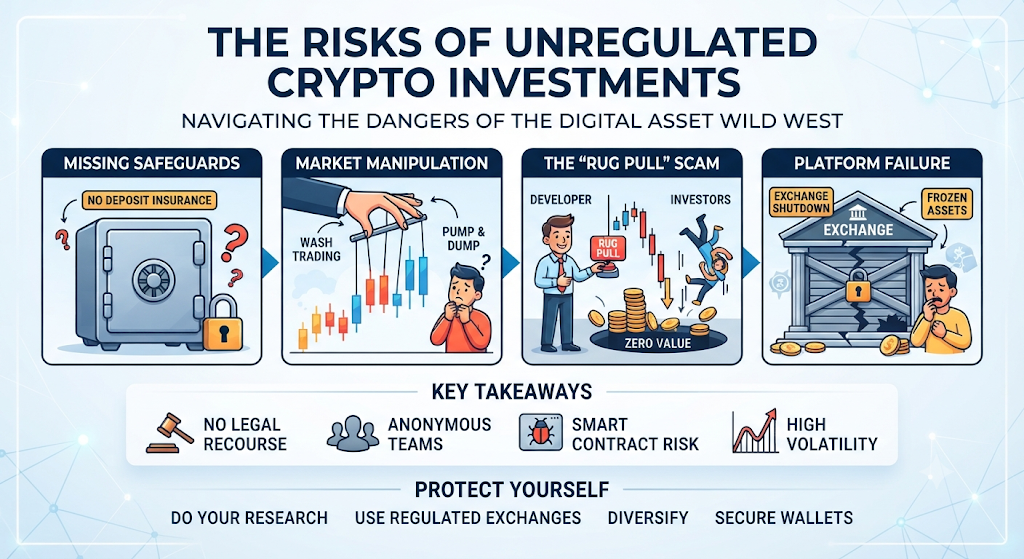
A rug pull happens when crypto developers create a new token, hype it up on social media to attract buyers, and then suddenly drain all the money out of the project’s trading pool.
- Why it matters: Investors are left holding worthless tokens that cannot be sold to anyone else.
- Example: A team launches a new gaming token. Once thousands of buyers trade their valuable coins for the new token, the developers use a hidden code function to withdraw all the valuable coins and delete their social media accounts.
2. Smart Contract Vulnerabilities
A smart contract is a self-executing program stored on a blockchain that automatically moves money when certain conditions are met. Unregulated decentralized finance (DeFi) apps rely entirely on smart contracts instead of human bankers.
- Why it matters: If the programmer makes a coding mistake, hackers can exploit that flaw to empty the entire system in seconds.
- Example: A new lending app skips paying for a professional code review to save money. A hacker spots a math error in the code and tricks the contract into sending them millions of dollars in user deposits.
3. Market Manipulation and Wash Trading
Wash trading is a fake trading activity where the same person or group buys and sells an asset repeatedly to create the illusion of high demand.
- Why it matters: It tricks beginners into thinking a token is popular and safe to buy, right before insiders dump their holdings.
- Example: An unregulated exchange uses automated trading bots to fake $50 million in daily trading volume for a tiny coin. A beginner sees the high volume, buys in, and watches the price crash 90% the next day when real buyers vanish.
4. Liquidity Freeze and Withdrawal Blocks
Liquidity refers to how easily an asset can be converted into cash without causing its price to drop sharply. Unregulated platforms often suffer from severe liquidity shortages during market downturns.
- Why it matters: Even if your account screen shows a profit, you cannot turn those numbers into real cash if the platform runs out of money.
- Example: During a sudden market drop, thousands of users try to withdraw their funds at once. Because the unregulated platform lent out user deposits to risky borrowers, it freezes all withdrawals and files for bankruptcy.
5. Lack of Custody Transparency
Custody means who holds and controls the private keys (secret passwords) to the cryptocurrency. In unregulated setups, custody rules are often vague or hidden in dense legal terms.
- Why it matters: If a company goes bankrupt, courts may rule that the crypto you deposited legally belongs to the company, not to you.
- Example: A user stores $10,000 worth of Bitcoin on an offshore yield app. The app goes bankrupt, and creditors claim the user’s Bitcoin to pay off the company’s corporate debts.
Practical Examples: How Investors Get Caught
Understanding theory is helpful, but seeing how these traps play out in real life makes them easier to spot.
Hypothetical Example 1: The High-Yield Staking Trap Sarah, a salaried office worker, wants to beat bank savings rates. She finds an unregistered website offering 35% annual returns if she locks up her stablecoins for six months. For the first three months, her dashboard shows steady daily profits. Encouraged, she deposits another $5,000. In month four, the website posts a message claiming “technical maintenance” has paused withdrawals. Two weeks later, the domain goes offline. Because the company operated anonymously from an unknown country, local police cannot trace the owners.
Hypothetical Example 2: The Influencer Meme Coin Alex, a college student, follows a popular finance influencer who promotes a brand-new token launching on a decentralized exchange. Alex buys $800 worth of the token. Within two hours, the price triples. However, when Alex tries to sell, the transaction fails repeatedly. The project creators programmed a hidden rule into the token’s smart contract—known as a honeypot—that allows anyone to buy the coin, but blocks everyone except the creators from selling it.
Common Mistakes Beginners Make
Even smart investors fall into avoidable traps when dealing with unregulated digital assets. Here are the most common errors and how to fix them.
- Confusing high returns with low risk: People assume a platform paying steady weekly rewards is safe because payments arrive on time. In reality, high yields in crypto almost always come from lending your money to high-risk borrowers or paying old investors with new investor deposits (a Ponzi scheme). Instead: Treat any guaranteed or unusually high return as a major warning sign.
- Trusting social media hype over verifiable data: Beginners often buy tokens because of viral posts or paid celebrity endorsements. Influencers are rarely vetted and often get paid to promote risky projects. Instead: Check independent blockchain data and verify whether a real, registered company stands behind the project.
- Leaving large balances on unregistered exchanges: Many traders keep all their coins on offshore platforms for convenience. If the exchange gets hacked or blocks your country’s IP address, you lose access instantly. Instead: Move long-term holdings to a self-custody wallet (a wallet where only you hold the secret recovery phrase).
- Ignoring legal jurisdiction: Users sign up for websites without checking where the company is legally based. When a dispute happens, they discover the company has no physical office or legal standing anywhere. Instead: Look up the company’s legal entity name and verify its registration on official government financial databases.
When Unregulated Platforms Are Strictly Unsuitable
While experienced blockchain developers sometimes interact with experimental, unregulated software tools using tiny amounts of test money, these environments are completely unsuitable for specific groups:
- Retirement or emergency savings: Never put money you cannot afford to lose into unverified crypto protocols.
- Passive beginners: If you do not know how to read basic blockchain transactions or verify smart contract permissions, avoid unregulated decentralized apps.
- Businesses managing operating cash: Companies face severe accounting, tax, and legal penalties if they store corporate funds on unlicensed platforms.
Decision-Making Framework Before Investing
Before putting money into any crypto platform or token, walk through these six practical steps to evaluate your risk:
- Verify regulatory status: Check if the platform is registered with your country’s primary financial regulator. Do not trust vague badges on a website’s footer; search the regulator’s official website directly.
- Identify the team behind the project: Look for real names, verifiable work histories, and a registered business address. Anonymous teams carry a much higher risk of walking away with investor money.
- Check independent security audits: If you are using a decentralized app, confirm that reputable cybersecurity firms have audited its smart contracts and published the full report publicly.
- Examine where the yield comes from: Ask how the platform generates profits. If they cannot explain their business model in clear, simple terms, your deposit is likely the product.
- Test withdrawals early: Before depositing a meaningful amount, deposit a small test sum and immediately withdraw it back to your personal wallet to verify the process works smoothly.
- Cap your exposure: Decide in advance the maximum amount you are willing to lose completely, and never exceed that limit regardless of price surges.
Pre-Investment Safety Checklist
Use this quick checklist before sending funds to any new crypto platform or token:
- I have confirmed whether the platform holds a valid license in my jurisdiction.
- I have verified the real-world identities of the founders or parent company.
- I understand exactly how the investment generates returns without relying on new buyer money.
- I have checked that the token can be freely sold (no honeypot restrictions).
- I am using a dedicated wallet with limited funds rather than my main savings wallet.
- I accept that if this platform fails or gets hacked, no government agency will refund my money.
Key Terms to Know
- Custodial Wallet: A crypto wallet managed by a third-party company, similar to a bank holding your money, where the company controls your private keys.
- Self-Custody (Non-Custodial) Wallet: A wallet where you alone hold the private keys and secret recovery phrase, giving you full control and full responsibility.
- Private Key: A secret cryptographic password that proves ownership of your crypto and allows you to spend or move it.
- Rug Pull: A scam where project creators abruptly abandon a crypto project and steal all pooled investor funds.
- Smart Contract: Automated computer code running on a blockchain that executes transactions without a human middleman.
- Stablecoin: A type of cryptocurrency designed to maintain a steady value by tying its price to a traditional currency like the US dollar.
- Wash Trading: Fake buying and selling by the same party to artificially inflate trading volume and trick investors.
- KYC (Know Your Customer): Legal identity verification rules requiring financial platforms to check government IDs before letting users trade.
Frequently Asked Questions
Are all cryptocurrencies unregulated?
No. While the underlying blockchain networks like Bitcoin operate without a central owner, the companies that let you buy, sell, and store crypto are regulated in many countries. Licensed exchanges must follow strict consumer protection, tax reporting, and anti-fraud laws.
Can I recover money lost in an unregulated crypto scam?
In most cases, no. Because blockchain transfers cannot be reversed and unregulated scammers often operate anonymously across international borders, law enforcement rarely recovers stolen funds. Be very careful of “crypto recovery services” online, as most of them are secondary scams targeting victims.
Why do unregulated crypto platforms offer much higher interest rates than banks?
Unregulated platforms do not have to maintain cash reserves, pay for deposit insurance, or follow strict lending limits. They often lend user deposits to high-risk traders or use aggressive marketing budgets to pay temporary rewards, which frequently collapse when market conditions tighten.
Is decentralized finance (DeFi) considered unregulated?
Most DeFi protocols operate without traditional corporate registration or government oversight. While the software code is transparent on the blockchain, users still face severe technical risks, including smart contract bugs, hacks, and zero customer support if something goes wrong.
How can I check if a crypto exchange is legally registered?
Visit the official website of your country’s financial regulator—such as the SEC or FinCEN in the US, the FCA in the UK, or FIU-IND in India—and search their public registry for the exact legal name of the company. Never rely solely on claims made on the exchange’s own website.
What happens to my crypto if an unregulated exchange goes bankrupt?
Your account is typically frozen immediately, and you become an unsecured creditor in a lengthy legal process. Bankruptcy proceedings can take years, and users often receive only a small fraction of their original deposit—or nothing at all—after legal fees are paid.
Are stablecoins safe on unregulated platforms?
Even if a stablecoin holds its value well, storing it on an unregulated platform puts you at risk. If the platform gets hacked, freezes withdrawals, or mismanages its reserves, you can lose your stablecoins just as easily as any other digital asset.
How do scammers hide malicious code in new tokens?
Developers can write rules into a token’s smart contract that allow them to mint unlimited new coins, block specific wallets from selling, or charge a 99% tax on sales. Automated token scanner tools can help detect some of these red flags before you buy.
Conclusion
Unregulated crypto investments strip away the basic protections that keep everyday investors safe in traditional finance. Without government oversight, audited financial statements, or deposit insurance, you carry 100% of the risk if a platform fails, gets hacked, or turns out to be a scam.
The most practical way to protect yourself is to stick to licensed, transparent platforms for buying and selling, and move long-term holdings into a self-custody wallet you control. Whenever an investment promises unusually high returns or hides behind anonymous founders, treat it as a clear signal to walk away. Start by auditing where your current crypto assets sit today, and make sure you hold the keys to anything you cannot afford to lose.