Introduction
Many people buy their first cryptocurrency believing it works like digital cash that no one can trace. They see a string of random letters and numbers instead of a name, and they assume their activity is private. Months or years later, some of those users receive unexpected tax notices or compliance questions from their banks, wondering how anyone connected their wallet to their real identity.
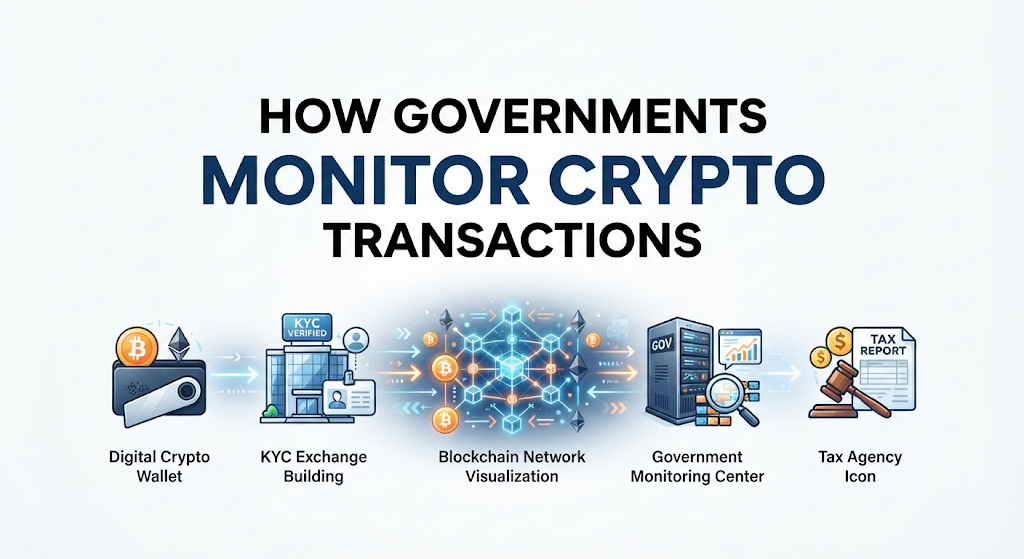
This confusion happens because people mix up anonymity with pseudonymity. Crypto networks do not put your name on a transaction, yet they broadcast every single transfer to millions of computers worldwide. Governments, tax agencies, and law enforcement units have spent years building systems to read those public records and match them to real people.
Understanding how this tracking works is essential for anyone holding, spending, or investing in digital assets. Poor understanding leads to expensive tax mistakes, frozen exchange accounts, and false assumptions about financial privacy. This guide explains the exact methods, laws, and software tools governments use to monitor crypto transactions, along with what those tools cannot do.
Core Concepts You Need to Know First
Before looking at government tracking methods, it helps to understand four basic terms that form the foundation of crypto monitoring.
Public Ledger (Blockchain)
- Simple meaning: A shared digital notebook that records every transaction and cannot be erased.
- Why it matters: Anyone with an internet connection can read this notebook for free. Governments do not need a warrant or special permission to view transaction histories on Bitcoin, Ethereum, or most major blockchains.
- Example: If Wallet A sends 1 Bitcoin to Wallet B, anyone using a free website called a block explorer can see the exact amount, date, and time of that transfer.
Pseudonymity
- Simple meaning: Using a fake name or code name instead of your real identity.
- Why it matters: Crypto wallets use public addresses (long strings of characters) instead of your legal name. You are hidden only until someone links that code name to your real-world identity.
- Example: An author writing under a pen name is pseudonymous. Once a publisher reveals the author’s real name, every book written under that pen name is immediately connected to them.
Know Your Customer (KYC)
- Simple meaning: Legal rules that force financial companies to verify the real identity of their users.
- Why it matters: KYC is the main bridge between the anonymous crypto world and the real world. Regulated crypto exchanges must collect your government ID, address, and sometimes a live selfie before letting you deposit or withdraw money.
- Example: When you open an account on Coinbase, Kraken, or Binance and upload your passport, the exchange links your legal name to every wallet address you use on their platform.
On-Ramps and Off-Ramps
- Simple meaning: The entry and exit points where traditional government money (like US dollars or euros) turns into crypto, or crypto turns back into cash.
- Why it matters: Governments control the traditional banking system. By monitoring the banks and exchanges at these entry and exit points, authorities see who is moving money into and out of crypto.
- Example: Transferring $500 from your Chase bank account to buy Ethereum is using a fiat on-ramp.
How Governments Monitor Crypto Transactions
Governments do not rely on a single tool to watch crypto networks. Instead, they use a multi-layered approach that combines banking laws, international agreements, and advanced computer programs.
1. Enforcing KYC and Anti-Money Laundering (AML) Laws
The easiest way for a government to track crypto is to regulate the businesses that handle it. In most countries, crypto exchanges are classified as financial institutions or Virtual Asset Service Providers (VASPs).
Under Anti-Money Laundering (AML) laws—rules designed to stop criminals from hiding illegal money—exchanges must record who their customers are and monitor their activity. If a user makes unusually large transfers or interacts with flagged wallets, the exchange must file a Suspicious Activity Report (SAR) directly with government financial intelligence units, such as FinCEN in the United States.
2. Using Blockchain Analytics Software
Government agencies rarely trace transactions manually. Instead, they purchase licenses for specialized blockchain analytics software from companies like Chainalysis, Elliptic, and TRM Labs.
These tools scan entire blockchains 24 hours a day. They label millions of wallet addresses belonging to exchanges, merchants, darknet markets, hackers, and scam operations. When an investigator enters a single wallet address into the software, the program generates a visual map showing where the funds came from and where they went, even across dozens of intermediate wallets.
3. Applying Wallet Clustering Heuristics
One of the smartest techniques used by analytics companies is clustering—grouping multiple wallet addresses together to prove they belong to the same person or company.
Software looks for common patterns in how people spend crypto:
- Common-input-ownership heuristic: If a single Bitcoin transaction pulls funds from three different wallet addresses to pay one recipient, the software assumes all three addresses belong to the same owner.
- Change address detection: When you send crypto, your wallet often sends the leftover balance back to a brand-new “change” address you control. Analytics tools spot which output is the payment and which is the change, linking the new address to your old one.
4. Enforcing the FATF Travel Rule
The Financial Action Task Force (FATF) is a global watchdog that sets anti-money laundering standards for over 200 countries. One of its strict requirements is the Travel Rule.
Under the Travel Rule, when a regulated exchange sends crypto worth above a certain threshold (often $1,000 or €1,000, though some regions apply it to all transfers) to another exchange, both companies must share the sender’s and receiver’s real names and account details. This closes the gap when funds move between different platforms or across international borders.
5. Mandatory Tax Reporting and Subpoenas
Tax authorities like the IRS in the United States, HMRC in the UK, and tax agencies across the European Union require exchanges to report user activity.
In the US, brokers must issue tax forms (such as Form 1099-DA) showing customer proceeds from digital asset sales. Globally, the Crypto-Asset Reporting Framework (CARF) allows tax agencies in different countries to automatically share crypto transaction data about each other’s citizens. When investigating specific crimes, courts also issue subpoenas—legal orders forcing exchanges, internet providers, and tech companies to hand over IP addresses, login times, and device records.
| Monitoring Method | What It Captures | Who Uses It | Main Limitation |
|---|---|---|---|
| KYC / Exchange Records | Real name, ID, bank account, deposit/withdrawal history | Tax agencies, police, regulators | Only covers regulated platforms; misses peer-to-peer cash trades |
| Blockchain Analytics | Full path of funds, wallet clusters, links to known entities | Law enforcement, exchanges, intelligence units | Relies on probabilities; can mislabel wallets if patterns are unclear |
| The Travel Rule | Sender and receiver identities across different exchanges | Global financial regulators, VASPs | Does not apply well to self-custody (unhosted) wallets |
| Network / IP Tracking | Physical location and internet connection of wallet users | Cybercrime units, intelligence agencies | Blocked easily by VPNs or privacy networks like Tor |
Why This Matters to Everyday Crypto Users
You do not need to be doing anything illegal for government monitoring to affect you. Understanding these systems protects you from everyday operational and financial headaches.
- Accurate tax reporting: Tax agencies receive summary reports from exchanges. If you move coins between your own wallets and an exchange misreads that transfer as a sale, you could be billed for taxes you do not owe unless you keep clear records.
- Avoiding tainted funds: If you accept crypto directly from a stranger for freelance work or selling an item, and those coins came from a hacked exchange, depositing them into your regulated account can trigger an automatic freeze.
- Protecting your personal safety: Because public blockchains show exact balances, anyone who links your name to your wallet can see how much money you hold.
Practical Examples of How Tracking Works
Example 1: The Salaried Investor and Tax Filing
Imagine Alex, a salaried worker, buys $2,000 worth of Bitcoin on a regulated exchange using a bank transfer. The exchange verifies Alex’s driver’s license. Alex then sends that Bitcoin to a personal hardware wallet to hold for two years. Later, Alex sends the Bitcoin to a different exchange to sell it for cash.
Even though Alex used a personal wallet in the middle, both exchanges know Alex’s real identity. Blockchain analytics software easily connects the withdrawal from Exchange A, through the hardware wallet, to the deposit on Exchange B. When tax season arrives, the tax agency already has records of the sale and expects Alex to report any capital gains.
Example 2: Tracing Stolen Funds Across Chains
Suppose a hacker steals $500,000 in Ethereum from a decentralized app. To hide the trail, the hacker swaps the Ethereum for another token and moves it across a cross-chain bridge—a tool that transfers value from one blockchain to another, such as from Ethereum to Solana.
In the past, switching blockchains broke the trail. Today, modern analytics software tracks cross-chain bridges automatically. Investigators watch the funds enter the bridge on Ethereum, match the exact amount and timing exiting on Solana, and wait until the hacker eventually sends a portion to a regulated exchange to cash out. At that moment, the exchange freezes the account and alerts authorities.
Real-World Considerations: Trade-Offs and Limitations
While government surveillance tools are powerful, they are not all-seeing. Experienced investigators and compliance officers deal with clear technical limits every day.
Privacy Coins and Mixing Services
Certain cryptocurrencies, such as Monero (XMR), are built specifically to hide transaction details. Monero uses cryptographic techniques like ring signatures and stealth addresses to conceal the sender, receiver, and amount on the public ledger. Because of this, standard blockchain tracing tools struggle to follow Monero transactions.
Similarly, crypto mixers (or tumblers) pool funds from many users together and send out clean coins to new addresses, breaking the direct link between sender and receiver. Governments respond to these tools not by breaking the math, but by banning regulated exchanges from listing privacy coins and sanctioning major mixing services, making it hard to convert those funds back into normal bank money.
Self-Custody and Peer-to-Peer (P2P) Transfers
When two people trade crypto directly using self-custody wallets—wallets where only the user holds the private keys—no bank or exchange sits in the middle. If neither person ever touches a regulated exchange or links their wallet address to a social media profile or public website, linking those addresses to real identities becomes very difficult.
Probabilistic Guesswork vs. Proof
Blockchain clustering relies on smart assumptions, not absolute certainty. For example, a technique called CoinJoin allows multiple unrelated people to combine their Bitcoin payments into a single transaction. This breaks the common-input-ownership rule and can confuse automated tracking tools. In court, prosecutors cannot rely on software labels alone; they must back up blockchain maps with bank records, exchange subpoenas, or device seizures.
Common Mistakes Crypto Users Make
Many beginners accidentally expose their entire financial history or trigger compliance flags through simple habits.
1. Reusing the Same Wallet Address
- What people do: Use one single Ethereum or Bitcoin address for every payment, paycheck, and exchange withdrawal.
- Why they do it: It is convenient and easy to copy-paste one saved address.
- Why it causes problems: Anyone who sends you money—or receives money from you—can look up that address and see your total net worth and every past transaction.
- What to do instead: Use a modern wallet that automatically generates a fresh receiving address for every transaction, and separate long-term savings wallets from daily spending wallets.
2. Posting Wallet Addresses Publicly
- What people do: Share their wallet address or ENS name (like
name.eth) on social media bios, forums, or public donation pages. - Why they do it: To receive tips, prove ownership of digital collectibles, or verify identity.
- Why it causes problems: This permanently ties your public online identity to your blockchain history, making it effortless for data brokers, scammers, and authorities to index your activity.
- What to do instead: Keep public-facing wallets completely separate from your main holdings, with minimal funds inside.
3. Ignoring Record-Keeping for Wallet Transfers
- What people do: Move crypto between multiple personal wallets and exchanges without writing down what each transfer was for.
- Why they do it: They assume exchanges track everything automatically.
- Why it causes problems: Exchanges only see funds leaving or arriving; they do not know if a transfer was a gift, a payment, or just moving money to your own hardware wallet. This leads to overpaying taxes or failing an audit.
- What to do instead: Maintain a simple log or use portfolio tracking software to label internal transfers between your own wallets.
4. Accepting Direct Payments Without Checking Source Risk
- What people do: Accept crypto directly into their primary exchange account from unverified buyers on peer-to-peer marketplaces.
- Why they do it: To save on network transfer fees by skipping a personal wallet.
- Why it causes problems: If the buyer’s wallet is flagged for fraud or sanctions, your exchange may lock your account immediately for receiving high-risk funds.
- What to do instead: Receive peer-to-peer payments into a separate self-custody wallet first, and only deal with reputable counterparties.
Practical Compliance and Privacy Checklist
Use this checklist to manage your crypto transactions safely and avoid unnecessary compliance issues:
- Separate your wallets: Keep one wallet for long-term storage, one for daily apps/spending, and a clean address for interacting with exchanges.
- Track cost basis: Record the date, USD/local currency value, and purpose every time you buy, sell, or swap crypto.
- Use fresh addresses: Generate a new receiving address for each incoming payment whenever your wallet supports it.
- Verify counterparties: Avoid receiving funds directly from unknown sources into a regulated exchange account.
- Keep exchange accounts updated: Ensure your KYC details are accurate so withdrawals are not delayed during routine security reviews.
- Review local tax rules: Check whether crypto-to-crypto swaps and staking rewards count as taxable events in your country.
Key Terms to Remember
- Blockchain Explorer: A free search engine (like Etherscan or Mempool.space) that lets anyone view live and past transactions on a public blockchain.
- Block Confirmation: The process of network computers verifying a transaction and locking it permanently into the ledger.
- Chainalysis / Elliptic: Leading private software companies that build blockchain tracking tools for governments, banks, and crypto exchanges.
- Cross-Chain Bridge: A service that locks tokens on one blockchain and mints equivalent tokens on another network.
- Custodial Wallet: A wallet where a third party, such as a crypto exchange, holds your private keys and manages your funds.
- Heuristic: An educated rule of thumb used by computer algorithms to spot patterns and group related wallet addresses together.
- IP Address: A unique numerical label assigned to your internet connection that can reveal your approximate geographic location.
- Mixer (Tumbler): A service that blends cryptocurrencies from many users to obscure the original source of the funds.
- Self-Custody (Non-Custodial) Wallet: A wallet where only you hold the secret recovery phrase and private keys, with no company in control.
- Suspicious Activity Report (SAR): A confidential report that banks and exchanges must file with government authorities when a customer’s transactions look unusual or potentially illegal.
- Travel Rule: A global regulation requiring crypto businesses to share sender and receiver identity details when transferring funds between platforms.
- Virtual Asset Service Provider (VASP): The official regulatory term for any business that exchanges, transfers, or holds crypto on behalf of customers.
Frequently Asked Questions (FAQs)
1. Can the government see my crypto in a hardware wallet like Ledger or Trezor?
A hardware wallet only stores your private keys offline; your coins actually live on the public blockchain. Governments cannot access your hardware wallet device, but anyone can view the balance and transaction history of the public addresses connected to it. If you funded that hardware wallet from a KYC exchange, authorities can easily link it to you.
2. Are crypto-to-crypto swaps tracked even if I do not cash out to my bank?
Yes. On centralized exchanges, every trade is logged under your verified account and reported to tax authorities in many jurisdictions. On decentralized exchanges (DEXs), every swap is recorded permanently on the public blockchain and can be traced back to your wallet address.
3. Does using a VPN hide my crypto transactions from the government?
No. A VPN hides your IP address from websites and internet providers, which helps protect your network privacy. However, a VPN does nothing to hide transactions recorded on a public blockchain, nor does it remove the identity documents you submitted to a regulated exchange.
4. How do tax agencies know if I own crypto on a foreign exchange?
Through international data-sharing treaties and the Crypto-Asset Reporting Framework (CARF). Over 50 countries have agreed to collect crypto transaction data from exchanges operating within their borders and automatically share that information with the user’s home country tax authority.
5. Can governments freeze crypto inside a self-custody wallet?
Governments cannot directly freeze a truly decentralized asset like Bitcoin inside a self-custody wallet without your private keys. However, centralized stablecoin issuers (such as Tether for USDT or Circle for USDC) have built-in admin functions that allow them to freeze specific wallet addresses when ordered by law enforcement.
6. Why do banks sometimes block transfers to crypto exchanges?
Banks follow strict anti-money laundering and fraud prevention rules. If a bank sees sudden, large transfers to an exchange—or notices an exchange has weak compliance controls—it may block the transfer to protect against scams or regulatory penalties.
7. Is Monero completely untraceable by governments?
Monero hides sender, receiver, and amount details on the blockchain, making standard ledger tracing ineffective. However, law enforcement can still investigate Monero users through off-chain evidence, such as exchange login records, IP leaks, undercover purchases, or device seizures.
8. How far back can blockchain analytics trace transactions?
All the way back to the very first block created on that network. Because blockchains never delete old records, a transaction made ten years ago can still be analyzed today using modern clustering tools.
Conclusion
Governments monitor crypto transactions not by breaking encryption, but by watching the public ledger and regulating the gateways where crypto meets traditional money. Public blockchains provide a permanent record of every transfer, KYC exchanges connect real names to wallet addresses, and analytics software bridges the gap between the two.
For everyday investors and users, the most important takeaway is simple: treat public blockchains as transparent financial records, not secret vaults. Understanding how tracking works helps you keep clean records for taxes, avoid accepting high-risk funds from strangers, and protect your personal privacy through good wallet habits.
If you hold or trade digital assets, take time to organize your transaction history and separate your long-term savings wallets from your daily exchange activity. Clear habits today prevent expensive compliance and tax problems later.