Most financial systems rely on a middleman to keep records honest. When you swipe a debit card or wire money, a bank checks your balance, updates its private database, and takes a small fee for the service.
Blockchain technology removes that central gatekeeper. Instead of one company holding a master ledger behind closed doors, thousands of independent computers maintain identical copies of the same record book. To understand how a network of strangers can agree on financial truth without a referee, it helps to look at the three building blocks that keep the entire system running: transactions, blocks, and consensus.
The Foundation: What Makes a Distributed Ledger Different?
Traditional databases store information in tables controlled by an administrator who can edit, delete, or restrict access to the data. A blockchain is a distributed ledger—a shared database spread across a peer-to-peer network of computers called nodes.
Every node holds a copy of the ledger. When new information is added, every node updates its own copy. Because no single server owns the data, a hacker cannot simply breach one headquarters to alter account balances or erase payment history. Tampering with the record requires overriding the majority of the network simultaneously.
Step 1: How Blockchain Transactions Move Value
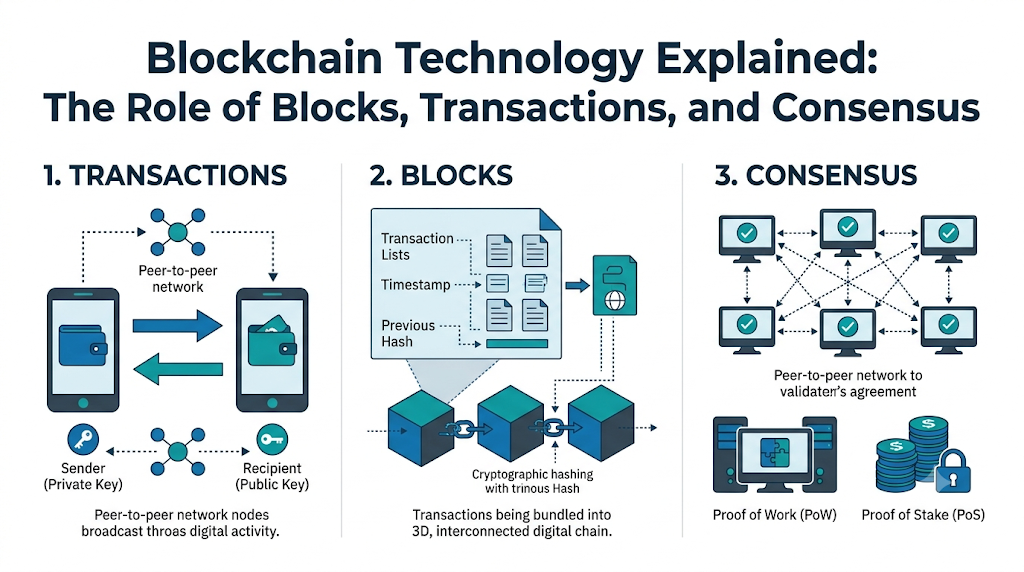
Everything on a blockchain starts with a transaction. While cryptocurrencies like Bitcoin and Ethereum use transactions to move digital coins, blockchains can also record smart contract instructions, supply chain updates, or digital asset ownership.
A blockchain transaction does not involve physical files moving from one device to another. Instead, it is a signed message broadcast to the network stating: “Transfer X amount from Wallet A to Wallet B.”
Public Keys, Private Keys, and Digital Signatures
To prevent anyone from spending someone else’s funds, blockchains rely on public-key cryptography:
- Public Key (Wallet Address): A string of letters and numbers you share with others to receive funds, similar to an email address or bank account number.
- Private Key: A secret cryptographic password that proves you own the funds tied to your public address.
- Digital Signature: When you send a transaction, your wallet software uses your private key to generate a unique digital signature. Nodes use your public key to verify that the signature is authentic—confirming you approved the transfer without you ever revealing your private key.
From Broadcast to the Mempool
Once signed, your transaction is broadcast to nearby nodes. Each node checks two basic rules:
- Is the digital signature valid?
- Does the sender’s address actually hold enough funds to cover the transfer and network fee?
If both checks pass, the transaction enters a waiting room called the mempool (memory pool). Transactions sit in the mempool until a block producer selects them—often prioritizing transfers that include higher network fees—to bundle into the next block.
Step 2: How Blocks Lock Data in Time
Processing transactions one by one across thousands of global computers would be slow and chaotic. To keep every node synchronized, the network groups pending transactions into batches called blocks.
Think of a block as a single page in a physical accounting ledger. Once a page is full, it is stamped, numbered, and permanently bound into the book before a new blank page begins.
Inside a Block’s Anatomy
While exact layouts vary between networks, a standard block contains two main parts:
- The Block Body: The list of verified transactions pulled from the mempool.
- The Block Header: Metadata that identifies and secures the block, including a timestamp, a summary of all transactions inside (known as a Merkle root), and a cryptographic fingerprint.
Cryptographic Hashes and the “Chain”
The security of a blockchain comes from how each block connects to the one before it. Every block is passed through a cryptographic hash function (such as SHA-256), which converts all the data inside the block into a fixed-length string of characters called a hash.
A hash acts like a digital tamper-evident seal:
- Even a tiny change—like altering a single digit in a transaction amount—produces a completely different hash.
- Every new block header includes the previous block’s hash.
Because Block 101 contains the hash of Block 100, and Block 102 contains the hash of Block 101, they form an unbroken chronological chain. If an attacker alters a transaction in Block 100, its hash changes. That breaks the link to Block 101, which breaks Block 102, immediately alerting every node on the network that the ledger was tampered with.
Step 3: Consensus Mechanisms—How Strangers Agree
If thousands of nodes hold copies of the ledger, who gets to publish the next official block? And what happens if two nodes propose different versions of the truth at the same time?
Consensus mechanisms are the rulebooks that solve this problem. They force participants to prove they have real-world skin in the game before they are allowed to add a block, making dishonest behavior too expensive to attempt.
Proof of Work (PoW)
Used by networks like Bitcoin, Proof of Work ties block creation to real-world computing power and electricity.
- Specialized computers called miners compete to solve a complex cryptographic puzzle—essentially guessing billions of numbers per second to find a hash that meets the network’s difficulty target.
- The first miner to find the winning number broadcasts the new block to the network.
- Other nodes easily verify the math, accept the block, and add it to their chain. The winning miner earns newly minted coins and transaction fees as a reward.
Because solving the puzzle requires massive hardware and energy costs, rewriting past blocks would require controlling more than half of the network’s total computing power—a prohibitively expensive feat known as a 51% attack.
Proof of Stake (PoS)
Used by networks like Ethereum, Proof of Stake replaces energy-intensive mining with financial collateral.
- Instead of miners, the network relies on validators who lock up (stake) a specific amount of the network’s native cryptocurrency in a smart contract.
- An algorithm randomly selects a validator to propose the next block, often weighting odds based on the size and duration of their stake.
- Other validators attest that the proposed block follows network rules. If a validator approves fraudulent transactions or tries to manipulate the chain, the protocol automatically destroys (“slashes”) a portion of their staked funds.
Comparing Proof of Work and Proof of Stake
| Feature | Proof of Work (PoW) | Proof of Stake (PoS) |
| Block Producers | Miners | Validators |
| Resource Required | Specialized hardware and electricity | Locked cryptocurrency collateral (stake) |
| Penalty for Cheating | Wasted electricity and hardware expenses | Slashing (forfeiture of staked funds) |
| Energy Consumption | High | Very low (over 99% less than PoW) |
| Prominent Examples | Bitcoin, Litecoin | Ethereum, Solana, Cardano |
Bringing It Together: A Transaction’s Complete Lifecycle
To see how these three pieces interact, follow a single payment from start to finish:
- Initiation: You enter a recipient’s wallet address, specify the amount, and authorize the transfer using your wallet’s private key.
- Propagation: Your signed transaction broadcasts across peer-to-peer nodes, passes validity checks, and lands in the mempool.
- Bundling: A miner or validator selects your transaction from the mempool and groups it with hundreds of others into a candidate block.
- Consensus: Through Proof of Work or Proof of Stake, the network validates the block and links it to the previous block’s hash.
- Finality: Every node updates its local copy of the ledger. As additional blocks build on top of yours, reversing the transaction becomes practically impossible.
Common Misconceptions and Practical Limitations
Understanding how blocks, transactions, and consensus work also clarifies what blockchain technology cannot do:
- Transactions Are Pseudonymous, Not Anonymous: Public blockchains hide your legal name, but every wallet address and transfer amount is permanently visible to anyone using a block explorer. Law enforcement and analytics firms regularly trace funds across public ledgers.
- Immutability Cuts Both Ways: Because confirmed blocks cannot be edited, there is no customer support desk to reverse a mistyped wallet address or recover stolen private keys. User self-custody carries permanent responsibility.
- The Scalability Trilemma: Blockchains constantly balance three competing priorities—decentralization, security, and speed. Requiring thousands of global nodes to verify every block keeps the system secure and decentralized, but it limits how many transactions per second the base layer can process compared to centralized payment networks like Visa.
Frequently Asked Questions
Can a blockchain transaction be canceled once it is sent? Once a transaction is confirmed inside a block, it cannot be reversed or canceled. If a transaction is still sitting unconfirmed in the mempool, some wallets allow you to replace it with a new transaction carrying a higher fee, effectively overwriting the pending transfer.
Do all blockchains use cryptocurrency? Public blockchains rely on native cryptocurrencies to pay transaction fees and reward miners or validators for securing the network. Private or permissioned enterprise blockchains—used by supply chains or internal corporate networks—often operate without a tradable token because participants are already known and vetted.
What happens if two miners find a valid block at the exact same time? This creates a temporary fork where part of the network sees Block A first and another part sees Block B first. Nodes follow the longest chain rule: as soon as the next block is built on top of either A or B, that branch becomes the longer chain, and the entire network switches to it while discarding the orphaned block.
How long does it take for a block to be created? Block times depend on the network’s design. Bitcoin targets an average of 10 minutes per block, Ethereum produces a new block roughly every 12 seconds, and faster networks like Solana generate blocks in under a second.
Key Takeaway
Blockchain technology is not magic—it is a coordinated system of checks and balances. Cryptography ensures that transactions are genuinely authorized, linked hashes ensure that blocks cannot be quietly altered after the fact, and consensus rules ensure that independent computers agree on a single version of history without trusting a central authority. Knowing how those three pieces fit together makes it far easier to evaluate any cryptocurrency, smart contract platform, or decentralized application on its technical merits rather than market hype.