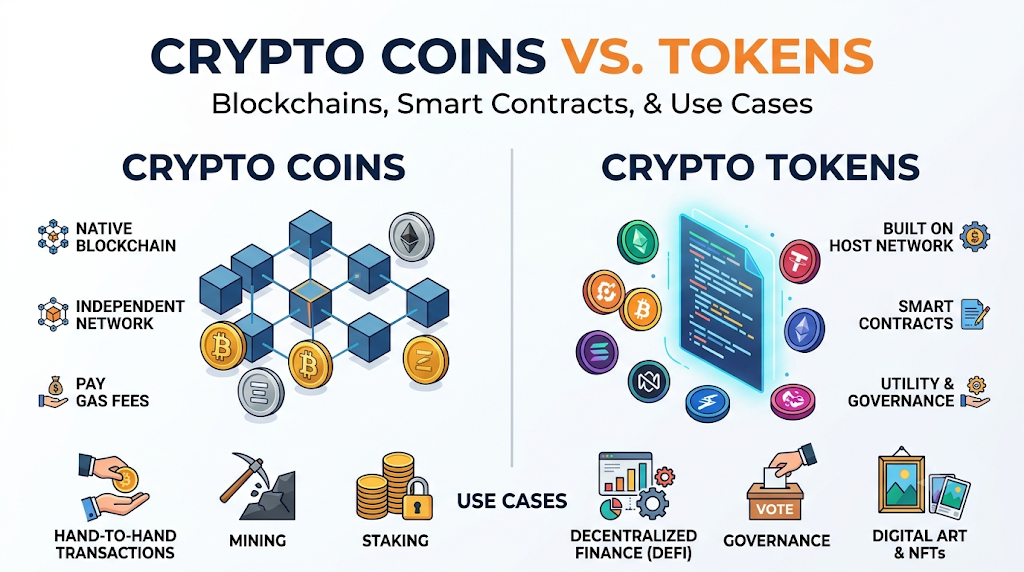
People in the cryptocurrency space often use the words “coin” and “token” as if they mean the exact same thing. You might hear someone refer to Bitcoin as a token, or call Chainlink a coin, during everyday market discussions. While both live on blockchains and trade on crypto exchanges, they operate on completely different technical foundations.
Understanding how coins and tokens differ is more than just vocabulary trivia. It affects how you pay transaction fees, which wallets you can safely use, and how you evaluate the real-world risks of a digital asset.
The Core Architectural Divide
The primary difference between a crypto coin and a crypto token comes down to infrastructure.
A coin is the native digital currency of its own independent blockchain. It is built directly into the base protocol of that network. Bitcoin (BTC) runs on the Bitcoin blockchain, Ether (ETH) runs on the Ethereum blockchain, and Solana (SOL) runs on the Solana network. Without the coin, the underlying blockchain cannot operate or reward the validators and miners who keep the ledger secure.
A token, by contrast, does not have its own blockchain. Instead, developers create tokens on top of an existing blockchain using smart contracts—self-executing pieces of code that follow predefined rules. Rather than building a network from scratch, a project launches a token on an established network like Ethereum, Solana, or BNB Smart Chain and relies on that host network for security and transaction validation.
Think of a coin as the official currency of a country, backed by its own central banking system and national infrastructure. A token is closer to a gift card, transit pass, or event ticket issued by a specific business operating inside that country. The business relies on the country’s roads, power grid, and legal system to function, just as a token relies on its host blockchain.
Technical Mechanics: Native Protocols vs. Smart Contracts
Looking under the hood reveals why coins and tokens behave differently when you send, receive, or store them.
How Coins Operate at the Protocol Level
Coins are hard-coded into the consensus rules of their respective blockchains. When you send BTC to another address, the Bitcoin network nodes verify that you hold the unspent transaction outputs (UTXOs) and update the global ledger directly.
Coins perform three essential technical jobs for their networks:
- Paying Transaction Fees (Gas): Every action on a blockchain requires computing power. Users must pay fees in the network’s native coin to compensate validators or miners. You cannot pay Ethereum gas fees with USDC or Shiba Inu; you must hold ETH.
- Securing the Network: In Proof-of-Work systems, miners earn newly minted coins for solving cryptographic puzzles. In Proof-of-Stake systems, validators lock up (stake) the native coin to verify blocks and earn rewards.
- Acting as a Base Unit of Account: Native coins serve as the primary medium of exchange and liquidity pair within their own ecosystems.
How Tokens Operate via Smart Contracts
Tokens exist as entries inside a smart contract’s internal ledger rather than as native assets of the base chain. When you transfer an ERC-20 token (the most common token standard on Ethereum), you are not directly moving a base protocol asset. Instead, you are sending a transaction to the token’s smart contract asking it to subtract a number from your wallet’s balance and add it to the recipient’s balance.
Because smart contracts are programmable, tokens follow standardized templates so wallets and decentralized applications can interact with them easily:
- ERC-20 (Ethereum) and SPL (Solana): Standards for fungible tokens, where every unit is identical and interchangeable.
- ERC-721 and ERC-1155: Standards for non-fungible tokens (NFTs) and semi-fungible items, where individual tokens carry unique identifiers and metadata.
Side-by-Side Comparison: Coins vs. Tokens
| Feature | Crypto Coins | Crypto Tokens |
|---|---|---|
| Blockchain Infrastructure | Operates on its own native, independent blockchain | Built on top of an existing host blockchain |
| Creation Process | Requires building a new blockchain protocol or forking an existing one | Created by deploying a smart contract using existing token standards |
| Transaction Fees | Used directly to pay network gas fees | Requires the host blockchain’s native coin to pay gas fees |
| Primary Purpose | Medium of exchange, store of value, and network security | Utility access, governance voting, stablecoins, or asset representation |
| Security Model | Secured by its own miners or validators | Inherits the security and consensus mechanism of its host network |
| Common Examples | Bitcoin (BTC), Ether (ETH), Solana (SOL), Litecoin (LTC) | Tether (USDT), Uniswap (UNI), Chainlink (LINK), USD Coin (USDC) |
Practical Differences That Affect Everyday Users
Knowing whether an asset is a coin or a token prevents costly mistakes when managing digital assets.
Wallet Compatibility and Network Selection
A single coin usually corresponds to one primary network. Bitcoin lives on the Bitcoin network. Tokens, however, frequently exist across multiple blockchains at the same time.
For example, Tether (USDT) is a stablecoin token issued on Ethereum, Tron, Solana, Polygon, and several other networks. If you withdraw USDT from an exchange using the Polygon network and send it to a wallet address that only supports Ethereum, your funds may become inaccessible or require complex recovery steps. Always match both the token and the underlying host network before confirming a transfer.
Managing Gas Fees
One of the most common frustrations for newer crypto users happens when they receive tokens in a self-custody wallet and try to move them. Even if you hold $500 worth of an ERC-20 token in your wallet, you cannot send or swap a single cent of it unless you also hold enough ETH to cover the network’s gas fee. Keeping a small reserve of the host chain’s native coin is mandatory whenever you interact with tokens.
Smart Contract Risk
When you hold a native coin like BTC, your main technical risks involve private key management or a flaw in the core blockchain protocol itself. When you hold a token, you face an additional layer of risk: smart contract vulnerabilities. Bugs in a token’s code, flawed upgrade mechanisms, or malicious admin permissions can allow attackers to drain liquidity or mint unauthorized tokens, even if the underlying host blockchain remains completely secure.
Common Categories of Tokens in Practice
Because developers can program custom rules into smart contracts, tokens serve a much wider variety of specific roles than native coins:
- Stablecoins: Tokens pegged to fiat currencies like the US dollar (such as USDC and USDT) to reduce price volatility during trading and payments.
- Governance Tokens: Assets that give holders voting power over protocol upgrades, fee structures, and treasury spending in decentralized autonomous organizations (DAOs).
- Utility Tokens: Tokens designed to unlock specific features, pay for decentralized storage, or access services within a particular application.
- Wrapped Tokens: Tokens that represent a coin from another blockchain so it can be used in smart contracts elsewhere—such as Wrapped Bitcoin (WBTC) operating as an ERC-20 token on Ethereum.
- Non-Fungible Tokens (NFTs): Unique digital tokens representing ownership of art, collectibles, event tickets, or tokenized real-world assets.
How a Token Can Become a Coin
The line between a coin and a token is not always permanent. Many projects launch as tokens first because building a secure blockchain from scratch requires substantial time, capital, and validator infrastructure. Issuing a token lets a team test its product, build a community, and raise funding quickly.
Once the project matures, the team may develop and launch its own independent mainnet. During this transition—known as a token migration or mainnet swap—holders exchange their old smart-contract tokens at a fixed ratio (usually 1:1) for the newly created native coins. Both BNB and Tron (TRX) originally launched as ERC-20 tokens on Ethereum before migrating onto their own independent blockchains.
Frequently Asked Questions (FAQs)
Is Ethereum a coin or a token?
Ethereum is the name of the blockchain network, while Ether (ETH) is its native coin. Because ETH operates at the base protocol level and pays for network gas fees, it is a coin. Assets built on top of Ethereum using standards like ERC-20 are tokens.
Why do people still call stablecoins “coins” if they are tokens?
“Stablecoin” is an industry term describing an asset’s price stability rather than its technical architecture. Almost all major stablecoins—including USDT, USDC, and DAI—are technically tokens deployed via smart contracts on existing blockchains.
Are coins safer investments than tokens?
Neither category is automatically safe, as all crypto assets carry market volatility and regulatory risks. However, established native coins generally avoid smart contract bugs and single-issuer centralization risks that affect many tokens. Always research a project’s code audits, token distribution, and utility before committing funds. (Note: This information is for educational purposes only and is not financial advice.)
Can a single blockchain host thousands of different tokens?
Yes. Because creating a token only requires deploying a smart contract, a single programmable blockchain like Ethereum or Solana can host hundreds of thousands of different tokens simultaneously, all sharing the same underlying validator network.
Key Takeaway
The distinction between coins and tokens comes down to ownership of the underlying rails. Coins power their own independent blockchains, validate transactions, and pay network fees. Tokens ride on top of those existing blockchains through smart contracts to deliver specialized applications, stable value, or governance rights. Checking whether an asset is a coin or a token—and identifying which host network it runs on—is one of the simplest ways to avoid transfer errors and understand what truly backs a digital asset.