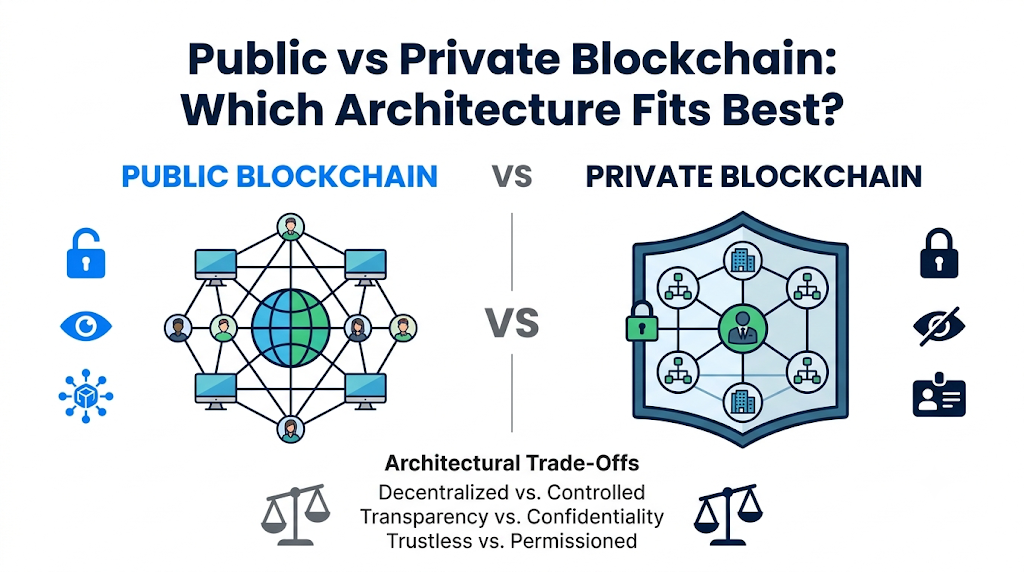
When Bitcoin launched in 2009, it introduced a radical idea: a financial ledger that anyone could inspect, verify, and help maintain without asking permission from a bank or government. Within a few years, corporations, supply chain operators, and financial institutions began asking a different question. They wanted the tamper-resistant record-keeping and shared database benefits of a blockchain, without exposing sensitive business data to the public or relying on anonymous validators.
That split created two distinct branches of distributed ledger technology. On one side sit public blockchains—open networks built for censorship resistance and trustless participation. On the other sit private blockchains—restricted networks engineered for speed, privacy, and clear organizational accountability.
Choosing between them is never a matter of picking the “better” technology. Each design solves a fundamentally different set of problems by making deliberate compromises in how the network is built, who gets inside, and what happens when rules need to change.
Core Architectural Differences
At a high level, both public and private blockchains store data in cryptographically linked blocks distributed across multiple computers (nodes). The divergence begins with how those nodes are arranged, who controls them, and how they agree on the truth.
Network Topology and Node Distribution
A public blockchain relies on a flat, peer-to-peer topology. Nodes are scattered across the globe, operated by independent individuals, hobbyists, universities, and commercial validators. No single entity owns the servers or controls the network’s physical infrastructure. If hundreds of nodes go offline simultaneously, the remaining nodes continue processing transactions without interruption.
A private blockchain operates on a controlled topology managed by a single organization or a pre-approved group of administrators. Nodes are typically hosted on dedicated cloud servers or internal corporate infrastructure. Because the network operator knows the exact hardware and bandwidth of every node, communication between nodes is far more predictable and efficient.
Consensus Mechanisms and Finality
Because public blockchains allow unknown participants to join, they must defend against malicious actors who might try to rewrite transaction history or flood the network with fake identities (known as a Sybil attack). To prevent this, public networks use resource-intensive consensus mechanisms:
- Proof of Work (PoW): Validators (miners) expend real-world electricity and computing power to solve cryptographic puzzles before adding a block, as seen on Bitcoin.
- Proof of Stake (PoS): Validators lock up financial collateral (tokens) that can be destroyed (“slashed”) if they act dishonestly, as used by Ethereum and Solana.
Private blockchains do not need to protect against anonymous attackers because every participant is vetted before receiving network credentials. Instead, they rely on lightweight, identity-based consensus algorithms such as Practical Byzantine Fault Tolerance (PBFT), Raft, or Proof of Authority (PoA). Without the need for complex cryptographic puzzles or global economic coordination, private networks confirm transactions in milliseconds with immediate finality—meaning a confirmed transaction cannot be reversed by a temporary chain split.
Access Controls: Permissionless vs. Permissioned
The terms “public” and “private” are often used interchangeably with “permissionless” and “permissioned,” though they describe slightly different layers of control: visibility and participation.
Read, Write, and Validation Rights
In a pure public (permissionless) blockchain, three core permissions are open to everyone:
- Read access: Anyone with an internet connection can download the ledger or use a block explorer to view every transaction ever recorded.
- Write access: Anyone can create a wallet, sign a transaction, and broadcast it to the network, provided they pay the required transaction fee.
- Validation access: Anyone who meets the hardware or staking requirements can run a node and participate in block production and governance.
In a private (permissioned) blockchain, a central authority or network administrator restricts all three layers using cryptographic certificates and identity management systems:
- Read access can be limited so that participants only see transactions relevant to their specific department or role.
- Write access is granted only to authorized employees, applications, or partner systems.
- Validation access is restricted to a small, designated group of trusted servers.
Data Visibility and Privacy
Public blockchains are transparent by design. While user identities are masked behind alphanumeric wallet addresses (pseudonymity), transaction amounts, timestamps, and smart contract interactions are permanently visible. For an individual or business, exposing payroll, supplier pricing, or customer balances on a public ledger is often a non-starter.
Private blockchains treat confidentiality as a core requirement. Frameworks like Hyperledger Fabric allow administrators to create isolated “channels” or private data collections, ensuring that two parties on the same network can transact without revealing the details to other authorized nodes.
Side-by-Side Comparison: Public vs. Private Blockchains
| Feature | Public Blockchain | Private Blockchain |
| Access Model | Open and permissionless; anyone can join | Closed and permissioned; invite-only via credentials |
| Governance | Decentralized across developers, validators, and users | Centralized under one organization or network admin |
| Consensus Mechanisms | Proof of Work (PoW), Proof of Stake (PoS) | Proof of Authority (PoA), Raft, PBFT |
| Transaction Speed | Lower throughput (tens to thousands of TPS) | High throughput (thousands to tens of thousands of TPS) |
| Data Transparency | Fully public ledger; pseudonymous addresses | Restricted visibility; encrypted or role-based access |
| Energy Consumption | High (PoW) to low (PoS) | Very low (runs on standard enterprise servers) |
| Immutability | Extremely high; nearly impossible to alter past blocks | Conditional; administrators can theoretically roll back data |
| Notable Examples | Bitcoin, Ethereum, Solana | Hyperledger Fabric, R3 Corda, Quorum |
The Core Trade-Offs
Every blockchain architecture forces a compromise. In blockchain engineering, this is often framed through the Blockchain Trilemma—the principle that a network can easily optimize for two of three properties (decentralization, security, and scalability), but struggles to maximize all three simultaneously.
Decentralization vs. Throughput and Latency
Public blockchains prioritize decentralization and censorship resistance. To keep the network open to everyday users running standard hardware, block sizes and block times must remain manageable so nodes around the world can stay synchronized. Waiting for thousands of globally distributed nodes to reach agreement introduces latency and caps transaction throughput.
Private blockchains flip this priority. By limiting the network to a dozen high-speed servers inside known data centers, they achieve rapid transaction processing and low latency. The trade-off is centralization: the network is no longer trustless. Users must trust the operating organization not to censor transactions, freeze accounts, or manipulate records.
Immutability vs. Regulatory Compliance
On a public blockchain, code and consensus are final. Once a transaction settles on Bitcoin or Ethereum, no customer support desk, CEO, or court order can directly edit the ledger. While this protects users from unilateral interference, it creates friction with modern data privacy laws. For example, regulations like Europe’s General Data Protection Regulation (GDPR) grant individuals the “right to be forgotten,” which conflicts with an append-only public database that never deletes data.
Private blockchains give organizations the administrative control needed to comply with strict legal frameworks. Administrators can enforce Know Your Customer (KYC) checks before onboarding users, restrict data access to satisfy confidentiality agreements, and—if legally required—modify or redact off-chain and on-chain records through governed administrative overrides.
Infrastructure Cost vs. Operational Control
Running an application on a public blockchain requires zero server maintenance for the underlying network—the global validator community handles uptime and security. However, every action on the network incurs variable transaction fees (“gas”), which can spike unpredictably during periods of high network congestion.
Operating a private blockchain eliminates unpredictable gas fees, making operational budgets steady and predictable. In exchange, the organization bears the full cost of software engineering, server hosting, cybersecurity monitoring, and ongoing maintenance.
Where Hybrid and Consortium Models Fit In
In practice, many real-world deployments fall between the two extremes:
- Consortium Blockchains: Instead of a single company holding total control, a group of organizations—such as competing banks, shipping carriers, or healthcare providers—jointly govern the network. Each member runs a validator node, preventing any single company from altering data unilaterally while keeping the ledger closed to the general public.
- Layer-2 and Hybrid Architectures: Businesses increasingly use private or permissioned environments to process high-volume, confidential operations, then periodically anchor cryptographic proofs (hashes) of that data onto a public blockchain like Ethereum. This approach preserves daily privacy and speed while borrowing the tamper-evident security of a public chain for audit verification.
Real-World Applications by Network Type
When Public Blockchains Make Sense
Public networks thrive when strangers need to coordinate value or verify digital ownership without relying on a middleman:
- Decentralized Finance (DeFi): Lending, borrowing, and asset swaps executed via open-source smart contracts accessible globally without banking intermediaries.
- Cross-Border Settlement: Peer-to-peer value transfers that operate 24/7 without correspondent banking delays.
- Digital Scarcity and Provenance: Verifying the authenticity and ownership history of digital art, collectibles, or tokenized real-world assets on a neutral ledger.
When Private Blockchains Make Sense
Private networks fit internal corporate workflows or tightly regulated industries where participant identity is mandatory:
- Internal Supply Chain Tracking: Monitoring inventory, batch numbers, and quality-control checkpoints across a manufacturer’s wholly owned factories and warehouses.
- Inter-Departmental Financial Auditing: Creating an internal, tamper-evident audit trail for accounting entries across global subsidiaries.
- Healthcare Record Management: Sharing patient permissions and clinical audit logs among authorized hospital departments while adhering to strict health privacy laws.
Frequently Asked Questions (FAQs)
Can a private blockchain be hacked or altered?
Yes. While cryptographic hashing makes accidental data corruption easy to detect, a private blockchain relies on a small number of administrators or validators. If an attacker compromises those central administrative keys—or if the controlling organization decides to rewrite history—the ledger can be altered.
Are public blockchains completely anonymous?
No. Most public blockchains are pseudonymous. Wallet addresses do not directly display your legal name, but every transaction is permanently recorded on a public ledger. Using blockchain analytics, investigators and exchanges can often link wallet addresses to real-world identities when funds enter or exit regulated platforms.
Why wouldn’t a company just use a traditional SQL database instead of a private blockchain?
If a single company controls all the data and no external parties need to verify it, a traditional database is faster, cheaper, and simpler. A private or consortium blockchain only adds value when multiple distinct departments or partner organizations need a shared, tamper-evident record without handing full database ownership to a single party.
Do private blockchains use cryptocurrency?
Usually not. Because private networks do not rely on open-market economic incentives to reward anonymous miners or validators, they rarely require a native cryptocurrency or volatile transaction fees to operate.
Choosing the Right Architecture
Evaluating public versus private blockchains comes down to a single foundational question: Where does trust live? If a system requires verifiable neutrality, open global access, and protection against any single authority changing the rules, a public blockchain is the only architecture built for the job. If the goal is high-speed execution, strict data confidentiality, and clear legal accountability among known participants, a private or consortium network delivers those capabilities without the friction of open consensus.