Introduction
Imagine a world where you can borrow money, earn interest on your savings, or trade assets without ever stepping into a bank, filling out piles of paperwork, or waiting for a loan officer’s approval. This isn’t a futuristic concept; it is happening right now in the cryptocurrency world.
Decentralized Finance, universally known as DeFi, is completely transforming crypto finance. By replacing centuries-old banking systems with code, blockchain applications are expanding at a rapid pace, drawing in billions of dollars from investors around the globe. For beginners, understanding this landscape is no longer optional—it is the gateway to the future of personal wealth management and digital banking.
Traditional finance relies on intermediaries like commercial banks, brokerages, and payment networks to facilitate transactions and build trust. However, these gatekeepers often impose high fees, take days to settle transactions, and lock out billions of unbanked individuals worldwide. This decentralized finance guide will show you how blockchain technology disrupts this model by providing direct, peer-to-peer financial access to anyone with an internet connection.
Key Benefits of Entering the DeFi Ecosystem
- True Financial Inclusion: Anyone with a smartphone and an internet connection can access global financial tools. There are no credit score checks, no geographical restrictions, and no background screening.
- Decentralized Control: You retain absolute ownership over your funds. Instead of trusting a commercial bank with your savings, your capital is secured by cryptography and managed by your own software wallet.
- Potential for Higher Yields: By removing expensive corporate overhead and intermediaries, DeFi protocols can pass savings directly to users, offering significantly more competitive interest rates than legacy savings accounts.
- Unmatched Blockchain Transparency: Every transaction, smart contract, and financial ledger is published openly on the blockchain. Anyone can independently audit the code, transaction history, and liquidity metrics in real-time.
What It Is
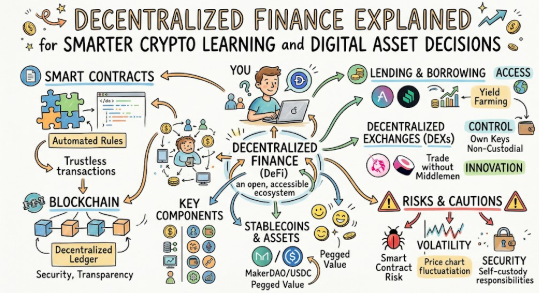
DeFi (Decentralized Finance) is an open, global financial ecosystem built on top of public blockchain networks. It operates entirely without traditional intermediaries—such as banks, brokerages, or clearing houses. Instead of human managers, DeFi relies on smart contract finance, using self-executing software code to automate lending, borrowing, asset trading, insurance, and yield optimization.
Why It Matters
DeFi is fundamentally important because it empowers individuals with complete crypto financial freedom. In the traditional financial world, institutions hold power over your money; they can freeze your accounts, restrict international transfers, and devalue currency through centralized monetary policies.
Moreover, DeFi removes the systemic friction inherent to legacy banking. Transactions settle in minutes rather than days, services operate 24/7/365 without regional holidays, and structural transparency mitigates the risk of hidden institutional leverage. It democratizes complex financial products—like market-making or algorithmic compounding—making them accessible to retail users instead of reserving them exclusively for elite Wall Street firms.
Key Components of DeFi Explained
Smart Contracts Automate Trustless Transactions
Smart contracts are the backbone of all DeFi protocols. These are self-executing programs stored on a blockchain that automatically run when predetermined conditions are met. For example, if you want to buy a specific token, the smart contract verifies you have the necessary funds, executes the trade, and delivers the token to your wallet in one atomic transaction. Because the code is immutable, it removes the need for a trusted third party to verify or clear the transaction.
Lending and Borrowing Protocols
Traditional loans require extensive documentation, employment verification, and weeks of administrative processing. In contrast, crypto lending and borrowing protocols allow users to access capital instantly.
- Suppliers (Lenders): Deposit their digital assets into a pool to earn variable or fixed interest rates paid out dynamically.
- Borrowers: Secure a loan instantly by depositing crypto collateral that exceeds the value of the loan (over-collateralization), ensuring the platform remains financially sound without needing a credit check.
Decentralized Exchanges (DEXs)
Unlike centralized platforms (like Coinbase or Binance) which manage an internal order book and hold your funds, Decentralized Exchanges (DEXs) facilitate peer-to-peer asset swaps directly from your personal wallet. They utilize an Automated Market Maker (AMM) framework, which relies on pre-funded pools of assets rather than matching individual buy and sell orders.
Staking and Liquidity Pools
To keep a decentralized exchange or lending platform running smoothly, it needs deep liquidity. This is accomplished via staking and liquidity pools.
- Liquidity Pools: These are digital repositories of tokens locked in a smart contract. Users called Liquidity Providers (LPs) deposit an equivalent value of two distinct tokens into these pools to facilitate trading. In exchange, LPs earn a proportional share of the transaction fees generated by users trading within that pool.
- Staking: This involves locking up your tokens to support a blockchain network’s security or a protocol’s governance, earning a steady stream of protocol rewards over time.
Yield Farming Crypto
Once you understand liquidity pools, you can explore yield farming crypto. This is the practice of moving your digital assets across various DeFi protocols to maximize your returns. Yield farmers constantly chase the highest rewards, shifting their tokens between different lending platforms and liquidity pools to stack multiple incentives, such as interest earnings combined with newly minted governance tokens.
Key DeFi Platforms and Their Features
| Platform | Feature | Use Case |
| Uniswap | Decentralized Exchange (DEX) | Trading tokens directly peer-to-peer without intermediaries. |
| Aave | Decentralized Lending & Borrowing | Depositing crypto to earn interest or borrowing assets against collateral. |
| Compound | Algorithmic Money Market | Supplying cryptocurrency assets to a liquidity pool to earn variable yield. |
| MakerDAO | Decentralized Stablecoin Issuance | Borrowing the DAI stablecoin by locking up collateral like ETH or WBTC. |
| PancakeSwap | Multi-chain DEX & Yield Farming | Trading tokens with lower transaction fees while earning farming rewards. |
| Curve Finance | Stablecoin Optimization Pools | Executing massive stablecoin swaps with minimal price slippage and low fees. |
| Yearn Finance | Automated Yield Aggregator | Utilizing automated strategies to maximize yield across lending protocols. |
Step-by-Step Guide to Getting Started with DeFi
1. Create a Compatible Crypto Wallet
DeFi protocols do not use usernames or passwords. Instead, you connect via a non-custodial Web3 wallet, such as MetaMask, Phantom, or a hardware wallet like Ledger. Download the official software, set a strong password, and write down your 12-to-24-word seed phrase on paper. Store this phrase securely; losing it means losing permanent access to your funds.
2. Fund Your Wallet with Cryptocurrency
To interact with smart contracts, your wallet must hold the native cryptocurrency of the blockchain you are using (e.g., Ethereum for the Ethereum network, BNB for BNB Chain) to pay for transaction fees, commonly called “gas fees.” Purchase your crypto on a fiat gateway or centralized exchange, then withdraw it directly to your public wallet address.
3. Connect to a Verified DeFi Platform
Navigate to the official website of the DeFi protocol you intend to use (for example, app.uniswap.org or app.aave.com). Look for the “Connect Wallet” button on the interface. A pop-up will appear in your browser extension asking you to approve the connection. Confirm that the URL is correct to avoid phishing scams.
4. Select Your Activity: Lending, Borrowing, or Swapping
Once connected, choose the appropriate financial activity for your goals:
- If you want to trade assets, navigate to the swap interface, select your token pair, and approve the trade.
- If you want to earn interest, navigate to the supply or deposit dashboard and choose an asset to lend out.
5. Review Risks, Audits, and APYs
Before signing any transaction, evaluate the protocol’s safety. Check the current Annual Percentage Yield (APY) to make sure it aligns with market averages. Confirm that the platform’s smart contracts have been thoroughly audited by reputable blockchain security firms like CertiK, OpenZeppelin, or Trail of Bits.
6. Execute the Transaction and Monitor Your Portfolio
Click the confirmation button on the platform web interface, then review the transaction details within your wallet pop-up window. Check the estimated gas fee, approve the transaction, and wait for the blockchain to confirm it. Once confirmed, you can track your positions using portfolio trackers like DeBank or Zapper.
Real-Life Examples
- Earning Passive Interest: A beginner stakes Ethereum (ETH) on Aave, instantly earning continuous interest directly from borrowers without dealing with a commercial bank or opening a savings account.
- Earning Trading Fees: A student provides equal parts USDC and ETH to a liquidity pool on Uniswap, earning a proportional share of transaction fees whenever traders use that pool to swap assets.
- Accessing Liquidity Without Selling: A freelance designer borrows DAI stablecoins on MakerDAO against their Bitcoin collateral, securing cash to pay urgent medical bills without triggering a taxable asset sale.
- Automating Compound Interest: A small retail investor deposits their idle stablecoins into Yearn Finance, allowing automated vaults to shift the funds to the highest-yielding verified pools each week.
- Trading Privately and Securely: A crypto enthusiast swaps tokens on PancakeSwap directly from their hardware wallet, retaining full custody of their assets while avoiding centralized exchange signup delays.
Practical Tips for Safe DeFi Participation
While the decentralization of finance offers significant opportunities, it also places all security responsibilities onto you. Implement these DeFi beginner tips to safeguard your capital.
- Always Prioritize Audited Protocols: Only interact with platforms that have undergone multiple public smart contract audits by respected third-party firms. Avoid brand-new, unverified protocols offering unrealistic returns.
- Diversify Your Assets Strategically: Never concentrate all your capital into a single DeFi protocol or asset class. Spread your investments across distinct lending platforms, decentralized exchanges, and multiple Layer-1 or Layer-2 blockchain networks.
- Begin with Small Trial Amounts: When testing a new protocol or wallet feature, always execute a small test transaction first. Confirm everything works as expected before committing larger sums of money.
- Secure Your Private Keys Physically: Your seed phrase is the master key to your digital wealth. Never type it into an email, store it on a cloud server, or share it with anyone. Write it down physically and keep it in a secure location.
- Calculate Gas Fees and Monitor APYs: Network congestion can dramatically increase gas fees. Always verify that the cost of execution won’t erase your projected earnings, and track APYs regularly as they fluctuate based on market demand.
DeFi Investment Checklist
| Checklist Point | Description & Verification | Verified (Yes/No) |
| Wallet Setup Complete | Non-custodial Web3 wallet is configured with private keys backed up offline. | Yes |
| Funds Available | Capital is divided between investment assets and native tokens for network gas fees. | Yes |
| Smart Contract Audited | The protocol has recent, clean security audit reports from reputable firms. | Yes |
| Risk Assessment Done | You understand the specific risks, including smart contract bugs and asset volatility. | Yes |
| Platform Verified | The application URL matches official documentation, protecting against phishing sites. | Yes |
| Liquidity Pool Selected | For market making, the specific pool has sufficient historical volume and trading depth. | Yes |
| Staking/Farming Planned | Lockup durations, redemption periods, and distribution schedules are known. | Yes |
| Gas Fees Calculated | The network transaction fees represent a very low percentage of the total transaction value. | Yes |
| Capital Diversified | The allocation represents only a safe portion of your overall portfolio. | Yes |
| Performance Monitored | A tracking schedule is set up to check yield changes, health factor, and protocol health. | Yes |
Common Mistakes Beginners Make
Ignoring Smart Contract Audits
Many beginners chase new platforms without checking their underlying security records. If a protocol has not been audited, its code could contain structural vulnerabilities or hidden backdoors that allow malicious actors to drain the entire liquidity pool.
Over-Leveraging Borrowing Positions
Lending protocols require you to maintain a healthy ratio between your collateral and your borrowed funds. If you borrow too close to your maximum limit and the value of your collateral drops suddenly during a market correction, the protocol will automatically liquidate your assets to recover the loan, charging a penalty fee.
Chasing Unstable, Triple-Digit APYs
New or experimental protocols often launch with high APYs to attract liquidity. However, these yields are usually paid out in highly inflationary native tokens that lose value quickly as early investors cash out. Chasing these metrics often leads to capital depreciation.
Falling Victim to Impermanent Loss
When providing liquidity to an Automated Market Maker (AMM), you must understand impermanent loss. If the price ratio of the two tokens you deposited changes significantly compared to when you deposited them, your portfolio value could end up lower than if you had simply held the individual tokens in your wallet.
Neglecting High Network Gas Fees
On popular blockchains like Ethereum, high network activity can drive gas fees up significantly. Beginners often make the mistake of depositing small sums (e.g., $50) into a protocol, only to find that entering and exiting the smart contract costs more than their total principal investment.
Frequently Asked Questions
1. What is DeFi in crypto?
DeFi stands for Decentralized Finance. It is an umbrella term for financial services—like lending, borrowing, and trading—built on public blockchain networks that operate via self-executing smart contracts without traditional banking intermediaries.
2. How do I start with DeFi as a beginner?
To start, set up a non-custodial wallet (like MetaMask), fund it with native cryptocurrency (such as ETH or BNB) from an exchange, navigate to a verified protocol like Uniswap or Aave, connect your wallet, and select an option like asset swapping or lending.
3. Is DeFi safer than centralized finance?
DeFi eliminates counterparty risks like bank insolvency or frozen accounts, giving you full control of your assets. However, it introduces technical risks, including smart contract bugs, code exploits, and user errors like losing private keys.
4. What is yield farming and how does it work?
Yield farming is the practice of moving crypto assets across different decentralized applications to maximize returns. Users leverage various lending and liquidity protocols to collect interest payments alongside protocol incentive tokens.
5. How do lending and borrowing protocols function?
Lenders add their crypto into shared liquidity pools to earn variable interest. Borrowers can instantly draw from these pools by depositing over-collateralized crypto assets, ensuring the platform remains stable without requiring credit checks.
6. Can I lose my funds in DeFi?
Yes. Capital loss can occur due to smart contract vulnerabilities, protocol exploits, extreme market volatility leading to collateral liquidation, impermanent loss in liquidity pools, or falling victim to phishing websites.
7. What are liquidity pools?
Liquidity pools are decentralized digital repositories of tokens locked inside a smart contract. They provide the necessary asset depth for decentralized exchanges to facilitate automated peer-to-peer trading without needing a traditional centralized order book.
8. How do I choose a DeFi platform?
Look for established protocols with a high Total Value Locked (TVL), multiple positive smart contract audits from top-tier security firms, a long operational track record, transparent developer teams, and active community governance.
9. Do I need a crypto wallet for DeFi?
Yes. A non-custodial cryptocurrency wallet is required to interact with DeFi. It serves as your digital identity, account interface, and asset vault, allowing you to sign smart contract transactions directly.
10. How to minimize risk while using DeFi protocols?
Minimize risk by using only audited platforms, diversifying across independent protocols and chains, starting with small amounts, using a hardware wallet for security, and keeping a close eye on your collateral utilization rates.
Conclusion
Decentralized finance represents a major shift in how we think about, interact with, and manage digital wealth. By cutting out expensive intermediaries and replacing them with open-source smart contracts, DeFi offers a level of global accessibility, programmatic transparency, and financial flexibility that traditional banking simply cannot match.
However, this freedom comes with personal responsibility. The key to succeeding in this ecosystem lies in continuous education, disciplined risk management, and step-by-step implementation. As you build your foundational knowledge, remember to start small, double-check your platform URLs, and thoroughly research protocol track records before committing your capital.