Introduction
Moving to a new country is a big dream for many people. It is about finding a better job, a safer home, or a fresh start for your family. But before you can pack your bags, you have to answer one very important question: “Am I allowed to move there?” This is where things can get confusing. Every country has its own rules, and most of them use a scoring system to decide who gets to stay.
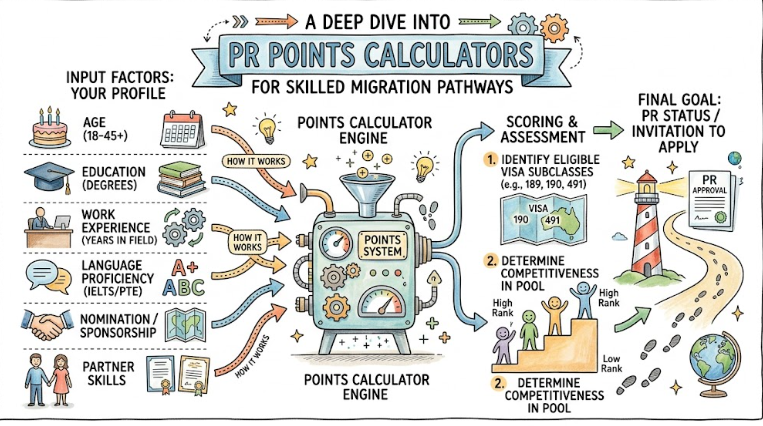
To make this easy, many people use a PR Points Calculator. Think of it like a report card for your life. It looks at your age, your studies, and your work to see if you are a good fit for that country. If your score is high enough, you get an invitation to apply for Permanent Residency (PR).
Imagine a young person who has spent years working hard, only to feel lost when looking at complicated immigration websites. By using a simple calculator, they can suddenly see a clear path forward. It turns a scary process into a simple math problem.
What Is a PR Points Calculator?
A PR Points Calculator is a digital tool that helps you understand if you meet the requirements for a points-based immigration system. Instead of waiting for a human to read your whole life story, these systems use data to rank people.
The Concept of Points-Based Immigration
In the past, moving to another country often depended on who you knew or if you had family there. Today, many countries use a “Human Capital” model. They want people who will help their economy grow. They give points for things they value, such as being in a certain age bracket, speaking the language well, or having a degree in a field that needs more workers.
How PR Points Determine Visa Eligibility
When you use a calculator, it gives you a total score. Countries then hold “draws” or “rounds of invitations.” They pick the people with the highest scores and tell them they can apply for a visa. If your score is too low, you aren’t rejected; you just stay in the “pool” until you find a way to increase your points.
How Points Systems Work
While every country is a bit different, most of them look at the same five or six factors. These are the building blocks of your immigration profile.
Table 1: Key Factors in Global PR Scoring
| Factor | Description | Impact on Score |
| Age | Points are usually highest for those between 20 and 35. | High |
| Education | Recognizes diplomas, Bachelor’s, Master’s, and Ph.D. degrees. | High |
| Language | Tests proficiency in the host country’s official language(s). | Critical |
| Work Experience | Measures years of skilled employment in professional roles. | High |
| Job Offer | Bonus points for having a valid contract from a local employer. | Moderate to High |
| Family/Spouse | Points for a partner’s skills or having relatives in the country. | Moderate |
How Factors are Scored
Each factor has a maximum value. For example, a system might give 30 points for being age 28, but only 15 points for being age 40. The calculator automatically weighs these factors based on the current government policy to give you a real-time estimate of your eligibility.
Country-Specific Sections
Canada PR Points Calculator
Canada is a top choice for many skilled workers. The system they use is called Express Entry, and the score you get is your Comprehensive Ranking System (CRS) score.
The CRS is a 1,200-point scale. It is divided into core points (for you) and additional points (for things like provincial nominations).
Point Distribution Breakdown:
- Age: Max 110 points.
- Level of Education: Max 150 points.
- Language Proficiency: Max 160 points.
- Skill Transferability: Max 100 points (combining your education and experience).
Example Scenario:
A 30-year-old applicant with a Master’s degree and high English test scores might land around 460–475 points. If a Canadian province nominates them, they get an extra 600 points, making their total 1,060—which is an almost certain invitation to apply for PR.
Australia PR Points Calculator
Australia uses a points test for its General Skilled Migration (GSM) program. This is for people who aren’t sponsored by an employer but have skills the country needs.
Key Factors for Australia:
- English Ability: Scoring “Superior” (like an IELTS 8) gives 20 points.
- Employment Outside Australia: 5 to 10 years of experience can give 10–15 points.
- Qualifications: A Doctorate degree gives 20 points.
- Partner Skills: If your spouse is also skilled, you can get up to 10 extra points.
New Zealand PR Points Calculator
New Zealand recently changed to a 6-Point System. It is designed to be faster and clearer for highly skilled people.
How to get points:
- Registration/Qualification: You can get 3 to 6 points based on your professional registration or your level of education (e.g., 6 points for a Ph.D.).
- Income: You get more points if you have a job offer that pays 1.5x to 3x the median wage.
- Local Experience: You can add 1 point per year of work in New Zealand (up to 3 points).
Japan / Other Countries
Japan offers a Highly Skilled Professional (HSP) system. It is a great path for researchers and business leaders.
- Eligibility: You need 70 points to qualify.
- Breakdown: Points are given for your academic background, your annual salary in Japan, and your professional achievements.
- Benefits: If you score 80 points, you can often apply for Permanent Residency after living in Japan for only one year.
Table 2: Comparison of Major Points Systems
| Feature | Canada (Express Entry) | Australia (GSM) | New Zealand (SMC) | Japan (HSP) |
| Minimum Score | Varies by Draw | 65 Points | 6 Points | 70 Points |
| Primary Focus | Human Capital Mix | Professional Skills | Job Level/Income | Salary & Research |
| Language Impact | Very High | High | Mandatory | Moderate |
| Process Type | Competitive Pool | Competitive Pool | Threshold Based | Threshold Based |
Benefits of Using a PR Points Calculator
- Immediate Clarity: You don’t have to guess. You get an instant number that tells you if you are ready to apply or if you need to wait.
- Resource Management: Moving costs money. A calculator helps you decide if it is worth spending money on document translation and health checks right now.
- Strategy Comparison: You can see which country “values” you more. You might find that your specific job is more highly rewarded in New Zealand than in Canada.
Step-by-Step Guide to Calculate Your Points
To get an accurate result, follow this guide:
- Confirm Your Job Category: Every country has a list of jobs they want. Ensure your job matches the official description for that country.
- Check Your Education Status: You may need an official report that says your degree is the same as a local degree.
- Be Realistic About Language: Don’t just say you are “good” at English. Take a practice test to see what your real score would be.
- Add Your Factors: Input your age, years of experience, and partner’s details into the calculator to get your final number.
Example Profile: The Professional Couple
- Main Applicant: Age 32, Master’s degree, 6 years experience.
- Partner: Bachelor’s degree, High English score.
- Result: This couple would likely score very high in Canada’s CRS because they maximize the “partner” points and stay in the top age bracket.
How to Maximize Your PR Points
If your score is a bit low, here is how you can boost it:
- Improve Language Scores: This is often the fastest way. Moving up one level in a language test can sometimes give you more points than another two years of work experience.
- Gain More Experience: In some systems, reaching the 3-year or 5-year mark in your job triggers a significant points jump.
- Study More: Completing a one-year post-graduate diploma can sometimes move you into a higher education bracket.
- Provincial/State Sponsorship: If a specific region needs your skills, they can give you a “nomination” which often provides enough points to guarantee your PR.
Common Mistakes to Avoid
- Miscalculating Work Experience: Only “skilled” work counts. Usually, work done while you were a student does not count toward your points.
- Using Outdated Rules: Immigration rules change often. Make sure the calculator you use is updated for the current year.
- Forgetting Expiry Dates: Language tests and skill assessments usually expire after 2 or 3 years. If they expire, your points disappear.
Practical Case Studies
Case Study 1: The Language Boost
A candidate for Canada was sitting at 435 points, which was too low for a recent draw. By spending three months studying and retaking their English exam, they improved their score from a “Level 8” to a “Level 9.” This small change added 30 points to their profile, and they were invited to apply in the very next round.
Case Study 2: The Experience Factor
An applicant for Australia had 75 points, but the cut-off for their job was 85. They decided to stay in their current job for one more year to reach the “8 years of experience” mark. This added 5 points. They also asked their spouse to take an English test, which added another 5 points. With 85 points, they successfully received their invitation.
FAQs
What is the strategic value of a PR points calculator?
It acts as a risk-assessment tool. By knowing your score, you can decide whether to invest in an application or pivot your strategy toward a different country with a better ROI for your profile.
How accurate are these calculators for long-term planning?
They are excellent for current snapshots. However, since governments change the “cutoff” scores regularly, a calculator should be used to see if you are in a safe “competitive range” rather than looking for a single magic number.
How many points should I aim for to ensure a Canada PR?
Strategic applicants should aim for a score that is 10–15% higher than the average draw from the last few months to account for fluctuations in the candidate pool.
Can I improve my points after I have already submitted a profile?
Yes. From a decision-making perspective, you should always keep working on your profile (like retaking tests or gaining experience) even after submission to maintain a competitive edge.
What is the biggest difference between the Canada and Australia systems?
Canada’s system is a broader “human capital” competition, while Australia’s is more “skill-specific.” If you have a very rare skill, Australia may be more advantageous regardless of your age.
How does age affect my long-term eligibility?
Most systems favor candidates under 35. Strategically, if you are approaching a milestone birthday, you should prioritize your application to lock in your points before they decrease.
Do I need a job offer to be successful?
While not always required, a job offer acts as a massive “accelerator.” It can often bypass the need for extremely high language or education scores.
How often do governments update their points tables?
Policy reviews typically happen annually, but “cutoff” scores can change every few weeks depending on how many people are in the pool.
What is the “6-point system” in New Zealand?
It is a streamlined system that rewards high-level skills, high income, or professional registration, moving away from the old, more complex multi-factor scoring.
Are there points for having money or investments?
In standard skilled worker paths, no. Investment-based residency usually falls under a different “Investor Visa” category with its own set of rules.
Conclusion
A PR Points Calculator is the first step on a long and exciting journey. It takes the mystery out of immigration and gives you the facts you need to make a plan. By understanding how points for age, language, and education work, you can take control of your future.
Don’t be discouraged if your score isn’t perfect today. Use the calculator as a map to see what you need to do next. Whether it is improving your language skills or gaining more work experience, every step forward brings you closer to your goal of a new life abroad.