Introduction
Imagine walking up to a traditional vending machine, sliding a crisp dollar bill into the slot, and watching a bag of chips drop into the collection tray. You press a physical button, an internal mechanism counts the money, releases the latch, and the deal is done. Sending money digitally through a bank feels similar, though hidden behind glossy smartphone apps and banking servers.
However, when you step into the world of web3 and try sending your very first digital coin, things can feel a bit mysterious. There is no central bank clearing the payment, no physical vault, and no customer service hotline to call if things go sideways.
For many beginners, learning how crypto works can feel like trying to read a foreign language. You are suddenly faced with long strings of random letters and numbers, shifting network fees, and warning signs screaming about permanent loss. It is completely normal to feel a bit anxious before hitting that final “Send” button.
This comprehensive crypto beginner guide breaks down exactly how cryptocurrency transactions work. We will pull back the curtain on the underlying technology, simplify the jargon, and trace a transaction from the moment you click send to the exact moment it safely arrives in another wallet. By the end of this guide, you will have the clarity and confidence to navigate the blockchain landscape like a seasoned pro.
What Is a Cryptocurrency Transaction?
At its absolute core, a cryptocurrency transaction is a digital message. It is a signed piece of data that announces to a global network: “I am moving X amount of ownership from my account to this other account.”
Unlike traditional wire transfers, sending and receiving crypto does not involve moving physical tokens or even digital files from one hard drive to another. Instead, cryptocurrencies live as balance entries on a massive, shared public record.
When you send Bitcoin, Ethereum, or any other digital asset to a friend, you aren’t actually sending them a digital file zipped up in an email attachment. Instead, you are broadcast-publishing a formal statement to the world stating that your balance has gone down by a specific amount, and your friend’s balance has gone up by that exact same amount.
Because these transactions rely entirely on math and decentralized consensus, they require no middlemen. There is no PayPal, Visa, or global bank standing in the center to approve, pause, or reverse the movement of your funds. The network updates itself based on mathematical rules, making the entire cryptocurrency transaction process completely independent, global, and operational 24 hours a day, 365 days a year.
How Blockchain Enables Transactions
To understand how these messages move securely, we have to look under the hood at the blockchain ledger. A blockchain is a digital, decentralized, chronological notebook shared across thousands of computers (called nodes) all over the world.
Every single time a transaction occurs, it is broadcast to this vast network of computers. Rather than processing these transactions one by one, the network groups them together into batches known as “blocks.” Each new block acts like a fresh page in a checkbook register.
Once a block is filled with transaction data, the network works together to verify that the transactions inside are completely valid. For example, the nodes check to ensure that the sender actually owns the crypto they are trying to spend, preventing anyone from spending the same digital funds twice (a puzzle known as the “double-spend problem”).
Once verified, the block is closed and mathematically linked to the block that came before it, creating an unbroken chronological chain—hence the name “blockchain.” Because every computer on the network keeps an identical copy of this historical notebook, modifying past entries is functionally impossible. This absolute permanence provides the foundation for decentralized trust and crypto security.
Cryptocurrency Transaction Key Terms
| Term | Meaning | Why It Matters |
| Cryptocurrency Wallets | A software application or physical device that stores your public and private keys. | It is your interface to the crypto world; you absolutely need one to store, send, or receive crypto. |
| Public Key (Address) | A long, unique alphanumeric string that acts like your digital bank account number or email address. | You share this openly with others so they can send funds directly to your wallet. |
| Private Key | A secret cryptographic password or 12-to-24 word phrase that grants access to your funds. | It controls your wallet. Whoever holds the private key owns the assets; it must never be shared. |
| Transaction Fee | A small payment given to the network’s miners or validators for processing your data. | It incentivizes the network to prioritize and include your transfer inside the next block. |
| Transaction Confirmations | The total number of blocks added to the blockchain after your transaction was included. | It proves your transfer is completely valid, deeply buried in history, and completely irreversible. |
| Hash (TXID) | A unique string of characters assigned to an individual transaction, acting as a digital receipt. | Allows you to track the exact real-time progress of your transfer using a public block explorer. |
| Blockchain Ledger | A distributed, immutable database that records all transactions across a decentralized network. | It serves as the single source of truth, ensuring total transparency and network security. |
Step-by-Step: How a Crypto Transaction Works
1. Create or Open Your Wallet
Your journey begins by accessing your chosen interface. Whether you use a mobile app, a browser extension, or a physical hardware wallet, opening your app initializes your secure gateway to the blockchain network.
2. Enter the Recipient’s Public Address
Next, you must input the destination address. This is a long string of characters (e.g., 0x71C... for Ethereum or bc1q... for Bitcoin) provided by the person or exchange receiving your funds.
3. Specify the Amount of Cryptocurrency
You type in the exact quantity of the specific asset you intend to transfer. Most wallets will display this value in both the native cryptocurrency amount and its rough real-time equivalent in local fiat currency (like USD or EUR).
4. Review the Network/Transaction Fee
Before finalizing, your wallet calculates the required network cost, often referred to as crypto fees explained. This fee does not go to the wallet developer; it is paid directly to the network operators processing your data. You can often choose to pay a higher fee for faster delivery or a lower fee if you don’t mind waiting.
5. Sign the Transaction with Your Private Key
When you click “Confirm” or “Send,” your wallet app uses your hidden private key to generate a unique digital signature. This mathematical signature proves to the outside world that you are the true owner of the funds without ever revealing your secret private key to the internet.
6. Broadcast to the Blockchain Network
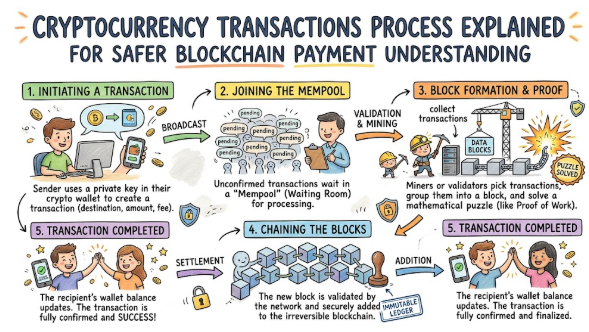
Your signed transaction leaves your device and is broadcasted into a digital waiting room known as the Mempool (memory pool). Here, your transaction sits alongside thousands of other pending transfers from all around the globe.
7. Validators or Miners Verify the Transaction
Decentralized computers (miners in Proof-of-Work networks like Bitcoin, or validators in Proof-of-Stake networks like Ethereum) pull pending transfers from the mempool. They check your digital signature and verify your balance to ensure your transaction is fully authentic.
8. Transaction Is Included in a New Block
Once verified, the miner or validator bundles your transaction with hundreds of other pending items into a brand-new block data structure.
9. The Block Is Confirmed on the Chain
The new block is officially added to the existing history of the blockchain. As soon as this block is appended, your transfer officially achieves its very first validation milestone, known as a confirmation.
10. Transaction Is Completed and Permanently Recorded
As time ticks forward, more new blocks are stacked directly on top of the block containing your transfer. With every subsequent block added, the number of transaction confirmations rises, rendering the payment completely unalterable and finalized. The recipient now sees the updated balance reflected in their wallet.
Types of Cryptocurrency Transactions
Not all movements on the blockchain look exactly the same. As decentralized ecosystems grow, transactions serve several distinct structural purposes:
- Peer-to-Peer (P2P) Transfers: This is the most basic form of a crypto transfer. It occurs when you send funds directly from your personal wallet to another individual’s wallet without any platform acting as a middleman.
- Exchange Deposits and Withdrawals: When you move assets from a personal wallet into a centralized trading platform (like Coinbase or Binance), or pull assets off an exchange back into your private storage, you are executing an exchange-based transaction.
- Smart Contract Executions: On programmable blockchains like Ethereum or Solana, you often send funds directly to an autonomous piece of code called a smart contract. This happens when you mint an NFT, buy an item in a decentralized game, or interact with automated web3 applications.
- Cross-Chain Swaps: This advanced transaction involves moving value across completely separate blockchain ecosystems—such as converting native Bitcoin directly into native Ethereum via a bridging protocol or decentralized routing system.
Factors Affecting Transaction Speed and Fees
One of the biggest surprises for newcomers is discovering that crypto transactions do not cost a flat, predictable fee, nor do they always take the exact same amount of time to settle. Four core dynamics drive these moving parts:
- Network Congestion: Think of a blockchain like a public highway. If thousands of people try to use the network at the exact same hour, the waiting room gets incredibly packed. Because block space is limited, sizers must compete for attention.
- The Chosen Fee Level: Because miners and validators want to maximize their earnings, they naturally sort the mempool queue by fee size. If you pay a slightly higher fee, your transaction skips to the front of the line. If you set your fee too low during peak traffic hours, your transfer might sit in limbo for hours or days.
- Blockchain Architecture Protocol: Different blockchains process data at radically different native speeds. Bitcoin creates a new block roughly every 10 minutes. Ethereum creates one roughly every 12 seconds. Newer chains like Solana can process thousands of micro-transactions per second, inherently keeping costs very low.
- Data Complexity (Transaction Size): Fees are determined by the amount of data computing space your transfer takes up on the blockchain ledger, not the financial value of the money you send. Moving $1,000,000 of simple crypto can cost significantly less than executing a massive, complex smart contract involving multiple moving parts.
A Real-Life Example: Sending Crypto in the Real World
[Sarah's Wallet App]
     │
     ▼ (Signs with Private Key)
[The Mempool Waiting Room] ── (Sarah pays a small gas fee)
     │
     ▼ (Validators verify & pack into a block)
[Ethereum Blockchain Ledger] ── (1, 2, 3+ Confirmations)
     │
     ▼
[Alex's Wallet App] (Balances updated permanently)
Sarah opens her mobile wallet and selects Ethereum. She taps “Send” and scans a QR code displayed on Alex’s smartphone screen, which contains Alex’s public address. Sarah types in the amount and reviews the screen. Her app tells her that the current network fee (often called “gas” on Ethereum) will be roughly $0.85, and the transfer should settle in less than a minute.
Sarah taps confirm. Her wallet uses her private key to sign the transaction details behind the scenes and broadcasts it to the Ethereum network.
Sarah’s transaction sits in the mempool for a few seconds until an automated validator picks it up, confirms that Sarah actually has the required ETH, and bundles it into the next block. Within 12 seconds, the block is written to history. Alex looks down at his phone and sees a notification: “Incoming transaction pending (1 Confirmation).” After a few more blocks accumulate, the status changes to fully completed, and Sarah’s dinner debt is completely settled.
Crypto Transaction Safety Checklist
| Checklist Point | Description | Verified? |
| Private Key Isolated | Is your private key/seed phrase stored completely offline and hidden from view? | [ ] Yes / [ ] No |
| Recipient Address Check | Have you verified the first and last 6 characters of the recipient address character-by-character? | [ ] Yes / [ ] No |
| Asset Compatibility | Are you sending the correct asset type (e.g., sending Bitcoin only to a Bitcoin address)? | [ ] Yes / [ ] No |
| Network Selection | Is your wallet set to the exact same network line as the recipient wallet (e.g., ERC-20 vs. TRC-20)? | [ ] Yes / [ ] No |
| Fee Evaluation | Have you checked the estimated fee to ensure it is reasonable and adequate for timely processing? | [ ] Yes / [ ] No |
| Value Verification | Did you confirm that the decimal place is in the correct spot so you don’t accidentally send too much? | [ ] Yes / [ ] No |
| 2FA Active | Is Two-Factor Authentication (preferably via an authenticator app) active on your software tools? | [ ] Yes / [ ] No |
| Secure Connection | Are you completely disconnected from public Wi-Fi networks or using a trusted, encrypted VPN? | [ ] Yes / [ ] No |
| Phishing Audit | If using a web interface, did you double-check that the URL slug is spelled correctly? | [ ] Yes / [ ] No |
| Test Transfer Option | If moving a large amount, are you starting with a tiny, low-value test transaction first? | [ ] Yes / [ ] No |
Common Beginner Mistakes to Avoid
When learning the ropes, certain pitfalls catch many newcomers off guard. Being aware of these common mistakes can save you significant time, stress, and capital:
- Sending Assets to the Wrong Blockchain Network: This is easily the most common error for beginners. For example, if you send native Bitcoin to an Ethereum public address, the network cannot route it correctly. In many instances, those assets become permanently unrecoverable in the digital void.
- The Infamous Copy-Paste Clipboards Exploits: There is malicious software designed to sit silently on your computer or phone. When it detects that you have copied a crypto address, it instantly swaps it out in your clipboard for the hacker’s address. If you do not visually inspect the address right before confirming, you may accidentally send your funds to an attacker.
- Setting Transaction Fees Too Low During Congestion: Trying to save a few pennies by manually overriding your wallet’s suggested fee can backfire. Your transaction can get stuck at the very bottom of the mempool stack for days, leaving your funds frozen in limbo until the network traffic clears out.
- Misinterpreting “Pending” Status as Lost Funds: Blockchains take time to process data. Seeing a transaction sit as “pending” for 20 minutes does not mean your money has vanished. It simply means the network is currently clearing a backlog of data.
Practical Tips for Smooth, Safe Transactions
Navigating web3 transactions safely comes down to building consistent habits. Incorporating these simple practical steps into your routine makes transferring crypto straightforward:
- Always Run a Tiny Test Transaction: Whenever you are transferring a large sum of money to a new wallet or exchange for the first time, send a minuscule amount first (like $2.00). Wait for that tiny amount to arrive safely. Once you know the path is clear, you can send the remaining balance with complete peace of mind.
- Lean on QR Codes Whenever Possible: Typing out a 42-character string of letters and numbers by hand is an invitation for typos. Whenever possible, use your phone’s camera to scan the recipient’s QR code. If you must copy and paste, always manually verify the first six and last six characters on the final screen.
- Keep Your Underlying Networks Aligned: Remember that different networks require different toll fees. To move assets on the Ethereum network, your wallet must hold a little bit of native ETH to cover gas. To move assets on the Solana chain, you must hold a little bit of SOL. Always keep a tiny buffer of native gas tokens in your wallets.
- Bookmark Your Trusted Web Platforms: Phishing sites look exactly like genuine crypto exchanges or web wallets but are designed to steal your credentials. Bookmark your primary exchange platforms and web3 apps, and access them only through those verified links.
Frequently Asked Questions (FAQs)
How long does a crypto transaction take?
Processing times depend entirely on the blockchain network you choose and the current level of traffic. While high-speed chains can settle your transfer in just a few seconds, older networks like Bitcoin typically take anywhere from 10 to 60 minutes to achieve deep confirmation.
What are transaction fees and why are they needed?
Transaction fees are micro-payments given to the decentralized miners and validators who operate the network hardware. They are absolutely essential because they prevent bad actors from spamming the network with infinite fake transactions, while keeping validators financially motivated to keep the ledger secure.
Can a crypto transaction fail?
Yes, transactions can fail, especially when interacting with complex smart contracts on networks like Ethereum or Solana. This typically happens if you do not provide enough fee parameters (gas) to execute the computation, or if the underlying contract conditions change mid-transfer. If it fails, your core funds remain in your wallet, though the small processing fee spent to test the calculation is lost.
What is a confirmation and how many are required?
A confirmation means your transaction has been successfully written into a fresh block on the chain. Each additional block built on top of that block counts as another confirmation. While most exchanges accept 1 to 6 confirmations for everyday deposits, larger financial amounts typically require a higher count to guarantee complete safety.
How do I track my transaction?
Every transaction produces a unique tracking string known as a Transaction Hash or TXID. You can copy this code from your wallet history and paste it into a public blockchain explorer website (like Blockchain.com or Etherscan) to view its exact real-time position in the queue.
Is my crypto safe while it is transferring?
Yes, your assets are fundamentally secure during transmission because they are fully protected by advanced mathematics. Your crypto is never floating around in the open digital air; it stays tied securely to your account on the historical ledger until the network officially re-assigns ownership to the destination address.
Can I reverse a cryptocurrency transaction if I make a mistake?
No. Blockchain ledgers are built to be completely immutable and irreversible. Once a transaction is broadcast and confirmed by the decentralized network nodes, no one—not even the developers of the coin or the creators of your wallet app—has the power to alter the data or claw back the funds.
How does a blockchain verify that I actually have the money to send?
Instead of asking a bank teller, the decentralized nodes scan the historical public ledger to check the inputs of your specific address. By adding up all the past incoming and outgoing movements linked to your public address, the math instantly calculates your exact real-time balance before approving a new transfer.
Should I use a mobile wallet or a desktop wallet for my transactions?
Mobile wallets offer fantastic day-to-day convenience and use secure QR scanning features for easy, on-the-go payments. Desktop wallets provide deeper features for advanced traders, but they carry a slightly higher risk of exposure to malware if your computer is connected to the open internet.
How can I avoid accidentally sending my crypto to a completely wrong address?
The most reliable way to avoid address errors is to use your device’s built-in copy-paste functions or scan a direct QR code, followed by a strict manual inspection of the characters. Pairing this habit with a small, low-value test transfer eliminates the risk of sending significant funds down the wrong pipeline.
Conclusion
Understanding the step-by-step mechanics of how cryptocurrency transactions work transforms a confusing technical barrier into a highly manageable, logical routine. While the world of decentralized public ledgers functions differently than traditional commercial retail banks, mastering a few core rules ensures your assets move smoothly around the globe.
Remember that everything comes down to managing your keys responsibly, matching your networks carefully, and double-checking your destination details before executing a transfer. By respecting these core principles, you can safely harness the full power of independent, global, decentralized finance.