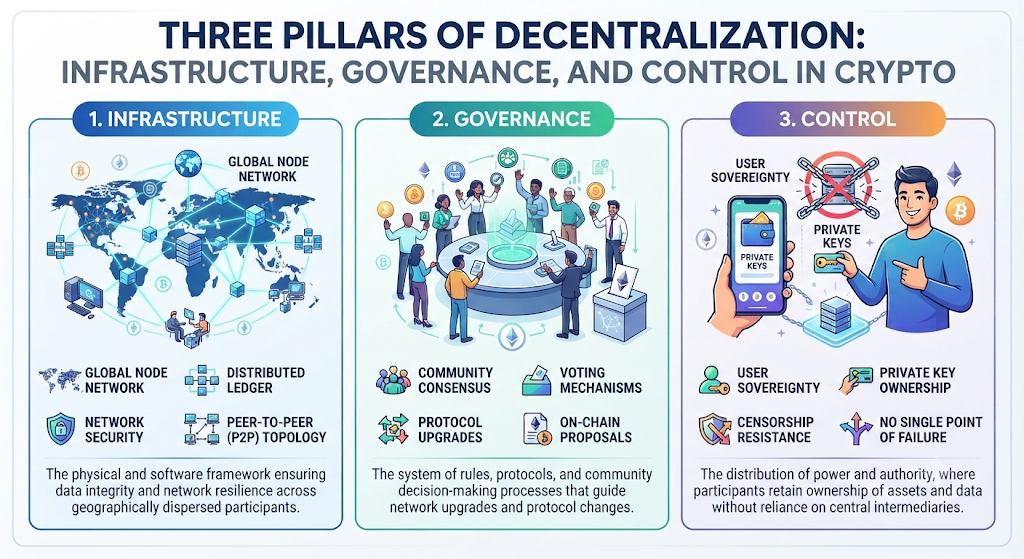
Every crypto project claims to be decentralized, yet almost none of them define what that actually means in practice. One protocol might have thousands of independent computers securing its ledger while a single small team holds the admin keys to pause the smart contracts. Another might distribute voting tokens to the public while relying entirely on one cloud provider to keep its servers online.
When people talk about blockchain without breaking it down into specific layers, the word loses its meaning. True decentralization is not a simple on-or-off switch. Instead, it operates across three distinct pillars: infrastructure, governance, and control. Examining each layer separately reveals where power actually sits in a crypto network—and where hidden points of failure might still exist.
Why “Decentralized” Means Different Things in Crypto
In traditional finance and web services, authority sits at the center. A bank approves transactions, a tech company owns the servers, and a board of directors changes the rules. Blockchain networks aim to remove these single points of failure, but projects rarely decentralize every part of their operation at the same time.
Most networks exist on a spectrum. Early-stage protocols often start with centralized elements so developers can fix bugs quickly, gradually handing over authority to users over time. Understanding this spectrum helps crypto users look past marketing buzzwords and evaluate the real resilience of a network or decentralized application (dApp).
Pillar 1: Infrastructure (Who Runs the Hardware?)
Infrastructure refers to the physical and digital machinery that keeps a blockchain running. If a network is truly decentralized at the infrastructure layer, no single entity can shut it down, censor transactions, or rewrite its history.
Nodes, Validators, and Miners
Every public blockchain relies on a distributed network of computers—called nodes, miners, or validators—to verify transactions and maintain copies of the ledger.
- Geographic distribution: If 80% of a network’s validators operate inside a single country, local regulators or power grid failures could disrupt the entire chain.
- Client diversity: Software matters just as much as hardware. If every validator runs the exact same code client, a single software bug can halt the whole network.
Hosting and Cloud Dependencies
A common blind spot in crypto infrastructure is cloud hosting. Even if a blockchain has 1,000 independent validators, the network faces significant concentration risk if 700 of those validators rent server space from the same cloud provider, such as Amazon Web Services (AWS). True infrastructure resilience requires bare-metal servers spread across independent data centers and home setups worldwide.
Front-End and RPC Bottlenecks
Even when a base blockchain is deeply distributed, users still need a way to connect to it. Most crypto wallets rely on Remote Procedure Call (RPC) providers to read blockchain data and broadcast transactions. Similarly, decentralized exchanges run web interfaces hosted on standard domain registrars. If a government or hosting provider blocks a front-end website, average users lose access—even if the underlying smart contracts remain untouched on-chain.
Pillar 2: Governance (Who Changes the Rules?)
Code is not static. Blockchains need software upgrades, fee adjustments, and treasury allocations. Governance is the decision-making system that determines how those changes happen and who gets a say.
Token-Based Voting and DAOs
Many decentralized finance (DeFi) protocols and Layer-2 networks use Decentralized Autonomous Organizations (DAOs) to manage upgrades. In these systems, holding a governance token grants voting power. While open in theory, token voting often runs into practical hurdles:
- Whale dominance: Early investors, founders, and venture capital firms frequently hold a large share of the token supply, allowing a handful of wallets to pass or block proposals.
- Voter apathy: Everyday users rarely participate in routine technical votes, leaving major decisions to a small group of active delegates.
Off-Chain Social Consensus
Not all blockchain governance happens through token votes. Networks like Bitcoin and Ethereum rely heavily on off-chain social consensus. Developers propose improvements (such as BIPs or EIPs), researchers debate the security trade-offs, and node operators ultimately decide whether to install the updated software. If the broader community rejects an update, they simply refuse to run the new code.
Pillar 3: Control (Who Holds the Keys?)
Control deals with direct operational power over assets, smart contracts, and emergency functions. You can have distributed servers and an active DAO, yet still have a centralized choke point if a small group holds administrative privileges.
Admin Keys and Multisig Wallets
Many smart contracts include upgrade mechanisms so developers can patch vulnerabilities. To prevent a single rogue developer from draining funds, projects often place these admin keys inside a multisignature (multisig) wallet—an account that requires multiple approvals (for example, 4 out of 7 keyholders) to execute a change. While safer than a single private key, a multisig still places direct control in the hands of a small committee.
Custodial vs. Non-Custodial Access
For individual users, control comes down to private key ownership:
- Non-custodial wallets: You hold your own recovery phrase and sign every transaction directly. No company can freeze your balance or block a transfer.
- Custodial platforms: Centralized exchanges and certain payment apps hold assets on your behalf. While convenient, these platforms retain legal and technical control over your funds.
Stablecoin Blacklists and Kill Switches
Certain tokens carry built-in control features at the asset level. Major centralized stablecoins, for instance, include smart contract functions that allow the issuing company to freeze specific wallet addresses when ordered by law enforcement. Any DeFi protocol that relies heavily on those stablecoins indirectly inherits that centralized control layer.
Comparing the Three Pillars at a Glance
Evaluating a crypto project becomes much clearer when you separate these three dimensions rather than looking for a single label.
| Dimension | Core Question | Signs of Strong Decentralization | Common Centralization Risks |
| Infrastructure | Who keeps the network online? | Thousands of independent nodes, diverse software clients, global geographic spread | Heavy reliance on one cloud host, few validators, single RPC provider |
| Governance | Who decides on upgrades and rules? | Broad community consensus, transparent proposals, active independent delegates | Majority token supply held by insiders, opaque decision-making |
| Control | Who can move funds or alter code? | Immutable contracts, non-custodial user wallets, timelocked upgrades | Small multisig committees with instant upgrade powers, freeze functions |
Trade-Offs: Why Full Decentralization Is Hard to Achieve
If decentralization reduces censorship and single points of failure, why don’t all projects maximize it from day one? The answer lies in practical engineering and security trade-offs.
- Speed vs. Consensus: Getting thousands of global nodes to agree on every transaction takes time and bandwidth. Networks that prioritize ultra-fast confirmation speeds often require expensive server hardware, which naturally limits how many people can afford to run a validator.
- Security vs. Agility: Immutable smart contracts cannot be altered by anyone—which means if a hacker discovers a bug, developers cannot push an emergency patch. Many teams keep temporary administrative controls during a protocol’s early months to protect user funds while the code is battle-tested.
- Usability vs. Self-Custody: Managing private keys and verifying smart contract permissions requires technical awareness. Centralized intermediaries often step in to offer password resets and customer support, trading user sovereignty for convenience.
How to Evaluate a Crypto Project’s Decentralization Yourself
Before trusting a blockchain network or protocol with your funds, check a few practical indicators across all three layers:
- Check the Nakamoto Coefficient: Look at the minimum number of independent validators or mining pools needed to disrupt or censor the network. A higher number signals stronger infrastructure resilience.
- Review Smart Contract Permissions: Use blockchain explorers or independent security trackers (like L2BEAT for Layer-2 networks) to see whether contracts are immutable, governed by a timelock, or controlled by an unverified multisig.
- Inspect Token Distribution: Examine how much of a governance token is held by the founding team and private investors versus the open community.
- Test Front-End Independence: Check whether open-source alternatives or IPFS-hosted interfaces exist in case the project’s primary website goes offline.
Frequently Asked Questions
Can a cryptocurrency be decentralized in one area and centralized in another?
Yes, and this is actually the norm. For example, a decentralized exchange might run on Ethereum—benefiting from Ethereum’s highly distributed infrastructure—while its web front-end is hosted on a centralized server and its token governance is dominated by a few large investors.
What is “progressive decentralization”?
Progressive decentralization is a development strategy where a founding team initially retains tight control over a protocol to build features and fix bugs quickly. Once the product matures and proves secure, the team gradually transfers governance and smart contract ownership to a community DAO.
Why does decentralization matter if a centralized platform works faster?
Centralized systems are efficient until something goes wrong. Without single operators, decentralized networks resist arbitrary account freezes, server outages, and unilateral rule changes. Users trade raw speed for predictable, censorship-resistant access that does not depend on trusting a company.
Are Layer-2 blockchains as decentralized as Layer-1 blockchains?
Most Layer-2 scaling networks inherit transaction settlement security from their underlying Layer-1 chain, such as Ethereum. However, many Layer-2 networks still rely on centralized sequencers to order transactions and multisig security councils to manage upgrades, making them less decentralized at the operational and control layers.
Putting the Three Pillars Together
Decentralization is not a binary badge a crypto project earns once and keeps forever. By separating infrastructure, governance, and control, you can see exactly where a network distributes power and where it still relies on human intermediaries. As blockchain technology matures, the most resilient platforms will be the ones that transparently address bottlenecks across all three layers rather than hiding behind a single buzzword.